Slashdot Mirror
Domain: aclu-wa.org
Stories and comments across the archive that link to aclu-wa.org.
Stories · 4
-
Sites Blocked By Smartfilter, Censored in Saudi Arabia
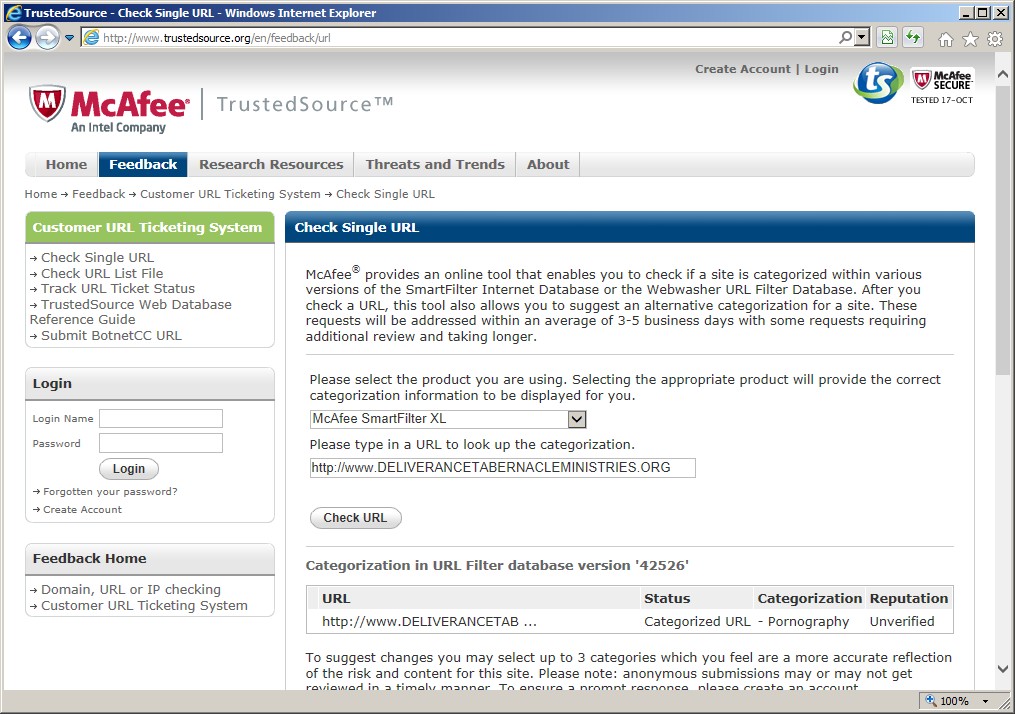
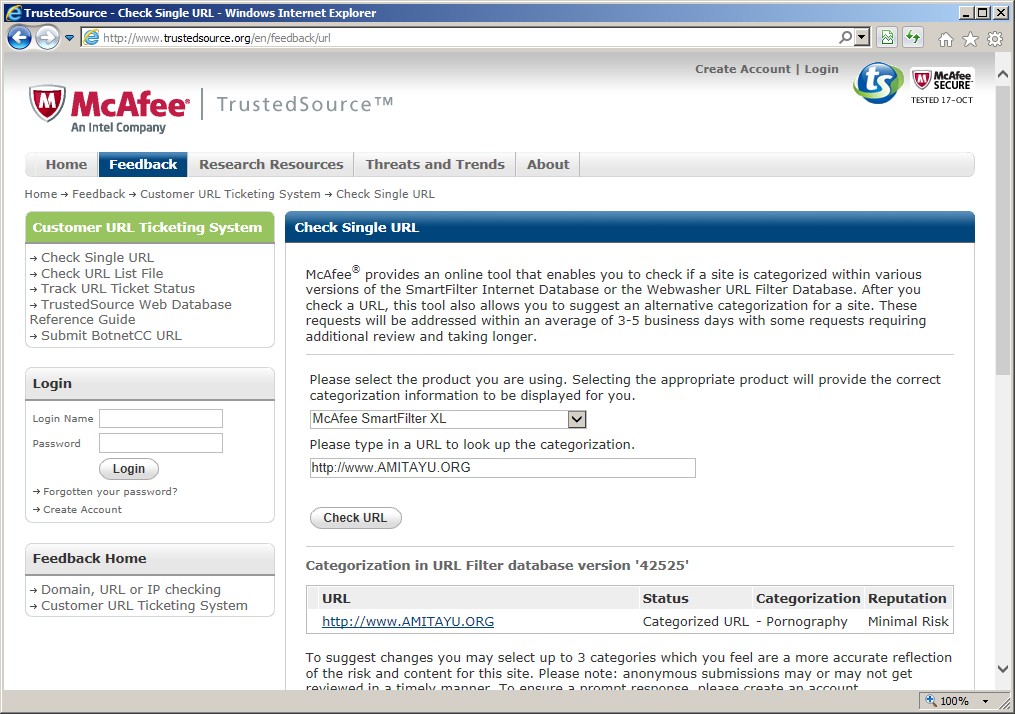
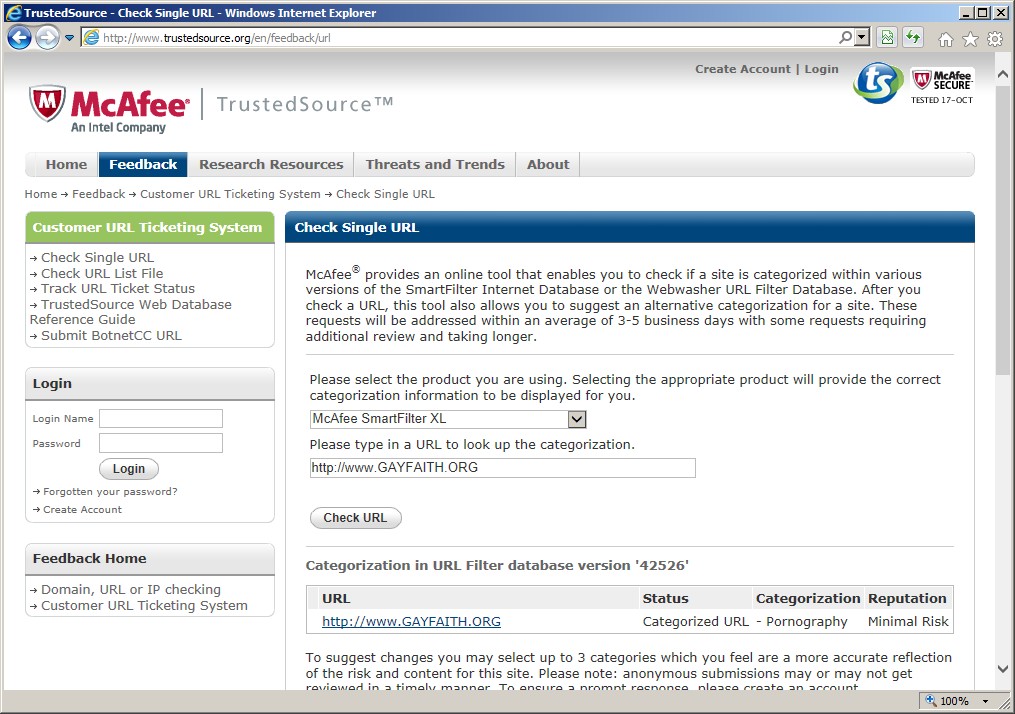
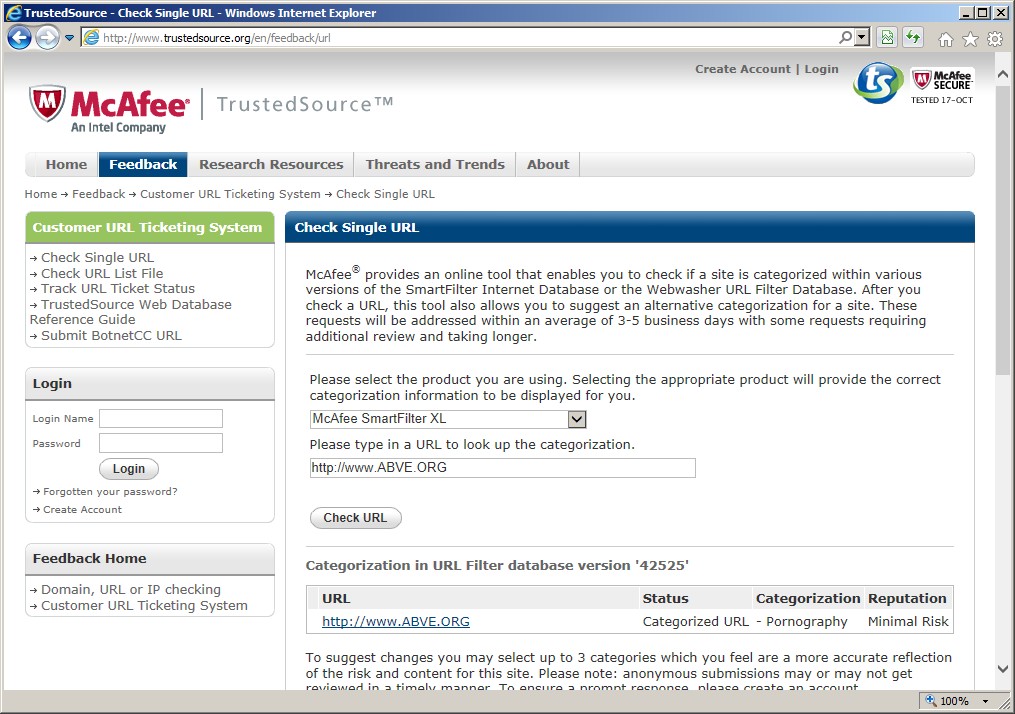
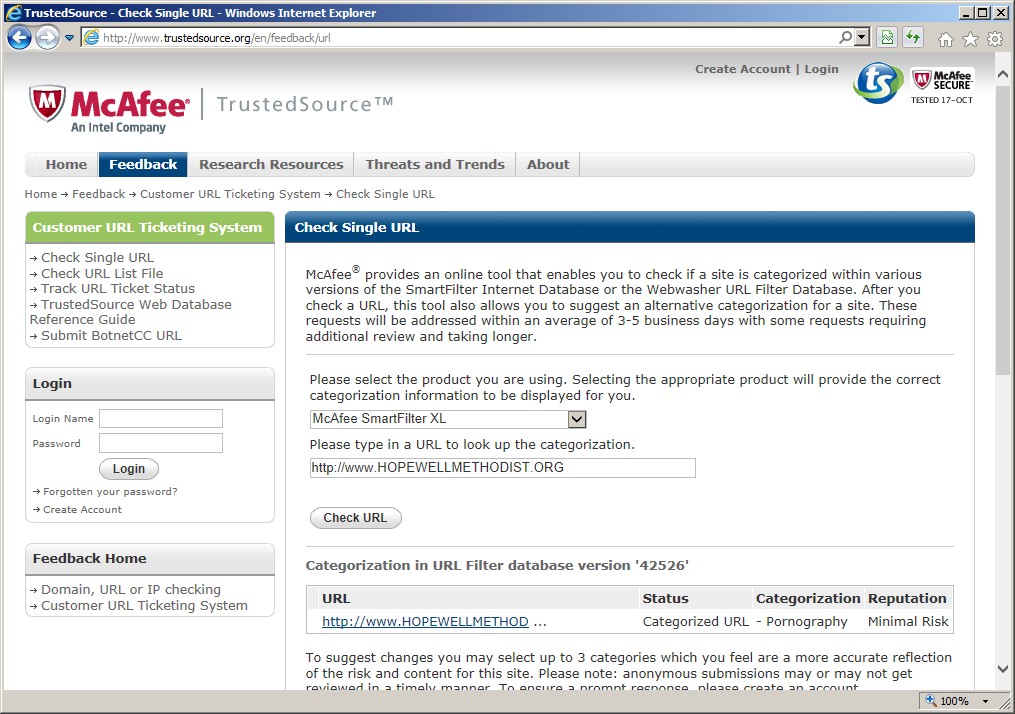
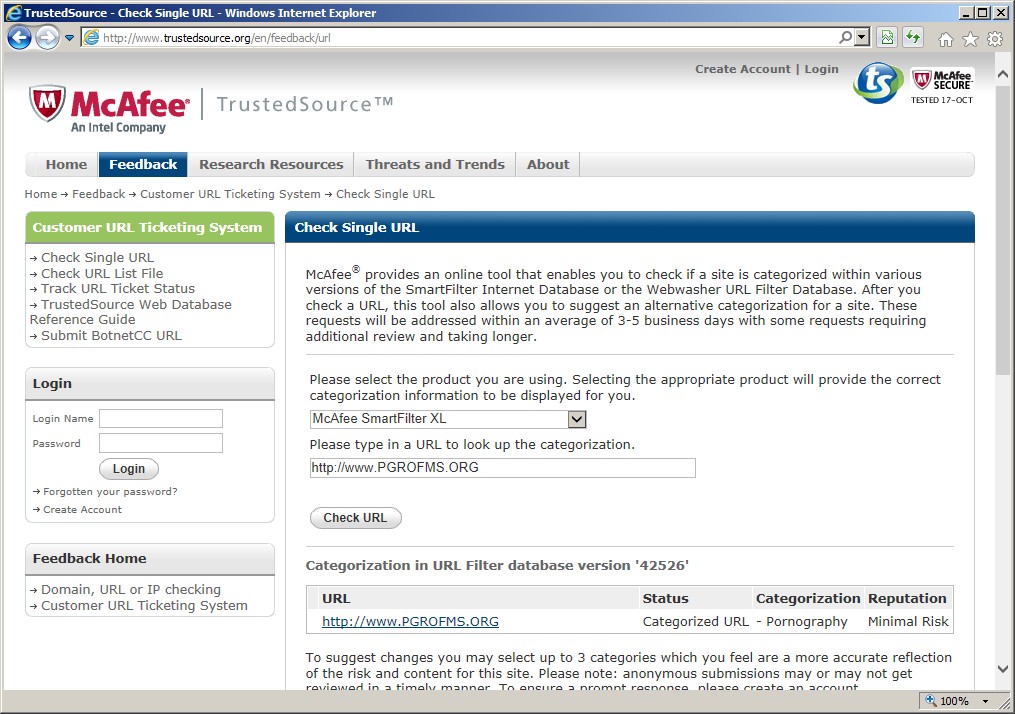
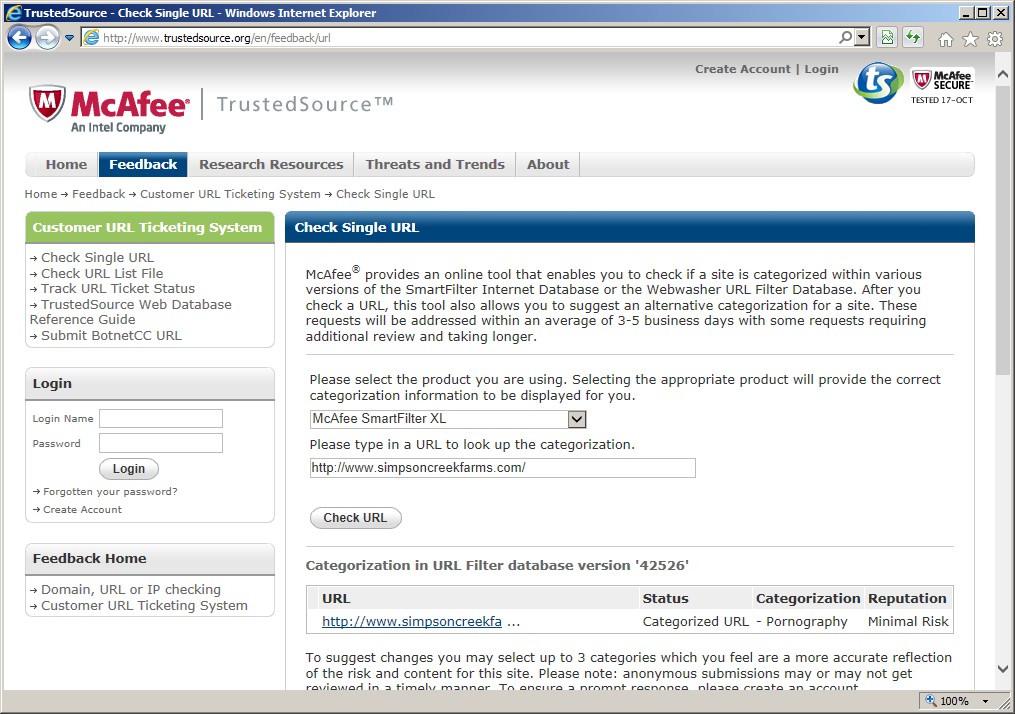
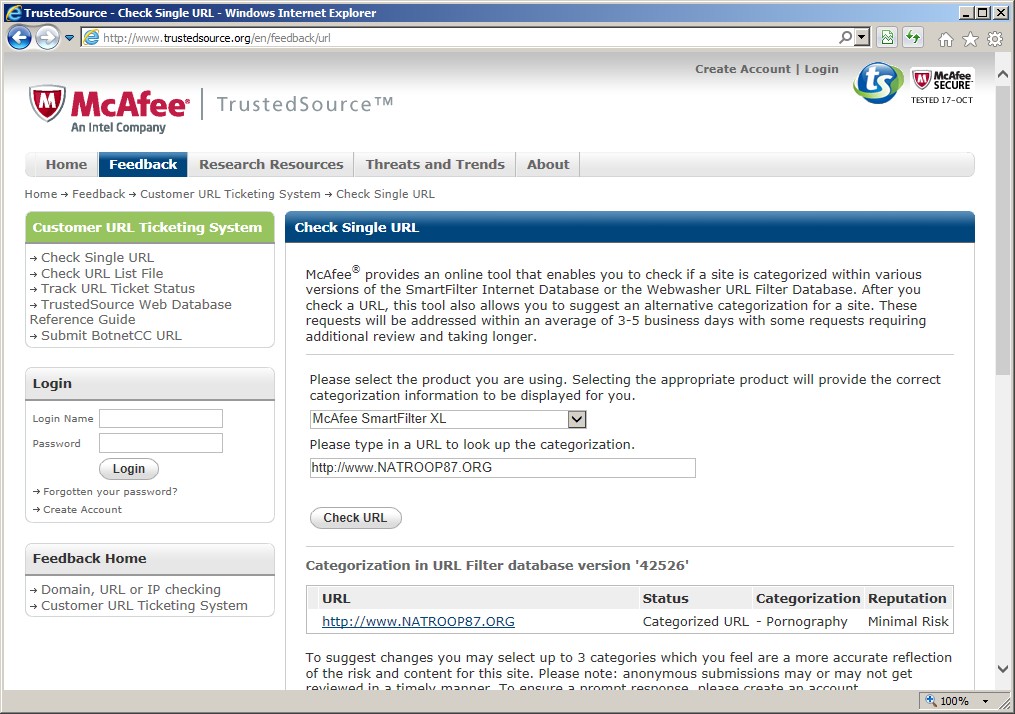
Slashdot contributor Bennett Haselton writes: "Internet users in Saudi Arabia, along with most users in the United Arab Emirates, are blocked by their respective government censors from accessing the websites of the Trinity Davison Lutheran Church, Deliverance Tabernacle Ministries in Pittsburgh, the Amitayu Buddhist Society of Taiwan, and GayFaith.org. An attempt to access any of those websites yields an error page like this one. However, the sites are not blocked because they conflict with the religions beliefs of those countries' governments. Rather, they are blocked because Smartfilter -- the American-made blocking program sold by McAfee, and used for state-mandated Internet censorship in those countries -- classifies those sites as "pornography". You can see the screen shots here, here, here and here." Read on for the rest of Bennett's thoughts.I found these blocked sites by starting with a combination of URL lists and ad hoc spidering, and running as many sites as possible through the Saudi filters to catch the ones that were blocked. Some of the sites were blocked for reasons that were easy to guess -- for example, http://www.bighornbasinsfw.org/, the home page of the Big Horn Basin, Wyoming chapter of Sportsmen for Fish & Wildlife, was almost certainly blocked because of the slang term "nsfw" in their URL. http://www.AgainstPornography.org and http://www.SearchingForMySpermDonorFather.org were presumably blocked because of the presence of the words "porn" and "sperm".
On the other hand, there appears to be no rational reason why the Filipino American Women's Network, the Tuscon Jazz Institute, or the Sacramento Police Activities League would have been blocked by Smartfilter, even by accident. A partial list of the blocked sites that I found is in the blog post I wrote for Citizen Lab, an Internet censorship research center at the University of Toronto.
Articles about sites that are erroneously blocked by Internet censorship software, have a storied history. The first widely read piece was the article "Keys to the Kingdom" written by Brock Meeks and Declan McCullagh in 1996, calling out Cyber Patrol for blocking EnviroLink.org and the University of Newcastle Computer Science Department, and CYBERsitter for blocking the National Organization for Women. I made a minor name for myself and the Peacefire.org site in the late 1990's by writing more pages about sites blocked by other products, including some (like X-Stop and SurfWatch) which no longer exist, and others that are still around, including Smartfilter. I was also one of six people comprising the Censorware Project, a loosely organized group of volunteers that published a few more reports.
By the early 2000's, however, it became clear that anyone whose mind was likely to be changed by information about what kinds of sites were blocked by blocking software, would have changed their mind already (or would, if they came across the research that had already been done up to that point). So the further reports on Internet blocking software errors, by me and other people, slowed to a trickle. I wrote a report in January 2002 on the latest list of sites blocked by Cyber Patrol, a product that most people today have forgotten. In 2006 I worked with the ACLU of Washington to publish a report on sites erroneously blocked by FortiGuard, a program used on computers in some libraries in central Washington, as part of the ACLU's suit to challenge the constitutionality of the program's use on public library terminals. (The Washington State Supreme Court rejected the lawsuit on the grounds that, regardless of what sites were blocked on the computers, it didn't matter because an adult library patron could request for the filter to be turned off.) In 2007 I wrote an article for Slashdot titled "From Bess to Worse" listing some sites that were blocked by an Internet filtering program called Bess (which was later bought out by Smartfilter and discontinued).
Most people's awareness of this debate, if they had heard about it at all, was limited to the perception that "breast cancer sites" and sites about "chicken breast recipes" were sometimes filtered by Internet blocking programs. Or they heard that "Beaver College" actually had to change its name to avoid being censored by web filters. As I tried to explain in a FAQ (written, according to the Wayback Machine, in 1999, but which still broadly holds true today), these examples are true, but they miss the point. These examples make it sound as if blocking software companies are doing the best job they can under the circumstances, and that the errors are unavoidable due to limitations on machine intelligence. In reality, any software algorithm that blocks the American Board of Vocational Experts, the Hopewell United Methodist Church, and the Patriot Guard Riders of Mississippi, as "pornography" (as Smartfilter currently does), is probably not the best algorithm the company could have come up with -- but there's no incentive for them to try harder, because few people will ever look that deep.
And yet, people continue to remember the "breast cancer site" examples. This sounds to me like an example of the narrative fallacy -- people remember that breast cancer sites were blocked, because there's a tidy explanation. There is no tidy explanation for most other examples of blocked sites, so the meme never spreads very far. Conveniently for the blocking companies, the blocked-site errors which make the company look most sloppy (the Kennels at Simpson Creek Farms, the St. Francis Institute of Milwaukee, etc.) are precisely the ones that, due to the narrative fallacy, most people won't remember or hear about.
One company, CYBERsitter, did manage to make a few blocking decisions in the 1990s that were egregious enough that their antics did make the news, and did finally raise some people's awareness that the controversy over private Internet filtering extended beyond "breast cancer sites". After TIME Magazine's website published an article (no longer online) that criticized CYBERsitter's blocking policies, CYBERsitter responded by blocking TIME Magazine's pathfinder.com domain. A few months earlier, CYBERsitter had blacklisted the monthly e-Zine "The Ethical Spectacle, after the Spectacle's founder, Jonathan Wallace, published an article criticizing CYBERsitter for blocking my own Peacefire.org website. And Peacefire.org had been blocked, in turn, because of a page I wrote (now very much out of date) listing some of the sites that CYBERsitter blocked, including the International Gay and Lesbian Human Rights Commission and Mother Jones. (Nowadays, of course, nobody would be surprised that filtering companies block Peacefire.org, since the site publishes ample instructions on how to get around Internet blockers. But at the time, the site's first and only article was the list of sites blocked by CYBERsitter, which is why CYBERsitter received so much criticism for blocking the domain in retaliation.) CYBERsitter also threatened to have Meeks and McCullagh criminally prosecuted for writing "Keys to the Kingdom" and threatened to sue me over the page that I had made.)
The moral, it seems, is that if you want an example of a censored web site to stick in people's minds, it either has to be a forgivable error, or an insane vindictive dick move -- because in either of those cases, people will understand why it happened. The vast swaths of censored websites on the spectrum in between, the ones for which there is no rational explanation for the blocking, go ignored.
These days, though, American and Canadian "censorware" makers have also come under fire for selling censoring software to foreign governments which use them for country-wide censorship. Most of the criticism focuses, naturally, not on the kinds of sites that are accidentally blocked by the blocking software, but on the immorality of these companies enabling statewide foreign censorship in the first place. Netsweeper, Blue Coat, and McAfee have all made the claim that "Once we sell their product to them, we have no control over what they do with it" -- which, as I wrote previously in Slashdot, is nonsense, because for the product to be effective, it has to rely on updates to the blocked-site list, which are provided at regular intervals by the manufacturer. Cut off the updates, and the product will not work, at least not as well.
So the fact that McAfee has classified the Boy Scout Troop 87 of North Andover, the Pan-Iranist Party of Iran, and Reptile Conservation International as "Pornography" is (rightly) overshadowed by the fact that McAfee is selling to government censors in Saudi Arabia and the UAE in the first place. However, as long as the filters are installed, these blocked sites are at least part of the problem for users in those countries, just as much as they are for students or cubicle workers in the U.S. whose network administrators happen to use Smartfilter. And, of course, I sampled only a miniscule fraction of the Web to find these examples of blocked sites, so the true number of stupid blocks affecting Saudi and UAE users is likely to be much larger. For each individual example, you might reasonably ask, "Is it really a big deal if Saudis are blocked from accessing Boy Scout Troop 87 of North Andover?" But it adds up.
-
Worst Censorware Blocks Cannot Be Fixed
Slashdot regular Bennett Haselton writes "The ACLU has targeted a group of Tennessee school districts for blocking websites categorized by a blocking company as 'LGBT.' I hope the ACLU wins, but it may create the mistaken impression that egregious overblocking of websites is easy to fix. On the contrary, the vast majority of errors are hard-coded into the products and cannot be fixed by unblocking a single category." Hit that tantalizingly entitled 'Read More' link to read his essay.The ACLU is threatening to sue a group of Tennessee School Districts for using blocking software that blocks sites categorized as "LGBT" — that is, sites themed around lesbian, gay, bisexual or transgender issues that would not be classified as pornographic. Some of the blocked sites include the Gay and Lesbian Alliance Against Defamation and the Human Rights Campaign.
Legally, the school districts' decision to block these sites seems fairly indefensible. The content being censored is political speech, not illegal to distribute to minors, and as the ACLU points out, by blocking these sites the school districts are engaging in "viewpoint discrimination," since the schools allow access to anti-gay sites like Americans for Truth Against Homosexuality (which, ironically, features a disclaimer saying its content is not suitable for children). But, you never can tell with judges. A judge in Utah once ruled in favor of a school that suspended a student for wearing a t-shirt with the word "Vegan." (Do you think the judge would have made the same ruling if the student's t-shirt had said "Christian"?)
However, while the ACLU would be right to bring this case, there may be another unintended side effect. By focusing on the fact that the "LGBT" category is enabled to be blocked in these districts, this sets up a contrast with districts that do not have the "LGBT" category enabled, which could lead people to think that such districts are not blocking LGBT sites. This is not the case.
When a school district buys blocking software, the software comes with an encrypted list of websites listed in different categories; categories like Pornography and Nudity are typically blocked, while categories like LGBT would usually not be. If a site falls into one or more of the blocked categories, then attempts to access that site will be blocked (at least until some reprobates help you get around the filter.) However, it's the blocking company that decides what to put on the list under each category. And even if only categories like "Pornography" are enabled, there are likely to be many non-pornographic sites categorized as "Pornography," and hence blocked wherever that category is turned on.
When the ACLU of Washington sued the North County Regional Library system for enabling blocking software for all patrons (including adults), they asked me to test the Fortinet Web filter that the library was using. I used a random sample of 100,000 .com and 100,000 .org domains and ran them through an automated script to find 536 .com domains and 207 .org domains that were blocked by Fortinet. Of those, about one out of every eight .com sites categorized as "Pornography" or "Adult Materials," and one of out of every four .org sites blocked in those categories, was a site with content that could not possibly be considered "adult" — some of the sites blocked in these categories included the Dabar Worship Center, the immigrant-rights group Families for Freedom, and the Seattle Women's Jazz Orchestra. Extrapolating these ratios to the set of all .com and .org domains in existence, one could conclude that there were about 71,000 non-pornographic .com sites and 5,800 non-pornographic .org sites blocked by FortiNet as "Pornography" or "Adult Materials" — a number almost certain to grow into six figures when you add in all the sites outside of .com and .org. Years earlier, I had run similar tests for Cyber Patrol and SurfWatch (products which have since been discontinued) and found that an absolute majority of sites blocked by each program were actually non-pornographic, which translated into an estimate of hundreds of thousands of .com and .org sites wrongly classified as "porn."
Only the blocking companies know for sure how such stupid mistakes end up on their lists, but the most widely accepted explanation is that they use machines to crawl the Web and guess which sites are pornographic, and add those sites to their blacklists without any human intervention. In their early years, the makers of SurfWatch and Cyber Patrol claimed that employees actually did review sites before adding them to their lists, but that claim became increasingly untenable as more and more reports came out of sites being blocked with no adult content on them.
Nobody has yet done a similar study for the ENA blocking program, but every blocking program that has ever been tested has had a non-trivial error rate that extrapolates to at least hundreds of thousands of non-pornographic websites being blocked under "Pornography" and similar categories. There is no reason to think that the ENA blocker is different; at the very least, if they claim that it is, then the burden of proof should be on them.
So, the ACLU will probably succeed in persuading the Tennessee Schools Cooperative to stop blocking the "LGBT" category, but that doesn't mean that LGBT sites — or any other category of non-pornographic sites — will no longer be blocked. A student who encounters a blocked LGBT site could request an override, but what if they don't want to "out" themselves as someone who was browsing an LGBT site? Is Tennessee the best place to be known as the "queer who wanted to get around the porn filter"? And there may not be an option of getting an override anyway. Some of the correspondents on Peacefire's mailing list for new proxy sites to get around blockers are teachers who aren't given a password to bypass the blocker on their school's computers.
Then of course — you know what's coming — there is the other "larger sense" in which unblocking the LGBT category doesn't "fix the problem," which is that there would be no "problem" if we didn't think of teenagers as children instead of adults. You've probably already decided which side you're on in that debate, but consider it as a scientific question instead of a moral one. Do you think there is any objective evidence that teenagers, if they were given the opportunity to have the same rights and responsibilities as adults, would behave differently from adults to a large degree — more differently than, say, men and women behave from each other? The trouble with the "evidence" that we gather from personal interactions is that it's not truly objective — if someone believes that teenagers are immature and adults are not, they're likely to see and remember only the pieces of evidence that confirm that belief. A true double-blind experiment might involve talking to someone through a computer terminal and rating the other person's "maturity" just based on their responses. That's a start, but the trouble with that experiment is that adults tend to know a larger set of words, so a participant might rate the other person as more "mature" because of their large vocabulary, even though having a large vocabulary is completely different from having mature thoughts or logical reasoning skills. A fairer test might be to take a non-native-English-speaking adult and a native-English-speaking young teenager who scored about the same on a test of English vocabulary, and see if participants could tell the difference in maturity between those two test subjects while talking to them through a computer terminal. I am not aware of any experiment along these lines that has been done, but this is the sort of evidence of differences between adults and minors, that would be truly objective.
Most of the evidence in favor of the innate "adulthood" of teenagers is also anecdotal and not scientific, but it is compelling. As psychologist Robert Epstein has pointed out in The Case Against Adolescence, for thousands of years humans in their early teens were giving birth and raising children of their own. That obviously does not mean that that is a good idea in today's society, it just means that somewhere along the way, we must have lost sight of the level of responsibility that human teenagers are biologically capable of handling. If one of our Stone Age forebears could be brought back to life, he might eventually get used to the Web, but he'd probably always be amused by the idea of Web blockers for teenagers who are older than he was when he was raising his first child.
-
Worst Censorware Blocks Cannot Be Fixed
Slashdot regular Bennett Haselton writes "The ACLU has targeted a group of Tennessee school districts for blocking websites categorized by a blocking company as 'LGBT.' I hope the ACLU wins, but it may create the mistaken impression that egregious overblocking of websites is easy to fix. On the contrary, the vast majority of errors are hard-coded into the products and cannot be fixed by unblocking a single category." Hit that tantalizingly entitled 'Read More' link to read his essay.The ACLU is threatening to sue a group of Tennessee School Districts for using blocking software that blocks sites categorized as "LGBT" — that is, sites themed around lesbian, gay, bisexual or transgender issues that would not be classified as pornographic. Some of the blocked sites include the Gay and Lesbian Alliance Against Defamation and the Human Rights Campaign.
Legally, the school districts' decision to block these sites seems fairly indefensible. The content being censored is political speech, not illegal to distribute to minors, and as the ACLU points out, by blocking these sites the school districts are engaging in "viewpoint discrimination," since the schools allow access to anti-gay sites like Americans for Truth Against Homosexuality (which, ironically, features a disclaimer saying its content is not suitable for children). But, you never can tell with judges. A judge in Utah once ruled in favor of a school that suspended a student for wearing a t-shirt with the word "Vegan." (Do you think the judge would have made the same ruling if the student's t-shirt had said "Christian"?)
However, while the ACLU would be right to bring this case, there may be another unintended side effect. By focusing on the fact that the "LGBT" category is enabled to be blocked in these districts, this sets up a contrast with districts that do not have the "LGBT" category enabled, which could lead people to think that such districts are not blocking LGBT sites. This is not the case.
When a school district buys blocking software, the software comes with an encrypted list of websites listed in different categories; categories like Pornography and Nudity are typically blocked, while categories like LGBT would usually not be. If a site falls into one or more of the blocked categories, then attempts to access that site will be blocked (at least until some reprobates help you get around the filter.) However, it's the blocking company that decides what to put on the list under each category. And even if only categories like "Pornography" are enabled, there are likely to be many non-pornographic sites categorized as "Pornography," and hence blocked wherever that category is turned on.
When the ACLU of Washington sued the North County Regional Library system for enabling blocking software for all patrons (including adults), they asked me to test the Fortinet Web filter that the library was using. I used a random sample of 100,000 .com and 100,000 .org domains and ran them through an automated script to find 536 .com domains and 207 .org domains that were blocked by Fortinet. Of those, about one out of every eight .com sites categorized as "Pornography" or "Adult Materials," and one of out of every four .org sites blocked in those categories, was a site with content that could not possibly be considered "adult" — some of the sites blocked in these categories included the Dabar Worship Center, the immigrant-rights group Families for Freedom, and the Seattle Women's Jazz Orchestra. Extrapolating these ratios to the set of all .com and .org domains in existence, one could conclude that there were about 71,000 non-pornographic .com sites and 5,800 non-pornographic .org sites blocked by FortiNet as "Pornography" or "Adult Materials" — a number almost certain to grow into six figures when you add in all the sites outside of .com and .org. Years earlier, I had run similar tests for Cyber Patrol and SurfWatch (products which have since been discontinued) and found that an absolute majority of sites blocked by each program were actually non-pornographic, which translated into an estimate of hundreds of thousands of .com and .org sites wrongly classified as "porn."
Only the blocking companies know for sure how such stupid mistakes end up on their lists, but the most widely accepted explanation is that they use machines to crawl the Web and guess which sites are pornographic, and add those sites to their blacklists without any human intervention. In their early years, the makers of SurfWatch and Cyber Patrol claimed that employees actually did review sites before adding them to their lists, but that claim became increasingly untenable as more and more reports came out of sites being blocked with no adult content on them.
Nobody has yet done a similar study for the ENA blocking program, but every blocking program that has ever been tested has had a non-trivial error rate that extrapolates to at least hundreds of thousands of non-pornographic websites being blocked under "Pornography" and similar categories. There is no reason to think that the ENA blocker is different; at the very least, if they claim that it is, then the burden of proof should be on them.
So, the ACLU will probably succeed in persuading the Tennessee Schools Cooperative to stop blocking the "LGBT" category, but that doesn't mean that LGBT sites — or any other category of non-pornographic sites — will no longer be blocked. A student who encounters a blocked LGBT site could request an override, but what if they don't want to "out" themselves as someone who was browsing an LGBT site? Is Tennessee the best place to be known as the "queer who wanted to get around the porn filter"? And there may not be an option of getting an override anyway. Some of the correspondents on Peacefire's mailing list for new proxy sites to get around blockers are teachers who aren't given a password to bypass the blocker on their school's computers.
Then of course — you know what's coming — there is the other "larger sense" in which unblocking the LGBT category doesn't "fix the problem," which is that there would be no "problem" if we didn't think of teenagers as children instead of adults. You've probably already decided which side you're on in that debate, but consider it as a scientific question instead of a moral one. Do you think there is any objective evidence that teenagers, if they were given the opportunity to have the same rights and responsibilities as adults, would behave differently from adults to a large degree — more differently than, say, men and women behave from each other? The trouble with the "evidence" that we gather from personal interactions is that it's not truly objective — if someone believes that teenagers are immature and adults are not, they're likely to see and remember only the pieces of evidence that confirm that belief. A true double-blind experiment might involve talking to someone through a computer terminal and rating the other person's "maturity" just based on their responses. That's a start, but the trouble with that experiment is that adults tend to know a larger set of words, so a participant might rate the other person as more "mature" because of their large vocabulary, even though having a large vocabulary is completely different from having mature thoughts or logical reasoning skills. A fairer test might be to take a non-native-English-speaking adult and a native-English-speaking young teenager who scored about the same on a test of English vocabulary, and see if participants could tell the difference in maturity between those two test subjects while talking to them through a computer terminal. I am not aware of any experiment along these lines that has been done, but this is the sort of evidence of differences between adults and minors, that would be truly objective.
Most of the evidence in favor of the innate "adulthood" of teenagers is also anecdotal and not scientific, but it is compelling. As psychologist Robert Epstein has pointed out in The Case Against Adolescence, for thousands of years humans in their early teens were giving birth and raising children of their own. That obviously does not mean that that is a good idea in today's society, it just means that somewhere along the way, we must have lost sight of the level of responsibility that human teenagers are biologically capable of handling. If one of our Stone Age forebears could be brought back to life, he might eventually get used to the Web, but he'd probably always be amused by the idea of Web blockers for teenagers who are older than he was when he was raising his first child.
-
ACLU Defends Spam