Slashdot Mirror
Domain: astrobites.org
Stories and comments across the archive that link to astrobites.org.
Comments · 5
-
Re:Reaction wheel failure?
Given that we know that Kepler has a bad batch of reaction wheels, that two of the four have already failed, and that this emergency mode happened while the spacecraft was being repointed to the Galactic Center for a microlensing campaign, which inevitably would mean a lot of reaction wheel use, I very much fear that this means that another reaction wheel has failed and the K2 mission is over.
-
Re:Why more fuel than usual?
A gyro to rotate you, not sense your rotation - here are the Kepler reaction wheels. (It has already had 2 reaction wheel failures.)
Note: Inertial sensing gyros are generally gimbaled, so they can stay rotating in the same direction. Reaction wheels are generally fix mounted, and are spun up and down as needed to get the desired attitude (or rate of rotation). If the spacecraft is being torqued by something (say, a small gas leak), the wheels will spin faster and faster to soak up the excess angular momentum until they reach their design limit, and have to be despun. This is called a momentum dump, and requires some other system (i.e., thrusters) to finally get rid of the excess angular momentum.
-
Re:Venus and Earth
You will not get the correct answer. If you arrive at a coincidentally close answer, you still have to account for albedo; the energy input is not what you think it is.
But let's go through it anyway. Inverse square law says we divide by distance squared, so it's 1/(venus orbit distance)^2, Venus is
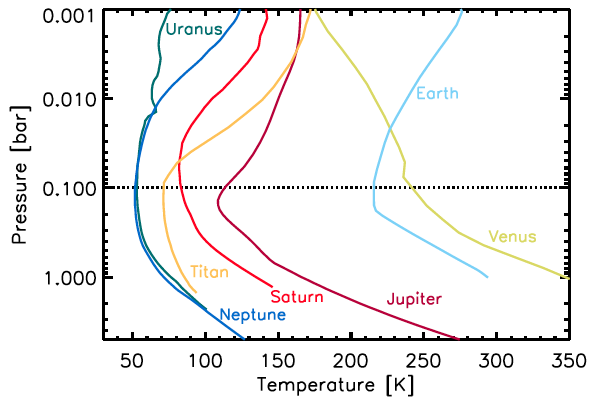
But even if that were correct, it still would not explain any of the rest of the differences in temp/pressure profile. This "atmospheric composition is irrelevant" dog won't hunt no matter what you do. The outer planets have the most similar temp/pressure curves, but they all look pretty different. Every wiggle in the curve is another observation your theory can't explain. There must be other factors involved than what your "simple" theory describes. Atmospheric science explains these observations well.
This is like saying polio and ebola have the same number of letters so therefore germs don't cause disease.
-
Re:Stop trying to win this politically
I didn't claim they were identical. I claimed that what differences were left were due to the distance from the star.
You managed to repeat yourself about seven times without saying what you meant. You are clearly confused about the subject, but it's nice how you can turn that around and claim it as someone else's problem.
It's good we're talking about just Venus now, because mentioning any other planets would make absolutely no sense. Mars' atmospheric pressure is
What is more, if you look at the temperature of Venus by altitude, you'll find that if you go up in Vensus' atmosphere by about a mile... call it the difference between Los Angeles and Denver... temperatures become tolerable for humans.
Before you say something like this you might want to verify it. Because if by "about a mile" you meant "about 50 kilometers" You would have been a lot closer to being right.
But wait, there's more! We are now saying that the temperature at the same pressure (1 atm was given) should only depend on the distance to the star. Clearly, given the graph in the previous post, this would be a coincidence; the temperature profiles look nothing alike. But let's just see if the math works out. Venus is 339 K at 1 atm pressure, Earth is 288 K. So never mind about any of this pesky atmospheric physics stuff, in order to work out the temperature of one, we just need to know the temperature of the other and the ratio of their distances from the source. Starting with Earth...oh dear. That doesn't work out at all. Well I am sure it will work the other way around. Oh no! I'm afraid it's not looking good for this theory.
Which is good, because chemical composition makes a huge difference. Venus reflects most of the light that hits it; less than 10% reaches the surface. It also wouldn't make sense to throw out everything we know about atmospheric physics based on one data point. Why don't you take a minute to read about the reality of Venus' atmosphere, rather than spitting out mis-remembered and false talking points?
-
Re:Stop trying to win this politically
Before you contradict me... actually look up the temperature of those worlds at equal pressure. I'll wait.
It's official, you're a moron. There's no sense in picking 1 atm in any case.
Do get into detail as to why that analogy isn't sound. Because it's clear you don't understand anything to do with either subject. In both cases while there are some underlying physical constraints, the result is a statistical model, not an exact representation, and an exact representation is impossible. Also, they're not evidence for or against the underlying theories.
You are completely wrong about everything that you believe about AGW and you're really trying your damndest to ignore empirical facts about reality. Ignoring reality makes you a lunatic. Please obtain a textbook on atmospheric physics, or a copy of the IPCC report, or both, and remedy your ignorance.