Slashdot Mirror
Domain: astronautix.com
Stories and comments across the archive that link to astronautix.com.
Comments · 776
-
OK, now I'm disturbed...
I make a one-line post about the apparent lack of attention to non-American deaths and I get smacked down as flamebait? I wasn't even intending to be flamebait!
THIS is flamebait:
If Apollo 11 can commemorate the deaths of Gagarin and Komarov alongside the friends they lost on Apollo 1, why can't I even reference Soyuz 1 and Soyuz 11 missions in passing on Slashdot? -
OK, now I'm disturbed...
I make a one-line post about the apparent lack of attention to non-American deaths and I get smacked down as flamebait? I wasn't even intending to be flamebait!
THIS is flamebait:
If Apollo 11 can commemorate the deaths of Gagarin and Komarov alongside the friends they lost on Apollo 1, why can't I even reference Soyuz 1 and Soyuz 11 missions in passing on Slashdot? -
Re:Rosaviakosmos, anyone?
"That's because there have been over 200 some Russians killed in their space program."
1.) Not all of those 200 Russians killed were cosmonauts. The vast majority of those deaths were ground crew killed in fuel-related explosions.
2.) Not all of those 200 were even working on the manned space program. The two accidents I can think of (1973 and 1980) weren't anywhere near Baikonur. Counting deaths at Plesetsk Cosmodrome would be like including deaths at Vandenberg AFB. (In fact, how did you arrive at 200, anyway?)
3.) Not all killed cosmonauts were Russian.
4.) Ten deaths are a tragedy, 200 are a statistic? Where have I heard that before?
"Having only had a handful of Americans killed is quite an accomplishement if you ask me."
Apollo 1 + STS-51L = 10
Soyuz 1 + Soyuz 11 = 4 -
Re:Rosaviakosmos, anyone?
"That's because there have been over 200 some Russians killed in their space program."
1.) Not all of those 200 Russians killed were cosmonauts. The vast majority of those deaths were ground crew killed in fuel-related explosions.
2.) Not all of those 200 were even working on the manned space program. The two accidents I can think of (1973 and 1980) weren't anywhere near Baikonur. Counting deaths at Plesetsk Cosmodrome would be like including deaths at Vandenberg AFB. (In fact, how did you arrive at 200, anyway?)
3.) Not all killed cosmonauts were Russian.
4.) Ten deaths are a tragedy, 200 are a statistic? Where have I heard that before?
"Having only had a handful of Americans killed is quite an accomplishement if you ask me."
Apollo 1 + STS-51L = 10
Soyuz 1 + Soyuz 11 = 4 -
Re:Rosaviakosmos, anyone?
"That's because there have been over 200 some Russians killed in their space program."
1.) Not all of those 200 Russians killed were cosmonauts. The vast majority of those deaths were ground crew killed in fuel-related explosions.
2.) Not all of those 200 were even working on the manned space program. The two accidents I can think of (1973 and 1980) weren't anywhere near Baikonur. Counting deaths at Plesetsk Cosmodrome would be like including deaths at Vandenberg AFB. (In fact, how did you arrive at 200, anyway?)
3.) Not all killed cosmonauts were Russian.
4.) Ten deaths are a tragedy, 200 are a statistic? Where have I heard that before?
"Having only had a handful of Americans killed is quite an accomplishement if you ask me."
Apollo 1 + STS-51L = 10
Soyuz 1 + Soyuz 11 = 4 -
Re:Rosaviakosmos, anyone?
"That's because there have been over 200 some Russians killed in their space program."
1.) Not all of those 200 Russians killed were cosmonauts. The vast majority of those deaths were ground crew killed in fuel-related explosions.
2.) Not all of those 200 were even working on the manned space program. The two accidents I can think of (1973 and 1980) weren't anywhere near Baikonur. Counting deaths at Plesetsk Cosmodrome would be like including deaths at Vandenberg AFB. (In fact, how did you arrive at 200, anyway?)
3.) Not all killed cosmonauts were Russian.
4.) Ten deaths are a tragedy, 200 are a statistic? Where have I heard that before?
"Having only had a handful of Americans killed is quite an accomplishement if you ask me."
Apollo 1 + STS-51L = 10
Soyuz 1 + Soyuz 11 = 4 -
Re:Why the signal is no longer degraded
It won't matter if another country makes their own GPS so that they aren't dependent on the U.S. The U.S. has the ASAT
-
Re:wow
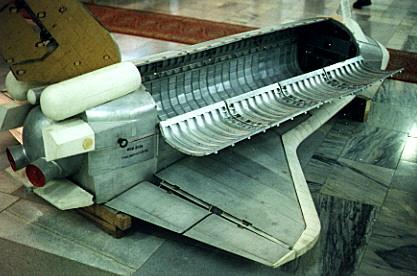
It never had one. It was most likely used for wind tunnel, weight, and fit checks along with fitting test payloads into the bay. This is what it originally looked like.
-
Re:Russian Space Shuttles?!?The Buran design was patterned after the US shuttle intentionally. When design work started, the Soviets realized that it would be more efficient to re-use the designs for ours, which were never classified and proven to work since the first tests of an air-dropped full size Orbiter in 1977. Thus, the result was a craft that resembles the Rockwell International design in many ways. (See here for some photos of another Buran test article, this one full-sized, on display in Sydney; an Australian friend donated the photos and is visible in one of them.)
This page has information about the Buran program in depth, including engineering background and a number of illustrations, including a few showing Buran docked to Mir. This, of course, never came to be following the program's cancellation after a single flight in 1988. The U.S. shuttle did visit in the mid- to late 1990s, however, as a prelude to the ISS program.
This may be a photo of the model that is on eBay, but I can't be sure. This might be, too -- in fact, the probability is rather high.
From the site:
"There was severe criticism of the decision to copy the space shuttle configuration. But earlier studies had considered numerous types of aircraft layouts, vertical takeoff designs, and ground- and sea- launched variants. The NPO Energia engineers could not find any configuration that was objectively better. This only validated the tremendous amount of work done in the US in refining the design. There was no point in picking a different inferior solution just because it was original."
So there you have it. -
Re:Russian Space Shuttles?!?The Buran design was patterned after the US shuttle intentionally. When design work started, the Soviets realized that it would be more efficient to re-use the designs for ours, which were never classified and proven to work since the first tests of an air-dropped full size Orbiter in 1977. Thus, the result was a craft that resembles the Rockwell International design in many ways. (See here for some photos of another Buran test article, this one full-sized, on display in Sydney; an Australian friend donated the photos and is visible in one of them.)
This page has information about the Buran program in depth, including engineering background and a number of illustrations, including a few showing Buran docked to Mir. This, of course, never came to be following the program's cancellation after a single flight in 1988. The U.S. shuttle did visit in the mid- to late 1990s, however, as a prelude to the ISS program.
This may be a photo of the model that is on eBay, but I can't be sure. This might be, too -- in fact, the probability is rather high.
From the site:
"There was severe criticism of the decision to copy the space shuttle configuration. But earlier studies had considered numerous types of aircraft layouts, vertical takeoff designs, and ground- and sea- launched variants. The NPO Energia engineers could not find any configuration that was objectively better. This only validated the tremendous amount of work done in the US in refining the design. There was no point in picking a different inferior solution just because it was original."
So there you have it. -
Re:Russian Space Shuttles?!?The Buran design was patterned after the US shuttle intentionally. When design work started, the Soviets realized that it would be more efficient to re-use the designs for ours, which were never classified and proven to work since the first tests of an air-dropped full size Orbiter in 1977. Thus, the result was a craft that resembles the Rockwell International design in many ways. (See here for some photos of another Buran test article, this one full-sized, on display in Sydney; an Australian friend donated the photos and is visible in one of them.)
This page has information about the Buran program in depth, including engineering background and a number of illustrations, including a few showing Buran docked to Mir. This, of course, never came to be following the program's cancellation after a single flight in 1988. The U.S. shuttle did visit in the mid- to late 1990s, however, as a prelude to the ISS program.
This may be a photo of the model that is on eBay, but I can't be sure. This might be, too -- in fact, the probability is rather high.
From the site:
"There was severe criticism of the decision to copy the space shuttle configuration. But earlier studies had considered numerous types of aircraft layouts, vertical takeoff designs, and ground- and sea- launched variants. The NPO Energia engineers could not find any configuration that was objectively better. This only validated the tremendous amount of work done in the US in refining the design. There was no point in picking a different inferior solution just because it was original."
So there you have it. -
Re:Might As Well Go EVA, There Ain't No Test Tubes
I think they should reconsider using one of the crazy personal space rescue systems from the 60's. It looks cheap to build, and it would probably be a blast to ride!
-
RD-0410
Oh no! newscientist.com is slashdotted. Did they mention experimental Russian/Soviet nuclear engine? It was half-tested in Semipalatinsk, Kazakhstan. I think it was only thermally tested, nobody loaded hydrogen and measured dynamic characteristics.
Anyway, here it is, with a nice museum picture. Thrust(vac) 3600 kgf, Isp 910 sec, burn time 1 hour. -
Re:Peroxide rockets wera Good Idea...All you have to do is run the peroxide (which is, btw, far, far more concentrated than what you buy at the drugstore)
Very true -- HTP is very unpleasant stuff. One speck of the wrong kind of impurity in your tank, and the whole thing goes up.
Combine that with a simple, pressurized fuel tank instead of turbopumps, and you have a rocket engine with the minimum of moving parts.
Yeah, and atrocious performance, too.
Pressure-fed rockets are much simpler than pump-fed ones -- they have many, many, fewer moving parts -- but they require very substantial tanks, since the tank pressure has to be greater than the combustion chamber pressure in order for the propellant to flow. Since, for weight reasons, you can't want to make your tanks out of 1 inch thick steel, you're stuck with fairly low chamber pressures, and the resulting low thrust.
On top of that, monopropellant peroxide has a very low specific impulse. SMAD3 doesn't give an ISP for mono-H2O2, but it does give a value for "Monopropellant (H2O2, N2H2, etc)" as 150-225 s; combining this with some other information would suggest that H2O2 is at the lower end of this scale.
Beal et. al. got around this by running their rockets off H2O2 and LOX; SMAD has no numbers for this kind of engine, but Mark Wade's site gives numbers from 250-300 s for Beal's design. This is quite respectable, but has the downside of requiring a (mildly) cryogenic oxidizer.
-
Re:GSLV, oxygen and l4m3 Reuters
Interesting... There's no info on KRB-12 on manufacturer's site, the have only 21 ton KVRB for Proton and Angara.
Mark Wade's Encyclopedia Astronautica mentions both KRB and KVRB in RD-56M article. -
Re:GSLV, oxygen and l4m3 Reuters
Interesting... There's no info on KRB-12 on manufacturer's site, the have only 21 ton KVRB for Proton and Angara.
Mark Wade's Encyclopedia Astronautica mentions both KRB and KVRB in RD-56M article. -
Re:X-15 not parabolic - wrong
I think if you will peruse either Mark Wade's Encyclopedia Astronautica or the various history articles on NASA's web site (look up the URL's yourself) you will find that there were two different flight profiles for the X-15. In both cases, the powered segment was generally quite brief, running around 80 to 120 seconds of and 8 to 12 minuite flight. The high speed profile was 'relatively' flat, as you state. But the high altitude profile, which resulted in the 62 mile altitude you refer to, is described as a ballistic trajectory, the central three minuites or so required use of reaction controls to maintain stability, as aerodynamic controls no longer worked at the extreme altitudes involved. One approximate description of a suborbital ballistic trajectory is parabolic.
-
Re:Chinese manned space flight"Would they announce an attempt beforehand?"
They wouldn't need to. Unlike the USA or former USSR, the Chinese don't have observation stations all around the Earth to keep in contact with their taikonauts when they're not over China. In order to compensate, they have a few specialized frigates (or are they cruisers?) with communications gear that's only useful for talking with spacecraft. Whenever these ships leave port, you can bet foreign spy satellites (even the commercial ones) take note of it.
Even more damning is the way their launches fly right into NORAD territory.
"Or would they wait and see if it were successful first?"
I'm not sure when the People's Daily is allowed to publish information on Shenzhou launches, but the pattern seems to be that Chinese launches are all over the US press either right before or right after launch.
They could try denying that somebody was aboard, but anybody with a decent radio would be able to find out the truth.
"anyone know what the Chinese version of astronaut/cosmonaut would be?)"
The Chinese government refers to them as "yuhangyuan," but the Western press has taken to calling them "taikonauts."
"kick the USA into being more ambitious about the manned space program? "
Probably not until they do something that seems to intrude on US pride, like, say, that lunar landing they say they can achieve by 2005. Yeah, that 2005 deadline is probably too ambitious, but not as ambitious as you might think. The Encyclopedia Astronautica has this interesting article on their lunar plans.
In short, instead of building a super-heavy lifter (Saturn V, N1), they intend to launch the taikonauts and lunar landing equipment on two different rockets, to meet up together in orbit. Whether they can figure out docking in orbit is another question entirely...
-
My favorite space conspiracy theorycomes from Robert Heinlein's 1960 essay, "PRAVDA" means "TRUTH":
About noon on Sunday, May 15, we were walking downhill through the park surrounding the castle that dominates Vilno. We encountered a group of six or eight Red Army cadets. Foreigners are a great curiosity in Vilno. Almost no tourists go there. So they stopped and we chatted, myself through our guide and my wife directly, in Russian.
Shortly one of the cadets asked us what we thought of their new manned rocket. We answered that we had had no news lately -- what was it and when did it happen? He told us, with the other cadets listening and agreeing, that the rocket had gone up that very day, and at that very moment a Russian astronaut was in orbit around the earth -- and what did we think of that?
I congratulated them on this wonderous achievement but, privately, felt a dull sickness. The Soviet Union had beaten us to the punch again. But later that day our guide looked us up and carefully corrected the story: The cadet had been mistaken, the rocket was not manned.
That evening we tried to purchase Pravda. No copies were available in Vilno. Later we heard from other Americans that Pravda was not available in other cities in the USSR that evening -- this part is hearsay, of course. We tried also to listen to the Voice of America. It was jammed. We listened to some Soviet radio stations but heard no mention of the rocket.
This is the rocket the Soviets tried to recover and later admitted they had had some trouble with the retrojets; they had fired while the rocket was in the wrong attitude.
So what is the answer? Did that rocket contain only a dummy, as the pravda now claims? Or is there a dead Russian revolving in space? an Orwellian "unperson," once it was realized that he could not be recovered.
I am sure of this: At noon on May 15 a group of Red Army cadets were unanimously positive that the rocket was manned. That pravda did not change until later that afternoon.
I'm not sure what to think. Heinlein's opinion of the Soviet Union was unabashedly critical; but it's not like I'd be any more trusting of official 1960s USSR reports.
The Encyclopedia Astronautica confirms that a Vostok program (the first Russian manned spaceflight) launch did occur on that day, and that it was pushed into a higher orbit when its retrorockets were fired at an incorrect attitude. The Astronautica claims that the launch was intended to test the spacecraft systems, that it was unmanned, and that it was unrecoverable because the heat shield had not been installed. If it lacked a heat shield, then it certainly wasn't a manned flight. But if they were testing reentry by firing the retrorockets, I don't understand why they wouldn't install the heat shield on the vehicle.
I think the "military cadets didn't know what they were talking about" theory is much more likely than the alternative "Heinlein made up some anti-Soviet propaganda" or "the Soviets killed a man, then tried launching dogs for a year until they felt confident to try a manned launch again" theories... but there's nothing quite so entertaining as a good conspiracy theory, is there? And the spacecraft components eventually did reenter, at a random attitude where they would burn up with or without heat shielding, so we'll never really know... -
Re: Russian record
we have lost 7 on the challenger and 3 in apollo ground fires... Compare ours with the Russian or Chinese
Russians lost 4 during flights and 1 in Apollo 1-like oxygen fire.
Technically, they lost no manned ships in space (one smashed in the ground, and one returned intact with 3 dead bodies).
Two launch aborts resulted in no casualties: Soyuz 18-1, Soyuz T-10-1.
There were a number of ground crew casualties during ICBM and equipment testing; I don't think this counts as manned flights casualties, does it?
This is tough for Americans to swallow. So, there are urban legends about Soviet secret space accidents. So far nothing was confirmed. If you have any hard facts, let me know. -
Re: Russian record
we have lost 7 on the challenger and 3 in apollo ground fires... Compare ours with the Russian or Chinese
Russians lost 4 during flights and 1 in Apollo 1-like oxygen fire.
Technically, they lost no manned ships in space (one smashed in the ground, and one returned intact with 3 dead bodies).
Two launch aborts resulted in no casualties: Soyuz 18-1, Soyuz T-10-1.
There were a number of ground crew casualties during ICBM and equipment testing; I don't think this counts as manned flights casualties, does it?
This is tough for Americans to swallow. So, there are urban legends about Soviet secret space accidents. So far nothing was confirmed. If you have any hard facts, let me know. -
Re: Russian record
we have lost 7 on the challenger and 3 in apollo ground fires... Compare ours with the Russian or Chinese
Russians lost 4 during flights and 1 in Apollo 1-like oxygen fire.
Technically, they lost no manned ships in space (one smashed in the ground, and one returned intact with 3 dead bodies).
Two launch aborts resulted in no casualties: Soyuz 18-1, Soyuz T-10-1.
There were a number of ground crew casualties during ICBM and equipment testing; I don't think this counts as manned flights casualties, does it?
This is tough for Americans to swallow. So, there are urban legends about Soviet secret space accidents. So far nothing was confirmed. If you have any hard facts, let me know. -
Re: Russian record
we have lost 7 on the challenger and 3 in apollo ground fires... Compare ours with the Russian or Chinese
Russians lost 4 during flights and 1 in Apollo 1-like oxygen fire.
Technically, they lost no manned ships in space (one smashed in the ground, and one returned intact with 3 dead bodies).
Two launch aborts resulted in no casualties: Soyuz 18-1, Soyuz T-10-1.
There were a number of ground crew casualties during ICBM and equipment testing; I don't think this counts as manned flights casualties, does it?
This is tough for Americans to swallow. So, there are urban legends about Soviet secret space accidents. So far nothing was confirmed. If you have any hard facts, let me know. -
Re: Russian record
we have lost 7 on the challenger and 3 in apollo ground fires... Compare ours with the Russian or Chinese
Russians lost 4 during flights and 1 in Apollo 1-like oxygen fire.
Technically, they lost no manned ships in space (one smashed in the ground, and one returned intact with 3 dead bodies).
Two launch aborts resulted in no casualties: Soyuz 18-1, Soyuz T-10-1.
There were a number of ground crew casualties during ICBM and equipment testing; I don't think this counts as manned flights casualties, does it?
This is tough for Americans to swallow. So, there are urban legends about Soviet secret space accidents. So far nothing was confirmed. If you have any hard facts, let me know. -
Re: Russian record
we have lost 7 on the challenger and 3 in apollo ground fires... Compare ours with the Russian or Chinese
Russians lost 4 during flights and 1 in Apollo 1-like oxygen fire.
Technically, they lost no manned ships in space (one smashed in the ground, and one returned intact with 3 dead bodies).
Two launch aborts resulted in no casualties: Soyuz 18-1, Soyuz T-10-1.
There were a number of ground crew casualties during ICBM and equipment testing; I don't think this counts as manned flights casualties, does it?
This is tough for Americans to swallow. So, there are urban legends about Soviet secret space accidents. So far nothing was confirmed. If you have any hard facts, let me know. -
Re:Put it in perspectiveI would say comparable number of people for both space programs (can anybody count the flights at Encyclopedia Astronautica?) And, of course, Russians spent a lot more man-days in space.
Russia (USSR) has lost 4 cosmonauts in two in-flight accidents, all of them on landing:
Vladimir Komarov (Soyuz 1, Apr 23 1967) - parachute system failure, the capsule crashed into a field;
Georgi Dobrovolsky, Viktor Patsayev, Vladislav Volkov (Soyuz 11, Jun 6 1971, first ever space station flight) - valve failure on separation of orbital module and landing capsule. No spacesuits and no air.
There was one Russian accident similar to Apollo 1: Valentin Bondarenko was killed on March 23, 1961 in oxygen camera. After a routine blood test he dropped alcohol soaked cotton ball on a hot electric stove, starting the oxygen fire. Valentin died in the hospital the same day.
There were no more Cosmonaut deaths. However, there were numerous rocket and military missile accidents killing the ground crew.