Slashdot Mirror
Domain: astronet.ru
Stories and comments across the archive that link to astronet.ru.
Comments · 6
-
Since the 1970's? And the Rest
engineering-wise. SPMTs have been around since the 1970s, and have moved much heavier loads
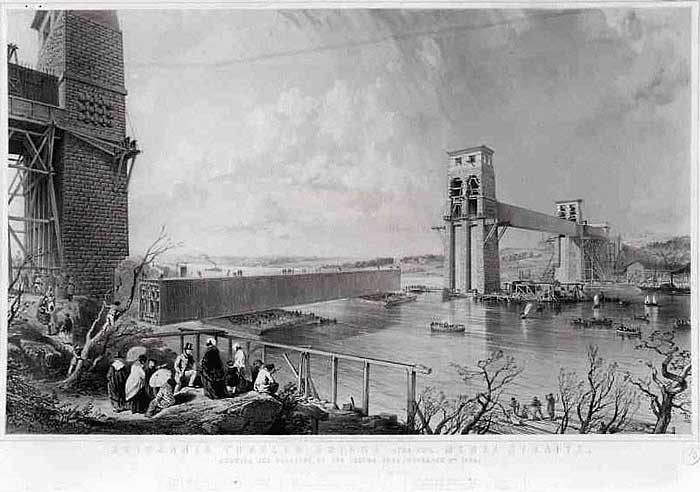
Depends what you call a SPTM. Bridges have been prefabricated and moved into place since pre-historic times, starting with carved tree trunks. It does not matter how the bridge gets put there, what matters is its strength and that of its supports. Here is a much more ambitious construction, overseen by Robert Stephenson and Brunel no less, over dangerous water too, 150 years ago
-
Re:1400 x 900 is now considered hi-res?
Are you serious? My first hit on Google Images beat that little image.
-
Re:Enchiladas
Did anyone else read that as Moon Enchiladas? Mmmm.. Moon enchiladas...
And Jupiter's moon Io looks like pizza:
http://www.astronet.ru/db/xware/msg/1159737
Now all we need is a hamburger moon and a fries moon(s), and the junkfoodification of the solar system is complete. (I hear Enceladus' geysers taste like coke, so we got that covered.)
-
Re:No free lunchYou are correct. The energy that must be input to the system is called potential energy. Even if there were no viscosity losses in the atmosphere which there will be and no friction losses in the mechanical components. Some people have responded to your post suggesting that another car be sent down the ribbon simultaneously which in a perfect system would give up its potential energy which could then be used to power the upward bound car.
First, I don't think two cars could travel the ribbon at once. Second, a car already at GEO is stationary relative to the earth so it would not provide any force that could be harnessed to power the other car. The force it could provide would depend on how far down the ribbon the car had travelled since below GEO the centrifugal force will be less than its weight. However that force will start from zero at GEO and increase to a maximum at sea level. Think about that. There is no upward force to help lift the upward bound cargo when it needs to get going and the cargo is being propelled violently when it nears the end of its journey at GEO. So I don't think this system would work.
I have concerns about laser assisted solar panels as well. Shining a laser so close to the ribbon could be problematic. A laser beam will travel in a straight line but a straight line is not perfectly straight inside the atmosphere. Some observatories use lasers now to adjust their mirrors reduce the blurring caused by the atmosphere. I don't know whether the effect would be pronounced enough to worry about for this application but I have another reason to worry as well. I expect the ribbon might oscillate like a guitar string for several reasons.
If the ribbon is not anchored directly over the equator there would be a natural tendancy to oscillate since the tug of gravity would not be completely along the length of the ribbon. To understand, imagine if the ribbon were anchored at the pole then think about the pull of gravity and consider the inverse square law and the fact that sealevel is about 4000 miles from the center of the earth while GEO is about 24000.
Moving the anchor to 'avoid space debris' would also "pluck" the string. Atomospheric winds would cause vibration in the ribbon. Imagine the force of a 150 mile per hour jetstream pushing against a 3 foot wide ribbon! And if there are lateral vibrations as in a guitar string then there would also be a circular precession similar to foucault's pendulum.
I can't say if these effects would be negligible or not, but I don't see any discussion of vibration in their FAQ much less an engineering study.
-
Re:Best of British
The answer is possibly related to the Scientists involved.
The Spirit and Opportunity landers may have been made by experienced scientists in scientifically clean labs and using wind tunnels designed for the military.
Beagle2 (not the Mars Express Orbiter) was cobbled together with pop groups and artists. There's a picture of the project PI (Collin Pillinger) pushing Beagle2 on a shopping trolley. This wasn't a "let's play up the low price tag" PR photograph. He really was transporting the lander on a shopping trolley.
There is then the technical complications. NASA have built two remote controlled sem-autonomous rovers, they have been designed to move about on terrain which has never been seen (from the ground) before. The Sojourner rover from the 90s did very little science because it was mostly wheels and batteries. The only thing I remember from the Sojourner mission is a rock named Yogi.
The thing that separates the two missions is really only the PR. NASA tried to get the fancy rover factor that worked well with Sojourner, and even borrowed a few tricks from Beagle2 in their "were using musical tones to represent spacecraft state".
Beagle2, on the other hand, has a PI who can get people to work for free with the promise of fame (and fortune?). using an artist to paint a spotted calibration plate for the spectrometers/cameras which a scientist would have otherwise done. Using a pop group to play the "mission success" tune on landing (which, I have no doubt, will come through in crystal clear surround sound in the Lander Mission Control).
Going to Mars is expensive, Beagle2 was only cheap because a 300 million Euro orbiter was going that way anyway. Venus Express is recycling the Mars Express engineering models (and will be cheap).
It also has less than 1 in 3 chance of success (3 out of the last 5 failed). Nozomi is dead. 100 million USD doesn't buy what it used to.
BB -
Lunokhod 1: Moon Robot