Slashdot Mirror
Domain: bartonpaullevenson.com
Stories and comments across the archive that link to bartonpaullevenson.com.
Comments · 19
-
Re:Any materialized predictions? (Re:Sudden?)
they predicted that Antarctic sea ice would increase in a warming world
But they DIDN'T predict growing sea ice in a world that is NOT warming, did they? [Jane Q. Public, 2015-05-22]
Good grief, Jane. They also didn't predict growing sea ice in a world that's infested with leprechauns. But neither of those silly objections are relevant, because the real world is warming. Remember?
"We know the Earth is warming, you idiot. That's not the issue here." [Lonny Eachus, 2010-07-01]
Since these conditions are not the conditions presumed in the model, in fact they have not predicted anything. You are just a master at inappropriately shifting contexts, as I have pointed out many time. You don't get to say that they predicted a result given THESE conditions, then say the same result under OTHER conditions constitutes a "prediction". Especially given the uncertainties involved. That's bullshit. [Jane Q. Public, 2015-05-22]
Nonsense, Jane. Manabe et al. 1991 predicted that increasing atmospheric CO2 warms the planet and causes a slight increase in Antarctic sea ice. This certainly constitutes a prediction because these conditions are happening. After all, as you've said, nobody is denying it's warming.
The next time you want to keep ignoring the predictions of Manabe et al. 1991 and all these other confirmed predictions, it might be more honest to just say that you reject all those confirmed predictions, rather than trying to pretend that they never happened.
You aren't using "all the available data". Once again, you are using the data that is convenient to you.
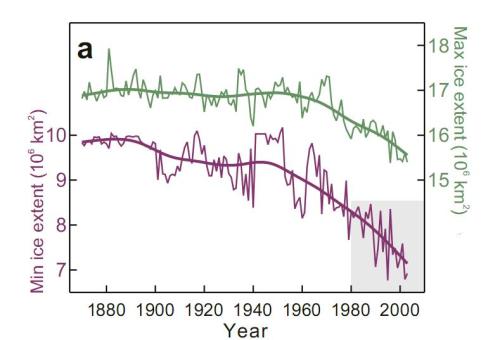
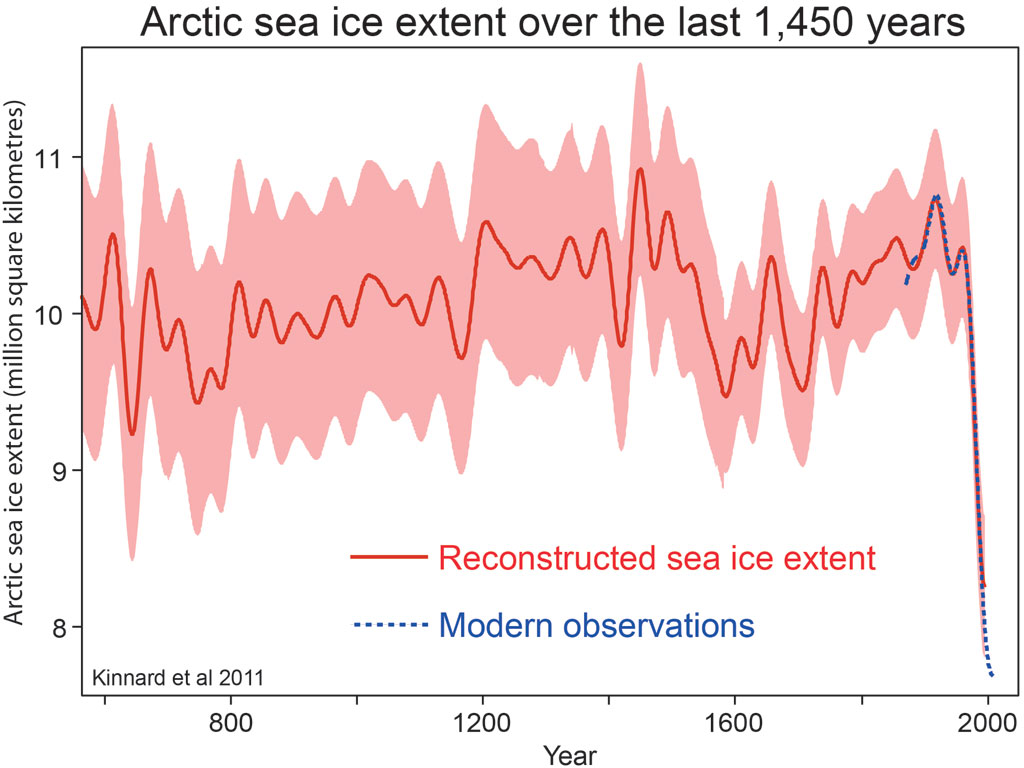
That's absurd, Jane. I've repeatedly linked to Polyak et al. 2010 and Kinnard et al. 2011. Polyak et al. reconstructs Arctic sea ice back to 1870, and Kinnard et al. goes back 1,450 years.
... I will ask you again: would the slope be the same if you chose 2000 for a starting point, or 1850? No, it would not. I made a simple comment based on a simple fact: 1981 was at or near a local maximum, and using it for a starting point of your "average" is questionable at best. That is an accurate statement. If you chose 1930 instead, as another local maximum you would again have to justify that as a starting point. You don't get to weasel out of that. [Jane Q. Public, 2015-05-22]
I don't have to "weasel out" of anything, because despite your baseless accusation I've always advocated using all the available data. In the context of using a single dataset, that means not cherry-picking the starting point, and instead using the entire dataset.
That's why it was so baffling when Jane baselessly accused Layzej of cherry-picking when he loaded the entire UAH d
-
Re:Any materialized predictions? (Re:Sudden?)
Manabe was 14 years ago. Conditions have changed rather significantly in that time, as has our understanding of the geology. It may be that Manabe is still correct. On the other hand, it may not. [Jane Q. Public, 2015-05-22]
No, Jane. Manabe et al. 1991 was 24 years ago. The fact that Manabe was 24 years ago is exactly why I've repeatedly showed it to you. They predicted that Antarctic sea ice would increase in a warming world, but you keep insisting that "The science is faulty at its roots. The models haven’t predicted one thing, in 30+ years.
In addition to the other 17 reasons I gave you, don't you think this is another reason you should reconsider making these baseless accusations?
I've told Jane and economart that Fig. 2(a) from Polyak et al. 2010 shows that the reconstructed Arctic sea ice extent in the 1930s was comparable to that in 1979, and the modern decline is quite clear.
You seem to feel that what "you told people" is necessarily truth. That's an interesting point of view. [Jane Q. Public, 2015-05-22]
Huh? Jane, I just gave you links to peer-reviewed long-term reconstructions of Arctic sea ice extent in response to your insinuations that scientists are deliberately misleading. In response, Jane tries to guess at my feelings about what I "told people".
Instead, you might find it more productive to click on those links and learn about peer-reviewed long-term reconstructions of Arctic sea ice extent. Then maybe you'll be in a better position to judge whether you should dare to accuse scientists of deliberately misleading.
I've also repeatedly explained that Jane's accusations of deliberately misleading cherry-picking are completely backwards. As usual.
You are implying that my statement that 1981 was near a temporal local maximum is incorrect? You would rather use 1930 as your starting point? As opposed to, say, 2000 or 1850? [Jane Q. Public, 2015-05-22]
Good grief, Jane. Once again, I'd rather use all the available data. In the context of using a single dataset, that means using all the data in that dataset. That's why it's so ironic that Jane baselessly accused Layzej of cherry-picking when he loaded the entire UAH dataset, then Jane suggested only using data since 1998. But Jane obviously won't ever be able to grasp this irony, because he just did the
-
Re:On the other hand...
Actually, no. You are probably confused by measurements of surface air temperature (you know the part of the combined ocean-atmosphere system that holds about 2% of the thermal mass). This temperature is affected by periodic turnovers of heat (or lack thereof) from the oceans. One of the better known of these periodic turnovers is the El Nino Southern Oscillation, but calling it "periodic" is a bit tricky; it depends on patterns of wind, which are hard to predict. Turns out that models that happen to match these temporal patterns are extremely good at predicting the observed surface air temperature. Other models more or less capture the moving average. Evidence indeed shows heat is being stored in the oceans, since the freaking massive El Nino event of 1997. (You should be asking "why hasn't the temperature returned to normal since then?")
But the models in general have worked very well.
-
Re:"Expected" to release methane
That climate science, to date, has been poor at prognostication is indisputably true. [Jane Q. Public, 2014-12-10]
Nonsense. Here's a list of 17 correct prognostications and their confirmations, including full citations.
-
Re:Yawn
... Things have changed. "Anthropogenic Global Warming" (AGW) advocates repeatedly and consistently stated that a trend of 10 years or more proved their point... [Jane Q. Public, 2013-05-05]
Presumably you're referring to "scientists." Also, I've repeatedly said:
Since climate is an average over ~20 years
In fact, I've repeatedly told you that ~20 years are needed:
As I've explained, climate is the global average over ~20 years. [Dumb Scientist to Jane Q. Public, 2010-02-16]
This graph shows why scientists prefer trends calculated over at least ~20 years. [Dumb Scientist to Jane Q. Public, 2013-01-21]
I've even gone into more detail, showing you a paper that says at least 17 years are required:
Of course, you ignored me just like you previously ignored riverat1:
And 10 years has what to do with climate trends? Not much. A recent paper by Santer et. al. calculated the signal (climate) to noise (weather/natural variation) ratio for climate trends. For 10 years the S/N ratio is less than 1. They found it takes 17 years to be sure the signal is greater than the noise. [riverat1 to Jane Q. Public, 2011-11-19]
For global temperatures, Santer et al. 2011 shows that one needs to average over ~17 years of data to obtain statistically significant climate trends. Here's another explanation by Tamino. Also, the Skeptical Science trend calculator helps visualize statistical significance. [Dumb Scientist, 2012-08-15]
Perhaps your ode to conspiracy theories distracted you, but I also linked to another method of calculating significance which is even more conservative:
Also, Bart
-
Re:Definition of 'climate'
Also, Barton Paul Levenson explains the World Meteorological Organization (WMO) definition of climate, which uses a more scientifically conservative 30 year minimum timespan.
-
Re:Scientists and "skeptics"
Most of the predictions of temperature change due to CO2 have been far, far off (The Earth should be far warmer if the models were right). Making expensive decisions on the basis of utterly failed prediction models is stupidity itself.
In fact this is not true, as you would have seen if you'd read the article I cited.
This is an excellent illustration of how global warming "skeptics" differ from actual skeptics. A true skeptic would look skeptically at the record of predictions of both sides of the debate. They would note that climate scientists predicted the timing of the temperature increase, the approximate magnitude, the rise in the oceans, the loss of arctic ice, and even numerous details about the pattern of warming, such as that warming would be greater at night than day (whereas the reverse would be the case if a change in solar radiance were responsible), and that surface warming would be accompanied by cooling at high altitudes. In contrast, industry funded professional doubters of science insisted after every new temperature record that the warming was merely a temporary weather fluctuation, that the trend was beginning to turn down, that arctic ice was on its way to recovery. Even now, when the warming trend has become so clear that no rational person can deny it, the same people consider to insist that the warming has some other cause (what? they don't know, but whatever it is, it must be "natural"). As the weather consequences predicted by the scientists begin to emerge (more frequent extreme weather events, and particularly more heat related events, more strong storms, more frequent flooding), they continue to insist that it is only coincidence.
But the climate science "skeptic" says, "Yes, the very earliest global climate models predicted global warming, but they were a bit off on the magnitude of the warming, so therefore climate science is all wrong, and we don't have to worry about mitigating CO2 pollution."
-
Re:The problem is chicken little
This is complete and utter crap. This kind of arrogance is why people are pushing back against you. You've created a theory that, rather conveniently can't be disproven.
Completely false. See here for a list of some of the confirmed falsifiable predictions of climate theory. And that includes the big one: predicting global warming before it was evident in the temperature record.
Never mind all of the predictions that haven't come true
Citation needed. Please provide IPCC report references for the consensus climate science predictions that supposedly have not come true
-
Re:Conservative meltdown in 5..4..3..2..1..
There are well established statistical methods of extracting long-term trend from short-term noise such as fluctuations in water vapor. As these fluctuations ride "on top of" the long-term trend, it is plausible that the rising trend could lead to more extreme weather events, although how much that is happening at the present time remains a challenging statistical question.
There have already been numerous tests of modern climate theory, which could have potentially have falsified the theory. For some of the tested predictions of climate science, see here. Indeed, every time a volcano erupts, it is another test of climate theory.
-
Re:We didn't really know how things worked before
All theories, from gravity to evolution generalizations that can never be exhaustively tested, but that are to some degree accepted because they make testable predictions that have turned out to be correct. For example, we theorize that all masses, past, present, and future exert a gravitational force on all other masses, but almost all of the masses in the universe are not directly accessible for testing--we have tested only an insignificant fraction of them.
Here's a list of some of the predictions of climate science that have been tested and have turned out to be correct
-
Re:Hypotheses and predictions
You keep saying that, but it doesn't make it any more true. GCMs are programmed with the basic assumption that CO2 drives global average temperature, more specifically through assumed feedback effects on water vapor (which is a much stronger greenhouse gas). I welcome you to show me any existing GCM which does not assume this.
Feedback effects of are not "assumed," but are based upon established physical properties of CO2 and water, such as the effect of temperature on CO2 solubility and evaporation of water.
You're really stretching yourself thin here. The null hypothesis is the assertion that there is no relationship (causal or otherwise) between to things. It is not the "zero hypothesis".
Yes it is: The "no relationship" hypothesis is that the derivative dy/dx = 0 (where x and y are two different measurements) . Nothing to do with causality--simply that a plot of y vs. x has a true slope of zero. Of course, if the slope is zero, then there is no evidence upon which to base a causal hypothesis relating x to y. But the converse is not true: a nonzero slope does not establish a causal relationship. In the case of CO2 and temperature, the null hypothesis of zero slope is readily excluded by simple statistics. There is a correlation between temperature and CO2; the question is why. For this question of causality, there is no null hypothesis, because the null hypothesis has already been excluded.
Pray tell, what would the "zero hypothesis" of "smoking causes lung cancer" be? That there is no difference between the measurement of smoking and the measurement of lung cancer?
I've answered this question before. Did you miss it? Of course, there is no null hypothesis about "smoking causes cancer," because null hypotheses apply only to statistics, and statistics does not address questions of causality. But there are certainly null hypotheses that can be formulated regarding the relationship between smoking and cancer. Examples would be: "There is zero difference in the incidence of lung cancer in smokers and nonsmokers" or (for more quantitative data regarding smoking) "the derivative dy/dx (where y is the incidence of lung cancer and x is the number of cigarettes smoked)" is equal to zero."
Again, you're not fighting with a competing model here, you're competing with the null hypothesis that there is no causal relationship between CO2 and global average temperature. Trying to put your model above strict scrutiny is clever, but not convincing.
Again, you are back to special pleading based upon your failure to understand that a question of causality cannot be a null hypothesis. The null hypothesis of no statistical relationship between temperature and CO2 is excluded. A causal model, whether "natural" or otherwise, must indeed be subject to strict scrutiny--which means you must do what climate scientists have done (and what the self-styled "skeptics" have so far failed to do): define a specific model of climate that makes definite predictions, and carry out observations to test those predictions.
You lie like a dog. Throughout this entire conversation, you have completely been unable to make any specific statement of what observation of CO2 and global average temperature, on any time scale, would falsify your hypothesis. Having a mathematical model that cannot hind cast such events as the MWP, or LIA, or Holocene optimum, much less forecast within any sort of error range, is no great feat.
There have been numerous papers published on the quality of hindcasts from the models (a good summary can be found in the IPCC report)--but you are hardly equipped to criticize the quality of those hindcasts unless you can offer a model that does a better job. Once again,
-
Re:Hypotheses and predictions
Looking over your list of predictions, I'll note that none of them seem to predict a specific level of CO2 and a specific temperature
Yes, this is a common crank objection to genuine science, one that has been applied to fields as diverse as climate science and quantum mechanics: "If your model can't predict what I want it to predict, then it must be wrong." But testing of scientific models does not require that a model be able to predict everything, merely that it makes testable predictions. This is something that climate science has done with flying colors. Meanwhile the vague hand-waving notions of "natural variation" cited by the self-styled critics have been unable to predict anything, and when challenged, they fall back upon special pleading: "It's not a theory, it's just a 'null hypothesis' (never mind that that makes no sense) so I don't have to subject it to the standard scientificdiscipline of creating a mathematical model that makes actual testable predictions."
Why do you consider AGW/CAGW the null hypothesis?
I don't. No actual scientist would make such a claim. As I've explained to you several times, a physical model such as AGW cannot be a null hypothesis. The term "null hypothesis" is only meaningful in the context of statistics and statistical models, and has a well-defined meaning, so nobody gets to choose what is the null hypothesis. The null hypothesis is the hypothesis of no change--and nobody seems to be crazy enough to claim that climate is unchanging.
AGW has more credibility with the scientific community not because it has some sort of nonsensical privileged "null model" status, but rather because it has been subjected to the standard scientific disciplines of "sanity checking" that any credible theory must conform to: it has been implemented in mathematical form consistent with known physics to derive definitive mathematical predictions, and those predictions have been tested against observation, yielding dramatic confirmation (of which the prediction of the modern warming trend before it occurred is just one). Here, once again, are some of the successful predictions of climate theory:
http://bartonpaullevenson.com/ModelsReliable.htmlI'l take that one further - the project increase in average temperature over the next 50 - 100 years is much smaller than the natural variance of annual average temperature
I'm skeptical, particularly since there is no single projection, but rather a series of scenarios depending upon how successful we are at controlling CO2. Over a single year, the difference between them is negligible, but over 100 years, it can make quite a bit. Please explain what specific model or models and scenarios you used for your projection (with appropriate citations), and describe (or provide a citation to) how the variance of annual temperature was calculated.
-
Re:Hypotheses and predictions
Unsupportable assertion - expanding water can be a good thing. The assertion that any expansion of water, no matter how minuscule, is a problem is completely unfounded.
Obviously, there are some people who already live very close to the water line, for whom any increase in ocean level whatsoever will be a problem, even somebody else happens benefit (perhaps Al Gore's house in the hills of Montecito will increase in value by virtue of becoming oceanfront property).
The null hypothesis is that there is no causal relationship for a given factor
Sorry, but that's scientific gibberish. Read up on statistics. The null hypothesis has nothing to do with causal relationships. "Null" means one thing, and one thing only: it is the hypothesis that there is no difference in the true value of two measurements that are subject to error. Any hypothesis other than that cannot be considered a null hypothesis. The term has no meaning whatsoever in any other area of science.
Are you listening to yourself? You're putting *your* faith in GCMs
No, as a scientist, I do not base my judgements on faith, but on how well a hypothesis is able to make testable predictions and how well those predictions are borne out. So I am impressed by a theory that successfully predicted the modern warming before it happened, as well as a whole host of details about how that warming has manifested.
I am not impressed by self-styled skeptics who have subjected their ideas to the discipline of mathematical modeling. I am not impressed by those who dismiss the careful modeling of others, and yet have consistently failed to create a model of their own that is consistent with observational data and does not predict warming. And I am even less by those who try to excuse their failing by the statistically illiterate insistence that their ideas are a "null hypothesis" and therefore exempt from the type of scrutiny to which real scientists subject their scientific hypotheses.
Make a testable prediction for what the CO2 and temperature level will be like next year, and include your error range.
If I had a casino, I'd love to have you for a customer. If a mathematician told you, "You know, the roulette wheel is statistically weighted in favor of the house, and you will lose your money if you keep playing," you would doubtless insist, "Well if you think you know so much, make a testable prediction on the outcome of the next spin," and keep playing.
Climate models do not purport to accurately predict the temperature next year--or to put in in statistical terms, the projected increase in average temperature next year is much smaller than the variance of annual average temperature.
-
Re:Hypotheses and predictions
If you can come up with half a dozen models that reasonably hind cast, and share fairly similar forecasts, but have *wildly* differing base assumptions about climate sensitivity, you've already shown that it is possible to have wildly different models spit out the same tuned results
Yet nobody has been able to come up with such a model that does not predict a problem with future warming as a result of CO2 increase. What this suggests is that none of the models is absolutely perfect (but then again, no model is), but that to be able to do a good job in hind casting, the errors have to cancel out, and this may happen in a somewhat different way in different models. In other words, the necessity to be consistent with the temperature record imposes a powerful constraint on model structure, and models that do not predict future warming cannot satisfy this constraint. Again, it would be easy to disprove this: just show me a model that can hind cast and that does not predict future warming.
Again, the fatal flaw with these models is that they brook no falsifiability - every observation of future climate can simply be dispensed with by an ad hoc special pleading.
Some of the tests of the models can be found here. Again, if the models are so adjustable that they can predict whatever you choose, why has no critic been able to come up with a model that passes the hindcast test and does not predict troublesome warming?
-
Re:You'd Think...
...that after 150 years AGW theorists would actually be able to provide some *proof*....
Absolute proof exists only in mathematics, not science. Scientific proof is testing and confirming the predictions of a theory, and so far climate theory has done pretty well. See here for some of the tests of climate theory.
-
Re:AGW
> Now run those experiments,
Yes, run the experiment..... oh yea, we can't because we don't have a couple of spare earths around.
So everyone runs computer models and expects us to believe the results of that instead. But I have seen some of what passes for climate modeling and it is pathetic. And it has NEVER produced a testable result. There are ZERO predictions made by a 'reputable' climate scientist from 10 or twenty years ago that matched reality 10 or twenty years later.
No model can predict the weather a day in advance 100%, none can predict a week or a month out with much skill and by the time you move from weather to climate the skill is pretty close to random chance, i.e. zero skill.
Short term behavior is unreliable so long-term averages must also be unreliable? Do you even think about what you are saying? Nobody can reliably predict the roll of the dice or the spin of a roulette wheel. Does that mean that casinos can't make money by betting on the long-term trend?
-
Re:A little late
Name one useful prediction of AGW theory. Now tell me how many attempts have been made to falsify it. Hint: zero because such a test can't be devised and wouldn't be funded if it could. Such a test can't be devised because AGW makes no testable predictions
The science is settled. Bullshit, and anyone saying that can't be a scientist or care one whit about it. Science is always one result away from a revolution. One testable, repeatable result trumps any theory.
Sure, tomorrow we may find discover some object that is not affected by gravity, and have to switch to an "intelligent falling" theory. But it's not likely. So while there will almost invariably be some scientist, somewhere, willing to challenge any theory whatsoever (scientists being a contentious lot), some theories are about as close to settled as any science every gets. AGW certainly falls into that category, with over 95% of scientists actively publishing in the field agreeing that temperatures are rising as a result of human activity
-
Re:AGW
Thanks for the nice tutorial on the Laffer curve. Nobody with half a brain and a telescope ever denied that enough CO2 triggers the Venus effect.
The partial pressure of CO2 on the surface of Venus is about 9MPa.
From Barton Paul Levenson
Let's find the partial pressure of carbon dioxide in a sample of dry air at sea-level. Sea-level pressure averages 101,325 Pa. As of this year (2008), carbon dioxide makes up 0.000385 of that (385 parts per million) by volume. The partial pressure of carbon dioxide should then be Pi = 0.000385 x 101325 = 39.0 Pa.
In the red trunks, weighing in at 9 MPa, planet Venus Greenus Galore. Weighing in a 39 Pa, planet earth, moving up from former weight class of 31 Pa during the sockhopocene, planet earth looking mighty flush, greenhouse pretender or greenhouse contender?
Mann's paper was hugely leveraged as the smoking gun at the bottom of the haystack by the IPCC. Failure to include a statistician in the original peer review is inexcusable for a paper pressed into service at the biggest dog and pony show in Broadway history. The normal course of a dusty statistical study on tree rings in to languish in obscurity for 50 years, after which the retrospective wisdom of peer review shines forth.
These smug bastards need to man up.
The actual debate here is whether the earth was poised to topple from one macro dynamic climate state to another with the insignificant (in absolute terms) addition of a few ppk CO2 to the atmosphere, and whether we should take a dramatic risky and unproven course of action to intervene in the outcome. Anyone who thinks that intervening in biological organisms competing for sustaining resources is a risk free undertaking needs to think again.
Unlike the CO2 record, which has been much higher than present levels, we have no historical record of any biological organism curtailing metabolic activity on a purely political consensus. It would be the first time ever, in the history of earth's biology.
Time to pop the precautionary cherry? Perhaps. But I'd rather not have these smug self-investigating bastards doing a remake of the pie fight that landed on Dr Strangelove's editing room floor.
How about some scientists of gravitas at the helm who take peer review seriously enough to include a statistician among the original peer reviewers of a paper pushing subtle statistical claims?
Is that too much to ask? Really?
-
Re:Before People Scream Conspiracy...
Another good links about reliability of models are:
http://www.skepticalscience.com/climate-models.htm
http://bartonpaullevenson.com/ModelsReliable.htmlI can only wish that economic models were at least order of magnitude less reliable than climatology ones.. Funny that nobody attacks economic models for that.