Slashdot Mirror
Domain: bealecorner.com
Stories and comments across the archive that link to bealecorner.com.
Comments · 7
-
Re:Give people what the want, for Pete's sake!
>>>scanlines go top to bottom, moron
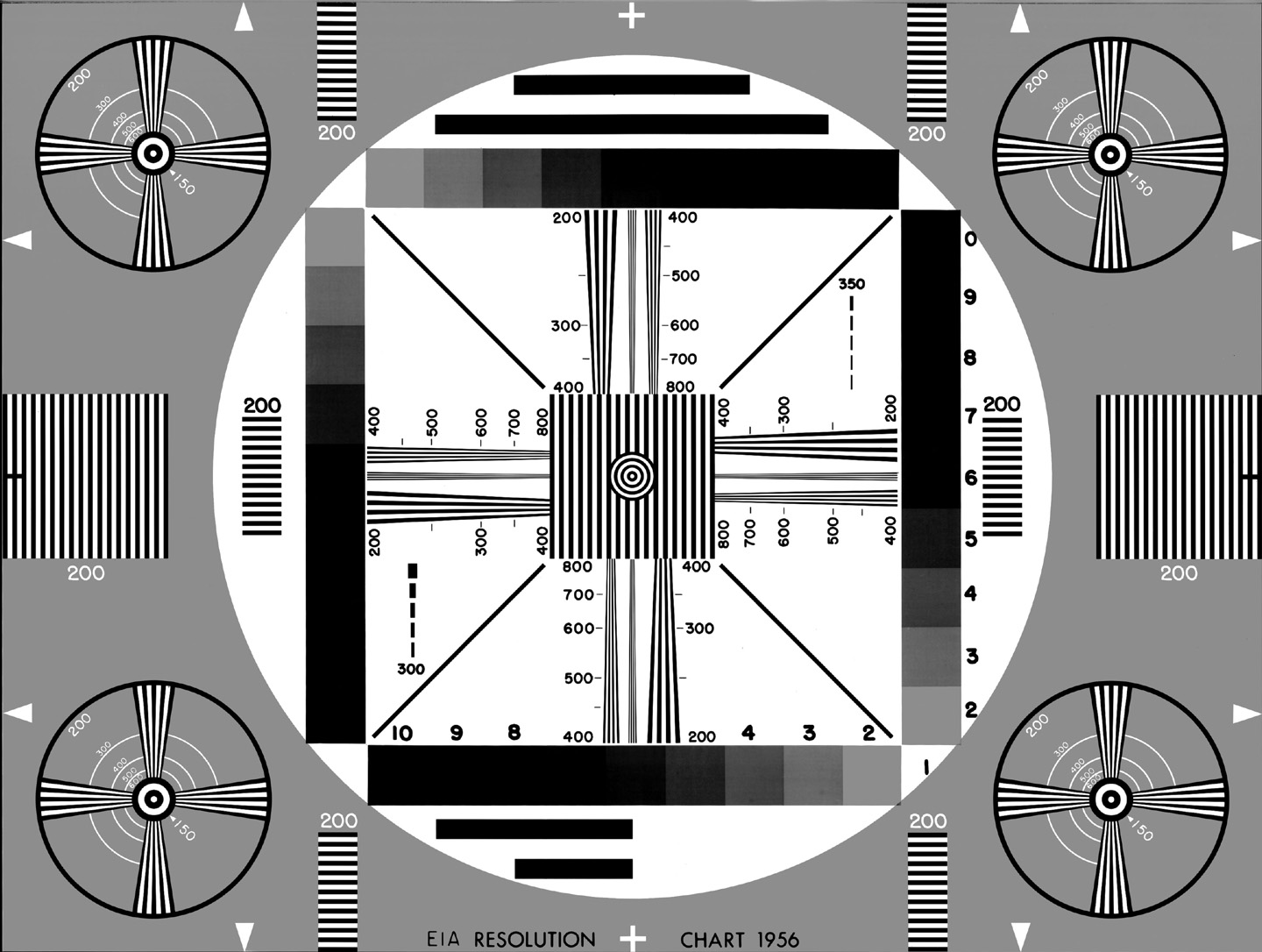
Here is the test chart used for measuring lines of resolution, per picture height. http://www.bealecorner.com/trv900/respat/eia1956-small.jpg - Look at the center square and below the center square. The lines go up-and-down (||||) and the technician reports how many distinct lines he can see. If he is using a primitive source like broadcast television, he will only be able to see ~330 lines. Laserdisc has about 400. DVD is around 500. And so on.
Does that look scanlines to you, "moron"??? No. Stupid Anonymous Coward.
-
my experience: some DVD media dies with no reason
One Maxell DVD-R I burned in Sept. 2003 went bad within 3 years, despite every detail of the burning, readback, handling, and storage being in accord with the advice I've seen posted. An email to Maxell support on this issue had the reply: "The media if stored properly will have a life of at least 50 years."
Possibly relevant, I noticed an internal pattern of small spots visible with a loupe or macro lens (on order of 10 microns in size; much larger than the data pits). You can read more about it here: http://www.bealecorner.com/trv900/DVD/Maxell-DVDR- spots.html
Maxell America agreed to take back this DVD for analysis. As instructed I sent it to their Fair Lawn, NJ site. It was received Oct. 5 2006 and Maxell acknowledged receipt. They have apparently done nothing with it since, despite several emails to them in the ensuing two months. -
Re:The cheap one wins
Um, Apple backed -R
And -R as you saw was half the price, though they were slower
The reason +R survived was because everyone created +/- drives, as you say.
So if BluRay is like -R, it will be cheaper and more widely available and the only reason HD-DVD will survive is because dual format players will exist.
Apple DVD-R variation
Apple finally adds DVD+R support in 2003 -
Re:Sigh.
The extra 45 lines in NTSC are known as the Vertical Blanking Interval or VBI for short. It is used to transmit things such as Closed Captioning and other information. The reason it is there is because TVs at the time couldn't re-aim the tube from the lower right to the top left and so they leave it blank. The 480 lines of active video are how resolution is measured. Lines are still used to measury quality.
There are two types of lines-- horizontal, and vertical. Horizontal lines (scanlines) are fixed by the ntsc standard-- 525, 480 of which get displayed. Laserdisc, VHS, DVD, broadcast--they all have 480 interlaced scanlines, period.
Vertical resolution is dependent on the resolution of the recieving device, and it must be measured. A technician counts the number of distinct vertical elements using a test pattern such as this one
As to the VGA standard, 640 is the number of columns. They all get displayed. Don't even know why you brought this up.
Video resolution is defined as number of (light+dark) lines resolved horizontally, divided by the image ratio. In this case, the ratio is 4:3. 640/1.33 is 480 lines of resolution, assuming that all 640 columns are resolved-- a fair assumption, given today's displays.
DVDs? 720x480 is not the equivalent of 540 lines. They use rectangular pixels and 2:1 is a compromise between 4:3 and 16:9. 720x480 is equal to 480 lines if progressive and 240 lines if interlaced (which it usually is as that is what most TVs are).
Again, scanlines should not be confused with lines of resolution. If all 720 columns of pixels can be resolved, then the dvd has 720*3/4=540 lines of resolution.
And FYI, HD cameras can resolve the full res of 1080i or 720p. They just aren't available for the consumer market yet. They are only for the broadcast market right now.
Some do, some don't. You would have to use a test pattern, and measure.
-
Re:Sigh.
The extra 45 lines in NTSC are known as the Vertical Blanking Interval or VBI for short. It is used to transmit things such as Closed Captioning and other information. The reason it is there is because TVs at the time couldn't re-aim the tube from the lower right to the top left and so they leave it blank. The 480 lines of active video are how resolution is measured. Lines are still used to measury quality.
There are two types of lines-- horizontal, and vertical. Horizontal lines (scanlines) are fixed by the ntsc standard-- 525, 480 of which get displayed. Laserdisc, VHS, DVD, broadcast--they all have 480 interlaced scanlines, period.
Vertical resolution is dependent on the resolution of the recieving device, and it must be measured. A technician counts the number of distinct vertical elements using a test pattern such as this one
As to the VGA standard, 640 is the number of columns. They all get displayed. Don't even know why you brought this up.
Video resolution is defined as number of (light+dark) lines resolved horizontally, divided by the image ratio. In this case, the ratio is 4:3. 640/1.33 is 480 lines of resolution, assuming that all 640 columns are resolved-- a fair assumption, given today's displays.
DVDs? 720x480 is not the equivalent of 540 lines. They use rectangular pixels and 2:1 is a compromise between 4:3 and 16:9. 720x480 is equal to 480 lines if progressive and 240 lines if interlaced (which it usually is as that is what most TVs are).
Again, scanlines should not be confused with lines of resolution. If all 720 columns of pixels can be resolved, then the dvd has 720*3/4=540 lines of resolution.
And FYI, HD cameras can resolve the full res of 1080i or 720p. They just aren't available for the consumer market yet. They are only for the broadcast market right now.
Some do, some don't. You would have to use a test pattern, and measure.
-
Sony PD150 or VX2000are probably about your speed. The PD150 is the pro DVCAM version (about $3.5K) and the VX2000 is the prosumer mini-DV version (maybe $2.5K). These are the standard cameras for most film-school and semi-pro and in-house projects. Lots of low-budget indie feature films are shot with these cameras. They are 3CCD cameras with tons of accessories available. Their main competition is the clunkier Canon XL1/XL2 series. Serious professional cameras are $5K and up which is probably steep for you.
Note that the resolution of all standard TV cameras is the same, 720x480 or something like that. There is just one consumer HDTV camera (made by JVC) which costs about $3K and is 800x600, but it's a 1-CCD camera. Professional HDTV cameras start a lot higher, like, $50K or who knows, more than you want to think about.
Beale Corner's video pages are a good place to surf around from about this stuff.
-
2GB Limit very easy to bump into
How clueless can this guy be ? If someone went to such great lengths to defeat the 2gb limit, then I'm pretty sure it's because it's been a problem for a while. Uncompressed video comes to mind [...]
You don't even have to reach that far. Compressed video easilly grows to larger than 2 gb for any non-trivial project. For example, I used dvgrab to capture multiple small video clips[1] from my ieee1394 sony trv-900 camcorder and media converter (sony), then edited them together into a 25 minute home video. This is all using compressed DV format, which is small enough that captures work perfectly fine in realtime to ATA33 IDE drives (unlike traditional analog captures which demand much faster drives because the quantity of data is so much greater).
25 minutes of video, even in 4:1:1 or 4:2:0 compressed DV format, is way bigger than 2 GB.
My solution was to upgrade to kernel 2.4.0 (which is easy to do with Mandrake 7.2, as long as you do not compile in devfs support) with the ieee1394 fixes. I opted to use SGI's XFS filesystem (which rocks) but to get around the 2GB limit upgrading to 2.4.0 was sufficient (ext2 and reiser both worked fine for test files of about 5.5 GB in size).
[1]This is a limiting bug in dvgrab which segfaults at around 900MB, but works fine in "looping" mode with filesizes 900MB.