Slashdot Mirror
Domain: digicamhistory.com
Stories and comments across the archive that link to digicamhistory.com.
Comments · 8
-
Re:means better stalked
Now we can be better stalked and assaulted by miscellaneous anonymous government bureaucrats.
FTFA:
The upgrade will include 1800 high-definition cameras, facial recognition systems, and digital archiving to replace the analog tape system in use since the 1980s
Calm down, will you? All it looks like they did was buy iPhones for the airport staff to replace their old Sony Cybershot cameras and Nokia Cellphones
-
Re:Digital has been around for awhile.
Even the summary makes it clear that the Kodak prototype preceded your experience by 14 years.
That and (as the OP acknowledges, but slightly minimises the significance of) the fact that the Xapshot wasn't digital. I'm guessing that the Xapshot was comparable to the Mavica still video cameras (*) Sony produced during the mid-to-late 1980s (**) which effectively recorded a single frame of NTSC-resolution video to a single track of a floppy disc in fully analogue format. I assume that it would still have required some form of digitiser to get it into the Amiga, so while such cameras were an important step in the commercial development of digital photography, they were only half the equation.
I remember seeing a video digitiser for the Atari 8-bit computers circa 1986 which digitised still frames from a video source. Such a source could of course include an analogue video camera or camcorder (which became popular during the mid-80s). But even that combo was over 10 years after Kodak had created the first truly digital camera shown.
(*) Sony later marketed some truly digital cameras under the "Digital Mavica" name, but the original Mavicas were analogue.
(**) In fact, Sony demonstrated a Mavica camera circa *1981*, although it's not clear if this early model was ever actually sold commercially. -
Don't forget the Sony D-50!
I still have the historic Sony D-50 (nice picture here) my father bought for me in 1984. It was called portable but it ran on AC power only. However it was astounding back then how you could make a CD player that small. I don't use it but it still works fine. A jewel of elegance and function in electronics.
-
Re:Analog?
There have been still video cameras that used analog signals recorded on magnetic discs. I've never seen these in real life, so I'm not sure if the disc is the one we're looking for.
-
Re:already been done?
They must have got the idea from this company
-
Look to Japan . . .
My feeling is that we must look to Japan when examining the Earliest History of the Digital Still Video Camera. I had recalled the Canon Ion from the late '80s.
"History and background of digital cameras
1. The first step was to improve the transmission from moon to earth antenna, researchers at NASA developed the methods that convert analog signals into digital information.
2. The second step was when Sony first demonstrated an electronic still camera using CCD in 1984. The name of the first digital still camera was 'Mavica.' This small toy uses 1.4 MB floppy diskette, and one-diskette stores twenty-five pictures."
FIRST INTERNET MENTION OF ELECTRONIC CAMERAS - 1984.
"In July, 1984, Canon conducted a trial of the RC-701 and an analog transmitter at the Los Angeles Olympics.
The Copal CV-1 electronic camera prototype - 1984.
HITACHI STILL VIDEO CAMERA PROTOTYPE - 1984.
PANASONIC PROTOTYPE ELECTRONIC CAMERA - 1984.
FUJI ES-1 - 1985. STill video camera.
KONICA SVC-20 - 1985. Prototype still video camera.
CANON RC-701 STILL VIDEO CAMERA - 1986. Canon was the first to market a still video camera, the professional model RC-701.
Canon's "RC-701" was the world's first commercial magnetic recording still camera."
SV Cameras Accessible to the General User
"In order to provide an affordable SV camera for general users, Canon set the price target that would not exceed 100,000 yen. The target was met by the release of the "RC-250 (Q-PIC)" in September 1989, whose price was 99,800 yen. The "RC-250 (Q-PIC)" had a built-in playback function. Connecting the camera to a television set with a video terminal, the user could easily view the pictures that had been taken. The camera with both "shooting" and "viewing" functions received much attention widely. The "RC-250" was a particular hit on the European market under the name of "ION." -
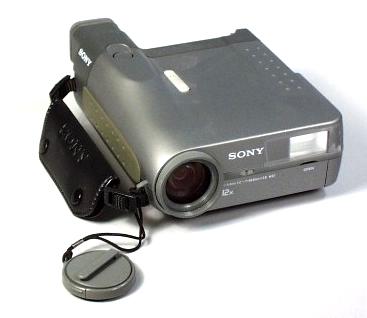
Sony had digital storage in 1981.See the description and photo of the original MAVICA (MAgnetic VIdeo CAmera) on digicamhistory.com.
I'm not sure when image compression entered the picture, but unless Kodak came up with it before 1981 and it took them until 1987 or longer to get the patent, it would appear that this constitutes prior art - by Sony themselves.
-
Re: No, the first Mavica debuted in 1981
On the agenda today..
1. Patent digital car equipped with a removable digital media capable of storing route and diagnostic data in one of several user selectable formats
2. #1 with an option for letting the user select the compression ratio or other compression algorithm parameters.
3. #1 with the removable media being a floppy disk.
The CCD has always been solid state, and in fact Sony's first Mavica unit dates back to 1981. It had removable media. To be able to patent any sort of digital data capture device, but with the addition of compression, is folly. The suing company simply patented the easily forseable combination of existing technologies. Maybe a special technologies court needs to be made to handle these kinds of things.