Slashdot Mirror
Domain: economicoutlook.net
Stories and comments across the archive that link to economicoutlook.net.
Comments · 74
-
Re:Why now?
Bitcoin is not a currency its a commodity.
http://www.win-vector.com/blog...
Why don't you read up on what drives hyperinflation. Hint its not 'printing money' its what money in circulation can buy. Printing money is false cause of hyperinflation wrongly associated because its the wrong response to an underlying problem. 'printing money' is a bulls**t non-specific term that does not really mean anything. (Can cover one or more scenarios which can be quite similar but also quite different).
Zimbabwe: give modern farms to war veterans during some of the worst drought years on record and you'll find what a unit of currency buys is a lot less. Then give corrupt government officials large loans which they don't have to pay back which they immediately exchange for other currencies and you get ingredients for hyperinflation.
Venezuela: archaic unavailability of modern currency exchange in 2012, and again in February 2013, the government sharply reduced the availability of foreign exchange. It was during this time that shortages of basic goods accelerated, along with inflation and the black market price of the dollar. The official exchange rate, at which the government sold the vast majority of dollars earned from oil sales, was at 6.3 Bolivares Fuertes per dollar. But a parallel market already existed, and the shortage of dollars at the official rate drove the parallel market sharply upward. At the same time, the higher parallel market price of the dollar increased inflation, because it increases the price of imported goods.
-
Re:X has unrealistic expectations about Y
-
Re:And HSBC is a honest broker here
Its not that at all. If FED 'sets' interest it also sets a component of inflation in the economy. Business leverages/expands credit to operate, if the baseline interest is raised this follows through to increased cost to build things and increased cost of living so the net effect is zero. The problem is that there is not enough real value adding being done in capitalism. Eg: where work builds something that makes profit. The private sector looks for investment and ultimately government spending creates areas where profit is higher yield than other areas. Eg: Lucrative profit for companies in China is not just operating costs its government creating money by keystroke to grow the economy. Now look at the efficiency of the financial sector that is supposed to make retirement stable: "The job of finance is to provide capital to companies. We do it to the tune of $250 billion a year in IPO's and secondary offerings" "What else do we do? We encourage investors to trade about 32 trillion a year. So by the way i calculate it, 99% of what we do in the industry is people trading with one another, with a gain only to the middleman.It's a waste of resources" -john bogle. Public pensions where the aggregate savings expand M1 of the money supply, where people DONT Have to take risks with a financial system that does not invest in real production or innovation IS THE PROBLEM nothing to do with interest rates. Also here are facts about millenials savings. They cant save enough because they dont earn enough. NO matter how you partition the income one of the basic living expenses is going to be defficient. https://www.principal.com/abou... https://www.forbes.com/sites/m... Employment participation rate is worse in the USA after every recession: https://i0.wp.com/bilbo.econom... http://bilbo.economicoutlook.n... https://i2.wp.com/bilbo.econom... https://i1.wp.com/bilbo.econom... People are poorer/earn less/more part time work replacing full time work: http://bilbo.economicoutlook.n... Not JUST evident in the USA: https://i2.wp.com/bilbo.econom...
-
Re:And HSBC is a honest broker here
Its not that at all. If FED 'sets' interest it also sets a component of inflation in the economy. Business leverages/expands credit to operate, if the baseline interest is raised this follows through to increased cost to build things and increased cost of living so the net effect is zero. The problem is that there is not enough real value adding being done in capitalism. Eg: where work builds something that makes profit. The private sector looks for investment and ultimately government spending creates areas where profit is higher yield than other areas. Eg: Lucrative profit for companies in China is not just operating costs its government creating money by keystroke to grow the economy. Now look at the efficiency of the financial sector that is supposed to make retirement stable: "The job of finance is to provide capital to companies. We do it to the tune of $250 billion a year in IPO's and secondary offerings" "What else do we do? We encourage investors to trade about 32 trillion a year. So by the way i calculate it, 99% of what we do in the industry is people trading with one another, with a gain only to the middleman.It's a waste of resources" -john bogle. Public pensions where the aggregate savings expand M1 of the money supply, where people DONT Have to take risks with a financial system that does not invest in real production or innovation IS THE PROBLEM nothing to do with interest rates. Also here are facts about millenials savings. They cant save enough because they dont earn enough. NO matter how you partition the income one of the basic living expenses is going to be defficient. https://www.principal.com/abou... https://www.forbes.com/sites/m... Employment participation rate is worse in the USA after every recession: https://i0.wp.com/bilbo.econom... http://bilbo.economicoutlook.n... https://i2.wp.com/bilbo.econom... https://i1.wp.com/bilbo.econom... People are poorer/earn less/more part time work replacing full time work: http://bilbo.economicoutlook.n... Not JUST evident in the USA: https://i2.wp.com/bilbo.econom...
-
fake news
There is not shortage of skilled workers never has been. That's supply-side myth used to suppress the movement of value into profit not wages. Nowhere near full employment: http://bilbo.economicoutlook.n... http://bilbo.economicoutlook.n...
-
fake news
There is not shortage of skilled workers never has been. That's supply-side myth used to suppress the movement of value into profit not wages. Nowhere near full employment: http://bilbo.economicoutlook.n... http://bilbo.economicoutlook.n...
-
rubbish
Author just pontificates truisms as if they were true: "People started feeling the pain of high-cost labor and there's an appetite for automation that we haven't seen before." Not since 1975... increases in productivity have gone to corporate profits, there has NEVER been a high cost labour problem in the last 30+ years ANYWHERE. Its the opposite they have deliberately undermined purchasing power and are worried about their falling rate of profit. The great recession was a financial collapse coming to a head with the worst possible policy response creating a real recession that for many has not really ended. It could be fixed with correct policy decisions and by keystroke but that's ideologically opposite to the wishes of the elites. http://bilbo.economicoutlook.n... The latest fad is to hype up the 'robots are coming'. Notwithstanding the larger context that automation has to make profit so further undermining spending equals income will make it hard for automation too. Civil engineer core in the USA says they need to rebuild all the infrastructure 50+ year old bridges. Bring on the robots and the people. The whole paradigm of automation is that it transforms jobs for workers and creates as many as it eliminates by aggregate. All those warehouse robots have electronics and sensors which break often so there's a whole industry of service/repair that will expand. As much as its the job of places like slashdot to inform its readers it does stoop to the hyperbole or 'fake news' level vested interests saying that their vested interest outcome in inevitable.
-
Market manipulation driving up electricity costs.
It's like Enron all over again. Economist Bill Mitchell goes into detail. http://bilbo.economicoutlook.n...
-
Re:Smart move for them
There is nothing innovative about the Uber model. Their ride matching algorithm is poor (regressive pattern matching algorithm with weighted outcomes = meh whatever) they just identified a market and monopolized exactly as the taxi companies did. But hey its 'an app' and f**k it in all those places around the world where real full time jobs are being lost... come in with a 19th century share cropping model. The middle man extracts the profit, owns the IP, runs the monopoly and relies on a bad low pay gig economy for people desperate enough to run a car making a loss to do the work. http://qz.com/312537/the-secre... http://bilbo.economicoutlook.n...
-
Labor Market Participation
This is part of an experiment to see what happens to people's participation in the labor market after they've been guaranteed a certain amount of money.
Generally people don't "participate in the labor market" because there is an insufficient supply of suitable jobs. BIG is unlikely to increase supply much, though some recipients may be enabled to become self-employed.
An alternative program is to guarantee jobs to anyone who wants one. Bill Mitchell compares the two ideas here. -
Re: Mixed reaction
They first confiscate it from you and me, whether we want it or not.
A common misconception, but one that doesn't match reality. Governments create money through the treasury and central bank (a.k.a. federal reserve in the US). Government spending doesn't proceed from money taken in by taxation; rather, money is created ex nihilo and electronically credited to appropriate accounts, then spent. There's no constitutional requirement that the money removed from circulation by taxation has to balance spending in pretty much any developed country in the world: the two are not operationally linked. Indeed, one of the major purposes of taxation (besides reducing the money supply) is enforcing the use of the official national currency -- and that's why you can only pay your taxes in that currency. Tax "revenue" is not for extinguishing debt. And the debt issue itself is another one attracting misunderstanding, because of the tendency by people to apply microeconomic "common sense" to macroeconomics, which is a well-known fallacy. The majority of the debt of a nation like the US is just a number registered between treasury and central bank/fed, and is like debt between husband and wife, pretty much an accounting fiction that doesn't have to be repaid (reducing it, however, makes for good politics); of the rest, much is held by nationals, not foreigners/foreign governments. This configuration gives governments great power to influence their economies through control of the money supply, something they have exclusive legal power to as monetary sovereigns**. Whether this is generally done correctly, incompetently, or abused, is a matter of politics. I'll point out this, however: the common argument against government spending -- inflation -- only applies when you're close to full employment; otherwise, spending feeds aggregate demand rather than inflation.
** The glaring exception being, of course, the euro currency, which nicely shows how attempting a monetary union without having a fiscal and economic union only benefits those who can maintain a trade surplus (Germany), thus beggaring their neighbors in classic mercantilist manner.
Some further reading: http://papers.ssrn.com/sol3/pa... http://bilbo.economicoutlook.n...
Disclaimer: my post is descriptive, not prescriptive. I'm simply pointing out how things are, not passing judgment on whether this is how they ought to be, and will keep my opinion to myself as I've no interest in a political discussion on Slashdot. -
Re:Yes yes yes
They are "undervalued" in your eyes. In reality, they get no value because there is no more growth. This is evidenced by the increase in base unemployment since the early 1990s.
http://bilbo.economicoutlook.n...
While other countries have employment ups and downs, Japan's population has been on a downward spiral because there is no more real growth. Since the 1980s, manufacturing has moved to Korea and China, and there's not enough of a service and tech industry to cover the loss.
So yeah, for the last 20 years those people who have jobs are treated well, and the young people get the finger. Same thing is beginning to happen here in the United States, although not as massive a movement. The Japanese companies are going to either adapt, or crater and then be reborn as fast-and-lean pension-less workhouses like the US.
-
Re:Money
No discussion of modern money can proceed without referencing the following people? Marriner Eccles http://mikenormaneconomics.blo... Beardsley Ruml http://www.constitution.org/ta... Abba Lerner http://en.wikipedia.org/wiki/F... William Vickrey http://www.columbia.edu/dlc/wp... Wynne Godley http://www.levyinstitute.org/s... Warren Mosler http://moslereconomics.com/man... Randy Wray http://www.levyinstitute.org/p... Bill Mitchell http://bilbo.economicoutlook.n... and CH Douglas, already referenced in another comment
-
Re:It's more like a stunt to me
Probably as a consequence of people realizing that unions have done all they can for worker rights, and all they're interested in now is keeping their power/income at the expense of workers' and the companies both.
At the expense of the companies?
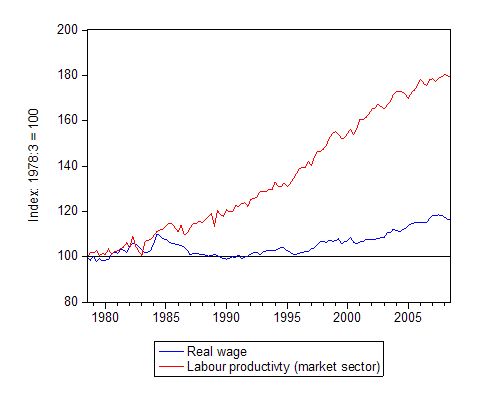
The decline in the fortunes of unions is reflected in the general decline of the average working (wo)man.Here's a nice *graph showing inflation adjusted wages vs worker productivity:
http://bilbo.economicoutlook.net/blog/wp-content/uploads/2009/02/real_wage_productivity_gap.jpgThe difference is certainly not going to employees.
The graph is also slightly deceptive, since it depicts average real wages and not median wages.
If you look at median wages, the gap is even bigger, since you no longer have CEOs pulling up the average.*If you don't like that specific graph, you can find many others that will show the exact same thing in various different ways
-
Re:Gross receipts tax
Not really. A large portion of the US debt is owed neither to foreign entities nor to members of the population, but is between treasury and Fed--it's an accounting fiction. It's about as meaningful as the deb between a husband and wife. It doesn't need to be repaid. This is a common confusion and another example of mixing up concepts from microeconomics with macroeconomics. http://bilbo.economicoutlook.net/blog/?p=11218
-
Re:Ironic
If the non-government sector desires to save in the currency of issue then the only way that this can happen (and this is just a matter of accounting) is if the government spends more than it taxes (in that currency). The only way the non-government sector can get the currency of issue is if the government spends it. That is the nature of the monopoly the government holds. It doesn’t come out of thin air. The currency enters the economy always via government spending (and central bank operations – like foreign exchange and gold transactions; open market operations (bond purchases in this case)). If the government is taxing as much as it spends (that is, running a balanced budget) then there can be no saving in the currency. If it runs a budget surplus (taxing more than it is spending on any day) then the non-government sector has to be dissaving (running down wealth). So the only way the non-government sector can accumulate assets in the currency of issue is when the budget is in deficit. Budget deficits “finance” private saving not the other way round.
-- Professor Bill Mitchell - Deficit Spending 101
-
Grab monetary policy from the private bank system
Start using money creation for funding government instead of giving private banks exclusive use of it, and limit government spending based on hitting the inflation target; you can pay for this and much more beyond it.
I know neoliberals/neoclassicists/libertarians will skewer me for even suggesting this (and will probably get downmodded to hell), and I know 'conventional knowledge' says using money creation for funding is an unspeakable evil, but when you break this taboo and purposely limit spending by the inflation target, it transforms much of what people think they know about economics.
Post Keynesian's, like Steve Keen (the only person to both predict and model the current economic crisis before it developed), Stephanie Kelton, and Bill Mitchell (among many others), are going a long way towards dragging economics out of the dark ages, and towards developing it into a proper science.
It's quite hard to believe that economics, in its current neoclassical form, has survived the economic crisis and is still taken credibly; virtually the entire field outside of heterodox schools, failed to spot something as blindingly obvious as private-debt vs GDP, as a massive indicator of an upcoming crisis.
-
Re:Why?
The "issuing bank" is the central bank and that for all practical purposes acts in unison with the treasury. http://bilbo.economicoutlook.net/blog/?p=11218 The restraint in question is then that of government, and indeed, government is the power base that backs its currency. This means that with a fiat currency, the government has two policy tools with which to intervene in an economic crisis: one fiscal and one monetary. The relative effectiveness of each is debatable and depends on whether you're an orthodox economist or an MMTer, but it certainly beats what happens when there is no such tool available at all. Two examples: the worsening of the Great Depression due to a gold-backed currency, and the dismal failure of the Euro experiment in which individual nations lack control of their own currencies and use a unified one instead without also having fiscal and economic unification (which, in a heterogeneous collection of states such as Europe, is impossible).
-
Re:Governments can't inflate the currency
Actually, the natural rate is zero. And I'd take professor Mitchell's word (not to mention the MMT-based rationale) over yours any day. http://bilbo.economicoutlook.net/blog/?p=4656
-
Re:What about TEMs?
You're talking about the traditional purpose of taxation. This has not been the case since Nixon nixed the last vestiges of gold-backing of the US dollar. You seem to have no idea how the modern monetary system actually works. http://papers.ssrn.com/sol3/papers.cfm?abstract_id=1905625 As well as here http://bilbo.economicoutlook.net/blog/?p=11218 note esp. "Given the national government can issue paper currency units or accounting information at the central bank at will, tax payments do not provide the state with any additional capacity (reflux) to spend." This is because governments which issue their own currency are not revenue constrained. There's no operational connection between deficit spending and tax collection.
-
Re:Of course.
They're looking for cash? That's funny, because the US government is not revenue constrained. There's no constitutional limit on creating any amount of money, and in fact that's one of the most important policy tools of a sovereign nation (the EU members gave that up, and it has ended with disaster except for the mercantilist Germans, as was predicted by Modern Monetary Theory many years ago). This is all the more clear when one notes that there is no operational connection between government spending and subsequent taxation or public/foreign borrowing (much like bank lending is not really reserve constrained since banks lend unconstrained during the day and borrow anything they need to make up for reserves from the overnight market--and even the Fed itself). Much of the debt is just an accounting fiction registered between the Fed and treasury (being about as meaningful as the between a husband and wife), and legally, 100% of government debt could be made in this form--there could legally be zero public borrowing and no taxation. The appearance that taxes pay for anything is just an illusion, since tax "revenue" does not make any legal constraint on spending. But borrowing is done due to custom and ideological and political considerations which are vestigial from the times of gold-backed currency--not any current legal constraints. Taxation's actual role, however, is critically important: it forces private entities to use the government issued currency. You can only pay the IRS in US dollars. More information: http://papers.ssrn.com/sol3/papers.cfm?abstract_id=1905625 or lighter reading at http://www.cnbc.com/id/45795986 as well as http://bilbo.economicoutlook.net/blog/ and http://moslereconomics.com/ MMT has been around for quite a while and derives from the old Chartalism, but nowadays it's really starting to gain steam, and some MMT ideas have been co-opted by other economic schools. Back to the original point, government doesn't need covert means of funding agencies such as the TSA because it can do so easily with legal means. Your conspiracy theory is superfluous.
-
Banks create money, end of discussion
This is simply not true. Banks cannot issue money they don't have, either physically or electronically.
You don't have to take it from me. Here is a nice visualization of what happens when a bank makes a loan. You can let economist Bill Mitchell explain it to you. Or you can read between the lines in the Basel accords, which define how much leverage a bank can have. Of course, "leverage" is the key word here - banks normally create money when they increase their leverage (technically speaking, they can also increase their leverage by changing their position to be riskier according to the Basel rules, but that is an exception rather than the rule). If you speak German, you might also want to look at this explanation of the German central bank, in particular the section on "Giralgeld". More generally, if you want to understand how money works, the best sources are the writings of Modern Monetary Theory economists, simply because they place value on explaining the down-to-earth mechanisms underlying all the fancy talk. I suggest you start here or here.
If I were you, this cross section of sources from all over the economics spectrum (from ultra-orthodox to highly unorthodox) would convince me.
Seriously, if every loan a bank made "magically created money", we'd be in such runaway inflation it would cost billions for a gallon of milk.
Since the premise of that implication is true without there being runaway inflation (though I want to emphasize that there still is no magic involved), it seems you also have to work on your understanding of how inflation works.
Look, I understand where you're coming from, and I understand you find it hard to believe the things that I'm writing. But consider the possibility that I'm right. Can you risk being wrong about that?
Two years ago, I probably would have reacted like you did (although I hope that I would have better estimated my own lack of knowledge in the matter). The fact of the matter is that, unfortunately, the macroeconomics education sucks everywhere around the world, and unless you study economics at university you never normally come across all these things. That's not your fault. In the context of the financial crisis I've become curious to understand more, and I've read up on all these things. I've come across a lot of unintuitive things along the way, and it takes time to digest everything. It took me at least a year, and I'm still learning new things.
I sincerely hope you will set aside some time to follow some of the links I listed above. It can be an amazing intellectual experience.
-
Re:The truth slowly comes out
Tax dollars are not paying for it. That's a common misunderstanding of modern monetary systems. Government is not revenue constrained as it creates money ex nihilo, given its the monopoly issuer of its currency, and does not have to rely on public or foreign borrowing (that some of the debt is owed to the public and foreign countries is purely a political choice; much of the debt is not real debt but an accounting fiction between treasury and central bank). Taxes are what government uses to 1) enforce usage of its currency ( since you can only pay your taxes with said currency), and 2) remove excess currency from circulation. See for example http://papers.ssrn.com/sol3/papers.cfm?abstract_id=1905625 and http://bilbo.economicoutlook.net/blog/?p=11218
In regards to the point you are making, the correct way to put it is that government spending power is being wasted on the wrong reasons. -
Re:Priorities
I won't comment on the EU, but I'll comment on the Euro, as you brought that up. The Euro cannot survive in a system so heavily unbalanced by Germany's mercantilist approach of "beggar thy neighbor" through extreme trade surplus combined with wage suppression. When individual countries are no longer monopoly issuers of their own currencies, they lack the monetary means of counteracting such negative external influences. Bundesbank policies based on dated neoliberal economic ideas that ignore what Modern Monetary Theory teaches us and the suicidal suggestions of austerity measures in difficult times make it inevitable that the weakest nations in the eurozone will be constantly suffering and in continuous needs of bailouts and other economic aid. As they fall out of the union, Germany's destructive influence will concentrate on the next weakest members, and so on. The behavior of the eurozone is essentially cannibalistic. It is impossible to sustain a monetary union either i) nations in it being far more homogeneous in economic terms than the eurozone members, or ii) significantly greater integration, including common bonds and other national debt instruments, and so on (which is politically unacceptable).
http://www.nakedcapitalism.com/2010/05/market-contagion-and-the-dangers-of-devil-take-the-hindmost.html
http://www.econ-pol.unisi.it/dipartimento/it/node/1173
http://bilbo.economicoutlook.net/blog/?p=17006 -
Re:I dont see any issues with them.
It's good to see at least few slashdotters are aware of MMT principles. The only beef I have with your post is using the word debt, because even though it is debt in name, it's quite different from microeconomic debt in the way most people understand it. http://bilbo.economicoutlook.net/blog/?p=11218
-
Re:Bipartisan supportIf you are talking Federal Government, then no, that's wrong. A sovereign government issuing it's own currency(fiat) can NEVER become insolvent, run out of money, and it does not need taxes to pay for things. Bill Mitchell says it best:
The orthodox conception is that taxation provides revenue to the government which it requires in order to spend. In fact, the reverse is the truth. Government spending provides revenue to the non-government sector which then allows them to extinguish their taxation liabilities.
-
Re:Yes, because debt IS money
Not really. Here are ways to fix the monetary aspect of the system: http://bilbo.economicoutlook.net/blog/?p=5098 and http://bilbo.economicoutlook.net/blog/?p=4656 and also proper regulation (for example in many cases before the crisis, bank capital ratios were not enforced or worse, were enforced selectively). But those things come down to good governance; using fiat instead of commodity money in itself is not a bad thing. The private sector left to its own devices will result in even bigger periodic crises. What's needed is to minimize banking influence on the government and to stop hiring ex-bankers into government positions, and applying regulation fairly across the board. Also we need government to stop public and international borrowing, and to use its ability to do deficit spending unconstrained until recovery and the private sector beings picking up the slack again, then remove the excess currency by appropriate taxation.
-
Re:Yes, because debt IS money
Not really. Here are ways to fix the monetary aspect of the system: http://bilbo.economicoutlook.net/blog/?p=5098 and http://bilbo.economicoutlook.net/blog/?p=4656 and also proper regulation (for example in many cases before the crisis, bank capital ratios were not enforced or worse, were enforced selectively). But those things come down to good governance; using fiat instead of commodity money in itself is not a bad thing. The private sector left to its own devices will result in even bigger periodic crises. What's needed is to minimize banking influence on the government and to stop hiring ex-bankers into government positions, and applying regulation fairly across the board. Also we need government to stop public and international borrowing, and to use its ability to do deficit spending unconstrained until recovery and the private sector beings picking up the slack again, then remove the excess currency by appropriate taxation.
-
Re:Yes, because debt IS money
> Most people think the way a bank works is.....Say I put $1000 in savings....This keeps going until there is $10,000. So the banks create $9,000 of money from that first $1000.
Complete and total refutation of what you have just written: http://bilbo.economicoutlook.net/blog/?p=1623
I'm begging you to educate yourself before making ignorant posts and spreading misinformation on a public website.
You conveniently omitted that loans banks make out (asset to the bank, liability to the customer) are deposited at other banks (asset to the customer, liability to the bank). This ALWAYS NETS TO ZERO. Only government deficit spending creates a net increase in money. That builds up government debt, and that debt can ALL be held at the Fed--where it is but an accounting fiction, like a debt between husband and wife. Government does NOT need to borrow from the public or other countries; that is a 100% political choice. -
Re:Yes, because debt IS money
This is a more clear explanation: http://bilbo.economicoutlook.net/blog/?p=1623
-
Re:Yes, because debt IS money
You are wrong, since the money lent out is deposited at other banks, creating corresponding liabilities. The other banks lend out, and new corresponding deposits are made. The system overall has a net increase of ZERO. Please read this carefully: http://bilbo.economicoutlook.net/blog/?p=1623
-
Re:Yes, because debt IS money
> a bank can create money based on some multiple of the amount of its deposits.
You seem to be misunderstanding the information you're quoting, because you're missing operational details of how this system is implemented. Banks lend out as much as they can (subject to capital, not reserve, constraints), and then, if their reserve accounts at the Fed are insufficient, they borrow from the overnight interbank market whatever is needed. So in practice the banks are not reserve constrained; the reserve ratio is a red herring. Only the capital/asset ratio matters. If the whole system is in trouble and the overnight market is insufficients, the Fed's discount window allows borrowing from the Fed directly. http://bilbo.economicoutlook.net/blog/?p=1623 -
Re:Yes, because debt IS money
> Banks create new money when they create loans
And those loans are deposited in other banks, creating corresponding liabilities that mean the net money created is ZERO. Banks don't create net money; only government deficit spending does. http://bilbo.economicoutlook.net/blog/?p=11218 -
Re:1%
Your argument is easy to obliterate:
1. The US can easily monetize its debts.
2. Economy can be sustained through deficit spending regardless of foreign exchange-implied value of dollar (government is not revenue constrained so the only limit to deficit spending is political).
3. Greece... LOL are you serious? the whole problem with Greece is that it's part of the Euro countries and no longer a monopoly issuer of its own currency. Kind of hard to fight back against Germany's "beggar-thy-neighbor" huge trade imbalance with the Euro countries when you've given up a major component of your sovereignty.
PUBLIC BORROWING IS NOT NECESSARY FOR THE GOVERNMENT TO FUND ITSELF. The US doesn't have to sell treasury debt instruments to the public or other countries. That's a purely political choice, and an obviously wrong one.
http://pragcap.com/resources/understanding-modern-monetary-system
http://bilbo.economicoutlook.net/blog/?p=11218
http://bilbo.economicoutlook.net/blog/?p=5098 -
Re:1%
Your argument is easy to obliterate:
1. The US can easily monetize its debts.
2. Economy can be sustained through deficit spending regardless of foreign exchange-implied value of dollar (government is not revenue constrained so the only limit to deficit spending is political).
3. Greece... LOL are you serious? the whole problem with Greece is that it's part of the Euro countries and no longer a monopoly issuer of its own currency. Kind of hard to fight back against Germany's "beggar-thy-neighbor" huge trade imbalance with the Euro countries when you've given up a major component of your sovereignty.
PUBLIC BORROWING IS NOT NECESSARY FOR THE GOVERNMENT TO FUND ITSELF. The US doesn't have to sell treasury debt instruments to the public or other countries. That's a purely political choice, and an obviously wrong one.
http://pragcap.com/resources/understanding-modern-monetary-system
http://bilbo.economicoutlook.net/blog/?p=11218
http://bilbo.economicoutlook.net/blog/?p=5098 -
Re:1%
The solution is simple. The government should stop public (and international) borrowing. The government is not revenue constrained and can do deficit spending as much as it wants; the only constraint is political. Don't forget that macroeconomic debt is categorically different from private sector debt (surely every economist is familiar with the fallacy of composition). http://bilbo.economicoutlook.net/blog/?p=5098
-
Re:Lack of Vision and Dominance of the 1%
You don't need to issue bonds at all; the law doesn't prevent deficit spending without selling Treasury instruments to the public and other countries. http://bilbo.economicoutlook.net/blog/?p=5098
-
Re:There is nothing intrinsically wrong with debt
Macroeconomic debt is not real. Why would US worry about debt enumerated in a currency of which it is the monopoly issuer? The mistake the politicians have made is using public and international borrowing, which is not necessary. It's better to stop selling Treasury bonds. http://bilbo.economicoutlook.net/blog/?p=5098
-
Re:Monetary Reform needed. Bankers = Fraudsters
Banks are a government-private sector joint operation, due to banks' reserve accounts at the Fed, and capital ratio regulation. The efficiency does come exactly from banks' work in determining who are creditworthy borrowers to lend to. But grandparent isn't even at this point yet, he needs to get the basics right, such as that there is no really a money multiplier. http://bilbo.economicoutlook.net/blog/?p=1623
-
Re:Monetary Reform needed. Bankers = Fraudsters
Complete refutation of everything you wrote in your post: http://bilbo.economicoutlook.net/blog/?p=1623
-
Re:Money as Debt
This is about as rigorous as the Zeitgeist movies *rolleyes*
If lazy slashdotters insist on videos rather than a rigorous description, a place to start would be http://pragcap.com/resources/media-section
Also, a summary by one of the core experts on modern monetary theory in an interview: http://hir.harvard.edu/debt-deficits-and-modern-monetary-theory
And how to fix things: http://bilbo.economicoutlook.net/blog/?p=5098 and http://bilbo.economicoutlook.net/blog/?p=4656
Note that MMT is pretty much the only rational approach and is derived mathematically. -
Re:Money as Debt
This is about as rigorous as the Zeitgeist movies *rolleyes*
If lazy slashdotters insist on videos rather than a rigorous description, a place to start would be http://pragcap.com/resources/media-section
Also, a summary by one of the core experts on modern monetary theory in an interview: http://hir.harvard.edu/debt-deficits-and-modern-monetary-theory
And how to fix things: http://bilbo.economicoutlook.net/blog/?p=5098 and http://bilbo.economicoutlook.net/blog/?p=4656
Note that MMT is pretty much the only rational approach and is derived mathematically. -
Re:Comprehending public debt
TheImmutable, don't forget that the government doesn't need to do public and intergovernmental borrowing in order to "fund" its spending. There's little reason for government borrowing, other than the inertia of neoliberal economics thinking still mired in the pre-Nixon days of commodity-based currency. http://bilbo.economicoutlook.net/blog/?p=5098
-
Re:Comprehending public debt
Dunbal, read the link I posted. Government doesn't have to borrow from other countries or the public in order to spend. It simply credits bank accounts, but that money doesn't have to be borrowed from anywhere (it is accounted for in the central bank, but see http://bilbo.economicoutlook.net/blog/?p=11218 as to why this doesn't matter, as well as, again, the link I had posted). The problem with quantitative easing and why it didn't do anything has in part to do with the fact that the way it was carried out, liabilities were created that offset the credits, and no net money was created in the system. Also, why was I modded Troll?
-
Re:The 1% are insulated
Take a step back to think about how deeply you accept the neoliberal framing of work. You implicitly accept the premise that welfare recipients are (to exaggerate to make a point) lazy, useless slobs who have decided to just not work. That premise is both incorrect and poisonous, and you should reject it outright.
The fact of the matter is that there are roughly two groups of people living off social welfare. One group is honestly disabled and simply cannot work for whatever reason, such as an unusual illness or an accident. It is a matter of basic human decency that we as a society support them. (It is especially ironic that those who want the US to be a Christian nation often do not have the empathy to think like Jesus would in this case.)
The other group is both willing and able to work, but simply cannot find a decent job because of macroeconomic problems, i.e. ultimately the government having a too contractionary stance in economic policy. Crushing the spirits of this group using workfare schemes or even forced labor is evil. What we really should do here is to ensure, using macro-economic policy, that enough work is demanded by employers so that they can find a job. We also have to demand of employers that they do not discriminate against the unemployed, and that they contribute their fair share to retraining potential employees whose skills do not exactly match the requirements.
Finally, keep in mind that the reason for the pervasiveness of the anti-social framing that I mentioned initially lies in the fact that a (small, but influential due to lack of position) number of people want unemployment to be high, because creating unemployment undermines the bargaining position of workers.
-
Re:True, but that's still going to be a tough sellUgh, your entire post reeks of neo-liberal myths constantly spouted by economic dumb asses. Go educate yourself on how sovereign governments that operate using fiat currencies really work.
-
What is the cost, really?
I have a crazy idea. Instead of flushing this money down the toilet, why don't we use it to pay the government's debt instead?
And what would that achieve, exactly? You would reduce the overall balance sheet of the economy, since the government's debt may be less than it would otherwise be, but also somebody's assets are less.
It is futile to think about the cost of government in monetary terms. The only useful measure of cost of government is to think about whether the government's spending uses real resources (goods, services, human labor) that could otherwise have been enjoyed to further the well-being of private citizens in a better way.
So DARPA will employ scientists and engineers and support staff for more pie-in-the-sky research. That adds directly to economic activity, and will indirectly lead to new technology that can increase productivity. That's a pretty good use of real resources in my book.
And as far as the debt is concerned, you're simply worrying about a non-problem.
-
Re:The issue is risk, not politics.
You really have no idea what you're talking about.
Money is whatever an elite says it is and governments have always simply created money. Taxes are what is used to force demand for said currency. They serve no other function.
Read
-
Re:Can someone explain
Monetary policy is a complex thing. The short answer: Sovereign nations do not "borrow" money as you borrow money. They create money. The purpose of taxation is to create demand for money within the political sphere of influence of a given power as well as control the inflationary effects that necessarily come from money creation. Modern economies issue debt to provide financial stability, while the US has gone even further in a system some call imperialist (Read Michael Hudson's Super Imperialism). The US Empire as it exists today would be impossible without the vast issuance of debt.
But, when it comes to the ratings agencies, you'll just have to read this.
-
Re:They weren't thinking about it though
You really need to turn of the left wing press that is funded by bankers. The "Tea Party" - i.e. the middle class - has nothing to do with this. If you really believe that, you have no ability to think critically nor have any understanding of economics, let alone social organization. You probably think our economic crisis is caused by all the racists, sexists, and homophobes too.
Read, and learn from a progressive economist more concerned with real prosperity than proving his moral superiority and participating in some weird inquisition.