Slashdot Mirror
Domain: edithsherwood.com
Stories and comments across the archive that link to edithsherwood.com.
Comments · 5
-
Re:It Hurts
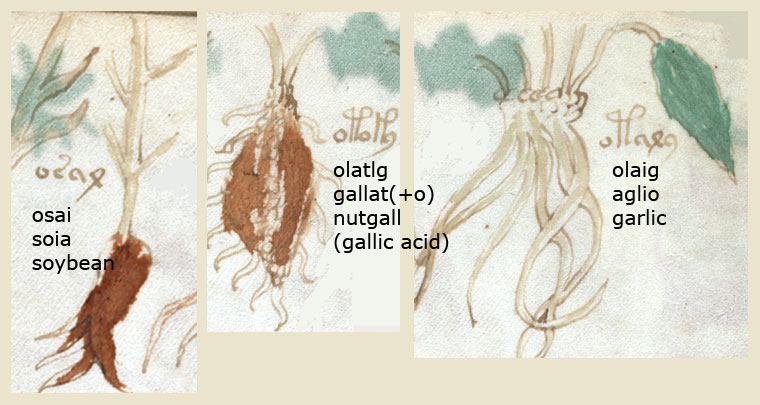
I call the labeling of the plants to be absolute complete bullshit. Yes, I said it. I'm not a botanist but I grew up on a farm and I know many of these plants very well and I can't tell any distinguishing characteristics apart from the drawings. This is what a garlic plant looks like. Not like this. I mean, come on!
http://ballardfarmersmarket.wordpress.com/2009/05/17/green-garlic/
http://inpraiseofsardines.typepad.com/blogs/2006/02/spring_is_just_.html
-
Re:It Hurts
What I find very telling and most undermining to this hypothesis is the simple fact that soybeans were not introduced to Europe and the United States until the 18th century, and did not become a significant crop until the 20th. Given that the Voyinch manuscript is thought to be from the 15th - 16th century, the supposed translation--which claims to identify a soia = soybean plant--has quite a bit of explaining to do.
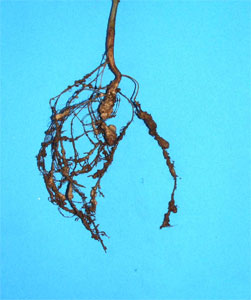
... along the same lines, do you notice any resemblance between the "soybean" illustration in the manuscript and these actual soybean roots?
I don't. -
Re:It Hurts
perhaps the text is simply anagrams of Italian words.
Then why does she only offer up a single page of plants as decoded anagrams? What about the other ~199 pages? What about the pages of block text? More importantly, why does the Voynich Manuscript flip between things derived from plants like gallic acid, oil and then return to naming the plants? Furthermore, I call the labeling of the plants to be absolute complete bullshit. Yes, I said it. I'm not a botanist but I grew up on a farm and I know many of these plants very well and I can't tell any distinguishing characteristics apart from the drawings. This is what a garlic plant looks like. Not like this. I mean, come on! Did Edith Sherwood ever stop to think that maybe -- similar to numerology in The Bible -- she'd be able to make words out of any strange text regardless of its true origin? Here's a real gem:
This brief sentence indicated that the use of anagrams should be investigated. This was further supported by reading Wikipedia’s report that anagrams were popular throughout Europe during the Middle Ages and that some 17th century astronomers, while engaged in verification of their discoveries, used anagrams to hide their ideas.
You found that on Wikipedia? Call Yale University, you've decoded it. Citing Wikipedia for a fact while analyzing centuries old manuscripts? Why you bother to put PhD after you name bewilders me. This is the game that will be played with the Voynich Manuscript. Every so often people will claim to have 'decoded it' by offering up a small part of the manuscript which very imaginative minds have pulled together 10+ very very flimsy clues that point to some individual. The fact that there are so many coincidences will add weight to it being the real explanation. But it oddly won't work for 99% of the manuscript. Now if the manuscript is ever decoded, a hell of a lot more than two pages is going to make sense. In fact, when someone figures it out, 99% of the manuscript will make sense. If you want my theory, we're dealing with an unknown autistic artist's work. Someone lost in a period of time where autism was misunderstood and they are forever lost to anonymity except they'll get the last laugh because we'll never understand what message they were trying to get to us. And some of us might go mad spending hours and hours and hours trying to figure this out with no luck.
Remember when making criticisms of a work, one must consider both the audience intended for the work and the work's context. This piece was aimed at a low-tech audience, designed to explain the basic concepts of her discovery to the layman. It was published on the Internet as opposed to an academic journal. For those reasons, the tone, style, and sources cited are appropriate.
Eldavojohn, she uses a method of decryption that is similar to how the Rosetta Stone was decoded. The decoder of the Rosetta Stone was considered a genius. The method: you find a page or a section with proper names that can be identified, or just guessed, and then use that decoded portion to slowly decode the rest of the text. She used the page with herbs, vegetables and drawings because, as you mentioned, the rest of the block text gives no clue as to the subject matter of the text and therefore unlikely to yield the decrypt key.
Using Wikipedia as a source of inspiration to find the key to decryption isn't idiotic: it's inspired. Mentioning Wikipedia as a source of inspiration is not the same as citing it as an academic source. One is appropriate; one is not. And, with respect, this is not the type of academic project that a Wikipedia source detracts from. This is a problem to-be-solved, not a new theory of genetics or history that de facto relies on the reliabilit
-
Re:It Hurts
Yeah but on the other hand take a look at page 4.
http://www.edithsherwood.com/voynich_decoded/image_list.php?page=4
We are lead to believe that these illustrate "Rose bush" (looks like few roses I've ever seen that haven't been trampled on), "illustration" (gee, really? Thanks for telling me that this illustration illustrates an illustration -- I mean, is she serious?) and "oil". Which isn't oil. It may be something that can *produce* oil, but it isn't oil, it's a plant with a name.This isn't news, this is just someone making a wild guess and pulling out some words from her arse, not many of which make sense.
Seriously, also on page 4, "mushroom"? OK, you could argue that's like the stem of a mushroom. So why are the very similar figures on previous pages marked "forget" (eh? unless in some medieval italian slang that apparently both dante and da vinci spoke a "forget" was a mushroom of some sort), "waste" (eh? this is the bit of the mushroom, or forget, that you're meant to waste? seriously?), "rapid" (evidently if you eat this particular mushroom, or forget, you rapidly produce waste) or two question marks.
Total nonsense. I quite agree that this hurts.
-
It Hurts
perhaps the text is simply anagrams of Italian words.
Then why does she only offer up a single page of plants as decoded anagrams? What about the other ~199 pages? What about the pages of block text?
More importantly, why does the Voynich Manuscript flip between things derived from plants like gallic acid, oil and then return to naming the plants? Furthermore, I call the labeling of the plants to be absolute complete bullshit. Yes, I said it. I'm not a botanist but I grew up on a farm and I know many of these plants very well and I can't tell any distinguishing characteristics apart from the drawings. This is what a garlic plant looks like. Not like this. I mean, come on! Did Edith Sherwood ever stop to think that maybe -- similar to numerology in The Bible -- she'd be able to make words out of any strange text regardless of its true origin?
Here's a real gem:This brief sentence indicated that the use of anagrams should be investigated. This was further supported by reading Wikipedia’s report that anagrams were popular throughout Europe during the Middle Ages and that some 17th century astronomers, while engaged in verification of their discoveries, used anagrams to hide their ideas.
You found that on Wikipedia? Call Yale University, you've decoded it. Citing Wikipedia for a fact while analyzing centuries old manuscripts? Why you bother to put PhD after you name bewilders me.
This is the game that will be played with the Voynich Manuscript. Every so often people will claim to have 'decoded it' by offering up a small part of the manuscript which very imaginative minds have pulled together 10+ very very flimsy clues that point to some individual. The fact that there are so many coincidences will add weight to it being the real explanation. But it oddly won't work for 99% of the manuscript. Now if the manuscript is ever decoded, a hell of a lot more than two pages is going to make sense. In fact, when someone figures it out, 99% of the manuscript will make sense.
If you want my theory, we're dealing with an unknown autistic artist's work. Someone lost in a period of time where autism was misunderstood and they are forever lost to anonymity except they'll get the last laugh because we'll never understand what message they were trying to get to us. And some of us might go mad spending hours and hours and hours trying to figure this out with no luck.