Slashdot Mirror
Domain: esa.nl
Stories and comments across the archive that link to esa.nl.
Stories · 6
-
Sun Open-Sourcing UltraSPARC Design
AKAImBatman writes "While everyone was busy with the holiday season, Sun Microsystems quietly announced the start of the OpenSPARC project. Unlike previous CPUs that were based on the "Open" SPARC specifications (such as LEON), Sun is releasing the complete Verilog source code to their latest and greatest microprocessor. Their current time frame for releasing the source code to the public is in March of 2006. Given their success with the OpenSolaris project, it seems that this is likely to be more than just vaporware. So get out your Virtex FPGAs and your Verilog compilers, and let's get ready to hack some hardware!" -
ESA Gives Green Light To Rosetta
JoeRobe writes "An ESA review board has given the green light for launch of the Rosetta Spacecraft in January 2003. The Rosetta Mission is one of the ESA's boldest missions to date. Over the next eight years, the spacecraft will conduct two asteroid (Otawara and Siwa) flybys and finish off by dropping a lander onto the surface of comet Wirtanen." -
Ulysses Reaches Unprecedented Solar Lattitude
T.Hobbes writes: "The pioneering European Space Agency's (Esa) Ulysses spacecraft flew over the Sun's north pole on Saturday, reaching a high northern solar latitude of 80 degrees. BBC coverage; ESA site; JPL site" -
A Close Encounter Of The Stellar Kind
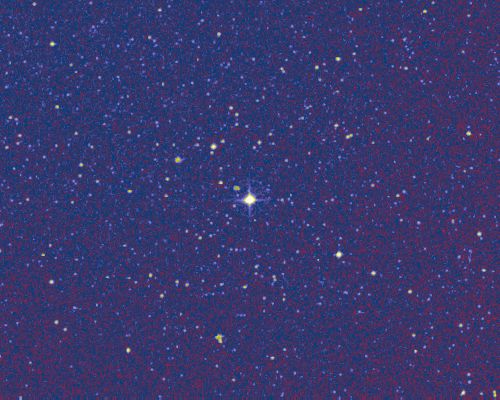
Beowulf_Boy writes "Acording to the APOD on July 7th, The star in this image known as Gliese (Gl) 710 (currently 63 lightyears away), will be only 1 Lightyear from Sol in 1.5 million years. Currently, it is much to faint to be seen by the naked eye, but, in 1,502,000 A.D. it will be at .6 magnitude, rivaling the current bright star of Antares. Although Gliese 710 will not apparently present any major dangers, it could possibly scatter debris out of the Oort cloud, cause many more comets and meteors than usual. This future stellar encounter was discovered by researchers Joan Garcia-Sanchez and Robert Preston (JPL), and collaborators while studying stars in the solar neighborhood using data from the Hipparcos Astrometry Satellite." -
MAP Satellite Launch
PineGreen writes: "Tomorrow, MAP Satellite is to be launched. MAP is the first space mission to measure Cosmic Microwave Background (CMB) fluctuations after the famous COBE who was first to detect fluctuations in the CMB. It is supposed to do the job with an unprecedented accuracy. There were several successful balloon experiments (Boomerang, Maxima) and interferometer experiments (VSA, DASI, CBI), some of which still haven't published their data. But of course, we are all waiting for the big European Planck mission in 2007. Measuring CMB fluctuations can tell us a lot about the universe in which we live, its constituents and its geometrical properties." -
Cluster Of Satellites To Study Effects Of Solar Wind
BigTed writes: "An international effort involving four satellites is set to study the effect of the Sun and the solar wind on the Earth's magnetosphere. This mission (Cluster II) is trying to achieve what Cluster I failed to do in 1996.
Yesterday the first pair of satellites were given the go ahead to launch in Russia (see the semi-live coverage)."