Slashdot Mirror
Domain: fluidinfo.com
Stories and comments across the archive that link to fluidinfo.com.
Comments · 8
-
Re:Cat blog
Still, HTTPS would at least prevent your ISP from monitoring your browsing activity.
That's part of it - a valuable enough part in itself, IMO; at least one UK ISP, TalkTalk, has started duplicating HTTP requests made by their customers: so, if you request http://example.com/stuff on one of their lines, 30 seconds later they'll go and request the same URL themselves for monitoring purposes.
But, but... That doesn't make any sense!
Using HTTP, the connection isn't encrypted in either direction. If they can see the original request, they can also see the original response, so why not just cache that?
What's the benefit of doing a second request for the same content?
Unless you're on a capped line and both requests/responses count towards your limit? Is that it?
-
Re:Cat blog
Still, HTTPS would at least prevent your ISP from monitoring your browsing activity.
That's part of it - a valuable enough part in itself, IMO; at least one UK ISP, TalkTalk, has started duplicating HTTP requests made by their customers: so, if you request http://example.com/stuff on one of their lines, 30 seconds later they'll go and request the same URL themselves for monitoring purposes. Obviously, enabling SSL prevents this kind of gratuitous stupidity - and the previous incarnation of such snooping, Phorm. If enough websites enable SSL, ISPs will no longer have the ability to monitor customer behavior that closely, all they will see are SSL flows to and from IP addresses, and whatever DNS queries you make to their servers, if any. (Use encrypted connections to OpenDNS or similar, and your ISP will only ever see IP addresses and traffic volume - exactly as it should be IMO!)
-
Fludinfo and OS X Mavericks
One interesting cross-domain tagging system, which I use extensively, is Fluidinfo. It allows users to attach tags, which can have typed values, to arbitrary objects identified by any unicode string (or by a UUID). There's a query language that lets you find things based on your own tags and, subject to permissions, other people's tags. It was discussed previously on
Another recent development that could be significant for tagging is the announcement by Apple that OS X Mavericks will have more extensive support for tags on files both in the OS and in iCloud. Since tags look like being the only way Apple will offer to organize files in iCloud, it is possible these will catch on in a big way, and this could lead to a broader interest in tagging as a general alternative/addition to hierarchical organization.
-
Re:Wikipedia already is a Database
Wikipedia is built on a database. It provides an alternate interface to information, allowing anyone to contribute. Ten years ago that sounded pretty ridiculous, I think to just about everyone. What if you had the same thing, but for applications and their data (or metadata, if you like). Is that also ridiculous? The idea of openly writable storage (with a permissions system, typed data, and a query language - as in Fluidinfo) isn't as bad as you're making out. Re vaporware - actually not. I've spent about 6 years of my life building and re-building versions of Fluidinfo, starting in 1998. I used to have an apartment, but I sold it and put all the money into starting the company. It hasn't been easy. You can go create an account if you like, at https://fluidinfo.com/accounts/new/ Feel free to drop by #fluidinfo on irc.freenode.net if you want to chat. Terry
-
Re:OK, so where's the data?
There are a few browsers for Fluidinfo data beginning to pop up. The most accessible is at http://explorer.fluidinfo.com/ which lets you do almost anything (make objects, add tags and values, query, change tag perms, etc) but its interface isn't crystal clear. You can also get at the data using http://shell-fish.appspot.com/ which is a browser based shell for interacting with Fluidinfo (type help). You can get visualizations of Fluidinfo objects at http://abouttag.appspot.com/ You can search Fluidinfo about tags at http://abouttag.appspot.com/search There are several other tools, but those are the main ones I'd suggest looking at to start with.
-
Their blog has a good example
A thought experiment how their service might be used to automatically confirm or reject friendship requests: http://blogs.fluidinfo.com/fluidinfo/2011/06/01/personalized-filtering-of-friend-requests-in-social-networks/
If I understand what they want to do, I think it's a failure. They make a big deal about metadata being context dependent and, as such, it should stored in the context in which it is meaningful rather than in a single place. But, if I understand what they do correctly, their service is basically a single place to store all their clients' metadata. You store all your metadata at fluidinfo and it does neat thing.
-
Re:So what is it?
The Gist: http://blogs.fluidinfo.com/fluidinfo/2011/02/23/putting-domain-names-onto-data-with-fluidinfo/
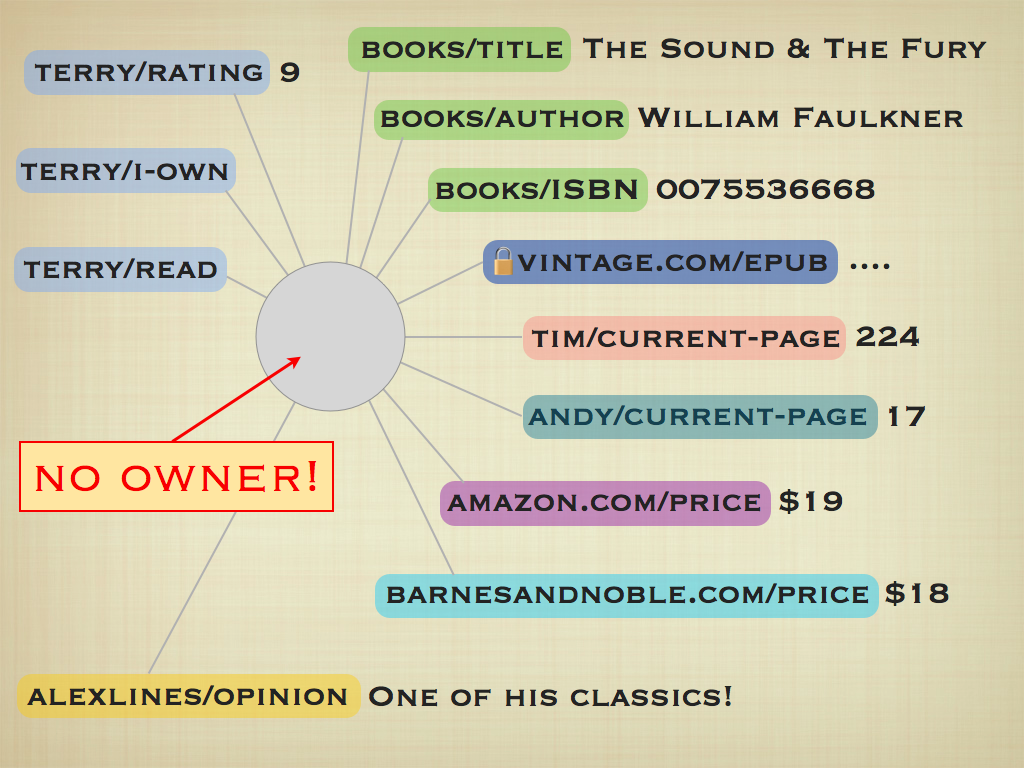
Example Object: http://blogs.fluidinfo.com/fluidinfo/wp-content/uploads/2011/02/book-object.pngMy 15s appraisal:
They want to be the single-source OO database for 'everything'. Take all the data in wiki or any webpage ( assuming it's about an entity), extract any quantitative properties, ( Size, color, temperature, weight, Atomic Number... etc) and add them to Fluidinfo. Incorporate a way for domain names to 'brand' their data, and you how have a way of defeating spammers and griefers who are just going to setup bots to load crap into this OO database.Way too many ways for this to fail imo. In the 'future' I expect the same info to simply be published by data owners. Or, simply extracted by an app for us running in a Google data center.. Actually... Wolfram Alpha already does this. but I think they threw people at the problem, not natural langue parser.
That said, wouldn't it be cool if ounce of knowledge was query-able in a semantic way? Yeah sure, it'd be cool. Don't hold your breathe we get their through Fluidinfo.
-
Re:So what is it?
The Gist: http://blogs.fluidinfo.com/fluidinfo/2011/02/23/putting-domain-names-onto-data-with-fluidinfo/
Example Object: http://blogs.fluidinfo.com/fluidinfo/wp-content/uploads/2011/02/book-object.pngMy 15s appraisal:
They want to be the single-source OO database for 'everything'. Take all the data in wiki or any webpage ( assuming it's about an entity), extract any quantitative properties, ( Size, color, temperature, weight, Atomic Number... etc) and add them to Fluidinfo. Incorporate a way for domain names to 'brand' their data, and you how have a way of defeating spammers and griefers who are just going to setup bots to load crap into this OO database.Way too many ways for this to fail imo. In the 'future' I expect the same info to simply be published by data owners. Or, simply extracted by an app for us running in a Google data center.. Actually... Wolfram Alpha already does this. but I think they threw people at the problem, not natural langue parser.
That said, wouldn't it be cool if ounce of knowledge was query-able in a semantic way? Yeah sure, it'd be cool. Don't hold your breathe we get their through Fluidinfo.