Slashdot Mirror
Domain: freebsd.org
Stories and comments across the archive that link to freebsd.org.
Comments · 3,599
-
or on the command-line...
...well, at least for those fortunate enough to be
working with a system supporting that kind of stuff
(like *cough* FreeBSD *cough*):
ncal -e
see http://www.freebsd.org/cgi/man.cgi?query=ncal -
Re:Where does this leave dragonfly?
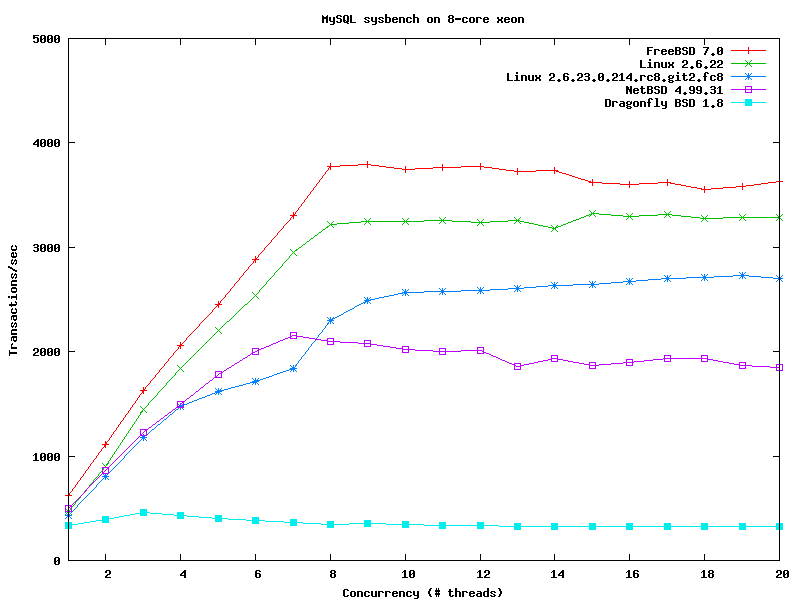
http://people.freebsd.org/~kris/scaling/os-mysql.png
Basically, dragonfly is both slower with a single thread and fails to scale at all -
Linux + Hoard malloc is faster than jemalloc
If they would have tested MySQL and Postgres with Hoard, Linux would have been faster than FreeBSD 7.
It's very odd how they tested with jemalloc with Hoard benchmarks and cited Hoard in the jemalloc paper but did not list Hoard timings.
http://www.hoard.org/
jemalloc -
Re:Bad news for Linux?
In my opinion, the article summary is a pretty big red herring because the SMP performance may not have a huge impact on the result.
Slide 10 out of 37 (emphasis mine -mi):
- Online transaction processing" benchmark;
- Complex transaction-based queries
- Read-only: no disk access to avoid benchmarking disk performance
- Clients and servers on the same system
- PostgreSQL 8.2.4 (process-based + System 5 Inter-Process Communication (IPC)
- MySQL 5.0.45 (thread-based)
- Test hardware:
- 4 * 2-core Opteron (amd64 mode) 2.2GHz CPUs, 4 GB RAM
- 2 * 4-core Xeon E5320 (i386 mode) 1.8GHz CPUs, 3.5GB RAM
- Online transaction processing" benchmark;
-
Re:FreeBSD SMP threads + boehm-gc = totally broken
boehm-gc is totally broken when using threads on FreeBSD SMP. And it's still totally broken on FreeBSD 7.
Strange, it's not listed as broken in the Ports tree:
http://www.freshports.org/devel/boehm-gc/
http://portsmon.freebsd.org/portoverview.py?category=devel&portname=boehm-gc
Have you contacted the MAINTAINER regarding your concerns, or filed a PR? If no one complains then no one will know to fix things. -
Re:BSD Desktops
You have to be wary with pkg_add. It will only grab packages from the -version-release branch (which are not updated--they're static for that release.) For example, if you're running 6.2, you'll find that pkg_add tracks this URL for packages:
ftp://ftp.freebsd.org/pub/FreeBSD/ports/i386/packages-6.2-release/Latest/
And the software is over a year old.
If you want updated packages, you will need to set some environment variables to force you to track a -stable URL (such as ftp://ftp.freebsd.org/pub/FreeBSD/ports/i386/packages-6-stable/Latest/). See man pkg_add for details.
Of course, just compiling from ports is probably the easiest way, if you've got a fast enough computer. -
Re:BSD Desktops
You have to be wary with pkg_add. It will only grab packages from the -version-release branch (which are not updated--they're static for that release.) For example, if you're running 6.2, you'll find that pkg_add tracks this URL for packages:
ftp://ftp.freebsd.org/pub/FreeBSD/ports/i386/packages-6.2-release/Latest/
And the software is over a year old.
If you want updated packages, you will need to set some environment variables to force you to track a -stable URL (such as ftp://ftp.freebsd.org/pub/FreeBSD/ports/i386/packages-6-stable/Latest/). See man pkg_add for details.
Of course, just compiling from ports is probably the easiest way, if you've got a fast enough computer. -
Re:Hope you enjoyed a your 5 minutes in the spotli
From that page:
Disclaimer: I'm not an expert with FreeBSD or MySQL. The Linux kernel used is not a "stable release" whereas FreeBSD is (although I'm not aware of any significant performance improvements over the 2.6.24 kernel -- 2.6.25-rc4 is simply what I have installed on the machine). Compilers were different versions of gcc-4.2, MySQL code base and compile options were slightly different due to being compiled from ports on FreeBSD. In other words, I can't say definitively that Linux is faster than FreeBSD. My primary interest is to see that Linux's performance problems on this workload are under control. Questions or suggestions are welcome.
And I do tend to agree with that. Ultimately, there are enough reasons keeping me on Linux (vs FreeBSD) that as long as there isn't that huge gap (seen in the graph linked to), I don't really care that much about whatever's left.
Nor am I particularly loyal to Linux. I understand and respect the GPL, but if there was another sufficiently open OS that beat Linux in ways I care about, I'd probably be using it, at least at home.
-
Also noted in the FreeBSD 7.0 release announcement
Here, and it applies to a significant number of other network servers.
Dramatic improvements in performance and SMP scalability shown by various database and other benchmarks, in some cases showing peak performance improvements as high as 350% over FreeBSD 6.X under normal loads and 1500% at high loads. When compared with the best performing Linux kernel (2.6.22 or 2.6.24) performance is 15% better.
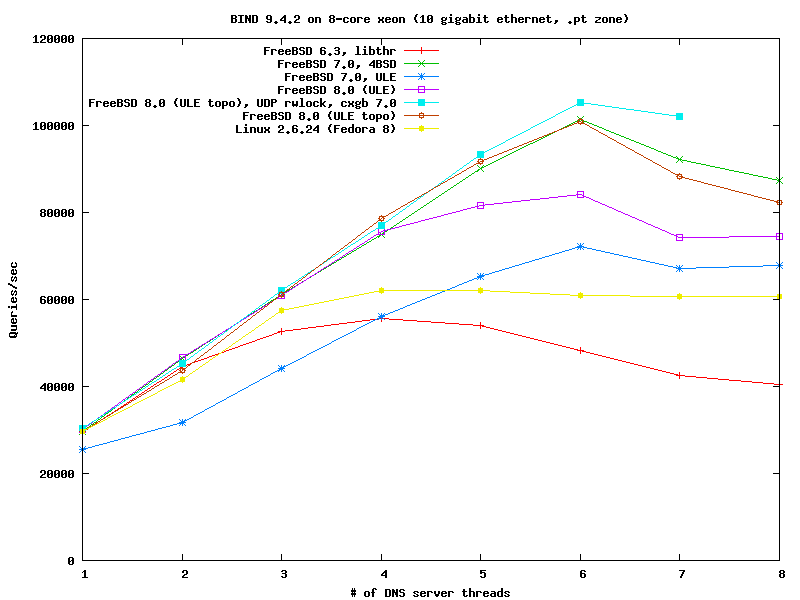
http://people.freebsd.org/~kris/scaling/bind-pt.png
Summary:
* FreeBSD 7.0-R with 4BSD scheduler has close to ideal scaling on this test.
* The drop above 6 threads is due to limitations within BIND.
* Linux 2.6.24 has about 35% lower performance than FreeBSD, which is significantly at variance with the ISC results. It also doesn't scale above 3 CPUs.
* 7.0 with ULE has a bug on this workload (actually to do with workloads involving high interrupt rates). It is fixed in 8.0.
* Changes in progress to improve UDP performance do not help much with this particular workload (only about 5%), but with more scalable applications we see 30-40% improvement. e.g. NSD (ports/dns/nsd) is a much faster and more scalable DNS server than BIND (because it is better optimized for the smaller set of features it supports). -
Also noted in the FreeBSD 7.0 release announcement
Here, and it applies to a significant number of other network servers.
Dramatic improvements in performance and SMP scalability shown by various database and other benchmarks, in some cases showing peak performance improvements as high as 350% over FreeBSD 6.X under normal loads and 1500% at high loads. When compared with the best performing Linux kernel (2.6.22 or 2.6.24) performance is 15% better.
http://people.freebsd.org/~kris/scaling/bind-pt.png
Summary:
* FreeBSD 7.0-R with 4BSD scheduler has close to ideal scaling on this test.
* The drop above 6 threads is due to limitations within BIND.
* Linux 2.6.24 has about 35% lower performance than FreeBSD, which is significantly at variance with the ISC results. It also doesn't scale above 3 CPUs.
* 7.0 with ULE has a bug on this workload (actually to do with workloads involving high interrupt rates). It is fixed in 8.0.
* Changes in progress to improve UDP performance do not help much with this particular workload (only about 5%), but with more scalable applications we see 30-40% improvement. e.g. NSD (ports/dns/nsd) is a much faster and more scalable DNS server than BIND (because it is better optimized for the smaller set of features it supports). -
Some clarifications on my benchmarks
Hi, I am the one who performed these benchmarks and I'd like to clarify a couple of things:
* The point of this benchmark is not to unilaterally declare victory over Linux, but to point out that FreeBSD is once again competitive with it on modern high-end hardware and certain workloads. Of course, we are working on other workloads too, and currently perform better than Linux on other benchmarks, and still worse on others. There will no doubt be further friendly competition between the two OSes that will work to the benefit of both. Our message to the Linux developers is that they should not expect to get away with resting on their laurels
* I benchmarked both mysql and postgresql, and FreeBSD 7.0 performs better than all Linux kernels (at least up to 2.6.23) with both databases. Incidentally postgresql is much faster than mysql, contradicting common wisdom. Other fun facts are that mysql 5.0.51 has poorer scaling than 5.0.47, and 5.1.x has *much* worse performance and scaling than 5.0.47 on my tests.
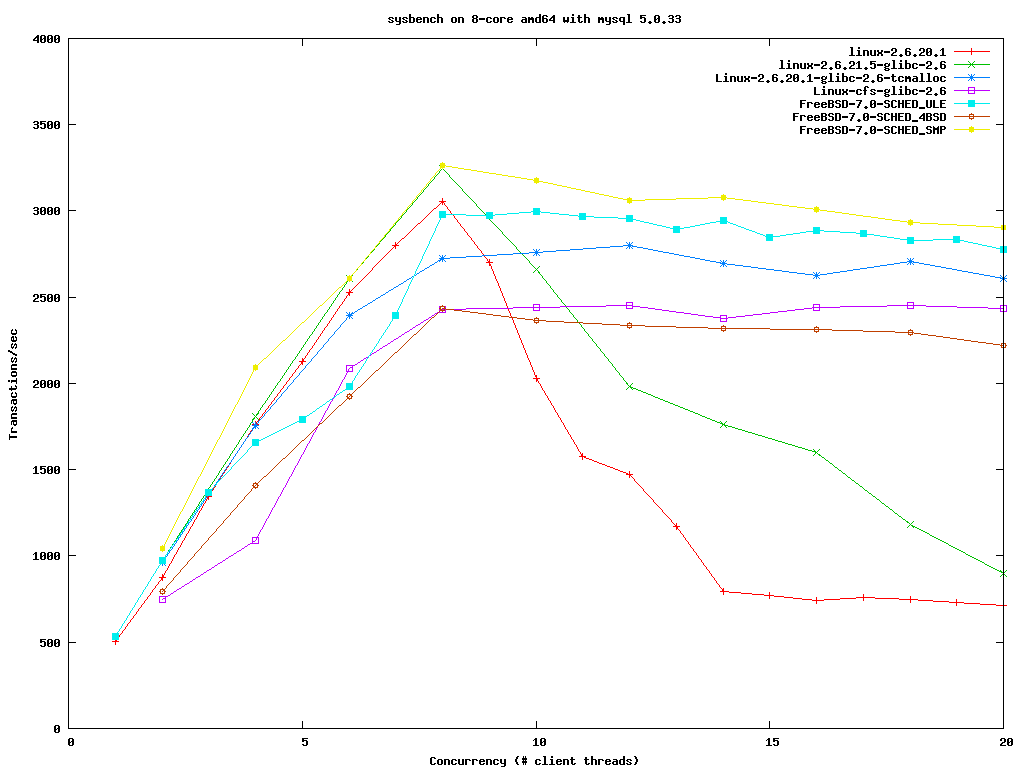
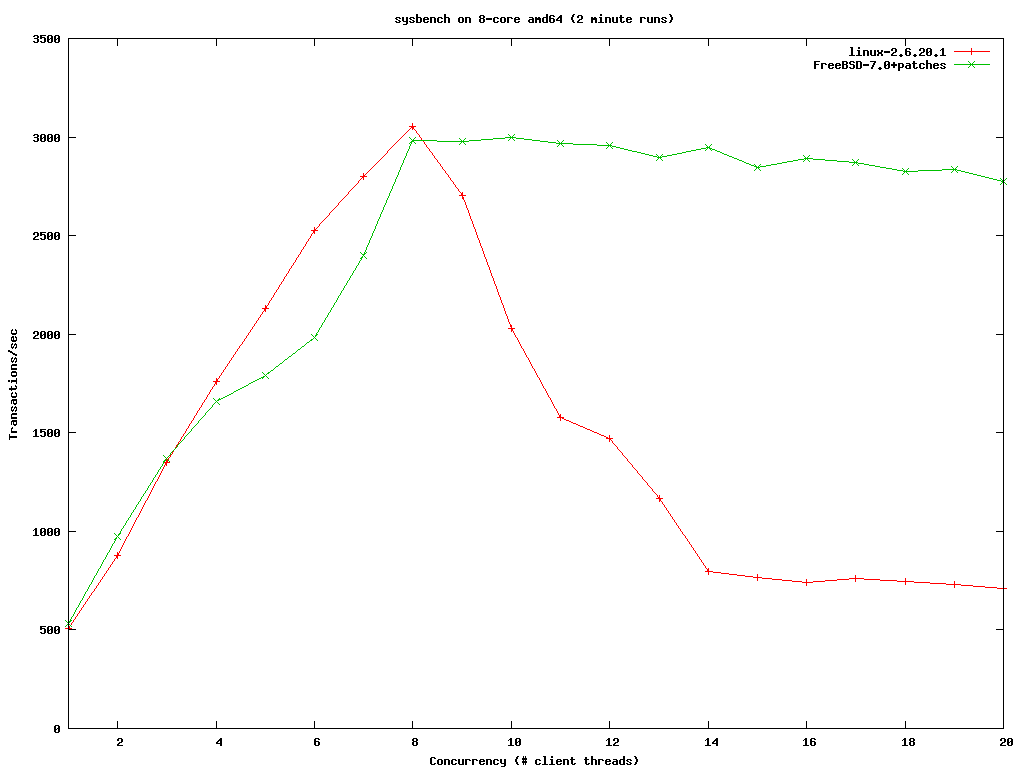
* I benchmarked several versions of Linux including 2.6.20.x, 2.6.22 and 2.6.23. 2.6.20.x has terrible performance http://people.freebsd.org/~kris/scaling/scaling.png. This graph is from Feb 2007 and the FreeBSD performance also improved after this point.
* 2.6.22 (which is pre-CFS) mostly fixed this but still performs worse than FreeBSD http://people.freebsd.org/~kris/scaling/os-mysql.png. 2.6.23 included the new scheduler and was a major performance regression. I did not yet retest with 2.6.24, so maybe they have fixed CFS by now.
* Contrary to some commenter's assertions that this is not a CPU benchmark, this benchmark is *extremely* sensitive to CPU performance and especially scheduling (in fact, as noted in the PDF, I/O performance is not a factor here). The scheduler really matters here, which is why Linux took a big hit when they switched to CFS (similarly, on FreeBSD the 4BSD scheduler performs much worse). Tuning the scheduler is critical to performance on this kind of workload. The other critical aspect is having a highly optimized kernel without concurrency bottlenecks. 2.6.20 fell over on kernel concurrency, and 2.6.23 fell over with the scheduler.
Hope this helps to clarify things. -
Some clarifications on my benchmarks
Hi, I am the one who performed these benchmarks and I'd like to clarify a couple of things:
* The point of this benchmark is not to unilaterally declare victory over Linux, but to point out that FreeBSD is once again competitive with it on modern high-end hardware and certain workloads. Of course, we are working on other workloads too, and currently perform better than Linux on other benchmarks, and still worse on others. There will no doubt be further friendly competition between the two OSes that will work to the benefit of both. Our message to the Linux developers is that they should not expect to get away with resting on their laurels
* I benchmarked both mysql and postgresql, and FreeBSD 7.0 performs better than all Linux kernels (at least up to 2.6.23) with both databases. Incidentally postgresql is much faster than mysql, contradicting common wisdom. Other fun facts are that mysql 5.0.51 has poorer scaling than 5.0.47, and 5.1.x has *much* worse performance and scaling than 5.0.47 on my tests.
* I benchmarked several versions of Linux including 2.6.20.x, 2.6.22 and 2.6.23. 2.6.20.x has terrible performance http://people.freebsd.org/~kris/scaling/scaling.png. This graph is from Feb 2007 and the FreeBSD performance also improved after this point.
* 2.6.22 (which is pre-CFS) mostly fixed this but still performs worse than FreeBSD http://people.freebsd.org/~kris/scaling/os-mysql.png. 2.6.23 included the new scheduler and was a major performance regression. I did not yet retest with 2.6.24, so maybe they have fixed CFS by now.
* Contrary to some commenter's assertions that this is not a CPU benchmark, this benchmark is *extremely* sensitive to CPU performance and especially scheduling (in fact, as noted in the PDF, I/O performance is not a factor here). The scheduler really matters here, which is why Linux took a big hit when they switched to CFS (similarly, on FreeBSD the 4BSD scheduler performs much worse). Tuning the scheduler is critical to performance on this kind of workload. The other critical aspect is having a highly optimized kernel without concurrency bottlenecks. 2.6.20 fell over on kernel concurrency, and 2.6.23 fell over with the scheduler.
Hope this helps to clarify things. -
Re:You don't have to be Kreskin
Well, according to this, there are several thousand. Not to mention that due to linux emulation, freebsd can run anything linux can run.
-
Re:My first submission
You mean put debian on them?
This would be a much more sensible solution. -
Re:Considering switching.
The main repository of FreeBSD packages is at ftp://ftp.freebsd.org/pub/FreeBSD/packages.
I turned out to be mistaken about this. The real address is: ftp.freebsd.org/pub/FreeBSD/ports/ARCH/packages-VERSION.
For example: ftp://ftp.freebsd.org/pub/FreeBSD/ports/amd64/packages-7.0-release
-
Re:Considering switching.
The main repository of FreeBSD packages is at ftp://ftp.freebsd.org/pub/FreeBSD/packages.
I turned out to be mistaken about this. The real address is: ftp.freebsd.org/pub/FreeBSD/ports/ARCH/packages-VERSION.
For example: ftp://ftp.freebsd.org/pub/FreeBSD/ports/amd64/packages-7.0-release
-
Re:Still hard to install?
You have to use a third-party patch to get domU support for FreeBSD. Unfortunately, there is no dom0 support, and while there are people supposedly working on it, there aren't many status reports.
The Xen information is available here: http://www.fsmware.com/xenofreebsd/7.0/ linked from http://wiki.freebsd.org/FreeBSD/Xen.
That said, VMWare seems to run FreeBSD just fine. VirtualBox, sadly, doesn't play nicely with newer versions of FreeBSD. -
Re:Considering switching.
How does one install new software on BSD? (do you compile everything from source?)
I upgraded from 6.2 to 7.0-PRERELEASE by doing the following:
It's a convolouted process, but I wanted to follow FreeBSD 7 development. It's easier when you do it from a binary CD. Basically you restart from the CD and upgrade and it's automated.
Start by updating my system source:
$ sed -e 's/RELENG_6/RELENG_7/'
$ csup -h cvsup6.freebsd.org
Now the source is updated. So we build:
$ cd
$ make buildworld buildkernel
Now the system is built from source, ready to go into my temporary directory. Back up
$ mergemaster -p
Now my
$ make installkernel
$ reboot
Now I start up in single user mode. Install new system just build from source.
$ mount -a
$ cd
$ make installworld
The binaries are all installed. Merge new
$ mergemaster
Now the machine is up to date.
As for installing packages, you have several choices. I prefer to build from source, but you can use packages. Packages are usually a little behind the ports tree. So for example, to install KDE the way I would do it:
$ cd
$ make install
And several hours later you have KDE 3, Xorg, and a host of other apps that aren't included with the base install that KDE3 needs.
Take a look here for more info about FreeBSD's package management. The main repository of FreeBSD packages is at ftp://ftp.freebsd.org/pub/FreeBSD/packages.
Installing from CD is easy, but it's all text based so don't be shocked. I recommend installing the "X-Developer" package and the ports tree. That should include all the base system and developer tools. -
Re:Considering switching.
How does one install new software on BSD? (do you compile everything from source?)
I upgraded from 6.2 to 7.0-PRERELEASE by doing the following:
It's a convolouted process, but I wanted to follow FreeBSD 7 development. It's easier when you do it from a binary CD. Basically you restart from the CD and upgrade and it's automated.
Start by updating my system source:
$ sed -e 's/RELENG_6/RELENG_7/'
$ csup -h cvsup6.freebsd.org
Now the source is updated. So we build:
$ cd
$ make buildworld buildkernel
Now the system is built from source, ready to go into my temporary directory. Back up
$ mergemaster -p
Now my
$ make installkernel
$ reboot
Now I start up in single user mode. Install new system just build from source.
$ mount -a
$ cd
$ make installworld
The binaries are all installed. Merge new
$ mergemaster
Now the machine is up to date.
As for installing packages, you have several choices. I prefer to build from source, but you can use packages. Packages are usually a little behind the ports tree. So for example, to install KDE the way I would do it:
$ cd
$ make install
And several hours later you have KDE 3, Xorg, and a host of other apps that aren't included with the base install that KDE3 needs.
Take a look here for more info about FreeBSD's package management. The main repository of FreeBSD packages is at ftp://ftp.freebsd.org/pub/FreeBSD/packages.
Installing from CD is easy, but it's all text based so don't be shocked. I recommend installing the "X-Developer" package and the ports tree. That should include all the base system and developer tools. -
Re:Does it work with MySQL yet?
Yes, the performance is excellent now... it was fine since that 'pissing match', however you had to go through a few hoops to get it that way.
Here's a few links that might help you with performance in newer incarnations of FreeBSD:
FreeBSD 6 - http://wiki.freebsd.org/MySQL
FreeBSD 7 - http://people.freebsd.org/~kris/scaling/mysql.html -
Re:Does it work with MySQL yet?
Yes, the performance is excellent now... it was fine since that 'pissing match', however you had to go through a few hoops to get it that way.
Here's a few links that might help you with performance in newer incarnations of FreeBSD:
FreeBSD 6 - http://wiki.freebsd.org/MySQL
FreeBSD 7 - http://people.freebsd.org/~kris/scaling/mysql.html -
Re:Does it work with MySQL yet?
I don't know the results of the "pissing match", but I can attest to the re-written ULE scheduler (NOT the same ULE that was in 5.x and 6.x! This scheduler is referred to as ULE/SMP2.0) being both stable and greatly improved. The scheduler was tested *specifically* against MySQL, and the benchmarks exceed that of Linux. Here's the details you want:
http://people.freebsd.org/~kris/scaling/mysql.html -
Re:ZFS?
No, it's not production quality. Not when there's bugs which can deadlock the entire system when copying large sums of data between UFS and ZFS filesystems:
http://wiki.freebsd.org/ZFSKnownProblems
The "this is experimental" tag should remain until all of the issues on the ZFSKnownProblems page are addressed. -
Re:ZFS Support
ZFS support is very experimental, and also very broken -- in ways which are unsettling (especially the deadlock issue happening during heavy I/O between UFS and ZFS):
http://wiki.freebsd.org/ZFSKnownProblems
I'm not posting this URL to try and put ripples in the water, but those problems have been mentioned for months now, and those responsible for the ZFS port to FreeBSD have not responded to any of the reports; they're MIA.
I can post freebsd-stable mailing list threads if people want additional proof of these problems, and how they manifest themselves. -
Current /usr/src/UPDATING
What the parent post describes should be sufficient, but the current
-
Current /usr/src/UPDATING
What the parent post describes should be sufficient, but the current
-
One of many benchmarks to back up the announcement
Dramatic improvements in performance and SMP scalability shown by various database and other benchmarks, in some cases showing peak performance improvements as high as 350% over FreeBSD 6.X under normal loads and 1500% at high loads. When compared with the best performing Linux kernel (2.6.22 or 2.6.24) performance is 15% better.
http://people.freebsd.org/~kris/scaling/bind-pt.png
Summary:
* FreeBSD 7.0-R with 4BSD scheduler has close to ideal scaling on this test.
* The drop above 6 threads is due to limitations within BIND.
* Linux 2.6.24 has about 35% lower performance than FreeBSD, which is significantly at variance with the ISC results. It also doesn't scale above 3 CPUs.
* 7.0 with ULE has a bug on this workload (actually to do with workloads involving high interrupt rates). It is fixed in 8.0.
* Changes in progress to improve UDP performance do not help much with this particular workload (only about 5%), but with more scalable applications we see 30-40% improvement. e.g. NSD (ports/dns/nsd) is a much faster and more scalable DNS server than BIND (because it is better optimized for the smaller set of features it supports). -
Re:no nvidia on amd64 yetReally, if you can do one, why is the other so much more trouble that you would ignore it? Here's why. Some appear to have been resolved, but many haven't.
Feel free to hire a developer to get things moving. -
FF3 is using FreeBSD's new malloc
Firefox is actually using FreeBSD's new malloc (jemalloc; PDF) internally, instead of the default OS allocater on all platforms. It's quite fast and has less fragmentation than other implementations.
-
Re:ZFS Support
Seconded!
We're using FreeBSD 7.2 RC2 ZFS in a production environment on Amd64. It's getting hammered, and holding up fine.
1) ZFS has *solved* our storage problems.
2) ZFS needs 2GB of RAM
3) You should run it on a dual core processor if you're going to use compression.
4) Research glabel so you can move drives around from cable to cable and still use the same device name.*
*more info: http://www.freebsd.org/cgi/man.cgi?query=glabel&sektion=8 -
Re:ZFS Support
ZFS is indeed labeled experimental, and it's an important distinction. That said, I believe that Pawel Dawidek, who ported the file system from Solaris, is using it in production. The chief caveat at the moment is that ZFS should only be used on the amd64 architecture. Other issues are not specific to FreeBSD's implementation of ZFS, e.g., the large memory footprint, but are instead inherent to the current release of ZFS and would be the same under any OS. More about the project at http://wiki.freebsd.org/ZFS/.
-
FreeBSD 7.0 Released (not offical)
Hi You can download the freebsd 7.0 release iso images from www.freebsd.org (please prefer mirrors) or download torrent file from http://torrents.freebsd.org:8080/ Good luck...
-
Some interesting info on jemalloc
This is kind of old news, but we ran into it at work today. Within the past couple weeks, Firefox 3 has imported FreeBSD 7's (je)malloc for its superior multithreaded performance and non-fragmentation.
http://ventnorsblog.blogspot.com/2008/02/beta-3.html
More info on jemalloc:
http://ivoras.sharanet.org/freebsd/freebsd7.html (near the bottom, under "Userland enhancements")
http://people.freebsd.org/~jasone/jemalloc/bsdcan2006/jemalloc.pdf -
I really like the addition of ZFS in FressBSD 7.0
-
Re:Haven't flown since before 9/11"I would say something but I don't want to be interrogated."
You know...my first thoughts when reading this was..."
Oh wow...a voluntary way for you to submit your name and info for one of their watch list databases..."
Whew...been a long time since I used remailers and nym accounts
-
Re:A very niche OS
FreeBSD Handbook
The Complete FreeBSD
I used Linux back in the 90s, but it was such a toy OS it wasn't going to help my career at the time. FreeBSD, however, has been serving high profile sites such as ftp.cdrom.com from this time. This proves FreeBSD's maturity, unfortunately the lawsuit left a bad taste in everyone's mouth forever. If I had a choice between FreeBSD and Linux, i would go for FreeBSD (assuming hardware support and that there were no other versions of unix in the shop). Unfortunately, FreeBSD lacks in enterprise support so RedHat, SuSE, et al have won the market. -
The cupholder problem
We get it -- you love Vista. You think it's the most secure and reliable operating system ever. You think it runs great on your 1GHz test system.
The problem you're having is there aren't that many newbies here. Most of these people have tried Vista. Which brings me to the cupholder problem.
I won't go over the apocryphal broken cupholder issue we've all read online a hundred times.
Are you sure this isn't the Vista you've been running all along? That would explain a lot.
-
Re:Huh?
Your post is wrong on so many levels I don't know where to start
-
Re:Looking forward to 7.0
There have been some tests done to compare FreeBSD 7 performance to FreeBSD 6, and the gains are impressive.
See these slides by Kris Kennaway for more details on that. -
Re:What about the new 40 and 50 year loans?
64-bit time_t on sparc64(freebsd sparc64 list feb/2004)
The open tools&OSes are making their way towards 64-bit time_t; some already have it. -
Re:Total garbage - has no error result codes!Requiring explicit unmount commands for removable drives is a design decision that should have died when we moved away from non-journaled filesystems.
"We"? The FreedBSD folk (and others) have adopted ordered metadata updates as a higher-throughput alternative. FreeBSD 7 does include the "gjournal" plugin for GEOM (meaning that you can put the journal on anything that GEOM supports, including weird constructs like an encrypted RAID of network devices). In practice, though, everyone seems to use "softupdates".
-
Re:The real questions are...Who's not happy about it being in FreeBSD? It's not like it's been made the default FS or anything:
valisk# kldload zfs
In the mean time, now lots of people get to play with it if they want to, and help make it less experimental, without having to install 8-CURRENT.
valisk# dmesg |grep ZFS
WARNING: ZFS is considered to be an experimental feature in FreeBSD.
For those interested in such things, DTrace seems to be going really well now too. -
Re:The real questions are...
It's already available on FreeBSD if you want to play.
-
Re:Why not leave it up to the producers?
sorry, but stuff like Linux only works BECAUSE of copyright... The only reason if i modify the kernel source and distribute the binary, that I HAVE to give the source with it, is because of copyright. Otherwise I could just take the code that was released, make a closed source software, and watch as people interested are forced to decompile it to figure out my changes.
You're absolutely right. Something like Linux, but without the requirement to distribute changes to the source code, could never be a successful open source project. -
Update on the article is posted
There's an update on the article here: http://www.informationweek.com/blog/main/archives/2008/01/oops_look_at_th.html See also http://lists.freebsd.org/pipermail/freebsd-hackers/2008-January/022854.html for discussion on FreeBSD.
-
Re:why BitTorrent
I use bittorrent. See here for one example:
http://www.freebsd.org/releases/6.2R/announce.html (scroll down a few lines)
Lots of LEGAL software is distributed this way, so why should I be targeted? -
Re:Looking good, too bad the press didn't understa
But it's not a first time scan. Amada was checked long ago, and FreeBSD has been running a Coverity server since Jan 2006.
http://www.linuxtoday.com/developer/2006031800826OSCYDV
http://www.freebsd.org/doc/en_US.ISO8859-1/articles/committers-guide/coverity.html
Worst of all, these articles haven't disclosed the classes of software issues detected. I'm sure huge classes of deadlocks and other system-wide issues go undetected. Even if the point of Coverity is to conduct system-wide analysis, I'd still say large classes escape.
I'm sure it can't detect that a Linux device driver sends the wrong byte to the wrong register of the hardware it supervises.
I think from the DHS perspective, they want to close as many bugs as possible that their adversaries could find by mechanical means. Finding deep bugs is real work, and wouldn't support a multi-vector concerted attack without massive preparation of the kind that HUMINT can usually detect. -
NetAvenger, you ignorant twit
Microsoft does hire bright minds. It's a pity what they do to them. And with them.
As for poorly trying to attack the NT platform for multi-tasking,...
The "NT platform" didn't invent multitasking. They cribbed it from the Mach kernel with the help of Dave Cutler. That's what they meant by "Unix underpinnings". Unfortunately, like a psychotic french chef, they'll adopt the best recipe for bouillabaisse but they don't like the flavor until they pee in it. The result was so hideously insecure it nearly broke the Internet - and that's saying something. The Internet was designed to survive nuclear war, but Code Red nearly broke it. I will concede that NT was the first useful Windows platform - but not that better alternatives didn't exist even then.
You evade the point that by the time NT came out in 1992, Unix had had multitasking for more than 20 years. Let's not forget your statement, shall we?:
assuming Windows users were like Mac users and were only capable of running one application at a time...
... As if
Disparage Apple's video playback all you want. I don't care for any DRM'd format so you're not going to bother me. I would bet a week's pay you couldn't decode a token string into a framebuffer using only the specification and C between now and the end of your pitiful existence, but I can and you miss the point: iTunes users care enough to avoid Vista, and that's the only thing saving this post from being off topic.
If you want to further try to argue the multi-tasking issue as a Windows Vista issue, go look up BeOS...
Cute. You're bringing up BeOS. You don't even do your homework well enough to check my slashdot user page where my favorite quote sits:
"I once preached peaceful coexistence with Windows. You may laugh at my expense -- I deserve it." Jean-Louis Gassée, former CEO, BeOS
And you have the gall to call me semi-retarded.
Then go look up a little fact that Vista is the only major consumer OS....
You know, if you narrow the scope of that statement any more it's going to disappear entirely. Who decides "major"? Who decides "consumer"? I'm asking because Shuttle has just announced a box that's going to clean your clock, the eee is sweeping the world, the olpc is selling in the millions of units and for years you have been able to buy a Linux PC at Wal-Mart, including the $200 PC I'm typing this on (but I got it from zareason and it works just fine, thanks, and no it's not my only one).
Then go look up a little fact that Vista is the only major consumer OS that uses realtime scheduling for multi-media, something OS X just can't do.
OK, let's talk about the Vista scheduler a little bit. You've got some insight into this you would like to share. It's completely fa
-
Re:Your AMD OptionsJust be careful what you put on a ServerWorks HT1000 board, they have some nasty bugs that need to be worked around (Linux and Windows should be ok): Implement a workaround of the datacorruption problem on serverworks HT1000 chipsets.
The HT1000 DMA engine seems to not always like 64K transfers and sometimes barfs data all over memory leading to instant chrash and burn. Somewhere there's a QA team which needs to be set on fire. -
Re:heh, half mentioned in the summary
http://www.freebsd.org/releases/7.0R/schedule.html
Of course, the 6.3 release seems to be behind schedule, but they haven't officially missed any 7.0 release milestones yet and the schedule puts it at mid January.