Slashdot Mirror
Domain: fusionfuture.org
Stories and comments across the archive that link to fusionfuture.org.
Comments · 6
-
This is an ongoing debate
Ph.D student in fusion here. (I was one of the authors of this Ask Slashdot.)
It's important to note that there are a range of opinions on this. Everyone thinks ITER is a good idea, at the right price. That price was originally quoted at $5-billion (with the U.S. picking up 9% of that) when the U.S. made the decision to join in 2003; today the construction cost is estimated at somewhere north of $20-billion. Hopefully now with Motojima as Director-General, this cost will stop rising. (From what I hear, he's being very rigorous about cost and schedule control and pushing the team hard on these fronts.)
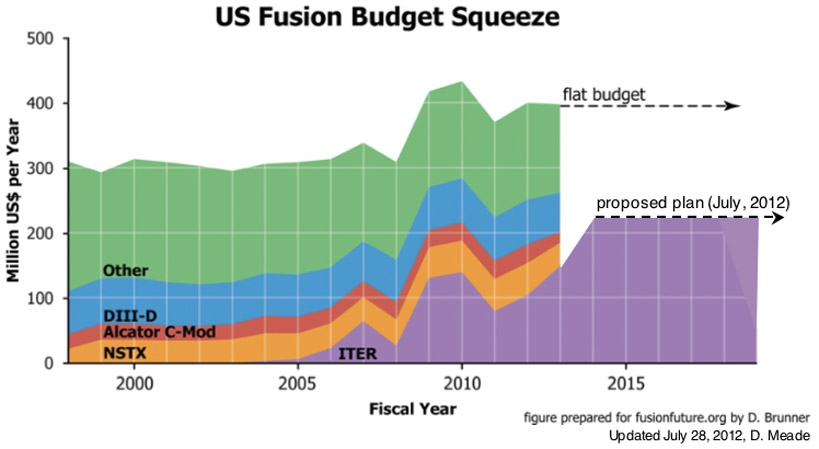
The problem for the U.S. is that participation in ITER doesn't make sense without a strong domestic program in place to take advantage of the results that come out of it. And without a (temporary) surge in U.S. fusion funding to get over the ITER construction "hump", the entire domestic program might be "squeezed" out of existence. Check out the graph here:
http://fire.pppl.gov/FusionFuture_USbudget_profile.jpg
So it's not so much a matter of "is ITER good science?" (it is!). The question is: "is ITER the right path for the U.S. at a cost of 9% of $20-billion or $25-billion, without a commitment to sustain the domestic program through the ITER construction phase?"
I urge everyone here to go to our website that we set up at fusionfuture.org, which has a lot of information about this issue. We still need your help - the House has restored funding for the domestic fusion program, but the current Senate version of the bill still has the domestic fusion budget slashed (and the fusion experiment at MIT entirely closed down). There is still work to do!
-
This is an ongoing debate
Ph.D student in fusion here. (I was one of the authors of this Ask Slashdot.)
It's important to note that there are a range of opinions on this. Everyone thinks ITER is a good idea, at the right price. That price was originally quoted at $5-billion (with the U.S. picking up 9% of that) when the U.S. made the decision to join in 2003; today the construction cost is estimated at somewhere north of $20-billion. Hopefully now with Motojima as Director-General, this cost will stop rising. (From what I hear, he's being very rigorous about cost and schedule control and pushing the team hard on these fronts.)
The problem for the U.S. is that participation in ITER doesn't make sense without a strong domestic program in place to take advantage of the results that come out of it. And without a (temporary) surge in U.S. fusion funding to get over the ITER construction "hump", the entire domestic program might be "squeezed" out of existence. Check out the graph here:
http://fire.pppl.gov/FusionFuture_USbudget_profile.jpg
So it's not so much a matter of "is ITER good science?" (it is!). The question is: "is ITER the right path for the U.S. at a cost of 9% of $20-billion or $25-billion, without a commitment to sustain the domestic program through the ITER construction phase?"
I urge everyone here to go to our website that we set up at fusionfuture.org, which has a lot of information about this issue. We still need your help - the House has restored funding for the domestic fusion program, but the current Senate version of the bill still has the domestic fusion budget slashed (and the fusion experiment at MIT entirely closed down). There is still work to do!
-
We need your help - fusionfuture.org
Hi all, Geoff Olynyk here, one of the interview participants.
It was linked in the interview, but I wanted to point out that some of us have put together a website, fusionfuture.org with information about fusion and a really easy-to-use link to urge Congress not to cut fusion funding in the 2013 budget. They are planning to shut down the MIT fusion experiment (Alcator C-Mod) this fall!
If you go to the website (www.fusionfuture.org), and click the "Contact Congress Now" button at right, it literally only takes a minute to send letters to the Department of Energy and your Representative and Senators. We need your help to ensure that this important research continues in the United States!
Thanks everyone.
-
We need your help - fusionfuture.org
Hi all, Geoff Olynyk here, one of the interview participants.
It was linked in the interview, but I wanted to point out that some of us have put together a website, fusionfuture.org with information about fusion and a really easy-to-use link to urge Congress not to cut fusion funding in the 2013 budget. They are planning to shut down the MIT fusion experiment (Alcator C-Mod) this fall!
If you go to the website (www.fusionfuture.org), and click the "Contact Congress Now" button at right, it literally only takes a minute to send letters to the Department of Energy and your Representative and Senators. We need your help to ensure that this important research continues in the United States!
Thanks everyone.
-
Re:Very brief summary / Obligatory XKCD
So put your mouth where your money is.
-
Re:Best Ask Slashdot Ever
Hello. I am not exactly sure of the answer to this question. Our current funding it provided by a DOE contract but I am not sure if there is anything that would prevent us from raising money directly. I am not aware of any such rule. The only problem is, this is very large scale science which is expensive (the current budget proposal for 2013 cuts our budget by 18 million dollars). It would most likely be quite difficult to raise that kind of money yearly to support or research. People in our field both in the US and aboard actually think that the current funding proposal is ill-advised and have contacted Congress and DOE to express their opinions. Government funding is essentially for our continued operation and the continued training of fusion researchers in the US. We are currently trying to inform the public about the situation, provide them with useful information about fusion energy, and provide people with an avenue to support US fusion reserach if they desire. We have set up a website, FusionFuture.org which make it easy to support fusion with just 1-2 minutes of time. I encourage you to check it out, even if you just want some additional information on Fusion and our facility, Alcator C-Mod.