Slashdot Mirror
Domain: interestingengineering.com
Stories and comments across the archive that link to interestingengineering.com.
Comments · 11
-
Re:Culture?Yep, culture. The same is true here in neighboring Austria. There's probably a quarter? a third? of countries that don't accept credit cards. It's just part of the culture - carry cash (sometimes a lot of it) with you everywhere. For larger items, do a bank transfer.
.
It's always a really weird juxtaposition when I read stories about Sweden (or other countries) going cashless: https://interestingengineering.com/sweden-how-to-live-in-the-worlds-first-cashless-society . It's neat, but it's so wildly different from the culture here in central Europe.
-
Very unlike training for driving a car
... pilots trained to fly one of these planes with hundreds of passengers are also trained how to handle all kinds of emergency situations. Additionally they have some kind of emergency manual (Quick Reference Handbook = QRH) at hand detailing procedures for all kind of in flight emergencies.
"Less than a minute" (*) is still sufficient time to switch off a system if you're trained to identify the problem and do that in such a situation, it might even be enough time to find the instructions in the QRH and implement them.
AFAIK pilots accused Boeing of being not properly informed about the characteristics of the MCAS-System, that probably means they weren't informed how to identify failure modes and/or how to react to them (i.e. switch the thing off).
(*)
According to this it's less than 40 seconds:
https://interestingengineering... -
Re:Selling phones because they are expensive
Lamborghini used to be a brand, now it's a kind of Volkswagen and gets blown off the road by much cheaper Teslas.
-
Re:100%
Multiple studies have shown that 100% of energy needs can be met by renewables. We don't need fossil fuels. Here's a few... try Google for more... https://interestingengineering... https://physicsworld.com/a/100... https://www.sciencedirect.com/...
Then how come we aren't?
Because of rich guys in top hats smoking cigars, cackling with glee as the planet burns?
-
Re:100%
Multiple studies have shown that 100% of energy needs can be met by renewables. We don't need fossil fuels.
Here's a few... try Google for more...
https://interestingengineering...
https://physicsworld.com/a/100...
https://www.sciencedirect.com/... -
Re:Yeah, right...
Recently some Google employees got upset about weaponized AI. This is just a press release to make their employees feel good, it doesn't need to be practical (Google employees on average aren't the sharpest tools in the drawer).
-
Re:This time it actually worked
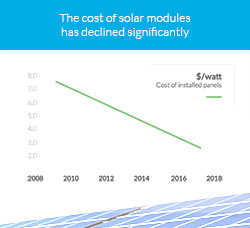
Not sure where you get your data from. Every source I see says that polysilicon was far and away the driving factor behind solar panel cost (http://costofsolar.com/management/uploads/2013/12/solar-pv-cost-trend.png). Only recently did other factors supplant polysilicon costs as a primary cost driver:
And lowering poly cost was, of course, one of the many technical achievements of the old DOE program.
https://interestingengineering...
"According to Deutsche Bank, the total costs for leading Chinese modules have fallen from $1.31 a watt in 2011 to around $0.50/W in 2014,
I suppose that last little bit is important, too, although the drop from a dollar a watt to fifty cents a watt is not nearly as important as the drop from seventy-five dollars a watt to a few dollars a watt. At either fifty cents a watt or a dollar a watt, installation costs dominate over panel purchase cost.
Here's a graph of solar cost from 1977, about when the ERDA program started: https://www.sunrun.com/sites/d... That drop from 1.31 to 0.50 you talk about is the tiny little bit at the end. You can see it if you kinda squint.
primarily due to cost reductions in processing, polysilicon and an improvement in conversion efficiencies. The company also believes that further price reductions will occur in response to improvements in scale and operating efficiencies. Polysilicon used to be the major cost component in solar pricing but now only represents 10 to 11 cents per watt."
The fact that you don't seem to know about the decades-long ERDA and DOE programs doesn't mean that they didn't exist. I suppose you can call this the best kind of government program-- the kind where, at the end, the people making panels say "I did it all myself! The market works!"
-
Re:This time it actually workedNot sure where you get your data from. Every source I see says that polysilicon was far and away the driving factor behind solar panel cost (http://costofsolar.com/management/uploads/2013/12/solar-pv-cost-trend.png). Only recently did other factors supplant polysilicon costs as a primary cost driver: https://interestingengineering...
"According to Deutsche Bank, the total costs for leading Chinese modules have fallen from $1.31 a watt in 2011 to around $0.50/W in 2014, primarily due to cost reductions in processing, polysilicon and an improvement in conversion efficiencies. The company also believes that further price reductions will occur in response to improvements in scale and operating efficiencies. Polysilicon used to be the major cost component in solar pricing but now only represents 10 to 11 cents per watt."
-
Re:Round and round...
A quick google search shows many of these. Anything change or is this a publicity advert for David Beckham? Google images magnus effect ship.
-
Re:Sutures
-
Re:Not that tough.
So it's completely useless because you can't use it to make 0.001% of specialty components that have only existed for the past thirty years or so? (By the way, what am I supposed to make of this, then?)