Slashdot Mirror
Domain: kev009.com
Stories and comments across the archive that link to kev009.com.
Comments · 5
-
Re:Tired it a few weeks ago
Absurd?
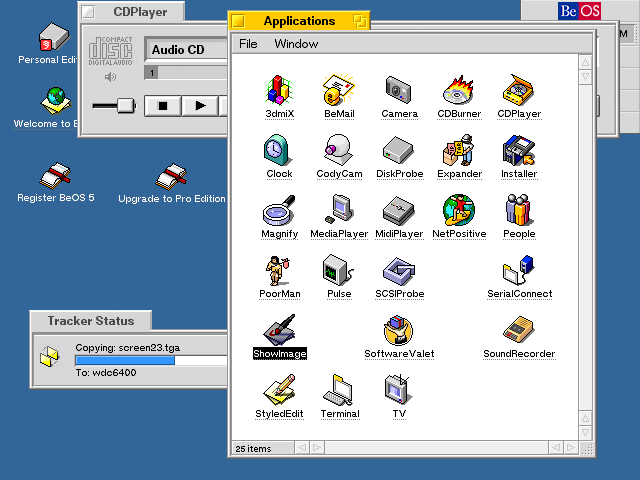
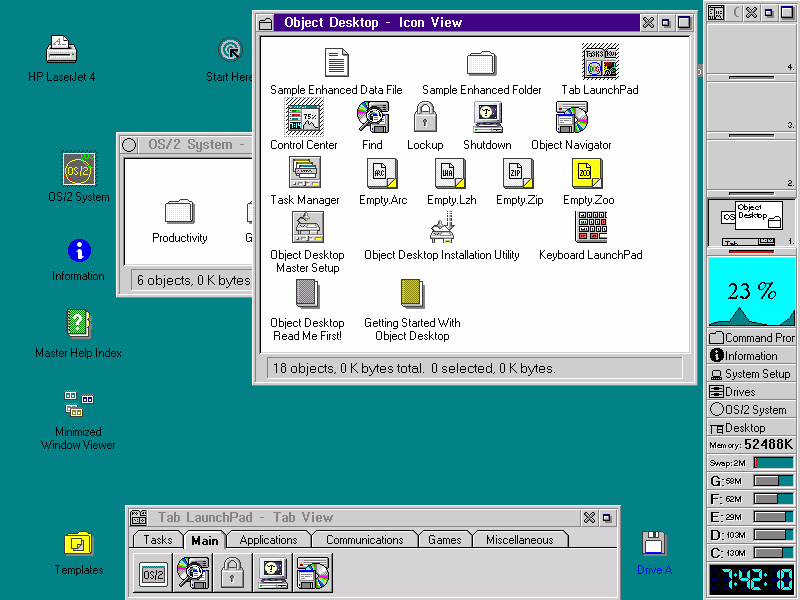
No. The ones I know which worked just fine.I used MUI + MagicWB because it's an improvement over AmigaOS Workbench but still about the same. Afterstep because Next, NextStep, Steve Jobs and that it was a decent UI. I guess BeOS and OS/2 could had been thrown in too:
http://lowendmac.com/wp-conten...
http://ps-2.kev009.com/michaln...
CDE because it's the standard(?) or was on Solaris machines(?), I don't know what it replaced if anything.
FVWM is very configurable so I don't know if any of the looks are standard but it's old, known and look typical enough.All those in total are six different examples of user-interfaces I think look pretty decent. They are all "complete different" which was kinda a joke with saying "the standard" but on the other hand looking at them like this they kinda all is very similar with highlightened and shaded buttons to give them a 3D feel / separate them, and lines and grey. Maybe it's not the best user-interface but it's very clear were everything is.
Like now I use Chrome but if I minimize this window then Steam sit behinds with it's completely own user-interface with much smaller buttons so I can't simply press on the same spot multiple times to minimize all my windows because they don't line up. How much of a crappy design isn't that?
Also the damn close button which sit in the corner of the window where if the window for whatever reason isn't fully maximized you may accidentally close some other window behind it or whatever it is which may happen. Also in Windows the close button sit together with the rest and even up until this day not all programs KNOW TO ASK WHATEVER ONE REALLY WANT TO CLOSE THEM DOWN!! Something like Chrome will just close the window / shut down and that's it. No "Do you really want to close this window with 35 tabs?" - no such thing, just close it all down!! No worries!
One the one hand I've kinda liked custom user interfaces when they are done right - like with Adobe Lightroom maybe I can accept it - I guess the difference is within whatever they live on a separate full screen themselves and have their own work-space or whatever they are windowed applications sharing the environment and space with other programs.
I guess in general I'm against non-standard user-interfaces AS LONG AS THE STANDARD IS A GOOD ONE.
Take KDE for instance - tool-bars, large tabs, vertical text written in rotated mode! Tree structures for selections here and there. I hate it. I'm ok with KDE as such but the user-interface is shit. I like that it's one environment but the user-interface used for it all isn't the best it could be IMHO.
In Windows I hate that I can't pull a drawer from explorer into a file selector dialog to enter that directory (or a file either I guess), I have to navigate through their explorer within the file selector dialog.I don't really know how this is on topic on the user-interfaces above let alone the
Oh well, back to topic then I guess:
I liked the old Opera - I like clever features and Opera was the inventor of many of them. The new Opera (and Edge) lost capabilities and I hate that. However Opera doesn't follow the native user-interface and I don't like that. I dislike tabs which somehow holds close gadgets within them which will be really cramped and when you want to switch tab you may eventually close one instead because supposedly it also held a close gadget.
So much poor design in user-interfaces. But I like the FEATURES of the good old Opera and Vivaldi. -
Re: file transfer
I dont know if you are serious or not--
No. No ancient aliens. ESDI was in use in server equipment from that era. 200mb ESDI interface drives were pretty common inside IBM PS/2 series towers of that era.
Specifically, found inside IBM PS/2 model 60 systems.
http://ps-2.kev009.com/pcpartn...These featured an MCA ESDI hard disk interface in the later models. (Early models had MFM controllers.)
If you suspect aliens, please inform the person selling this 680mb ESDI drive on Ebay.
http://www.ebay.ca/itm/MICROSC...
MFM and ESDI technology didn't get much beyond the 600-700mb before it was completely eliminated, but you CAN find drives that large with that interface type.
No aliens involved.
-
Re:Favorite computer of all time: PowerBook 540c.
The Apple AUI connector was used on more than Apple machines. There was an IBM Microchannel Ethernet card that used it too.
-
Phoronix fluff
Phoronix has a history of questionable choices for their benchmark setups. Hardware, versions, and tuning are... cleverly chosen, almost as if there was a preconceived agenda with inevitable results. Not that there is one-- just like it seems like there is. And so colorfully presented! I remember when they tested ZFS on an i386 version of FreeBSD on a 1G laptop! Others have also noticed this Phoronix phenomenon:
http://forums.freebsd.org/archive/index.php/t-16396.html
http://www.kev009.com/wp/2008/12/phoronix-benchmarking-statistically-significant-and-other-performance-concerns/The whole point of Hurd, at least right now, is tangential to benchmarks. Nothing wrong with testing, of course, but I think the results should not be used for any long term planning. Nobody is planning on launching a business running on Hurd servers... yet.
-
Re:IBM Model M
I am indeed talking about the same Model M as the rest of the world, assuming they are talking about the keyboards shipped with IBM PS/2 computers starting from 1986 until the early ninties). The figure you refer to comes from United States Patent 4,118,611 granted in 1978. The XT and AT keyboards from 1984-1986 used the capacitance switches shown in the patent. The PS/2 Model Ms replaced those with a membrane under the keys, but still kept the buckling spring that is responsible for most of the noise and the tactile feel. The Japanese link on this page used to show some actual Model M keys sawed in half, where you could see both the buckling spring mechanism, as well as the membrane. Unfortunately the link is down at the moment.