Slashdot Mirror
Domain: ladyandtramp.com
Stories and comments across the archive that link to ladyandtramp.com.
Comments · 17
-
Legs, it had LEGSSpent four years on the flight deck of a carrier in the early '80's and watched many a 14 cat and trap and took a lot of pix of them (included busted ones). My favorite 14 shot.
But what I remember is the excitment of the senior officers and mission planners because the 14 had long legs compared to the old F-4. That means it carried more fuel and could fly longer without refueling. The F-4 could fly something like 5 minutes on afterburner. They were like sysadmins with a hot new box, coming up with ways to use those legs.
Funny though, the replacement F-18 is famous for short legs as well. Haven't heard that complaint about the F-35.
Anytime baby.
-
Re:Skepticism is well and good, but...Of course transparency is an obstactle, but seeing limits ground-based observation even when you build on mountain tops.
The pros are more and more often beating atmospheric seeing with technology. Look at the resolution the 8-meter ESO scopes in Chile are getting, not to mention WYIN and other new generation pro scopes - they are routinely putting the post WWII generation of large scopes to shame, especially at longer wavelengths. Amateurs have mastered technology to combat atmospheric seeing - that's exactly what is going on when you take a 500 avi images of a planet with a C-8 and a simple webcam and stack and process them to create a planetary image that blows away any photograph of that same planet taken by the 200-inch Hale telescope in the 1970s or earlier.
will happily look into it, instead of just dismissing the notion outright.
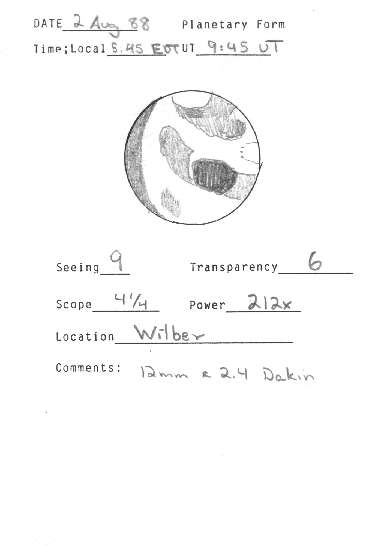
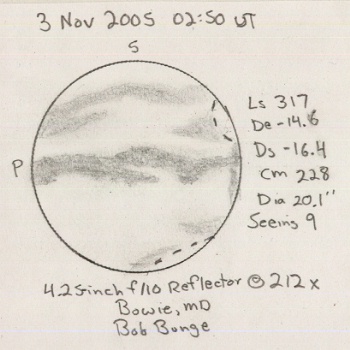
Who's dismissing it outright? Here are two drawings of Mars, 17 years apart, same telescope, even the same eyepieces:
Similar detail (my sketching ability certainly has improved!) under similar conditions. If I dig through my log books, bet I can find a couple of dozen similar examples. If there was a mid-term reduction in the quality of seeing conditions, I just think I would have recorded it and I haven't. Even I had recorded something, I'd still have to be skeptical that aircraft emissions were the cause when there are so many other variables that need to be factored out.
Hope you manage to get out and see the sky!
-
Re:Skepticism is well and good, but...Of course transparency is an obstactle, but seeing limits ground-based observation even when you build on mountain tops.
The pros are more and more often beating atmospheric seeing with technology. Look at the resolution the 8-meter ESO scopes in Chile are getting, not to mention WYIN and other new generation pro scopes - they are routinely putting the post WWII generation of large scopes to shame, especially at longer wavelengths. Amateurs have mastered technology to combat atmospheric seeing - that's exactly what is going on when you take a 500 avi images of a planet with a C-8 and a simple webcam and stack and process them to create a planetary image that blows away any photograph of that same planet taken by the 200-inch Hale telescope in the 1970s or earlier.
will happily look into it, instead of just dismissing the notion outright.
Who's dismissing it outright? Here are two drawings of Mars, 17 years apart, same telescope, even the same eyepieces:
Similar detail (my sketching ability certainly has improved!) under similar conditions. If I dig through my log books, bet I can find a couple of dozen similar examples. If there was a mid-term reduction in the quality of seeing conditions, I just think I would have recorded it and I haven't. Even I had recorded something, I'd still have to be skeptical that aircraft emissions were the cause when there are so many other variables that need to be factored out.
Hope you manage to get out and see the sky!
-
Re:hundreds of amateur images
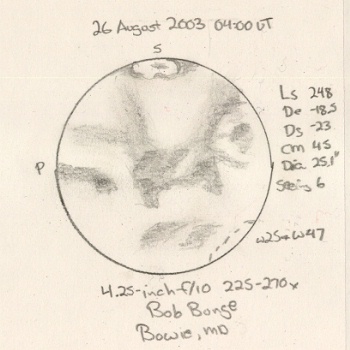
Nah, over the years, I've routinely used a 4-inch to see plenty of detail on Mars. Here's example from 2003.
-
A drawing of the comet
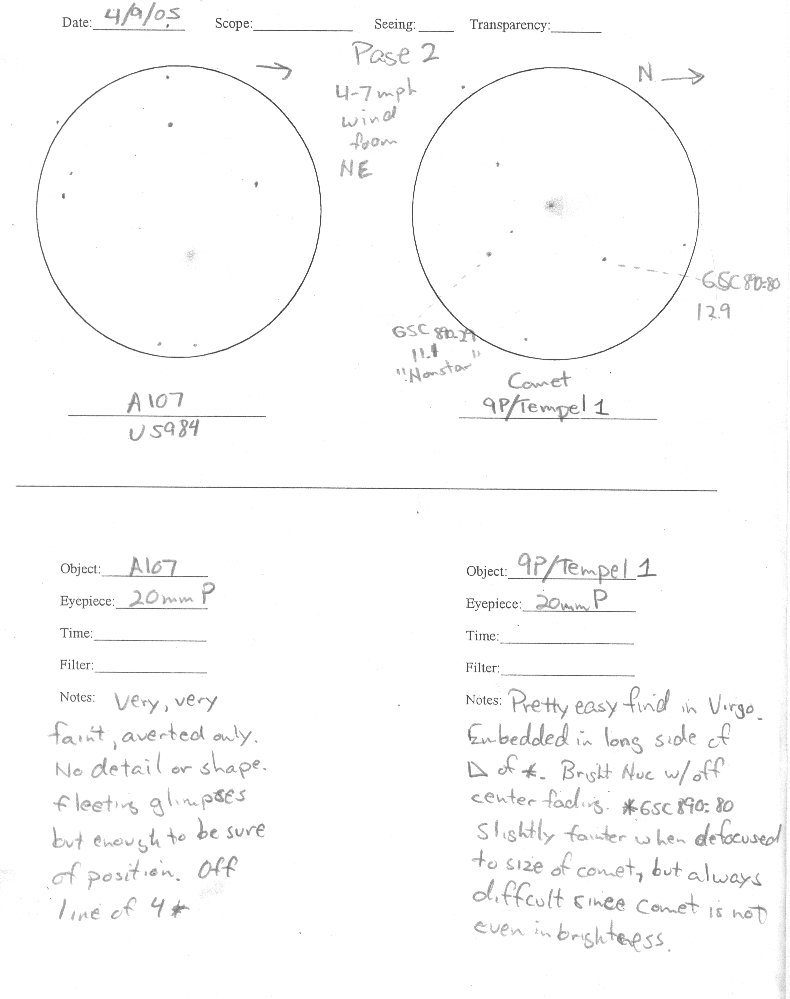
Last new moon, I made this visual visual drawing of the comet using this telescope.
-
A drawing of the comet
Last new moon, I made this visual visual drawing of the comet using this telescope.
-
Re:Is it just meWhen you look though an astronomical telescope, the image appears upside down. Since additional optics needed to flip the image are likely to slightly degrade the image we don't bother flipping the image.
Since astronomers have been images/drawing planets seen south down in telescopes for a hundred plus years, normal convention is to leave the image south down.
Of course NASA decides to do things their own way, so when they publish images from the Hubble Space Telescope they normally put north up (This "NASA's always right" attitude explains alot, IMHO).
Personal examples are drawings of Mars I've made this year are here.
-
Re:Overhyped "once-in-a-lifetime" statementsThe difference between 2001 and 2003 is actually quite striking. I'm seeing much more detail, partly because of the larger size, but also because Mars is higher in the sky, so the air is more steady.
The number one mistake most beginning Mars observers make is to not really look. A 30 second glance isn't enough. A five minute watch is better - that at least five actual minutes of eye against the eyepiece. Only watching for a long period of time will you see those moments of very good seeing (steadiness) where lots of detail pops out and becomes visible.
There is reason to get excited by this approach, and if you are really itching for 2005, then use this time around, to train your observing skills - and perhaps drawing skills - to prepare yourself for 2005. The more eyepiece time that you have, the more that you see.
JMHO
Here is my Mars blog. I think I'm up to about 25 drawings this time around. Don't know if I'll beat my record of 55 drawings that I made in 1988.
Clear Skies
-
Pitch and astronomical mirror makingI've had hands on contact with pitch for many years since you use it to polish and figure astronomical mirrors - a hobby of mine. It is pitch's odd behavior that makes it possible to even make (figure) and astronomical mirror (since you force the glass into a non-spherical shape).
Amateur Telescope Makers often call pitch "funny stuff" since it will behave in different ways with just minor changes in the environment or handling.
The cool thing is that someone figured out how to make use of the properties long before we understood why it does what it does.
-
Re:75,000 light-years from the Sunthat means what we are seeing of Palomar 5 actually took place around 75,000 years ago. I am no astronamer or astro physisist but is it possible that Palomar 5 is already gone.
No, I just saw it a couple of years ago in my 20-inch telescope.
Of course what I saw was 75k or so years old also. It is so strange to see referenced on CNN a pretty obscure object that perhaps less than 100 people have seen with their eyeballs (I first saw it in 1988) and not that many people had heard about prior to yesterday.
-
Re:I disagree.I agree to disagree. I've built many telescopes over the past 20 years and almost always build them cheaper then I could have bought them.
There are more manufacturers out there, now. That's a good thing since people who don't have the time can at least get in the hobby and even contribute to science.
And anyone who complains they aren't into astronomy because they live in the city and have to deal with light pollution, doesn't understand the hobby, the science and the technology completely.
You can build your own telescope, your own CCD camera, and a cheap PC to run it and do some great science and take some great pretty pictures all from a very light polluted area.
-
Interesting take...Actually, many serious amateur astronomers have played with webcams over the past few years. I played with a Logicom quickcam on a homebuilt 4-inch Reflector a couple years ago. By 2003 I'll have it mounted on a homebuilt 12-inch scope to image Mars.
I first played with CCD's on telescopes in 1987. It has come along way since then; in fact some early amateur astronomers turned image processing software developers have even contributed serious advances in image processing.
If you want to hack a really cool system, see how to build your own "Cookbook" cooled CCD camera and the related Cookbook camera website.
-
Interesting take...Actually, many serious amateur astronomers have played with webcams over the past few years. I played with a Logicom quickcam on a homebuilt 4-inch Reflector a couple years ago. By 2003 I'll have it mounted on a homebuilt 12-inch scope to image Mars.
I first played with CCD's on telescopes in 1987. It has come along way since then; in fact some early amateur astronomers turned image processing software developers have even contributed serious advances in image processing.
If you want to hack a really cool system, see how to build your own "Cookbook" cooled CCD camera and the related Cookbook camera website.
-
I'll third this...Get a pair of decent bincs (if you lose interest in astro, they are still very usefull);
Learn the sky. Be willing to travel out to dark skies. This takes AT LEAST a year!
Find and join a local astro club. Find these on the net... many astronerds are just that... nerds. There were more astronomers on the net in the early days...
Get active in the club, go out observing with them, astroheads aways want to show off their hardware, so you can get lots of chances to try before you buy;
Be patient: imaging is hard work, takes a pretty good investment and can become "work" pretty quickly;
Don't be blind to building your own scope with collected parts... sort of like putting together a PC. It's fun, it's entertaining, you know it, you can fix it, you love it. Lots of good groups around the web for this;
Read all the old Sky and Telescopes and ASTRONOMY magazines you can find. Check them out of a local library and read, read and read. Read everything, including the ads;
Don't get sucked in to the idea that "more expensive" is better. You can do some serious science or just have great fun with some of the cheap hardware;
I'm in my 21st year of amateur astronomy and still going strong... it's a blast. See:
My drawings of Mars - many made with a small 4-inch telescope.
Good luck!
-
I'll third this...Get a pair of decent bincs (if you lose interest in astro, they are still very usefull);
Learn the sky. Be willing to travel out to dark skies. This takes AT LEAST a year!
Find and join a local astro club. Find these on the net... many astronerds are just that... nerds. There were more astronomers on the net in the early days...
Get active in the club, go out observing with them, astroheads aways want to show off their hardware, so you can get lots of chances to try before you buy;
Be patient: imaging is hard work, takes a pretty good investment and can become "work" pretty quickly;
Don't be blind to building your own scope with collected parts... sort of like putting together a PC. It's fun, it's entertaining, you know it, you can fix it, you love it. Lots of good groups around the web for this;
Read all the old Sky and Telescopes and ASTRONOMY magazines you can find. Check them out of a local library and read, read and read. Read everything, including the ads;
Don't get sucked in to the idea that "more expensive" is better. You can do some serious science or just have great fun with some of the cheap hardware;
I'm in my 21st year of amateur astronomy and still going strong... it's a blast. See:
My drawings of Mars - many made with a small 4-inch telescope.
Good luck!
-
Re:Validity of meteorites.. from Mars?Apparently in the distant past, there was at least one impact event on Mars that was large enough to have thrown a good amount of Martian material into solar orbit. The Earth has sweep this material up over the ions and some of the pieces have survived entry into the Earth's atmosphere.
A good bet for the impact location on Mars is the Hellas Basin region. Because this is a low area on the surface of Mars, it is often covered with frost and can be pretty easy to see with a telescope at certain times.
If you look at a globe of Mars, it is interesting to realize that the massive volcanos of the Tharsis region is directly on the other side of the planet. In the image above, Hellas is the big crater to the lower right, Tharsis is left of center - look for four big "mountains."
A nice map as you see Mars in a telescope with markings labeled is here
And my drawings of Mars.
These rocks have a chemical make up that is completely different then any other meteorites found on Earth. Chemical studies of Martian soil done by the Viking spacecraft in the 1970's comfirmed that these rocks come from Mars.
There are lunar meteorites also.
-
From Skyline Drive in VirginiaPeaked at about 1400 per hour from Thorofare Mtn Overlook (3,600 feet) on Skyline Drive in Shenandoah National Park (about 90 miles west, southwest from Washington, DC) around 4:30 EST. Clouds/fog about 1000 feet below did a good job of blocking the light pollution from below, perhaps adding a quarter to half limiting magnitude to the skies.
Long and bright, short and bright, dim and short, exploding flashers, point source flashers, long ones that changed brightness as they skipped along, it was quite the show. Beat the 1998 show by quite a bit, if not because it lasted for four+ hours instead of the 45 minute tease we got in '98. Still not 100,000 per hour, though [:-)]
Before the main part of the show started, showed about 50 people M-42 and Saturn through my 20-inch dobsonian, many of which had never looked through a telescope before. Had spent the hours between 10pm and 2am chasing down some faint galaxies.
The overlook was gridlocked with cars by 4:30. By 5:30, cars were parked on both sides of Skyline drive and perhaps 500 people were at the overlook. Even as twilight overtook the sky, you could see bright meteors flashing across the western sky. Many stayed to watch sunrise over solid clouds as far as the eye could see.