Slashdot Mirror
Domain: larrysanger.org
Stories and comments across the archive that link to larrysanger.org.
Comments · 6
-
Re:I don't get it
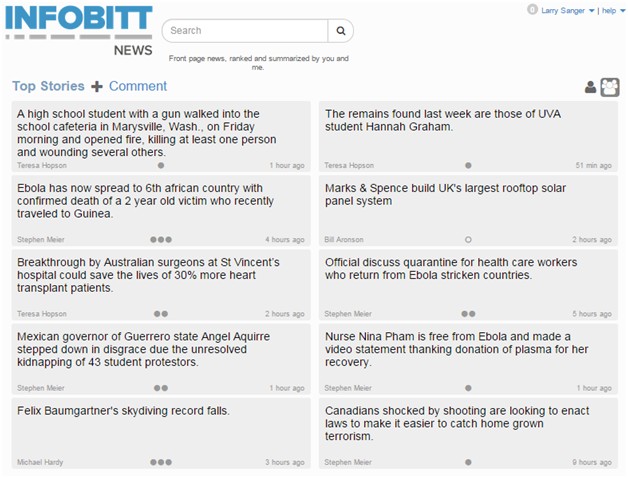
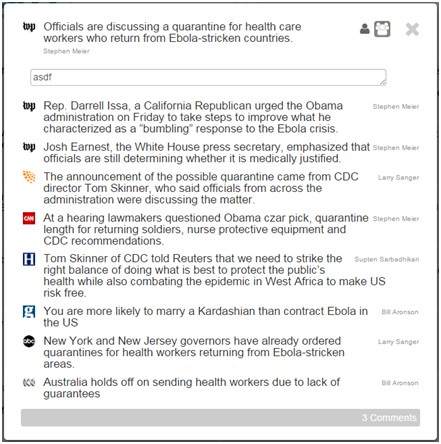
I'm a journalist. After looking at your samples http://larrysanger.org/wp-cont... http://larrysanger.org/wp-cont... I was wondering what the benefit is of Infobitt over Google News.
You had an Ebola story. I would define the task as gathering information, verifying it, identifying the important issues and organizing it. By that definition, I think the New York Times did a pretty good job. I got most of my information about it from Science magazine and New England Journal of Medicine. (The trade press covers stories with an order of magnitude more detail, they understand it better, and they know better how to identify the important issues and organize it.)
Jon Cohen did a lot of the Ebola coverage for Science. He covered the AIDS epidemic, wrote one of the leading books about it, and covered several other major epidemics around the world in the kind of detail Science magazine's PhD-level readers want to know. He has a salary that's enough to live comfortably and an expense account that can send him around the world. I can't imagine how crowd-sourced volunteers could ever deliver information about Ebola as well as Cohen could.
I could say the same for New England Journal of Medicine, JAMA, Lancet, BMJ, Reuters, and several other news sources. The big difference I notice is that your Bitt is a miscellaneous collection of stories, some of which is unverified bullshit, like Darrell Issa's pointless partisan attacks on Obama. There were easily 100 major stories on the Ebola quarantine that day. Why did you pick those 8?
If I were giving a journalism class, I would say, "A news story has to have a story."
There's a fire hose of information out there. The first job of a journalist is to throw out 99% of it. Then throw out another 90%. Then try to make some sense out of it.
For example, JAMA last week had 8 or 9 articles on the theme of reforming health care delivery.
http://jama.jamanetwork.com/is... Each of those articles illustrated one important aspect of the problem, and they all fit in together. They deliberately had one article that contradicts another article.Sorry to be so tough but that's the way editors treated me, and that's the way I treat reporters today. It's for their own good.
-
Re:I don't get it
I'm a journalist. After looking at your samples http://larrysanger.org/wp-cont... http://larrysanger.org/wp-cont... I was wondering what the benefit is of Infobitt over Google News.
You had an Ebola story. I would define the task as gathering information, verifying it, identifying the important issues and organizing it. By that definition, I think the New York Times did a pretty good job. I got most of my information about it from Science magazine and New England Journal of Medicine. (The trade press covers stories with an order of magnitude more detail, they understand it better, and they know better how to identify the important issues and organize it.)
Jon Cohen did a lot of the Ebola coverage for Science. He covered the AIDS epidemic, wrote one of the leading books about it, and covered several other major epidemics around the world in the kind of detail Science magazine's PhD-level readers want to know. He has a salary that's enough to live comfortably and an expense account that can send him around the world. I can't imagine how crowd-sourced volunteers could ever deliver information about Ebola as well as Cohen could.
I could say the same for New England Journal of Medicine, JAMA, Lancet, BMJ, Reuters, and several other news sources. The big difference I notice is that your Bitt is a miscellaneous collection of stories, some of which is unverified bullshit, like Darrell Issa's pointless partisan attacks on Obama. There were easily 100 major stories on the Ebola quarantine that day. Why did you pick those 8?
If I were giving a journalism class, I would say, "A news story has to have a story."
There's a fire hose of information out there. The first job of a journalist is to throw out 99% of it. Then throw out another 90%. Then try to make some sense out of it.
For example, JAMA last week had 8 or 9 articles on the theme of reforming health care delivery.
http://jama.jamanetwork.com/is... Each of those articles illustrated one important aspect of the problem, and they all fit in together. They deliberately had one article that contradicts another article.Sorry to be so tough but that's the way editors treated me, and that's the way I treat reporters today. It's for their own good.
-
Re:Use university essays to replace stubs?
“There is a cult of ignorance in the United States, and there has always been. The strain of anti-intellectualism has been a constant thread winding its way through our political and cultural life, nurtured by the false notion that democracy means that "my ignorance is just as good as your knowledge.” - Isaac Asimov
Wikipediocracy:1. Wikipedia disrespects and disregards scholars, experts, scientists, and others with special knowledge. Wikipedia specifically disregards authors with special knowledge, expertise, or credentials. There is no way for a real scholar to distinguish himself or herself from a random anonymous editor merely claiming scholarly credentials, and thus no claim of credentials is typically believed. Even when credentials are accepted, Wikipedia affords no special regard for expert editors contributing in their fields. This has driven most expert editors away from editing Wikipedia in their fields. Similarly, Wikipedia implements no controls that distinguish mature and educated editors from immature and uneducated ones.
Compare to Jimbulb Wales' response regarding expert certification of sections on articles on science and medicine:
"There's a notion that the way to get the very highest quality information is to have an expert certify it. But there's actually little evidence that this is true. There is far more evidence that the best way to get to high quality information is to have a thoughtful, open, public dialog and discussion and debate. To ask anyone with a concern to come forward and voice it reasonably. And to respond quickly and openly to errors."
So what we get with Shittypedia is what we've always gotten with shittypedia: lack of anything more than superficial "well it wer in the new york times durr" level research, people who engage in edit warring to "own" the articles, and the admins playing to push their personal POV or help their personal friends. Articles remain much, much worse because of the threads of anti-intellectualism running through the wikipedia culture. It's the "if it isn't on the internet it isn't worthy as a reference" crowd, and the "TL;DR" crowd.
And of course Jimbulb will never answer the other problem inherent to Wikipedia, which makes the anti-intellectual problem even worse:
3. Wikipedia’s administrators have become an entrenched and over-powerful elite, unresponsive and harmful to authors and contributors. Without meaningful checks and balances on administrators, administrative abuse is the norm, rather than the exception, with blocks and bans being enforced by fiat and whim, rather than in implementation of policy. Many well-meaning editors have been banned simply on suspicion of being previously banned users, without any transgression, while others have been banned for disagreeing with a powerful admin’s editorial point of view. There is no clear-cut code of ethics for administrators, no truly independent process leading to blocks and bans, no process for appeal that is not corrupted by the imbalance of power between admin and blocked editor, and no process by which administrators are reviewed regularly for misbehaviour.
4. Wikipedia’s numerous policies and procedures are not enforced equally on the community — popular or powerful editors are often exempted. Administrators, in particular, and former administrators, are frequently allowed to transgress (or change!) Wikipedia’s numerous “policies”, such as those prohibiting personal attacks, prohibiting the release of personal information about editors, and those prohibiting collusion in editing.
Ask yourself: why did Jimbulb hire "Essjay", KNOWING that the kid had lied and misrepresented himself as a topic area expert (claiming to have a doctorate and b
-
Re:links?
Main link is the last one in the summary: http://larrysanger.org/2012/05/what-should-we-do-about-wikipedias-porn-problem/
-
Big ol' reply post
Hi all, author of TFA here. I have a bunch of replies, which address many of the things said here on Slashdot, on my blog.
-
Re:Not anti-intellectualism
Well, there's more to the post than the "college is a waste of time" thing. Scan down for the points (numbered 1-5) that I'm calling anti-intellectual. "College is a waste of time" is one only of them. And besides, if you'll look at Dale Stephens' CNN article, you'll see plenty of anti-intellectual notes.