Slashdot Mirror
Domain: mantleplumes.org
Stories and comments across the archive that link to mantleplumes.org.
Comments · 8
-
Sorry, missing refs.
Canada kimberlites:
Greenland kimberlites: and
African Karoo missing lava sills here and here
Also... I forgot to mention that we really do see a huge scatter in the data for the age of the moon rocks: here .
And yes, that last guy is a creation scientist. I don't happen to agree with his conclusions, but I agree with his methods a lot faster than with those of a lot of proponents of "standard" conclusions. I happen to think that our real science, as you might call it, is driven by those who -- while disagreeing with the creation scientists -- still listen to them, especially when they say "you have an inconsistency here" or "I disagree with your statistics there", etc.
-
Re:hypothesis #1Actually, I have wondered whether perhaps the moon came out of asteroid bombardment, not by aliens, but by Permian/ordovician intelligent life.
The reasoning behind my speculation is as follows:
(1) According to an article in Science News and others referenced from Slashdot, the Moon appears to be from 2 moons, both from the mantle, no major asteroid content, thus no mars-sized asteroid.
(2) If that is the case, then the best explanation is de Meijer's critical georeactor theory: calcium bergs blew up in the mantle. But...
(3) the de Meijer theory falls down based on the fact that the uranium/calcium bergs would create enough vapor pressure in going critical, that they wouldn't go sufficiently supercritical to blow out a major fraction of the moon, unless a *small* asteroid knocked one of them into the center of a group, or if another blast created shockwaves that compressed a collection of U-Ca bergs together. So it *does* require a small asteroid.
(4) If that is so, then due to the neutron bombardment, the U-Th, U-Pb, Pb-Pb dating of rocks is going to be off, but there will be great scatter in the estimated ages, and the event will be more recent than the dating indicates (2.3- billion years). But
(5) we have earth rocks that date older than that, too. So we should have evidence of the locations. That is, the Earth's crust should show evidence of the blast.
(6) Such a blast would shatter the Earth's crust, leaving rings of Kimberlites around the blast zone, that dated younger (because the rings are structural failures, and less contaminated by neutrons), while the center would date older, being more contaminated.
(7) Two such locations exist: the 850 mi-radius ring of Kimberlites around the Hudson Bay (search Canada kimberlite, and Greenland kimberlite), and the ring of Kimberlites around Vredefort that stretches from Brazil, through Africa, through North India, and into Austrailia.
(8) According to plate tectonics, both rings align correctly at the Permian extinction. Both rings have central rocks dating to about the age of the moon,
(9) At the site of the Vredefort blast, you have an area called the African Karoo. The lava sills (light gray in this picture) are excluded from a region which is heavy in Kimberlites, and indeed includes the city of Kimberly. The shape, size, and location of the excluded zone, at 230 ma ago, exactly matches the shape size and location of the Scotia plate, which remains volcanic to this day.
What this makes me think happened, is that an asteroid hit at an oblique angle at the location of a collection of georeactors, near the South Sandwich islands. The blast went supercritical, and blew out a close to half of the moon. most of the blast going back through the asteroid scar, but a lot of it going straight out. Crustally speaking, the blast destroyed whatever continent existed to the west.
The blast also sent shock waves through the earth. 1/3 of the way around the globe, another collection of georeactors was forced supercritical, creating a symmetrically round blast (the Hudson and its k
-
Re:What "new methods and instruments" ?
Mantle plumes and mantle processes in general are integral to continental break-up and the development of sedimentary (rift) basins, within continents and along continental margins. Petroleum companies are very interested in mantle processes and basin development (it's a branch of geology called Basin Analysis); some of the worlds largest oil and gas fields are found in sedimentary basins along rifted continental margins.
Near me to the west of Ireland, there's the Corrib, Slyne, Porcupine & Rockall Basins to name a few, these were formed when the North Atlantic opened up in the last 60 million years. That break-up was caused in large part by the Iceland Plume and furthermore, it appears that fluctuations in the strength of the Iceland Plume over time caused land uplift and erosion (and thus production of sediments into those basins i.e. oil/gas trap rock). The reason why there was uplift is poorly understood.
Mantle plumes definitely exist (Iceland would be underwater without it's buoyant plume impinging on and lifting up the crust). The question is, what depth do plumes start? At the core-mantle boundary ~2900 km or near the upper/lower mantle boundary ~660 km depth? The Iceland plume has been imaged to ~400 km depth using seismic tomography. This new project will extend the depth imaged beyond the crucial 660 km boundary.
An Iceland hotspot saga by Ingi orleifur Bjarnason
-
Re:Cite?
If I did you wouldn't know the difference, apparently. This is ok reference on the East Africa Rift. And this talks about abandoned arms. This talks about membrane stresses and fault angles. I could go on. Just google on "triple junction", "failed arm", "rift system", etc. What I said really is geology 101. You simply can't spread along 3 axes. Afar may flood with sea water, but it will never be an ocean basin as the original article suggests.
-
Re:Liquid CoresI am making lots of replies in this interestig thread.
I used to think the radioactic heating was from core material, but the bulk of it is from mantle material: primarily from Th, U and K.
Of course, many have different opinions as to the distribution of the radioactives and the need to assume the abundances others have put forth. This is an interesting article to show some of those assumptions.
-
Re:In A World Where...The 'super volcano' risk sounds completely bogus... over time the earth is cooling (radiologically) so statistically the odds of something happening becomes less and less.
The Earth cools very slowly. So slowly that eruptions now are probably not significantly different from eruptions tens of millions of years ago. The same effect occurs on a local scale. For example, the Yellowstone caldera started out (16 million years ago) far more active than it currently is. But the hotspot probably has cooled significantly in the meantime.
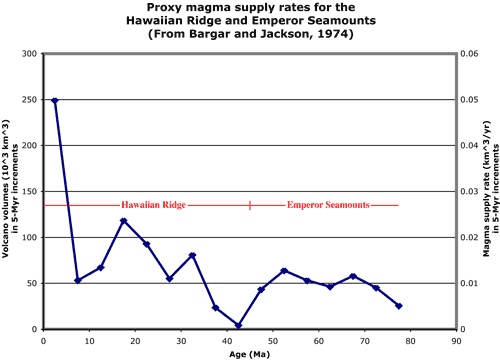
On the other hand, I suspect that the Hawaii hotspot is at least as active as it's ever been. This graph from here claims a substantial increase in the hotspot's activity in the past five million years.
Given two sizeable eruptions Tambora in 1815 in Indonesia and Santorini in the Aegean Sea somewhere around 1650-1600 BC.
-
Re:In A World Where...The 'super volcano' risk sounds completely bogus... over time the earth is cooling (radiologically) so statistically the odds of something happening becomes less and less.
The Earth cools very slowly. So slowly that eruptions now are probably not significantly different from eruptions tens of millions of years ago. The same effect occurs on a local scale. For example, the Yellowstone caldera started out (16 million years ago) far more active than it currently is. But the hotspot probably has cooled significantly in the meantime.
On the other hand, I suspect that the Hawaii hotspot is at least as active as it's ever been. This graph from here claims a substantial increase in the hotspot's activity in the past five million years.
Given two sizeable eruptions Tambora in 1815 in Indonesia and Santorini in the Aegean Sea somewhere around 1650-1600 BC.
-
Re:Hype
Yes, seismic tomography has been around for at least 30 years. Around that time I remember seeing pictures of the Pacific Ocean plate being subducted under California. For an interesting article that places the current article in context, see Plumes From the Core Lost and Found.