Slashdot Mirror
Domain: moneyweek.com
Stories and comments across the archive that link to moneyweek.com.
Comments · 9
-
Union membership is a good idea
Some people have an irrational and emotional dislike of trade unions and are not afraid to show it, with words such as fools, idiots, morons, and so on. Crispin Odey the president of a 12-billion-dollar hedge fund would like to disagree with you: “... there is huge value in being in a union at the moment.” http://moneyweek.com/merryns-b...
-
Re:Not just Reno
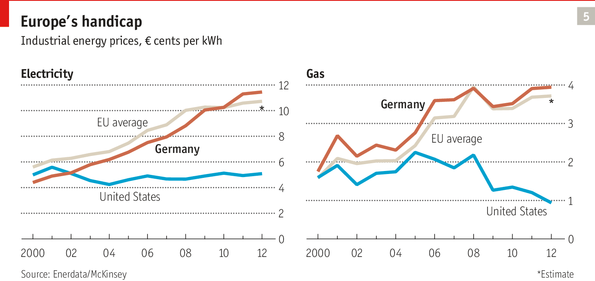
How much of that comes from their invesment in renewable energy, though? Other neighboring European countries that have not invested in renewables have comparable prices, as shown on this map. Denmark is 13% more expensive and Italy is 15% less expensive and the UK is 36% less expensive. Germany is towards the top there, but it is not an outlier. There are a few countries with prices comparable to the USA in the EU, such as Estonia which is 2.4 times chepear than Germany. But it seems strange to claim that the main difference between Germany and Estonia is the amount of renewables. And as this image shows, the price of electricity in Germany has been following the average in the European Union for some time now, which again doesn't match with the hypothesis that power in Germany is more expensive than in the USA because of all the solar power.
Not to mention, I'd be curious how much the US electrical prices might rise if our tax dollars stopped subsidizing certain areas of the energy sector. I know we subsidize oil, so I assume we also give tax breaks and other forms of encouragement to things like natural gas and coal.
-
Re:Not just Reno
How much of that comes from their invesment in renewable energy, though? Other neighboring European countries that have not invested in renewables have comparable prices, as shown on this map. Denmark is 13% more expensive and Italy is 15% less expensive and the UK is 36% less expensive. Germany is towards the top there, but it is not an outlier. There are a few countries with prices comparable to the USA in the EU, such as Estonia which is 2.4 times chepear than Germany. But it seems strange to claim that the main difference between Germany and Estonia is the amount of renewables. And as this image shows, the price of electricity in Germany has been following the average in the European Union for some time now, which again doesn't match with the hypothesis that power in Germany is more expensive than in the USA because of all the solar power.
-
I am in that industry and working in Australia
I work in the industry. Stock exchanges (and futures, options etc) and investors use a variety of protocols to distribute stock prices and accept orders and there is a huge variety of middleware and endware involved.
Learn about the FIX protocol, learn about the basics of multicast binary protocols, and learn a bit about how basic stock trading works (or indeed even just namedrop all those things during an interview) and all other things being equal you should be able to get a job working on or with such software.
Some links you might find useful:
http://fixprotocol.org/
http://fixprotocol.org/fast/
http://www.moneyweek.com/tutorials -
Re:Article Has a Very Strange Conflict
I live where we don't trust Government statistics and notice all four major currencies in a devaluation race and gold at 1500 USD an ounce.
Also, have a look at this, it's a long term graph showing the real value of sterling since 1750.
http://www.moneyweek.com/~/media/MoneyWeek/2011/110411/11-04-13-MM01.ashx?w=450&h=279&as=1
Inflation in the UK is rising and has just topped 4%. It'll be worse in the USA.
-
Re:It's Worse Than You think!
http://groups.google.com/group/soc.culture.korean/browse_thread/thread/63a135baa9ae8b87
> Average annual income: Taiwan US$16563, Korea US$19921
> PPP: Taiwan US$32041, Korea US$23331
PPP is the purchasing power.I.e., Because many items are much cheaper in Taiwan than in the US (partially because of laws the corporations have had passed to prevent importation of substantially cheaper medicine and items-- i.e. killing what should happen in a true capitalist economy), the $16,563 annual income allows a citizen of Taiwan to live as well as a person making $32041 dollars in the US. So they live about 3/4 as well as the average income $46,000 american citizen.
http://www.worldsalaries.org/taiwan.shtml
Personal Average Income (2005)
17,138 $US.
297,862 NT$For example:
http://www.footprintsrecruiting.com/cost-of-living-in-taiwan/cost-of-food-in-taiwan
Monthly expenses (for an expatriate english teacher)...* Rent: NT$10,000
* Utilities: NT$1,750
* Food: NT$7,500
* Transportation: NT$700
* Entertainment: NT$2,500
* Internet: NT $500
* Cell Phone: NT $1,000
* TOTAL: NT$23,950 (NT$256,000 annually)
---China and India have the lower wage structure, not Taiwan.
---
India has some advantages over the US for costs. Medical is about 20% of our cost (for nearly identical care for many procedures) and a college degree is about 10% of the cost. The college degree is going to be very intense (so like advanced placement classes here) but perhaps less creative and definitely less networking with other US people in your field.
Medical and University costs have grossly outpaced inflation for the last two decades in the US. Since I got my degree in 93, the cost of an in state degree has gone up 500%.
---
These lower prices are an artifact and they will shed away quickly. I think within 8 years. Wages here will stagnate and wages their will rise.
For exmample:
http://www.businessweek.com/magazine/content/06_13/b3977049.htm
"Last year salaries surged 40%, to an average of $160 a month.""Wait a minute. Doesn't China have an inexhaustible supply of cheap labor? Not any longer. From the textile and toy factories of the south to the corporate headquarters and research labs in Beijing and Shanghai, the No. 1 challenge today is finding and keeping good workers. "
http://www.moneyweek.com/news-and-charts/economics/what-chinas-changing-labour-market-means-for-the-west.aspx
Incomes are rising at double-digit rates - even rural incomes.http://www.forbes.com/2007/07/02/china-wage-growth-markets-econ-cx_jc_0702markets1.html
On a per-capita basis, the average Chinese worker earned an annual wage of 12,422 yuan ($1,630) in 2002, or 1,035 yuan ($136) per month. As of 2006, they were making 21,001 yuan ($2,756) a year, or 1,750 yuan ($230) a month.Chinese workers experienced 400% wage inflation at the lowest tiers from 1995 to 2006 alone. Wages for US workers went up about 50% in the same time period (wages for executives went from 85x us workers annual pay to 531x us workers annual pay) http://www.svsu.edu/emplibrary/Whelton%20article.pdf
I
-
Re:Question: How plentiful is Uranium?
How plentiful is Uranium for nuclear power?
This link is a pretty good read for that information. Current price of uranium is nowhere near the historic inflation-adjusted high ($75/pound versus $145/pound). However, the author gives some very good information on why the price will be skyrocketing soon:
-there's a gap between production and consumption that's currently being closed by using stockpiles, i.e. old Russian nukes. Once those are used up, that gap opens up again.
-there are many nuclear power plants coming online in the next decade or so. 28 are currently under construction, over 100 more in the next decade.
-at current rates of demand, we'll need 900 new nuclear plants by 2050 to keep up.
In short, it's plentiful now, but it won't be soon. -
The money supply to the UK is increasing at 14%pa
If you're not getting it, who is?
No idea what the US supply looks like. They decided you don't need to know that. -
Re:In related news
Sorry, you are correct, I misspoke. I didn't mean to write that the only growth sector was health care, I meant the write that economy was entirely stagnant without the healthcare sector. Or in other words, the net growth of the economy over the last 6 years is directly attributable to the health care sector.
It should be obvious then, that with the end of the housing bubble, comes the likely hood of a major recession.