Slashdot Mirror
Domain: nasa.gov
Stories and comments across the archive that link to nasa.gov.
Comments · 16,365
-
Re:Never mind Mars, what about the ISS?
No, but the parent was talking about retrofitting it so it would be a spacecraft. Most people don't realize this, but the Challenger was origionaly built as a test vehicle as well. Much like Enterprise. It was later retrofitted to become a full fledged orbiter. From the very site you cited:
"Rockwell's original $2.6 billion contract had authorized the building of a pair of static-test articles (MPTA-098 and STA-099 and two initial flight-test vehicles (OV-101 and OV-102. A decision in 1978 not to modify Enterprise from her Approach and Landing Test (ALT) configuration would have left Columbia as the only operational orbiter vehicle so on 1/29/79 NASA awarded Rockwell a supplemental contract to convert Challenger (STA-099) from a test vehicle into a space-rated Orbiter (OV-099)."
Also, although the Smithsonian now owns the Enterprise, it's not (yet) a museum piece. It's been sitting, in a hanger at Washington's Dulles International Airport, since... well, since the Smithsonian took delivery of the Enterprise in 1985.
There is good news though. The Smithsonian does have plans to display the Enterprise in it's new facility at the Dulles annex, when it opens (planned for December 2003).
So although converting the Enterprise probably won't happen, that doesn't mean it's technically impossible. It was done with Challenger. -
nasa website to upload pics/videos
-
web site to submit info/pics
-
Nasa's smoking gun?...
Found this interesting on Nasa's website:
"Because of evidence of plasma flow on the lower wing trailing edge and elevon leading edge tiles (wing/elevon cove) at the outboard elevon tip and inboard elevon, the LRSI tiles are replaced FRCI-12 and HRSI 22 tiles along with gap fillers on Discovery (OV-103) and Atlantis (OV-104). On Columbia (OV-102), only gap fillers are being installed in this area."
http://spaceflight.nasa.gov/shuttle/reference/shut ref/orbiter/tps/lrsitiles.html
Columbia was the only shuttle to keep the "old technology" tiles in this critical area.
This is the area where the first bad sensor readings came from. "At 7:53 a.m. Central Standard Time -- and all times will be Central Standard Time -- as we were over California, four left-hand elevon hydraulic return line temperature measurements dropped off scale, "
hmmmm... -
Re:Never mind Mars, what about the ISS?If they didn't retrofit Enterprise after Challenger, what makes you think they'd do that now?
More info on Enterprise(OV-101) from http://science.ksc.nasa.gov/shuttle/resources/orb
i ters/enterprise.htmlEnterprise, the first Space Shuttle Orbiter, was originally to be named Constitution (in honor of the U.S. Constitution's Bicentennial). However, viewers of the popular TV Science Fiction show Star Trek started a write-in campaign urging the White House to select the name Enterprise. Designated, OV-101, the vehicle was rolled out of Rockwell's Air Force Plant 42, Site 1 Palmdale California assembly facility on Sept. 17, 1976. On Jan. 31, 1977, it was transported 36 miles overland from Rockwell's assembly facility to NASA's Dryden Flight Research Facility at Edwards Air Force Base for the approach and landing test program.
The nine-month-long ALT program was conducted from February through November 1977 at the Dryden Flight Research Facility and demonstrated that the orbiter could fly in the atmosphere and land like an airplane, except without power-gliding flight.
Click here for the JSC Shuttle Approach and Landing Test Image server.
Two NASA astronaut crews-Fred Haise and Gordon Fullerton and Joe Engle and Dick Truly-took turns flying the 150,000-pound spacecraft to free-flight landings.
The ALT program involved ground tests and flight tests. The ground tests included taxi tests of the 747 shuttle carrier aircraft with the Enterprise mated atop the SCA to determine structural loads and responses and assess the mated capability in ground handling and control characteristics up to flight takeoff speed. The taxi tests also validated 747 steering and braking with the orbiter attached. A ground test of orbiter systems followed the unmanned captive tests. All orbiter systems were activated as they would be in atmospheric flight. This was the final preparation for the manned captive flight phase.
Five captive flights of the Enterprise mounted atop the SCA with the Enterprise unmanned and Enterprise's systems inert were conducted to assess the structural integrity and performance handling qualities of the mated craft.
Three manned captive flights that followed the five captive flights included an astronaut crew aboard the orbiter operating its flight control systems while the orbiter remained perched atop the SCA. These flights were designed to exercise and evaluate all systems in the flight environment in preparation for the orbiter release (free) flights. They included flutter tests of the mated craft at low and high speed, a separation trajectory test and a dress rehearsal for the first orbiter free flight.
In the five free flights the astronaut crew separated the spacecraft from the SCA and maneuvered to a landing at Edwards Air Force Base. In the first four such flights the landing was on a dry lake bed; in the fifth, the landing was on Edwards' main concrete runway under conditions simulating a return from space. The last two free flights were made without the tail cone, which is the spacecraft's configuration during an actual landing from Earth orbit. These flights verified the orbiter's pilot-guided approach and landing capability; demonstrated the orbiter's subsonic terminal area energy management autoland approach capability; and verified the orbiter's subsonic airworthiness, integrated system operation and selected subsystems in preparation for the first manned orbital flight. The flights demonstrated the orbiter's ability to approach and land safely with a minimum gross weight and using several center-of-gravity configurations.
For all of the captive flights and the first three free flights, the orbiter was outfitted with a tail cone covering its aft section to reduce aerodynamic drag and turbulence. The final two free flights were without the tail cone, and the three simulated space shuttle main engines and two orbital maneuvering system engines were exposed aerodynamically.
The final phase of the ALT program prepared the spacecraft for four ferry flights. Fluid systems were drained and purged, the tail cone was reinstalled, and elevon locks were installed. The forward attachment strut was replaced to lower the orbiter's cant from 6 to 3 degrees. This reduces drag to the mated vehicles during the ferry flights.
After the ferry flight tests, OV-101 was returned to the NASA hangar at the Dryden Flight Research Facility and modified for vertical ground vibration tests at the Marshall Space Flight Center, Huntsville, Ala.
On March 13, 1978, the Enterprise was ferried atop the SCA to NASA's Marshall Space Flight Center, where it was mated with the external tank and solid rocket boosters and subjected to a series of vertical ground vibration tests. These tested the mated configuration's critical structural dynamic response modes, which were assessed against analytical math models used to design the various element interfaces.
These were completed in March 1979. On April 10, 1979, the Enterprise was ferried to the Kennedy Space Center. mated with the external tank and solid rocket boosters and transported via the mobile launcher platform to Launch Complex 39-A. At Launch Complex 39-A, the Enterprise served as a practice and launch complex fit-check verification tool representing the flight vehicles.
It was ferried back to NASA's Dryden Flight Research Facility on Aug. 16, 1979, and then returned overland to Rockwell's Palmdale final assembly facility on Oct. 30, 1979. Certain components were refurbished for use on flight vehicles being assembled at Palmdale. The Enterprise was then returned overland to the Dryden Flight Research Facility on Sept. 6, 1981.
During May and June of 1983, Enterprise was ferried to the Paris, France, Air Show, as well as to Germany, Italy, England and Canada, and was returned to the Dryden Flight Research Facility.
In the April-October 1984 time period, Enterprise was ferried to Vandenberg Air Force Base in California and to Mobile, Ala. From there it was taken by barge to New Orleans, La., for the United States 1984 World's Fair.
In November 1984 it was ferried to Vandenberg Air Force Base and used as a practice and fit-check verification tool. On May 24, 1985, Enterprise was ferried from Vandenberg Air Force Base to NASA's Dryden Flight Research Facility.
On Sept. 20, 1985, Enterprise was ferried from Dryden Flight Research Facility to the Kennedy Space Center in Florida. On Nov. 18, 1985, Enterprise was ferried from the Kennedy Space Center to Dulles Airport, Washington, D.C., and became the property of the Smithsonian Institution. The Enterprise was built as a test vehicle and is not equipped for space flight.
Following in the Enterprise's, the orbiter Columbia was created and it became the first Space Shuttle to fly into Earth orbit in 1981. Four sister ships joined the fleet over the next 10 years: Challenger, arriving in 1982 but destroyed four years later; Discovery, 1983; Atlantis, 1985; and Endeavour, built as a replacement for Challenger, 1991.
In the day-to-day world of Shuttle operations and processing, Space Shuttle orbiters go by a more prosaic designation. Enterprise is commonly refered to as OV-101, for Orbiter Vehicle-101.
-
Re:Never mind Mars, what about the ISS?If they didn't retrofit Enterprise after Challenger, what makes you think they'd do that now?
More info on Enterprise(OV-101) from http://science.ksc.nasa.gov/shuttle/resources/orb
i ters/enterprise.htmlEnterprise, the first Space Shuttle Orbiter, was originally to be named Constitution (in honor of the U.S. Constitution's Bicentennial). However, viewers of the popular TV Science Fiction show Star Trek started a write-in campaign urging the White House to select the name Enterprise. Designated, OV-101, the vehicle was rolled out of Rockwell's Air Force Plant 42, Site 1 Palmdale California assembly facility on Sept. 17, 1976. On Jan. 31, 1977, it was transported 36 miles overland from Rockwell's assembly facility to NASA's Dryden Flight Research Facility at Edwards Air Force Base for the approach and landing test program.
The nine-month-long ALT program was conducted from February through November 1977 at the Dryden Flight Research Facility and demonstrated that the orbiter could fly in the atmosphere and land like an airplane, except without power-gliding flight.
Click here for the JSC Shuttle Approach and Landing Test Image server.
Two NASA astronaut crews-Fred Haise and Gordon Fullerton and Joe Engle and Dick Truly-took turns flying the 150,000-pound spacecraft to free-flight landings.
The ALT program involved ground tests and flight tests. The ground tests included taxi tests of the 747 shuttle carrier aircraft with the Enterprise mated atop the SCA to determine structural loads and responses and assess the mated capability in ground handling and control characteristics up to flight takeoff speed. The taxi tests also validated 747 steering and braking with the orbiter attached. A ground test of orbiter systems followed the unmanned captive tests. All orbiter systems were activated as they would be in atmospheric flight. This was the final preparation for the manned captive flight phase.
Five captive flights of the Enterprise mounted atop the SCA with the Enterprise unmanned and Enterprise's systems inert were conducted to assess the structural integrity and performance handling qualities of the mated craft.
Three manned captive flights that followed the five captive flights included an astronaut crew aboard the orbiter operating its flight control systems while the orbiter remained perched atop the SCA. These flights were designed to exercise and evaluate all systems in the flight environment in preparation for the orbiter release (free) flights. They included flutter tests of the mated craft at low and high speed, a separation trajectory test and a dress rehearsal for the first orbiter free flight.
In the five free flights the astronaut crew separated the spacecraft from the SCA and maneuvered to a landing at Edwards Air Force Base. In the first four such flights the landing was on a dry lake bed; in the fifth, the landing was on Edwards' main concrete runway under conditions simulating a return from space. The last two free flights were made without the tail cone, which is the spacecraft's configuration during an actual landing from Earth orbit. These flights verified the orbiter's pilot-guided approach and landing capability; demonstrated the orbiter's subsonic terminal area energy management autoland approach capability; and verified the orbiter's subsonic airworthiness, integrated system operation and selected subsystems in preparation for the first manned orbital flight. The flights demonstrated the orbiter's ability to approach and land safely with a minimum gross weight and using several center-of-gravity configurations.
For all of the captive flights and the first three free flights, the orbiter was outfitted with a tail cone covering its aft section to reduce aerodynamic drag and turbulence. The final two free flights were without the tail cone, and the three simulated space shuttle main engines and two orbital maneuvering system engines were exposed aerodynamically.
The final phase of the ALT program prepared the spacecraft for four ferry flights. Fluid systems were drained and purged, the tail cone was reinstalled, and elevon locks were installed. The forward attachment strut was replaced to lower the orbiter's cant from 6 to 3 degrees. This reduces drag to the mated vehicles during the ferry flights.
After the ferry flight tests, OV-101 was returned to the NASA hangar at the Dryden Flight Research Facility and modified for vertical ground vibration tests at the Marshall Space Flight Center, Huntsville, Ala.
On March 13, 1978, the Enterprise was ferried atop the SCA to NASA's Marshall Space Flight Center, where it was mated with the external tank and solid rocket boosters and subjected to a series of vertical ground vibration tests. These tested the mated configuration's critical structural dynamic response modes, which were assessed against analytical math models used to design the various element interfaces.
These were completed in March 1979. On April 10, 1979, the Enterprise was ferried to the Kennedy Space Center. mated with the external tank and solid rocket boosters and transported via the mobile launcher platform to Launch Complex 39-A. At Launch Complex 39-A, the Enterprise served as a practice and launch complex fit-check verification tool representing the flight vehicles.
It was ferried back to NASA's Dryden Flight Research Facility on Aug. 16, 1979, and then returned overland to Rockwell's Palmdale final assembly facility on Oct. 30, 1979. Certain components were refurbished for use on flight vehicles being assembled at Palmdale. The Enterprise was then returned overland to the Dryden Flight Research Facility on Sept. 6, 1981.
During May and June of 1983, Enterprise was ferried to the Paris, France, Air Show, as well as to Germany, Italy, England and Canada, and was returned to the Dryden Flight Research Facility.
In the April-October 1984 time period, Enterprise was ferried to Vandenberg Air Force Base in California and to Mobile, Ala. From there it was taken by barge to New Orleans, La., for the United States 1984 World's Fair.
In November 1984 it was ferried to Vandenberg Air Force Base and used as a practice and fit-check verification tool. On May 24, 1985, Enterprise was ferried from Vandenberg Air Force Base to NASA's Dryden Flight Research Facility.
On Sept. 20, 1985, Enterprise was ferried from Dryden Flight Research Facility to the Kennedy Space Center in Florida. On Nov. 18, 1985, Enterprise was ferried from the Kennedy Space Center to Dulles Airport, Washington, D.C., and became the property of the Smithsonian Institution. The Enterprise was built as a test vehicle and is not equipped for space flight.
Following in the Enterprise's, the orbiter Columbia was created and it became the first Space Shuttle to fly into Earth orbit in 1981. Four sister ships joined the fleet over the next 10 years: Challenger, arriving in 1982 but destroyed four years later; Discovery, 1983; Atlantis, 1985; and Endeavour, built as a replacement for Challenger, 1991.
In the day-to-day world of Shuttle operations and processing, Space Shuttle orbiters go by a more prosaic designation. Enterprise is commonly refered to as OV-101, for Orbiter Vehicle-101.
-
Re:Never mind Mars, what about the ISS?If they didn't retrofit Enterprise after Challenger, what makes you think they'd do that now?
More info on Enterprise(OV-101) from http://science.ksc.nasa.gov/shuttle/resources/orb
i ters/enterprise.htmlEnterprise, the first Space Shuttle Orbiter, was originally to be named Constitution (in honor of the U.S. Constitution's Bicentennial). However, viewers of the popular TV Science Fiction show Star Trek started a write-in campaign urging the White House to select the name Enterprise. Designated, OV-101, the vehicle was rolled out of Rockwell's Air Force Plant 42, Site 1 Palmdale California assembly facility on Sept. 17, 1976. On Jan. 31, 1977, it was transported 36 miles overland from Rockwell's assembly facility to NASA's Dryden Flight Research Facility at Edwards Air Force Base for the approach and landing test program.
The nine-month-long ALT program was conducted from February through November 1977 at the Dryden Flight Research Facility and demonstrated that the orbiter could fly in the atmosphere and land like an airplane, except without power-gliding flight.
Click here for the JSC Shuttle Approach and Landing Test Image server.
Two NASA astronaut crews-Fred Haise and Gordon Fullerton and Joe Engle and Dick Truly-took turns flying the 150,000-pound spacecraft to free-flight landings.
The ALT program involved ground tests and flight tests. The ground tests included taxi tests of the 747 shuttle carrier aircraft with the Enterprise mated atop the SCA to determine structural loads and responses and assess the mated capability in ground handling and control characteristics up to flight takeoff speed. The taxi tests also validated 747 steering and braking with the orbiter attached. A ground test of orbiter systems followed the unmanned captive tests. All orbiter systems were activated as they would be in atmospheric flight. This was the final preparation for the manned captive flight phase.
Five captive flights of the Enterprise mounted atop the SCA with the Enterprise unmanned and Enterprise's systems inert were conducted to assess the structural integrity and performance handling qualities of the mated craft.
Three manned captive flights that followed the five captive flights included an astronaut crew aboard the orbiter operating its flight control systems while the orbiter remained perched atop the SCA. These flights were designed to exercise and evaluate all systems in the flight environment in preparation for the orbiter release (free) flights. They included flutter tests of the mated craft at low and high speed, a separation trajectory test and a dress rehearsal for the first orbiter free flight.
In the five free flights the astronaut crew separated the spacecraft from the SCA and maneuvered to a landing at Edwards Air Force Base. In the first four such flights the landing was on a dry lake bed; in the fifth, the landing was on Edwards' main concrete runway under conditions simulating a return from space. The last two free flights were made without the tail cone, which is the spacecraft's configuration during an actual landing from Earth orbit. These flights verified the orbiter's pilot-guided approach and landing capability; demonstrated the orbiter's subsonic terminal area energy management autoland approach capability; and verified the orbiter's subsonic airworthiness, integrated system operation and selected subsystems in preparation for the first manned orbital flight. The flights demonstrated the orbiter's ability to approach and land safely with a minimum gross weight and using several center-of-gravity configurations.
For all of the captive flights and the first three free flights, the orbiter was outfitted with a tail cone covering its aft section to reduce aerodynamic drag and turbulence. The final two free flights were without the tail cone, and the three simulated space shuttle main engines and two orbital maneuvering system engines were exposed aerodynamically.
The final phase of the ALT program prepared the spacecraft for four ferry flights. Fluid systems were drained and purged, the tail cone was reinstalled, and elevon locks were installed. The forward attachment strut was replaced to lower the orbiter's cant from 6 to 3 degrees. This reduces drag to the mated vehicles during the ferry flights.
After the ferry flight tests, OV-101 was returned to the NASA hangar at the Dryden Flight Research Facility and modified for vertical ground vibration tests at the Marshall Space Flight Center, Huntsville, Ala.
On March 13, 1978, the Enterprise was ferried atop the SCA to NASA's Marshall Space Flight Center, where it was mated with the external tank and solid rocket boosters and subjected to a series of vertical ground vibration tests. These tested the mated configuration's critical structural dynamic response modes, which were assessed against analytical math models used to design the various element interfaces.
These were completed in March 1979. On April 10, 1979, the Enterprise was ferried to the Kennedy Space Center. mated with the external tank and solid rocket boosters and transported via the mobile launcher platform to Launch Complex 39-A. At Launch Complex 39-A, the Enterprise served as a practice and launch complex fit-check verification tool representing the flight vehicles.
It was ferried back to NASA's Dryden Flight Research Facility on Aug. 16, 1979, and then returned overland to Rockwell's Palmdale final assembly facility on Oct. 30, 1979. Certain components were refurbished for use on flight vehicles being assembled at Palmdale. The Enterprise was then returned overland to the Dryden Flight Research Facility on Sept. 6, 1981.
During May and June of 1983, Enterprise was ferried to the Paris, France, Air Show, as well as to Germany, Italy, England and Canada, and was returned to the Dryden Flight Research Facility.
In the April-October 1984 time period, Enterprise was ferried to Vandenberg Air Force Base in California and to Mobile, Ala. From there it was taken by barge to New Orleans, La., for the United States 1984 World's Fair.
In November 1984 it was ferried to Vandenberg Air Force Base and used as a practice and fit-check verification tool. On May 24, 1985, Enterprise was ferried from Vandenberg Air Force Base to NASA's Dryden Flight Research Facility.
On Sept. 20, 1985, Enterprise was ferried from Dryden Flight Research Facility to the Kennedy Space Center in Florida. On Nov. 18, 1985, Enterprise was ferried from the Kennedy Space Center to Dulles Airport, Washington, D.C., and became the property of the Smithsonian Institution. The Enterprise was built as a test vehicle and is not equipped for space flight.
Following in the Enterprise's, the orbiter Columbia was created and it became the first Space Shuttle to fly into Earth orbit in 1981. Four sister ships joined the fleet over the next 10 years: Challenger, arriving in 1982 but destroyed four years later; Discovery, 1983; Atlantis, 1985; and Endeavour, built as a replacement for Challenger, 1991.
In the day-to-day world of Shuttle operations and processing, Space Shuttle orbiters go by a more prosaic designation. Enterprise is commonly refered to as OV-101, for Orbiter Vehicle-101.
-
Re:Never mind Mars, what about the ISS?If they didn't retrofit Enterprise after Challenger, what makes you think they'd do that now?
More info on Enterprise(OV-101) from http://science.ksc.nasa.gov/shuttle/resources/orb
i ters/enterprise.htmlEnterprise, the first Space Shuttle Orbiter, was originally to be named Constitution (in honor of the U.S. Constitution's Bicentennial). However, viewers of the popular TV Science Fiction show Star Trek started a write-in campaign urging the White House to select the name Enterprise. Designated, OV-101, the vehicle was rolled out of Rockwell's Air Force Plant 42, Site 1 Palmdale California assembly facility on Sept. 17, 1976. On Jan. 31, 1977, it was transported 36 miles overland from Rockwell's assembly facility to NASA's Dryden Flight Research Facility at Edwards Air Force Base for the approach and landing test program.
The nine-month-long ALT program was conducted from February through November 1977 at the Dryden Flight Research Facility and demonstrated that the orbiter could fly in the atmosphere and land like an airplane, except without power-gliding flight.
Click here for the JSC Shuttle Approach and Landing Test Image server.
Two NASA astronaut crews-Fred Haise and Gordon Fullerton and Joe Engle and Dick Truly-took turns flying the 150,000-pound spacecraft to free-flight landings.
The ALT program involved ground tests and flight tests. The ground tests included taxi tests of the 747 shuttle carrier aircraft with the Enterprise mated atop the SCA to determine structural loads and responses and assess the mated capability in ground handling and control characteristics up to flight takeoff speed. The taxi tests also validated 747 steering and braking with the orbiter attached. A ground test of orbiter systems followed the unmanned captive tests. All orbiter systems were activated as they would be in atmospheric flight. This was the final preparation for the manned captive flight phase.
Five captive flights of the Enterprise mounted atop the SCA with the Enterprise unmanned and Enterprise's systems inert were conducted to assess the structural integrity and performance handling qualities of the mated craft.
Three manned captive flights that followed the five captive flights included an astronaut crew aboard the orbiter operating its flight control systems while the orbiter remained perched atop the SCA. These flights were designed to exercise and evaluate all systems in the flight environment in preparation for the orbiter release (free) flights. They included flutter tests of the mated craft at low and high speed, a separation trajectory test and a dress rehearsal for the first orbiter free flight.
In the five free flights the astronaut crew separated the spacecraft from the SCA and maneuvered to a landing at Edwards Air Force Base. In the first four such flights the landing was on a dry lake bed; in the fifth, the landing was on Edwards' main concrete runway under conditions simulating a return from space. The last two free flights were made without the tail cone, which is the spacecraft's configuration during an actual landing from Earth orbit. These flights verified the orbiter's pilot-guided approach and landing capability; demonstrated the orbiter's subsonic terminal area energy management autoland approach capability; and verified the orbiter's subsonic airworthiness, integrated system operation and selected subsystems in preparation for the first manned orbital flight. The flights demonstrated the orbiter's ability to approach and land safely with a minimum gross weight and using several center-of-gravity configurations.
For all of the captive flights and the first three free flights, the orbiter was outfitted with a tail cone covering its aft section to reduce aerodynamic drag and turbulence. The final two free flights were without the tail cone, and the three simulated space shuttle main engines and two orbital maneuvering system engines were exposed aerodynamically.
The final phase of the ALT program prepared the spacecraft for four ferry flights. Fluid systems were drained and purged, the tail cone was reinstalled, and elevon locks were installed. The forward attachment strut was replaced to lower the orbiter's cant from 6 to 3 degrees. This reduces drag to the mated vehicles during the ferry flights.
After the ferry flight tests, OV-101 was returned to the NASA hangar at the Dryden Flight Research Facility and modified for vertical ground vibration tests at the Marshall Space Flight Center, Huntsville, Ala.
On March 13, 1978, the Enterprise was ferried atop the SCA to NASA's Marshall Space Flight Center, where it was mated with the external tank and solid rocket boosters and subjected to a series of vertical ground vibration tests. These tested the mated configuration's critical structural dynamic response modes, which were assessed against analytical math models used to design the various element interfaces.
These were completed in March 1979. On April 10, 1979, the Enterprise was ferried to the Kennedy Space Center. mated with the external tank and solid rocket boosters and transported via the mobile launcher platform to Launch Complex 39-A. At Launch Complex 39-A, the Enterprise served as a practice and launch complex fit-check verification tool representing the flight vehicles.
It was ferried back to NASA's Dryden Flight Research Facility on Aug. 16, 1979, and then returned overland to Rockwell's Palmdale final assembly facility on Oct. 30, 1979. Certain components were refurbished for use on flight vehicles being assembled at Palmdale. The Enterprise was then returned overland to the Dryden Flight Research Facility on Sept. 6, 1981.
During May and June of 1983, Enterprise was ferried to the Paris, France, Air Show, as well as to Germany, Italy, England and Canada, and was returned to the Dryden Flight Research Facility.
In the April-October 1984 time period, Enterprise was ferried to Vandenberg Air Force Base in California and to Mobile, Ala. From there it was taken by barge to New Orleans, La., for the United States 1984 World's Fair.
In November 1984 it was ferried to Vandenberg Air Force Base and used as a practice and fit-check verification tool. On May 24, 1985, Enterprise was ferried from Vandenberg Air Force Base to NASA's Dryden Flight Research Facility.
On Sept. 20, 1985, Enterprise was ferried from Dryden Flight Research Facility to the Kennedy Space Center in Florida. On Nov. 18, 1985, Enterprise was ferried from the Kennedy Space Center to Dulles Airport, Washington, D.C., and became the property of the Smithsonian Institution. The Enterprise was built as a test vehicle and is not equipped for space flight.
Following in the Enterprise's, the orbiter Columbia was created and it became the first Space Shuttle to fly into Earth orbit in 1981. Four sister ships joined the fleet over the next 10 years: Challenger, arriving in 1982 but destroyed four years later; Discovery, 1983; Atlantis, 1985; and Endeavour, built as a replacement for Challenger, 1991.
In the day-to-day world of Shuttle operations and processing, Space Shuttle orbiters go by a more prosaic designation. Enterprise is commonly refered to as OV-101, for Orbiter Vehicle-101.
-
Re:Never mind Mars, what about the ISS?If they didn't retrofit Enterprise after Challenger, what makes you think they'd do that now?
More info on Enterprise(OV-101) from http://science.ksc.nasa.gov/shuttle/resources/orb
i ters/enterprise.htmlEnterprise, the first Space Shuttle Orbiter, was originally to be named Constitution (in honor of the U.S. Constitution's Bicentennial). However, viewers of the popular TV Science Fiction show Star Trek started a write-in campaign urging the White House to select the name Enterprise. Designated, OV-101, the vehicle was rolled out of Rockwell's Air Force Plant 42, Site 1 Palmdale California assembly facility on Sept. 17, 1976. On Jan. 31, 1977, it was transported 36 miles overland from Rockwell's assembly facility to NASA's Dryden Flight Research Facility at Edwards Air Force Base for the approach and landing test program.
The nine-month-long ALT program was conducted from February through November 1977 at the Dryden Flight Research Facility and demonstrated that the orbiter could fly in the atmosphere and land like an airplane, except without power-gliding flight.
Click here for the JSC Shuttle Approach and Landing Test Image server.
Two NASA astronaut crews-Fred Haise and Gordon Fullerton and Joe Engle and Dick Truly-took turns flying the 150,000-pound spacecraft to free-flight landings.
The ALT program involved ground tests and flight tests. The ground tests included taxi tests of the 747 shuttle carrier aircraft with the Enterprise mated atop the SCA to determine structural loads and responses and assess the mated capability in ground handling and control characteristics up to flight takeoff speed. The taxi tests also validated 747 steering and braking with the orbiter attached. A ground test of orbiter systems followed the unmanned captive tests. All orbiter systems were activated as they would be in atmospheric flight. This was the final preparation for the manned captive flight phase.
Five captive flights of the Enterprise mounted atop the SCA with the Enterprise unmanned and Enterprise's systems inert were conducted to assess the structural integrity and performance handling qualities of the mated craft.
Three manned captive flights that followed the five captive flights included an astronaut crew aboard the orbiter operating its flight control systems while the orbiter remained perched atop the SCA. These flights were designed to exercise and evaluate all systems in the flight environment in preparation for the orbiter release (free) flights. They included flutter tests of the mated craft at low and high speed, a separation trajectory test and a dress rehearsal for the first orbiter free flight.
In the five free flights the astronaut crew separated the spacecraft from the SCA and maneuvered to a landing at Edwards Air Force Base. In the first four such flights the landing was on a dry lake bed; in the fifth, the landing was on Edwards' main concrete runway under conditions simulating a return from space. The last two free flights were made without the tail cone, which is the spacecraft's configuration during an actual landing from Earth orbit. These flights verified the orbiter's pilot-guided approach and landing capability; demonstrated the orbiter's subsonic terminal area energy management autoland approach capability; and verified the orbiter's subsonic airworthiness, integrated system operation and selected subsystems in preparation for the first manned orbital flight. The flights demonstrated the orbiter's ability to approach and land safely with a minimum gross weight and using several center-of-gravity configurations.
For all of the captive flights and the first three free flights, the orbiter was outfitted with a tail cone covering its aft section to reduce aerodynamic drag and turbulence. The final two free flights were without the tail cone, and the three simulated space shuttle main engines and two orbital maneuvering system engines were exposed aerodynamically.
The final phase of the ALT program prepared the spacecraft for four ferry flights. Fluid systems were drained and purged, the tail cone was reinstalled, and elevon locks were installed. The forward attachment strut was replaced to lower the orbiter's cant from 6 to 3 degrees. This reduces drag to the mated vehicles during the ferry flights.
After the ferry flight tests, OV-101 was returned to the NASA hangar at the Dryden Flight Research Facility and modified for vertical ground vibration tests at the Marshall Space Flight Center, Huntsville, Ala.
On March 13, 1978, the Enterprise was ferried atop the SCA to NASA's Marshall Space Flight Center, where it was mated with the external tank and solid rocket boosters and subjected to a series of vertical ground vibration tests. These tested the mated configuration's critical structural dynamic response modes, which were assessed against analytical math models used to design the various element interfaces.
These were completed in March 1979. On April 10, 1979, the Enterprise was ferried to the Kennedy Space Center. mated with the external tank and solid rocket boosters and transported via the mobile launcher platform to Launch Complex 39-A. At Launch Complex 39-A, the Enterprise served as a practice and launch complex fit-check verification tool representing the flight vehicles.
It was ferried back to NASA's Dryden Flight Research Facility on Aug. 16, 1979, and then returned overland to Rockwell's Palmdale final assembly facility on Oct. 30, 1979. Certain components were refurbished for use on flight vehicles being assembled at Palmdale. The Enterprise was then returned overland to the Dryden Flight Research Facility on Sept. 6, 1981.
During May and June of 1983, Enterprise was ferried to the Paris, France, Air Show, as well as to Germany, Italy, England and Canada, and was returned to the Dryden Flight Research Facility.
In the April-October 1984 time period, Enterprise was ferried to Vandenberg Air Force Base in California and to Mobile, Ala. From there it was taken by barge to New Orleans, La., for the United States 1984 World's Fair.
In November 1984 it was ferried to Vandenberg Air Force Base and used as a practice and fit-check verification tool. On May 24, 1985, Enterprise was ferried from Vandenberg Air Force Base to NASA's Dryden Flight Research Facility.
On Sept. 20, 1985, Enterprise was ferried from Dryden Flight Research Facility to the Kennedy Space Center in Florida. On Nov. 18, 1985, Enterprise was ferried from the Kennedy Space Center to Dulles Airport, Washington, D.C., and became the property of the Smithsonian Institution. The Enterprise was built as a test vehicle and is not equipped for space flight.
Following in the Enterprise's, the orbiter Columbia was created and it became the first Space Shuttle to fly into Earth orbit in 1981. Four sister ships joined the fleet over the next 10 years: Challenger, arriving in 1982 but destroyed four years later; Discovery, 1983; Atlantis, 1985; and Endeavour, built as a replacement for Challenger, 1991.
In the day-to-day world of Shuttle operations and processing, Space Shuttle orbiters go by a more prosaic designation. Enterprise is commonly refered to as OV-101, for Orbiter Vehicle-101.
-
Re:Never mind Mars, what about the ISS?If they didn't retrofit Enterprise after Challenger, what makes you think they'd do that now?
More info on Enterprise(OV-101) from http://science.ksc.nasa.gov/shuttle/resources/orb
i ters/enterprise.htmlEnterprise, the first Space Shuttle Orbiter, was originally to be named Constitution (in honor of the U.S. Constitution's Bicentennial). However, viewers of the popular TV Science Fiction show Star Trek started a write-in campaign urging the White House to select the name Enterprise. Designated, OV-101, the vehicle was rolled out of Rockwell's Air Force Plant 42, Site 1 Palmdale California assembly facility on Sept. 17, 1976. On Jan. 31, 1977, it was transported 36 miles overland from Rockwell's assembly facility to NASA's Dryden Flight Research Facility at Edwards Air Force Base for the approach and landing test program.
The nine-month-long ALT program was conducted from February through November 1977 at the Dryden Flight Research Facility and demonstrated that the orbiter could fly in the atmosphere and land like an airplane, except without power-gliding flight.
Click here for the JSC Shuttle Approach and Landing Test Image server.
Two NASA astronaut crews-Fred Haise and Gordon Fullerton and Joe Engle and Dick Truly-took turns flying the 150,000-pound spacecraft to free-flight landings.
The ALT program involved ground tests and flight tests. The ground tests included taxi tests of the 747 shuttle carrier aircraft with the Enterprise mated atop the SCA to determine structural loads and responses and assess the mated capability in ground handling and control characteristics up to flight takeoff speed. The taxi tests also validated 747 steering and braking with the orbiter attached. A ground test of orbiter systems followed the unmanned captive tests. All orbiter systems were activated as they would be in atmospheric flight. This was the final preparation for the manned captive flight phase.
Five captive flights of the Enterprise mounted atop the SCA with the Enterprise unmanned and Enterprise's systems inert were conducted to assess the structural integrity and performance handling qualities of the mated craft.
Three manned captive flights that followed the five captive flights included an astronaut crew aboard the orbiter operating its flight control systems while the orbiter remained perched atop the SCA. These flights were designed to exercise and evaluate all systems in the flight environment in preparation for the orbiter release (free) flights. They included flutter tests of the mated craft at low and high speed, a separation trajectory test and a dress rehearsal for the first orbiter free flight.
In the five free flights the astronaut crew separated the spacecraft from the SCA and maneuvered to a landing at Edwards Air Force Base. In the first four such flights the landing was on a dry lake bed; in the fifth, the landing was on Edwards' main concrete runway under conditions simulating a return from space. The last two free flights were made without the tail cone, which is the spacecraft's configuration during an actual landing from Earth orbit. These flights verified the orbiter's pilot-guided approach and landing capability; demonstrated the orbiter's subsonic terminal area energy management autoland approach capability; and verified the orbiter's subsonic airworthiness, integrated system operation and selected subsystems in preparation for the first manned orbital flight. The flights demonstrated the orbiter's ability to approach and land safely with a minimum gross weight and using several center-of-gravity configurations.
For all of the captive flights and the first three free flights, the orbiter was outfitted with a tail cone covering its aft section to reduce aerodynamic drag and turbulence. The final two free flights were without the tail cone, and the three simulated space shuttle main engines and two orbital maneuvering system engines were exposed aerodynamically.
The final phase of the ALT program prepared the spacecraft for four ferry flights. Fluid systems were drained and purged, the tail cone was reinstalled, and elevon locks were installed. The forward attachment strut was replaced to lower the orbiter's cant from 6 to 3 degrees. This reduces drag to the mated vehicles during the ferry flights.
After the ferry flight tests, OV-101 was returned to the NASA hangar at the Dryden Flight Research Facility and modified for vertical ground vibration tests at the Marshall Space Flight Center, Huntsville, Ala.
On March 13, 1978, the Enterprise was ferried atop the SCA to NASA's Marshall Space Flight Center, where it was mated with the external tank and solid rocket boosters and subjected to a series of vertical ground vibration tests. These tested the mated configuration's critical structural dynamic response modes, which were assessed against analytical math models used to design the various element interfaces.
These were completed in March 1979. On April 10, 1979, the Enterprise was ferried to the Kennedy Space Center. mated with the external tank and solid rocket boosters and transported via the mobile launcher platform to Launch Complex 39-A. At Launch Complex 39-A, the Enterprise served as a practice and launch complex fit-check verification tool representing the flight vehicles.
It was ferried back to NASA's Dryden Flight Research Facility on Aug. 16, 1979, and then returned overland to Rockwell's Palmdale final assembly facility on Oct. 30, 1979. Certain components were refurbished for use on flight vehicles being assembled at Palmdale. The Enterprise was then returned overland to the Dryden Flight Research Facility on Sept. 6, 1981.
During May and June of 1983, Enterprise was ferried to the Paris, France, Air Show, as well as to Germany, Italy, England and Canada, and was returned to the Dryden Flight Research Facility.
In the April-October 1984 time period, Enterprise was ferried to Vandenberg Air Force Base in California and to Mobile, Ala. From there it was taken by barge to New Orleans, La., for the United States 1984 World's Fair.
In November 1984 it was ferried to Vandenberg Air Force Base and used as a practice and fit-check verification tool. On May 24, 1985, Enterprise was ferried from Vandenberg Air Force Base to NASA's Dryden Flight Research Facility.
On Sept. 20, 1985, Enterprise was ferried from Dryden Flight Research Facility to the Kennedy Space Center in Florida. On Nov. 18, 1985, Enterprise was ferried from the Kennedy Space Center to Dulles Airport, Washington, D.C., and became the property of the Smithsonian Institution. The Enterprise was built as a test vehicle and is not equipped for space flight.
Following in the Enterprise's, the orbiter Columbia was created and it became the first Space Shuttle to fly into Earth orbit in 1981. Four sister ships joined the fleet over the next 10 years: Challenger, arriving in 1982 but destroyed four years later; Discovery, 1983; Atlantis, 1985; and Endeavour, built as a replacement for Challenger, 1991.
In the day-to-day world of Shuttle operations and processing, Space Shuttle orbiters go by a more prosaic designation. Enterprise is commonly refered to as OV-101, for Orbiter Vehicle-101.
-
Re:Never mind Mars, what about the ISS?If they didn't retrofit Enterprise after Challenger, what makes you think they'd do that now?
More info on Enterprise(OV-101) from http://science.ksc.nasa.gov/shuttle/resources/orb
i ters/enterprise.htmlEnterprise, the first Space Shuttle Orbiter, was originally to be named Constitution (in honor of the U.S. Constitution's Bicentennial). However, viewers of the popular TV Science Fiction show Star Trek started a write-in campaign urging the White House to select the name Enterprise. Designated, OV-101, the vehicle was rolled out of Rockwell's Air Force Plant 42, Site 1 Palmdale California assembly facility on Sept. 17, 1976. On Jan. 31, 1977, it was transported 36 miles overland from Rockwell's assembly facility to NASA's Dryden Flight Research Facility at Edwards Air Force Base for the approach and landing test program.
The nine-month-long ALT program was conducted from February through November 1977 at the Dryden Flight Research Facility and demonstrated that the orbiter could fly in the atmosphere and land like an airplane, except without power-gliding flight.
Click here for the JSC Shuttle Approach and Landing Test Image server.
Two NASA astronaut crews-Fred Haise and Gordon Fullerton and Joe Engle and Dick Truly-took turns flying the 150,000-pound spacecraft to free-flight landings.
The ALT program involved ground tests and flight tests. The ground tests included taxi tests of the 747 shuttle carrier aircraft with the Enterprise mated atop the SCA to determine structural loads and responses and assess the mated capability in ground handling and control characteristics up to flight takeoff speed. The taxi tests also validated 747 steering and braking with the orbiter attached. A ground test of orbiter systems followed the unmanned captive tests. All orbiter systems were activated as they would be in atmospheric flight. This was the final preparation for the manned captive flight phase.
Five captive flights of the Enterprise mounted atop the SCA with the Enterprise unmanned and Enterprise's systems inert were conducted to assess the structural integrity and performance handling qualities of the mated craft.
Three manned captive flights that followed the five captive flights included an astronaut crew aboard the orbiter operating its flight control systems while the orbiter remained perched atop the SCA. These flights were designed to exercise and evaluate all systems in the flight environment in preparation for the orbiter release (free) flights. They included flutter tests of the mated craft at low and high speed, a separation trajectory test and a dress rehearsal for the first orbiter free flight.
In the five free flights the astronaut crew separated the spacecraft from the SCA and maneuvered to a landing at Edwards Air Force Base. In the first four such flights the landing was on a dry lake bed; in the fifth, the landing was on Edwards' main concrete runway under conditions simulating a return from space. The last two free flights were made without the tail cone, which is the spacecraft's configuration during an actual landing from Earth orbit. These flights verified the orbiter's pilot-guided approach and landing capability; demonstrated the orbiter's subsonic terminal area energy management autoland approach capability; and verified the orbiter's subsonic airworthiness, integrated system operation and selected subsystems in preparation for the first manned orbital flight. The flights demonstrated the orbiter's ability to approach and land safely with a minimum gross weight and using several center-of-gravity configurations.
For all of the captive flights and the first three free flights, the orbiter was outfitted with a tail cone covering its aft section to reduce aerodynamic drag and turbulence. The final two free flights were without the tail cone, and the three simulated space shuttle main engines and two orbital maneuvering system engines were exposed aerodynamically.
The final phase of the ALT program prepared the spacecraft for four ferry flights. Fluid systems were drained and purged, the tail cone was reinstalled, and elevon locks were installed. The forward attachment strut was replaced to lower the orbiter's cant from 6 to 3 degrees. This reduces drag to the mated vehicles during the ferry flights.
After the ferry flight tests, OV-101 was returned to the NASA hangar at the Dryden Flight Research Facility and modified for vertical ground vibration tests at the Marshall Space Flight Center, Huntsville, Ala.
On March 13, 1978, the Enterprise was ferried atop the SCA to NASA's Marshall Space Flight Center, where it was mated with the external tank and solid rocket boosters and subjected to a series of vertical ground vibration tests. These tested the mated configuration's critical structural dynamic response modes, which were assessed against analytical math models used to design the various element interfaces.
These were completed in March 1979. On April 10, 1979, the Enterprise was ferried to the Kennedy Space Center. mated with the external tank and solid rocket boosters and transported via the mobile launcher platform to Launch Complex 39-A. At Launch Complex 39-A, the Enterprise served as a practice and launch complex fit-check verification tool representing the flight vehicles.
It was ferried back to NASA's Dryden Flight Research Facility on Aug. 16, 1979, and then returned overland to Rockwell's Palmdale final assembly facility on Oct. 30, 1979. Certain components were refurbished for use on flight vehicles being assembled at Palmdale. The Enterprise was then returned overland to the Dryden Flight Research Facility on Sept. 6, 1981.
During May and June of 1983, Enterprise was ferried to the Paris, France, Air Show, as well as to Germany, Italy, England and Canada, and was returned to the Dryden Flight Research Facility.
In the April-October 1984 time period, Enterprise was ferried to Vandenberg Air Force Base in California and to Mobile, Ala. From there it was taken by barge to New Orleans, La., for the United States 1984 World's Fair.
In November 1984 it was ferried to Vandenberg Air Force Base and used as a practice and fit-check verification tool. On May 24, 1985, Enterprise was ferried from Vandenberg Air Force Base to NASA's Dryden Flight Research Facility.
On Sept. 20, 1985, Enterprise was ferried from Dryden Flight Research Facility to the Kennedy Space Center in Florida. On Nov. 18, 1985, Enterprise was ferried from the Kennedy Space Center to Dulles Airport, Washington, D.C., and became the property of the Smithsonian Institution. The Enterprise was built as a test vehicle and is not equipped for space flight.
Following in the Enterprise's, the orbiter Columbia was created and it became the first Space Shuttle to fly into Earth orbit in 1981. Four sister ships joined the fleet over the next 10 years: Challenger, arriving in 1982 but destroyed four years later; Discovery, 1983; Atlantis, 1985; and Endeavour, built as a replacement for Challenger, 1991.
In the day-to-day world of Shuttle operations and processing, Space Shuttle orbiters go by a more prosaic designation. Enterprise is commonly refered to as OV-101, for Orbiter Vehicle-101.
-
Re:Never mind Mars, what about the ISS?If they didn't retrofit Enterprise after Challenger, what makes you think they'd do that now?
More info on Enterprise(OV-101) from http://science.ksc.nasa.gov/shuttle/resources/orb
i ters/enterprise.htmlEnterprise, the first Space Shuttle Orbiter, was originally to be named Constitution (in honor of the U.S. Constitution's Bicentennial). However, viewers of the popular TV Science Fiction show Star Trek started a write-in campaign urging the White House to select the name Enterprise. Designated, OV-101, the vehicle was rolled out of Rockwell's Air Force Plant 42, Site 1 Palmdale California assembly facility on Sept. 17, 1976. On Jan. 31, 1977, it was transported 36 miles overland from Rockwell's assembly facility to NASA's Dryden Flight Research Facility at Edwards Air Force Base for the approach and landing test program.
The nine-month-long ALT program was conducted from February through November 1977 at the Dryden Flight Research Facility and demonstrated that the orbiter could fly in the atmosphere and land like an airplane, except without power-gliding flight.
Click here for the JSC Shuttle Approach and Landing Test Image server.
Two NASA astronaut crews-Fred Haise and Gordon Fullerton and Joe Engle and Dick Truly-took turns flying the 150,000-pound spacecraft to free-flight landings.
The ALT program involved ground tests and flight tests. The ground tests included taxi tests of the 747 shuttle carrier aircraft with the Enterprise mated atop the SCA to determine structural loads and responses and assess the mated capability in ground handling and control characteristics up to flight takeoff speed. The taxi tests also validated 747 steering and braking with the orbiter attached. A ground test of orbiter systems followed the unmanned captive tests. All orbiter systems were activated as they would be in atmospheric flight. This was the final preparation for the manned captive flight phase.
Five captive flights of the Enterprise mounted atop the SCA with the Enterprise unmanned and Enterprise's systems inert were conducted to assess the structural integrity and performance handling qualities of the mated craft.
Three manned captive flights that followed the five captive flights included an astronaut crew aboard the orbiter operating its flight control systems while the orbiter remained perched atop the SCA. These flights were designed to exercise and evaluate all systems in the flight environment in preparation for the orbiter release (free) flights. They included flutter tests of the mated craft at low and high speed, a separation trajectory test and a dress rehearsal for the first orbiter free flight.
In the five free flights the astronaut crew separated the spacecraft from the SCA and maneuvered to a landing at Edwards Air Force Base. In the first four such flights the landing was on a dry lake bed; in the fifth, the landing was on Edwards' main concrete runway under conditions simulating a return from space. The last two free flights were made without the tail cone, which is the spacecraft's configuration during an actual landing from Earth orbit. These flights verified the orbiter's pilot-guided approach and landing capability; demonstrated the orbiter's subsonic terminal area energy management autoland approach capability; and verified the orbiter's subsonic airworthiness, integrated system operation and selected subsystems in preparation for the first manned orbital flight. The flights demonstrated the orbiter's ability to approach and land safely with a minimum gross weight and using several center-of-gravity configurations.
For all of the captive flights and the first three free flights, the orbiter was outfitted with a tail cone covering its aft section to reduce aerodynamic drag and turbulence. The final two free flights were without the tail cone, and the three simulated space shuttle main engines and two orbital maneuvering system engines were exposed aerodynamically.
The final phase of the ALT program prepared the spacecraft for four ferry flights. Fluid systems were drained and purged, the tail cone was reinstalled, and elevon locks were installed. The forward attachment strut was replaced to lower the orbiter's cant from 6 to 3 degrees. This reduces drag to the mated vehicles during the ferry flights.
After the ferry flight tests, OV-101 was returned to the NASA hangar at the Dryden Flight Research Facility and modified for vertical ground vibration tests at the Marshall Space Flight Center, Huntsville, Ala.
On March 13, 1978, the Enterprise was ferried atop the SCA to NASA's Marshall Space Flight Center, where it was mated with the external tank and solid rocket boosters and subjected to a series of vertical ground vibration tests. These tested the mated configuration's critical structural dynamic response modes, which were assessed against analytical math models used to design the various element interfaces.
These were completed in March 1979. On April 10, 1979, the Enterprise was ferried to the Kennedy Space Center. mated with the external tank and solid rocket boosters and transported via the mobile launcher platform to Launch Complex 39-A. At Launch Complex 39-A, the Enterprise served as a practice and launch complex fit-check verification tool representing the flight vehicles.
It was ferried back to NASA's Dryden Flight Research Facility on Aug. 16, 1979, and then returned overland to Rockwell's Palmdale final assembly facility on Oct. 30, 1979. Certain components were refurbished for use on flight vehicles being assembled at Palmdale. The Enterprise was then returned overland to the Dryden Flight Research Facility on Sept. 6, 1981.
During May and June of 1983, Enterprise was ferried to the Paris, France, Air Show, as well as to Germany, Italy, England and Canada, and was returned to the Dryden Flight Research Facility.
In the April-October 1984 time period, Enterprise was ferried to Vandenberg Air Force Base in California and to Mobile, Ala. From there it was taken by barge to New Orleans, La., for the United States 1984 World's Fair.
In November 1984 it was ferried to Vandenberg Air Force Base and used as a practice and fit-check verification tool. On May 24, 1985, Enterprise was ferried from Vandenberg Air Force Base to NASA's Dryden Flight Research Facility.
On Sept. 20, 1985, Enterprise was ferried from Dryden Flight Research Facility to the Kennedy Space Center in Florida. On Nov. 18, 1985, Enterprise was ferried from the Kennedy Space Center to Dulles Airport, Washington, D.C., and became the property of the Smithsonian Institution. The Enterprise was built as a test vehicle and is not equipped for space flight.
Following in the Enterprise's, the orbiter Columbia was created and it became the first Space Shuttle to fly into Earth orbit in 1981. Four sister ships joined the fleet over the next 10 years: Challenger, arriving in 1982 but destroyed four years later; Discovery, 1983; Atlantis, 1985; and Endeavour, built as a replacement for Challenger, 1991.
In the day-to-day world of Shuttle operations and processing, Space Shuttle orbiters go by a more prosaic designation. Enterprise is commonly refered to as OV-101, for Orbiter Vehicle-101.
-
Toxicity Information Requested
I watched the local news and they spoke of 70 people visiting emergency rooms after coming in contact with debris. They said that they had no symptoms to report. What does this mean? People go to the emergency room without symptoms or is there something being held back? What sort of symptoms would one expect to have after coming in contact with some hypergolic fuel?
More on fuels used in shuttle.
If the tiny pieces of material are toxic to the touch how toxic is the huge cloud of vaporized shuttle parts? This cloud could certainly travel around the world.
I noticed that someone posted here from carbon60. Were there buckyballs on board? Will a cloud of buckyballs released at high altitudes contribute to global warming? How long before a buckyball dropped at say 200,000 feet hits the ground? What is the terminal velocity of a buckyball? Is it like a penny dropped off the empire state building flattening a cab?
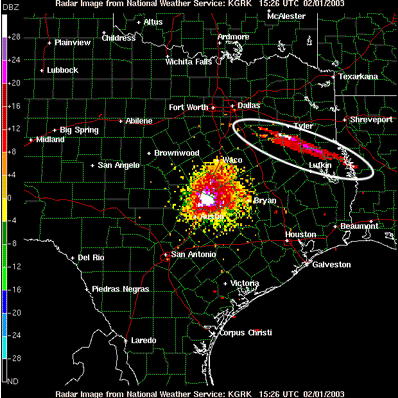
Is this an environmental disaster? FEMA was called in early on this. The radar images show a huge cloud that stretched for hundreds of miles. Some of the debris may have stayed in the jet stream where will it go.
What happens if some birds eat some of the debris? Will it then be toxic to it's hunter?
I saw pictures of officials picking up debris using what appeared to be standard latex gloves. Shouldn't they be using something more chemical resistant like PVC gloves?
What about plutonium? is there any plutonium? I haven't seen anywhere where NASA has come out stating there is no plutonium in use anywhere on the shuttle. What other radioactive substances were aboard?
What about these tiles? Are the tiles toxic too? Many ceramic materials are toxic. If you vaporize a ceramic shuttle tile and someone in a room with toxic ceramic shuttle tile dust in the air will it make that person sick?
I am going on and on but I get the feeling that this topic has been squelched. I don't like hearing about people going to the ER when they don't have any symptoms.
-wargames
-
Re:What about the Israeli guy?
I checked the spafelight site too. Once again this guy never actually worked as a scientist and is only known for his ability to drop bombs on people. If you have any links to any anywhere indicating that this guy actually worked as a scientist then post them here. You can continue to post as a coward if you like.
As I said before. The israelis got to space the way they do everything else, on the backs of the american tax payers. Israel gets anywhere from three to five billion in US aid every year and nasa spaceflight budget is around six billion. Considering that the NASA budget supports 10 flight and research centers it seems like the israelis could build their own space program just from US welfare. Instead they use it to kill people. -
Re:NASA site mission STS-107
We already had a vehicle which didn't need to be rebuilt between missions. You'd just throw it out and buy a new one. Still cheaper and safer than a shuttle- the crew didn't even need to know how to fly a plane! (But he couldn't strech his legs). An enhanced Gemini would've been better than the Shuttle for all missions- it just doesn't give you the Buck Rogers feeling of piloting the same craft back and forth into space.
Hubble seems to be the only example I can find of an important satellite being repaired. Maybe there were others, less newsworthy. If only the Hubble and a few other satellites were repaired, then they hardly justify even a fraction of the shuttle program's $20,000+ million startup cost. The entire brand new Hubble cost $1,500 million- just 3 times the price of a shuttle launch. (Most satelittes cost less than $50 million, much of that recoverable design costs. Hubble's lenses made it's replacement cost uniquely higher)
The major other use of the Shuttle's "space-truck" abilities is to assemble space stations, and the same astronomers who love the Hubble widely agree that ISS is a boondoggle (they keep quiet to stay friendly with NASA). -
Re:God rest their souls
The Shuttle is the ONLY American Manned Space Vehicle that did NOT have an Emergency Egress or Emergency Escape System at the time of construction.
Didn't Columbia have a couple of ejection seats on the flight deck? They may have been removed at some point, but I'd swear it had them through at least the first few flights. The model I built years ago has a couple of small hatches above the seats.
(A little bit of googling turned up this link, which mentioned that Columbia's ejection seats were the same basic type as those used on the SR-71. This link says that the seats were removed sometime in the mid-80s as part of its conversion from a test vehicle to an operational shuttle.)
-
Wikipedia Entry - The Wrong Stuff
Not wasting any time Wikipedia has published an entry on Columbia's last flight.
Looking at a picture of this crew brought to mind a quote from a movie "Talk about the wrong stuff."
Refer to this database and fill in your own title to the crew picture -
Re:Shuttle Disaster Scenarios from 1988 sci.spaceIt's always been known that APUs can fail - and they occasionally have. But there is a difference between a destructive and non-destructive failure mode for the APU. If you start with three good APUs and one fails nondestructively, even during reentry, the Orbiter is designed to return safely on the remaining two APUs. (Acrobat reader required.)
If the APU fails destructively, the potential for damage to the Orbiter is obviously much greater. Nobody would be happier than I (whatever happiness means in such a tragic context) if the incident analysis for this mission concludes that they caught the rare unstoppable failure for which no reasonable contingency mode can be designed. But I wouldn't put any money on it.
We need to start doing more of the things that advances in technology allow us to do (in the 30 years since STS was designed) to insure on-orbit crew and craft survivability. There are projects that basically can't compete for funding during times when everybody's coming home healthy and the budget crunch is worry #1. Now we're in different times. I hope we press for more safety while we can.
PS Trust me on the Bowery assessment, I was there.
-
Re:How Independent an Investigation?You can find Feyman's comments here
Personally I find his ending comment very fitting to the challenger disaster (I quote):
For a successful technology, reality must take precedence over public relations, for nature cannot be fooled.
-
Re:No way out?Nevertheless, some kind of EVA inspection/repair capability is probably what we should implement. It would not be THAT difficult or THAT dangerous, especially when compared with the difficulty and danger of reentry in a damaged orbiter.
The Aercam Sprint is a 35-lb remotely piloted spherical robot with a camera. It has already flown and is being developed primarily for the Station, but it could easily be carried on Shuttle missions as well, and used in an inspection pass over the exterior of the orbiter as a normal part of the on-orbit maintenance routine.
If damage is found, an EVA would be done to repair it. Payload-bay-filling modules like Spacehab-RDM (which now has to be rebuilt anyway) should be modified to permit EVA egress through the lab bulkhead. Tethered operation and handholds are difficult on the underside of the orbiter, but we already have Manned Maneuvering Unit (MMU) capability and we could train to use it.
Replacing a tile (pulling the old, regluing a new one) might be difficult to do in space, plus you have thousands of different shapes and you can't carry them all. But you could design an epoxy "spackle" that could be applied to fill the hole created by a missing or damaged tile.
We could also develop a bigger "repair kit" that could be launched by an unmanned rocket (a la Progress, but based at the Cape for easier orbit match) on short notice.
All of these suggestions carry a certain amount of cost and inconvenience, but again, compared with the cost and inconvenience of burning up on re-entry, it's a better choice.
-
Re:What probably went wrong
NASA isn't even sure that was foam. It may have been ice.
Even if they had sustained some minor damage on the way up, what is the remedy? Could another Shuttle have ferried tiles? Can you apply them in Space? Could they have docked at the ISS? Did they have the equipment? Could they have "spacewalked" to another Shuttle? I have no clue, but the situation may have been such that NASA had to chance a reentry.
Also, NASA said today that the tire sensor went to off-scale low. The last communication with Columbia was Houston saying that the tire sensor was still off-scale low, and Columbia answered with a "roger" just before communication went dead.
Some have speculated that off-scale low is some sort of reading. It actually indicates no reading. Here is a selection from the NASA chronology of Apollo 13:
55:54:51 - Oxygen tank No. 2 quantity jumps to off-scale high
and then begins to drop until the time of telemetry loss,
indicating failed sensor.
55:54:52 - Oxygen tank No. 2 temperature sensor reads -151.3 F.
55:54:52.703 - Oxygen tank No. 2 temperature suddenly goes
off-scale low, indicating failed sensor. -
Re:What probably went wrong
Could they get close enough to the ISS to EVA to it, since according to some other posts, they didn't have a docking ring?
I don't think so, no. In order to reach the ISS, they'd have to either start out in a closely-matched orbit and burn a little bit of OMS fuel, or burn one hell of a lot of OMS fuel to reach the correct orbit.I don't know that the OMS fuel tanks even have the capacity to carry enough fuel for a radical orbit change (a NASA site lists 1000 fps delta-V), and I'd think it would be inadvisable to have that much fuel onboard, even if they could.
-
Re:Could have easily been terrorism
And here I was worried that I didn't have any friends on
Here, let's see if we can make your head explode.
Look at the mission patch for STS-113.
Notice that it is a view of the shuttle from the perspective of someone who is looking at it from underneath.
Consider then that the right wing on the patch is actually the left wing of the shuttle.
Now, accounting for the fact that the most plausible theory at present is that a piece of foam insulation fell off the left booster, impacting the left wing of the shuttle and thereby loosening or damaging one or more of the critical ceramic tiles, please take note of the name of the astronaut on that wing.
If you die of an aneurism from this post, I humbly suggest I should get modded up +1, Benefitting Mankind.
For surely, this Earth can do without retards like yourself. -
Re:No way out?
Why can't NASA develop a small tethered inspection robot?
NASA already is, you can read about it here. Just last weekend two of the Robonaut engineers gave a talk and slide show at a robotics workshop I attended in Houston. Robonaut is designed to be fully articulating from the waist up (actually, there are no legs), and designed to perform spacewalks via remote control (each spacewalk costs several hundred thousands of dollars in planning, preparation, training, and execution). The robot is able to grip and manipulate objects autonomously, without need for external input or guidance. -
Sadly, this was a headline on their science site
"A Flame Ball Named Kelly"
Flame balls onboard the space shuttle Columbia (STS-107) have been doing some strange and wonderful things.
link
This is a cruel irony for sure. They should probably pull that page in the time being. -
Re:NASA site mission STS-107
Looniness is quite natural for me, I don't mind at all. But the explanation is entertaining, so I'll share with you. (Hint: negative evidence is still evidence)
Carl Sagan said it better than I ever could. The Drake Equation posits that by now, at least 100 (or anywhere from 5 to 50000, depending on your assumptions) electronics-capable intelligent species have existed in our area of the galaxy so far.
So where are their radio signals? Their space probes? Why does SETI strain fruitless to discover any kind of extraterrestrial signal?
The possible explanations are that there either never was any other intelligent life, or that it lost its ability to send radio signals and space probes shortly after acquiring it. (The Dyson Sphere is another possiblity. So is the Prime Directive, and plain xenophobic paranoia.)
Look at the technology level on earth today. We can already send probes out of the solar system. Given this ability, within 100-300 years at most, we'll be flinging a capsule laden with data storage and solar-powered radio transmitters towards every star we can see.
If we ever manage to colonize other worlds, then over a few millenia there will be an exponential population growth, and nary a corner of the galaxy will be free of us.
But evidently, this hasn't happened yet. Where are all the alien visitors?
Again, using ourselves as an example, the most likely possibility is that whenever technology increases to the point where a species can venture into space, it also allows the species to destroy the viability of it's entire ecosystem. Looking around at the relative popularity of military activities vice space exploration, which one do you think will happen first?
Darwinian evolution dooms us- it creates a locally optimal species, which struggles violently against its peers for resources, always knowing there is a frontier to explore where more open land can be found. But when the frontiers are gone, and the planet is full, it leaves us with a competitive psychology that will be unlikely to abide cooperation long enough for us to "get off the rock".
Look at the science-fiction worlds of something like Clarke's 2001. Flight to Jupiter in 1997? It seemed reasonable then- because it was on the assumption that petty nationalist squabbles wouldn't divert our attention and resources in the meantime. Sadly, that is exactly what's been happening.
-
In the immortal words of Gus GrissomGus Grissom, Apollo 1 commander:
" If we die, we want people to accept it. We're in a risky business and we hope if anything happens to us it will not delay the program. The conquest of space is worth the risk of life."
-
Re:Very sad...What I find sadest is that there's a real chance the failure might never be tracked down or traced back. I followed it all day, and the closest thing to fault indication was garbled radio, but since the vehicle is travelling in a bubble of plasma, that's not unusual.
Telemetry failed "out of range low", as if the instrumentation had just diedConcerning probabilies of survival, keep in mind that the vehicle was travelling 12,500 MPH
Here's something that really chokes me up
(Note: My
-
Re:The media wants quick answers> Except that Columbia was the only Shuttle not capable of docking with the space station.
Psst: Columia's next mission (STS-118) was scheduled to dock to ISS to deliver supplies and a truss.
-
Will Columbia Explosion Impact Bush's Prometheus?
Following today's Columbia Space shuttle tragedy, I questioned how this tragedy might affect President Bush's recently reported Prometheus Project, which was suspected of reinvigorating the 'NERVA' concept, first proposed in the 1950's, but canceled in the late 1960's due to "excessive development costs." The NERVA engine "would not use nuclear fission as a propulsive mechanism per-se, but rather would expel super-heated hydrogen, flowing through a nuclear fission reactor, as an ultra-high-speed exhaust."
In a January 17 story, the Los Angeles Times quoted Sean O'Keefe, the current head of NASA,suggesting that the President plans to tacitly announce an aggressive plan ultimately designed to send humans to Mars" in the then upcoming State of the Union Address.
How does the Slashdot crowd think this second shuttle disaster might influence President Bush's plans to use these alternative sources of energy to send human's to Mars? -
Re:An old problem> The engineer (i forgot who it was) said that Columbia and Challenger both would have been too heavy to reach it, but Discovery, Atlantis, and Endeavour were lighter and thus were the three orbiters used to service the ISS. This may or may not be true, i'm just relaying what i heard...
It is not true. Columbia's next mission was to have been to ISS.
-
Re:Statistics
I read after the Challenger disaster than there are many "criticality 1" functions on the shuttle. If any of these functions fail during a mission, it could lead to the loss of the spacecraft. Evidently, they try to achieve a very low failure probability on each of these "criticality 1" functions, something like 1/100th of a percent. But while each of these "criticality 1" has a, say 1 in 10,000 chance of failing on any given mission, multiplying the statistical probability of all the "criticality 1" functions together develops something like a 1 in 25 or 1 in 50 chance of one of these functions failing on any given mission. With Challenger, and now Columbia, we tragically seem to be maintaining this probability. See here for more info on criticality 1 features.
-
Re: Profiteers
All day on TV they've been saying "Don't touch it, its toxic!". If that was really the only reason, I'd take my chances.
Blame that on media sensationalism. It is almost certainly illegal to remove debris from the crash site. Most likely it's covered by FAA regulations. Note that NASA's emergency notice states that:Comments to the effect that scavenging would hinder the investigation were few and far between.. and I didn't hear anyone say it was against the law.
Not that I'm disagreeing with you, I just found it strange, the way TV kept saying "TOXIC! TOXIC!" and little else.
All debris is United States Government property and is critical to the investigation of the shuttle accident. Any and all debris from the accident is to be left alone and reported to Government authorities. Unauthorized persons found in possession of accident debris will be prosecuted to the full extent of the law.
In a situation as serious as this I would tend to believe that they aren't making idle threats. -
Re:Never mind Mars, what about the ISS?
Unlikely. The Enterprise was never meant to go into space and is only for training inside the atmosphere.
Not quite the full story. Enterprise was the ALT (Approach and Landing Test) vehicle. It was used to evaluate and confirm the Shuttles' design in terms of landing and the 747-piggyback transportation system.It was intended to be retrofitted as a fully rated orbiter (and always carried the OV-101 designation), but the decision was made in 1978 to leave it in it's ALT configuration and instead upgrade Challenger. Challenger (STA-099, Structural Test Article) was the test vehicle used to verify the structual design of the Shuttles under load. It was upgraded to join Columbia (OV-102) as a fully rated orbiter (becomming OV-99).
Enterprise is now owned by the Smithsonian Institution.
-
Re:Never mind Mars, what about the ISS?
Unlikely. The Enterprise was never meant to go into space and is only for training inside the atmosphere.
Not quite the full story. Enterprise was the ALT (Approach and Landing Test) vehicle. It was used to evaluate and confirm the Shuttles' design in terms of landing and the 747-piggyback transportation system.It was intended to be retrofitted as a fully rated orbiter (and always carried the OV-101 designation), but the decision was made in 1978 to leave it in it's ALT configuration and instead upgrade Challenger. Challenger (STA-099, Structural Test Article) was the test vehicle used to verify the structual design of the Shuttles under load. It was upgraded to join Columbia (OV-102) as a fully rated orbiter (becomming OV-99).
Enterprise is now owned by the Smithsonian Institution.
-
Another good link on reentry....A lot of NASA is
I'm sure some better stuff is available or will be, on the web, but at the moment it appears that RCS (reaction jets) is used down to about down to 83Km (250000 feet). At this point flight surfaces are used.for manouvering. They then do some serious braking down to 67Km (200,000 feet) killing the vertical speed. This appears to be whe the disaster ocurred.
-
Re:Question...> Losing columbia does not effect any of the scheuled ISS missions as it was incapable of making the ISS orbit with enough payload [...]
Psst: Columia's next mission (STS-118) was scheduled to dock to ISS to deliver supplies and a truss.
-
Who is going to be our Feynman this time?When the Challenger exploded, the only commission member to actually give a damn about figuring out what happened was the late physicist Richard Feynman. He was hardly a space shuttle expert, but he had the right kind of skeptical mind.
Without his intrepid investigations, we probably still wouldn't know what happened (though some NASA engineers might). His investigation was thorough enough to find myriad safe (software) and unsafe (mission cancellation policies) aspects of the shuttle program.
Who will be our Feynman now?
-
Engineer who brought that warning was firedFor the crime of testifying before Congress that NASA was skimping on safety, she was fired. Here is what she has to say about the situation (forwarded from Politech):
Two years ago, I was a highly decorated NASA engineer. I was awarded their highest medal, for Exceptional Achievement -- something that is usually reserved for senior managers -- because of my expertise.
I was a safety engineer.
I was removed from my GS-13 position, as an internationally-recognized authority on hypergolic propellants and explosives, and forced off the Kennedy Space Center. At gunpoint.
Their excuse was that I had "abused government equipment." Because I sent a friend an e-mail joke.
The reality was that I wouldn't play their "political ball."
I F-ING WARNED THEM.
I told them that the technicians and engineers were overworked. I told them that there were too many managers and too many meetings and "dog-and-pony" shows. I told them that their senior "face time" play games, while they spent all their time plotting how to give each other pay raises, and left the guys on the floor to struggle day to day with obsolete and overpriced and unqualified equipment, was going to result in another Challenger.
I was there for Challenger.
I saw the same exact conditions happening again. Overpaid, lazy, irresponsible managers concerned solely with their climbing up their ladders.
I told them they were skimping on inspections. I told them that the ground crews were asleep on their feet from exhaustion. I made as much noise as I knew how to make about the top-heavy bureaucracy sitting around in their fancy panelled offices, giving whorish press interviews in their smugness, while they did not have a clue what was going on in the real world where I was working.
They fired me. They fired a GS-13 civil servant, with an Exceptional Service medal and ten dozen commendations. For sending an e-mail joke.
In reality, for objecting to political fat-cats sitting on their fat rear ends and failing to do their jobs.
Like Challenger, those who are most guilty are the ones who will attempt to make the most political capital out of it. But the blame for Columbia lies entirely and totally with the NASA administrators. They should all be investigated for their criminal negligence. They should all serve time in jail.
I warned them. They did their best to destroy me, because I warned them.
It's too bad that innocent astronauts paid with their lives for NASA managers greed and political ass-kissing.
But I am not surprised.
Two years ago, I warned them.
Dian Hardison
Cocoa, FL 32927Note: Her NASA biography is still online at a NASA site.
-
Re:bring back the VentureStar
What are you talking about? There still a TON of information about the X-33/VentureStar on the net, including at NASA. In fact, the NASA page is very complete containg the entire history of the X-33, a timeline from 1996-2001 of important events, and so on.
All this "disappearing" information was as hard to find as clicking search on Google. Try it sometime. -
Re:NASA site mission STS-107
Idunno. I think you were clicking the wrong link.
Yes, I naturally picked the dumbest looking experiment to showcase.
But reading through the page you mention, it seems that just about every experiment description contains the line "control via the remote Payload Operations Control Center (POCC)".
Meaning that it could've been accomplished just as well on an unmanned rocket. The people are there as figureheads- to give the public of Israel and the US something to feel proud of.
(That they can also serve to unpack a few experimental rigs is of no importance- the experiment designers could've added in a little automation if they hadn't known there would be astronauts on hand for the busywork)
-
Re:Now we have a stranded ISS crew...
What are the chances NASA will send up STS 108 on schedule?
STS-108 landed safely on December 17,2001 ; STS-107 was the 113th launch - missions don't happen in strict sequential orderMy thoughts are for the pilots' families, friends and colleagues, but I hope there will be plenty more successful flights.
-
Re:NASA site mission STS-107
Idunno. I think you were clicking the wrong link.
I think it's totally worth the risk. The problem with science/research is that no one sees the value of it until it's been done, only after the seemingly pointless work. I'm not surprised everyone thinks it's not worth the risk. But I'll bet if you resurrected the crew of the Columbia, they'd tell you it was worth it.
Great achievements are never born of safety and cautious steps. The argument about whether or not our research is worth something is a valid one. We're definitely politicking NASA's cash away on some of the shuttles' payloads. But we shouldn't stop just for the fear of death. I'd risk death to help the cause of human progress. I'm not sure i can agree with anyone who values their life more than that.
Just my -
Re:Very sad...
-
Re:Very sad...
-
Re:The future seems bleak...or does it ?> ISS is dependent on the STS for deliveries. Even if Columbia was unable to do go there she did other important work freeing up the newer shuttles for ISS-related activities.
Columbia's next flight was to go to ISS: STS-118
> The long term solution (circa five years)would be to completely replace the STS with a new, cheap and safe reusable launch system.
Development of the Orbital Space Plane was announced last fall. Due for operation in 2008.
But if the shuttles are grounded for two years (like after Challanger), there will be no ISS for the Orbital Space Plane to go to. Much as everyone hates the ISS, if we lose it, the USA will loose critical mass and discover that it is starting form scratch.
After Challenger we had the luxury of being able to take our time. But ISS urgently needs shuttle flights. We need to either get back online right away, or close up shop.
-
Related Official NASA Links
Related Official NASA Links (feel free to repost at other sites):
STS-107 Mission Status Reports
Last Night's Status Report (deals with possible landing times)
Future Scheduled STS Flights
NASA TV Webcasts -
Related Official NASA Links
Related Official NASA Links (feel free to repost at other sites):
STS-107 Mission Status Reports
Last Night's Status Report (deals with possible landing times)
Future Scheduled STS Flights
NASA TV Webcasts -
Related Official NASA Links
Related Official NASA Links (feel free to repost at other sites):
STS-107 Mission Status Reports
Last Night's Status Report (deals with possible landing times)
Future Scheduled STS Flights
NASA TV Webcasts -
Related Official NASA Links
Related Official NASA Links (feel free to repost at other sites):
STS-107 Mission Status Reports
Last Night's Status Report (deals with possible landing times)
Future Scheduled STS Flights
NASA TV Webcasts