Slashdot Mirror
Domain: ncsu.edu
Stories and comments across the archive that link to ncsu.edu.
Comments · 1,326
-
Whoa...
So your argument is that they just don't care about their customers?
I believe that; that's why I stopped using their stuff whenever possible, somewhere between DOS 6.0 and Windows '95. (I hated Win 3.1, but at least I understood it, and could tweak all the config files; Win '95 was when they really started trying to bolt the hood down)
So I guess if they keep up with that attitude, they won't win on merit...
---
pb Reply or e-mail; don't vaguely moderate. -
Re:Heh.
Well, if it gets the job done faster, then it's better, right?
Seriously, I'll tell you after I finish either my Realtime course or my Project course; both of them might do something with APM on Linux.
But usually I'd only really worry about power management on laptops, not on servers. Also, Linux generally blanks the screen after 15 min or so, which does a lot more for a laptop than most other power-saving means. You can also have it spin down your hard drive, and even use the APM features in your BIOS...
And remember, screensavers eat cycles like nobody's business; disable them on either platform, and just blank your screen. Or use a more efficient platform, like the ARM. Or shut your computer down when you aren't using it...
---
pb Reply or e-mail; don't vaguely moderate. -
Re:Thank you, Gandhi.
Um.
First they Ignore you.
Then they laugh at you.
Then they fight you.
Then you get bought by AOL.
Then they laugh at you.
---
pb Reply or e-mail; don't vaguely moderate. -
Heh.
Ballmer is right.
That's because if the breakup goes through, Microsoft will have to play fair...
And, as we all know, they've never been able to win on merit, so it should be interesting to see what they do.
P.S. I'd love to debate this with any rabid MS fanatics who think Windows is the greatest thing since sliced bread, but it might be too easy. Bring it on.
---
pb Reply or e-mail; don't vaguely moderate. -
Re:Tell us something we don't already know...
I'll help you to understand.
Omitting white space really does speed it up; that's because the first thing the Perl interpreter has to do is read in the file, and if the file is shorter, it has to read less. If you *must* use some spaces, then pad it at the end and align it to a 4096 byte boundary (or at least 512 bytes). Also, when the code is tokenized, you don't have to ignore as much whitespace, or allocate as much memory as a buffer. All of these are improvements.
Enforced scope is fine, if you only need a variable in that scope; that's what my is for. But why always deallocate and allocate off the stack when you can have a few permanent, reusable memory locations? This is especially true for replacing extra loop counters, or getting rid of variable allocation in tight loops or small subroutines. Why be so wasteful?
Also, $m is a variable, and probably a mnemonic as well. $m2 is another $m distinct from the first. $mt2 is probably a temp variable, maybe for $m2. See the simple yet concise variable naming scheme at work?
So I suppose this self-taught programmer also considered comments and documentation to be a waste of disk space? I'm sorry, I've done that before. Managed to delete a lot of silly code, too...
---
pb Reply or e-mail; don't vaguely moderate. -
No...
They're just as far behind. Use this formula:
Apple_Max_Mhz*2 ~= x86_Max_Mhz
...sounds about right to me.
Never mind that Joe Average generally doesn't need nearly that much power for all the things he really needs to do. Any home computer sold in the past 15 years can easily do word processing and spreadsheets, even a Pentium 133 plays mp3's with some cycles left to spare, and unless you're still using that 386, your modem is the bottleneck in browsing the web, not your processor, no matter what Intel tells you...
---
pb Reply or e-mail; don't vaguely moderate. -
All I have to say is...
Fade in:
D-VHS Tape looks over at the large server computer, and says: "RAID? Oh NO!!!"
D-VHS tape is quickly recorded and then explodes...
RAID. Kills tapes dead, where they hide.
---
pb Reply or e-mail; don't vaguely moderate. -
Use it...
Use it for automated, batched transfers. Use it for mail and newsgroups. Maybe use it for ftping large files.
But for god's sake, don't use it to browse the web, unless you plan to use your web browser like an Off-Line Reader...
---
pb Reply or e-mail; don't vaguely moderate. -
Wow.
Troll stories at troll times; what will they think of next?
Man, I'm only reading slashdot at night if I can help it now; the WTO will never restrict my pancakes, right, ninjas???
---
pb Reply or e-mail; don't vaguely moderate. -
Re:Atari 2600 Development SoftwareYou can also purchase cartridges of new games from Hozer Video. Definately check out the brilliant Thrust.
Of course, "real" computers need versions of Minesweeper and Tetris. And all modern gaming systems have first person 3D games.
If you're armed with an emulator you can download ROMs of various games, classic and new.
-
Sounds fishy...
First, I'd like to know just how much "Open Source" code was lifted, and from where.
If it's from X, well, that's cool (BSD-style). If it's from the Linux Kernel, that would probably not be cool (likely just GPLed). I guess we'll see when it comes out, but the reference to 'strict licensing terms' makes me a little leery.
Also, could they pick a new name before it comes out, please? Between MIT's Project Athena, and AtheOS, I'm confused already.
Until then, that's the most kick-ass version of twm I've ever seen, and at the moment it looks like they went through a lot of work to implement essentially a new version of Enlightenment on top of Linux; until they expand their platform support a bit I won't be that impressed.
---
pb Reply or e-mail; don't vaguely moderate. -
Sounds good to me...
As long as it can hold at least a GB or two, that's more than enough for me. I don't know if I'd want to pay ~$400 for it, though; I'd definitely pay $200.
As to the interface, I'm sure that'll get reverse-engineered soon enough, but it'd be much nicer if it didn't have to; there's no reason to develop a proprietary protocol for this. Heck, what's wrong with ftp?
---
pb Reply or e-mail; don't vaguely moderate. -
Apparently someone else did this first
According to this page Paul Graber got a first before the person mentioned on
Here is what he wrote.
From: Paul Graber
Whew!!
I can't believe I did it! I got a perfect 114,000 on pitfall. It can be done. I got all 32 treasures with 40 secs left on the clock! the game just stops when you get the last treasure. Maybe I am the first to do this. I doubt it. Anyway here is how I did it.
First start out by going right to the 7th screen where the first gold bar is. Then immediately go back to the left and run right into the snake on the next screen left. Yes this loses a life but you will appear on the left and save you about 5secs instead of waiting for the rope to come back. Since I had 40 secs left at the end I guess this did not mean much but I wanted every sec. I could get. Okay keep going left and make sure you can take the rope after the alligators immediately. Go all the way to your original starting point.
Take the ladder and go left. Upon exit go left until you come to the second left ladder, a ladder which will let you go left. Then upon exit go right until you come to the diamond. Go left till you come to the second left ladder after the diamond. Upon exit, go left and you will come to a bunch of treasures including 2 diamonds and 2 gold bars. After the last gold bar take the first left ladder you come to and go left obviously. Upon exit go left until you get 69,000 points. Then take the next left ladder you come to and go left. When you exit go right 3 screens to get a money bag and then it's back left for the rest of the game.
The last treasure you will get is the gold bar which is the second gold bar you come to if you start right in the begining of the game. All this sound confusing? Sorry but it is the best I can do to explain it. Now it is important to try and hit every vine and vanishing pond exactly with no wait that you can. This will save you about 4-5 secs each time. It took me a couple of days to finally do it but I did. E-Mail me if you still have questions.
Good Luck!!
-
The boat sank; get over it.
Wow. Ten ideas that made it big for a short period of time, and then got superceded by other new ideas. Big deal.
They got outcompeted; they served their time, and now they're relegated to their technological niches. The implementation is outmoded, but the idea lives on. That's how unnatural selection works; it's technological Darwinism.
---
pb Reply or e-mail; don't vaguely moderate. -
Re:Port Everybuddy to Win32? Odigo?
No, winamp is a proprietary API, and they're both reinventing the wheel. All you have to do is statically link GTK, and there's no difference from the perspective of an outside user.
What you'd need to do is create a GTK wrapper for Win32; then you could thunk through all the calls you need, and port all the GTK stuff to (mostly) native Windows.
In fact, I'd want wrappers for everything to a target API, personally, so I could port everything, and make it all themeable. But it'd be a lot of work...
Also, you don't need efficiency in an IM client; otherwise, people would never write them in Java and Tcl/Tk.
---
pb Reply or e-mail; don't vaguely moderate. -
Re:Port Everybuddy to Win32? Odigo?
I suppose you don't use winamp, then?
The "Standard GUI" argument doesn't mean much to me, and it means even less when you don't have to compile it yourself, and you don't know what gets installed on your system--like your average Windows user.
---
pb Reply or e-mail; don't vaguely moderate. -
Re:Slashdot blurbs considered harmful
Hey, thanks! If I had found that earlier, it would have saved me some time.
So basically, we still need to standardize the 'IMX' protocol; that's the one thing that document explicitly doesn't cover. And it looks like the only perspective on what to support comes from RFCs 2778 and 2779...
---
pb Reply or e-mail; don't vaguely moderate. -
Re:This disrupts the voluntary IETF standards proc
Well, I'm not quite sure why the FCC thinks they'd know about this area, but I'm pretty sure they're just overseeing the merger, and not drafting the standard. It's a little creepy, but not as creepy as letting The Secret Service handle Computer Crime.
I wish E-mail programs were interoperable; as it is, I see a lot of MIME headers that break elm. But usually that's just spam; only occasionally is it from real people (users of OutLook) that don't know how to send *text*...
These guys wrote RFC2778 and RFC2779; it seems to be designed from an "agent" perspective. I suppose that's the new, hot trend nowadays, but it seems a little heavyweight for just a chat client. However, they're working on it and I'm not, so I suppose I can't complain.
Does anyone know about any other RFCs related to this?
---
pb Reply or e-mail; don't vaguely moderate. -
ROFL
"perhaps I am some christian missionary in your fantasies"?
Never hack AOLiza to post to slashdot; you'd get too many biters.
"First Post!"
"Does it please you to get First Post?"
"I 0wn j00!!!"
"Interesting, please continue."
---
pb Reply or e-mail; don't vaguely moderate. -
Re:Port Everybuddy to Win32? Odigo?
Have you tried The GIMP (under Win32) lately? GTK for Windows seems pretty decent.
Of course, a lot of the Windows port stuff is pretty beta-ish. As in, all the basic command-line stuff seems to work, and maybe you could compile X applications under Windows with cygwin, but the port of XFree86 itself is definitely alpha.
I'd love to see more skins for Whistler, since there are only two at the moment: one looks just like Win95/98, and the other one sucks. Hard.
---
pb Reply or e-mail; don't vaguely moderate. -
Re:Standards are good.
I agree; I want that too.
Until then, I'm using EveryBuddy. In fact, it looks like they have a new release out...
It isn't perfect; it's more like sox. It's the swiss-army knife of IM clients.
---
pb Reply or e-mail; don't vaguely moderate. -
Slashdot blurbs considered harmful
Actually, unlike the misleading
Sounds good to me. I mean, really, how many stupid datagram headers can you have anyhow? I implemented tftp recently, and that wasn't hard at all.
I say we do this the old-fashioned way. Draft a standard, and write an RFC. We shouldn't need more than 5-7 actual commands anyhow.
---
pb Reply or e-mail; don't vaguely moderate. -
Mod this up!
Dr. Livingston, what's that?
I believe it's a very rare species of post.
I don't think I've ever seen it before.
I used to see it every so often, in the past.
It's a first post! Therefore, it should be modded down.
No, no my dear, it's an intelligent first post.
An intelligent first post?
I told you it was rare. I haven't seen actual posting content in a long time, let alone an intelligent first post.
I say!
Indeed.
---
pb Reply or e-mail; don't vaguely moderate. -
Re:It's detailed, but...
You can get "1-meter" images through a fairly intuitive navigation interface at The Terraserver (a Micro$oft-owned property).MS got copies of US Geological Survey maps and "1-meter" satellite photos and has scanned them and wrapped them in a slightly over-complicated website. Coverage is pretty good for most of the US, and even for other parts of the world (don't know if USGS is the data-source outside of the US). The survey maps are mostly circa 1981-1992, and the "1-meter" photos are ~ 1988-1996.
I put "1-meter" in quotes because the resolution of many of the shots seems to be worse than that. If you compare the above referenced image against the terraserver photo of the Washington Monument, it is obvious that terraserver's isn't as good. Though, judging by the scaffolding apparent on the monument, the image at NCSU is about 3 or so years more recent, and may benefit from superior "1-meter" technology.
Terraserver recently got "SPIN-2" satellite images, though I've never used them, because the interface seems to demand JavaScript and an image-viewing plugin (CleverContent) that I haven't bothered with getting/checking for security issues.
There are some holes in the satellite coverage for the US, and the places where USGS maps overlap don't always get the best treatment. Twice I've wanted to look at places that were covered up by the key from one map, when they could obviously have been displayed from an adjacent map. Still, for a free (beer) service it isn't so bad.
-
It's detailed, but...
I don't think it's *that* detailed, guys.
Here's one of the early "meter" images.
Sure, you can see the road, and big buildings, but you can't really identify a person...
---
pb Reply or e-mail; don't vaguely moderate. -
It's detailed, but...
I don't think it's *that* detailed, guys.
Here's one of the early "meter" images.
Sure, you can see the road, and big buildings, but you can't really identify a person...
---
pb Reply or e-mail; don't vaguely moderate. -
Re:It's not just about the licenses...
Well, gosh, someone tell them that!
I was pretty sure a Trident TGUI9680 was common when I had it, but it was supported in Grayscale.
I think it used the standard SVGA Server....
---
pb Reply or e-mail; don't vaguely moderate. -
Re:It's not just about the licenses...
That's true; but if they don't tell me about it, I won't know to be upset; ignorance is bliss, and all.
Hey, if I'm done working on it, and other people aren't, so be it. That's when you appoint a maintainer and do other stuff. But at least I'll have the ability to browse through it later at my leisure, and see what's new, and be proud of what I started....
---
pb Reply or e-mail; don't vaguely moderate. -
Re:It's not just about the licenses...
Well, either you need that, or you need a lot of man-hours to support as much stuff as Linux does, and a whole lot of information that certain hardware companies often don't give you...
In any case, it couldn't hurt. I mentioned this because BeOS didn't support my old video card...
---
pb Reply or e-mail; don't vaguely moderate. -
It's not just about the licenses...
I think the question is, what if everyone could share code? The BSD License makes it so that everyone can have the code; the GPL makes it so that everyone has to share.
And I think that Linux would get another journaling filesystem, and maybe some threaded C libraries, and that would kick ass. And BeOS would get a whole lot of drivers, which would also be very cool. And maybe they could eventually merge together.
Although it'd be more unlikely for Linux and "Linux projects" (which often tend to compile on other Unixes as well) to switch to *BSD, I think what you'd see is a lot more code sharing, but then you'd have corporations involved as well. That would be the big difference.
I don't think it's going to actually happen, mind you, but being able to share code is definitely a good thing, and also the point of free licenses. It's a shame that these two are incompatible, but they also have different goals.
I'm not a BSD user because developments like MacOS X make me uncomfortable. It's an ideological difference. I don't like the idea of someone modifying my code and not showing me what they did. I'd like to know, in the same way that a playwright would like to know if you changed the Third Act on him while producing his play, and then made money on it, and told everyone else that it was "your play" now, based on their play, but only your company had rights to your version...
---
pb Reply or e-mail; don't vaguely moderate. -
Re:Doesn't look like an OS in a browser
1) Operating Systems provide services to applications.
2) Inferno is an OS
3) Limbo apps run on Inferno
If, indeed, Limbo apps need services from Inferno to run, and the Browser Plug-in can do this as well, then it would follow that....
4) The web browser plug-in is an OS for the same reasons that Inferno is.
Apparently those required services are called "Dis". I catch the reference, but it's been a while since I read up on Inferno.
In any case, it's definitely blurring the line for what an OS is and isn't. It's pretty far away from the hardware, in any case.
But wasn't that what people were predicting? Wasn't that why Microsoft was afraid of Netscape, and then Java? "The browser is the OS"?
That's right, folks. It's not just emacs anymore.
---
pb Reply or e-mail; don't vaguely moderate. -
Re:Who cares?
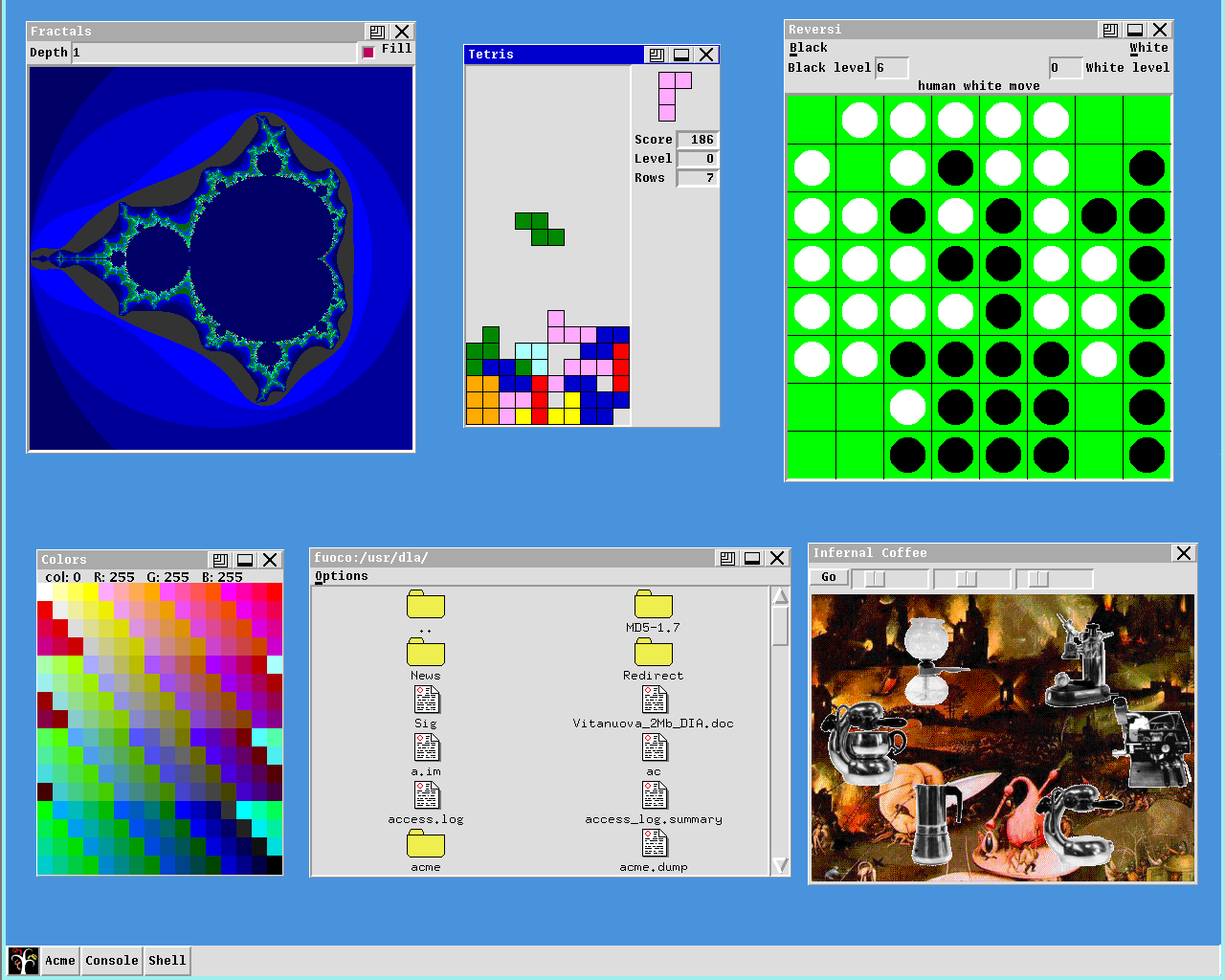
(screenshot is here)
Tetris I can take or leave, but I love Reversi.
However, I remember an Othello game for the Apple II; I think it moved randomly. Therefore, I could almost always win, even back then. So I don't see the advantage.
Try again; you won't be able to seduce me to your wicked ways!
---
pb Reply or e-mail; don't vaguely moderate. -
Who cares?
I never got past the Apple ][ emulator in Java.
I bet Inferno doesn't have any games, either.
Damn you, AT&T, and your Unix heritage. MacOS X will never have any good games. You're not going to take away my web browser too!
---
pb Reply or e-mail; don't vaguely moderate. -
Re:Language Advocacy Is Great!
Scheme never really did catch on, but it's used as a glue language in some places.
Like, say.... The GIMP.
I know I find it hard to progam apps in Scheme, but maybe that's just because I'm not used to it. Ripping apart and parsing Scheme-style data structures is really trivial, though.
---
pb Reply or e-mail; don't vaguely moderate. -
Re:call/cc
Hey, it's no big deal.
First you make it tail-recursive, then you pass your continuations, and you can break it up into data structures if needed, etc., etc...
The langauge doesn't matter that much, but Perl already has continuations and eval and lexically scoped variables and stuff built-in, so Schemers should be right at home, once they learn the syntax.
---
pb Reply or e-mail; don't vaguely moderate. -
Re:Loops not so hard in (Common) Lisp
Exactly; that's cheating!
---
pb Reply or e-mail; don't vaguely moderate. -
the 2600
I just want to give a big word up to the Atari 2600. I gotta say, I take reservation at the dissing of it in this post. It's alive and well, both in emulation, available roms, and ebay auctions for the systems themselves.
~Voose -
Re:arrays/loops in Scheme
Scheme gives you less to work with, but what it gives you is more powerful. It's sort of like giving someone a nand operator and a macro system and saying "Implement the logic yourself". It's more powerful than only giving someone and, or, and not, because that makes, say, xor pretty ugly to implement. (does Scheme have an xor? I think I ended up rolling my own...)
Yeah, you can always wrap it up in a closure; that's beautiful. I remember when our teacher showed us how to do Object-Oriented programming in Scheme with closures... I was amazed.
Heck, I don't care what your motivation was; it's just nice to discuss it. I like Scheme, the language, a lot, but I still haven't really gotten used to programming in it, and that's after spending a semester slaving away on Scheme programs and simple Scheme interpreters in Scheme...
It's just one of those things where I don't know where to start. Maybe if I had learned it earlier, I wouldn't have as much of a problem with it. However, it definitely helped out my recursive programming skills in general.
---
pb Reply or e-mail; don't vaguely moderate. -
Re:Language Advocacy Is Great!
call/cc? Good question. I never did use that much in my class; I don't remember if we implemented that or not. (we were writing Scheme on top of Scheme...)
I imagine it would involve calling the function with a copy of that environment. At least Perl supports continuations, but I could try to implement the lambda function anyhow...
---
pb Reply or e-mail; don't vaguely moderate. -
Re:Pascal and the short sighted
I think it's due to a lack of resources or knowledge.
I had heard of Ada when I knew Pascal, but I figured that I'd never be able to afford an Ada Compiler (or even find one...) and Turbo Pascal had object support anyhow, so what was I missing?
Of course C has its limits too, as does C++. But at least I had heard of those back then. And at least we have decent C compilers...
Also, WTF is Sather? I've played around with a few languages, but not *that* many...
---
pb Reply or e-mail; don't vaguely moderate. -
Re:Language Advocacy Is Great!
Oh, I know; I'm just pondering the parentheses matching and conversion. I'll probably have to write routines both ways, or I could stare at Data::Dumper for a while and see if I can hack Scheme syntax into it....
I'll work on the first one if you do the third one; I don't know much about Python besides the classic whitespace vs. line noise flamewars...
---
pb Reply or e-mail; don't vaguely moderate. -
Re:Language Advocacy Is Great!Well, it sounds easier than writing in Lisp, at least at first. Array access in Lisp is pretty ugly, and of course figuring out how to construct a loop in either Lisp or Scheme is pretty baffling until you begin to understand...
And yes, once you start passing back references to anonymous functions in lists from other functions, it starts getting pretty ugly; and that's just the beginning. Then, when you try to see if that reference goes to a function, a number (or a string), another list, or something else, the fun continues...
Here was my original simple example; it gets uglier when you use more references for sublists, and then parse them. If you like native perl syntax, though, Data::Dumper works wonders...
Scheme:
(define descending
(lambda (n)
(cond
((zero? n) `())
(else (cons n (descending (sub1 n)))))))
(descending 10)
Perl:
#!/usr/bin/perl
$descending = sub {my $n = $_[0];
if (!$n){()}
else {($n, &$descending($n - 1))}
};
print "(", join " ", &$descending(10), ")\n";
Also, does this say something about Perl, or what?
Lameness filter encountered. Post aborted.
Reason: Junk character post.
Taco, you're on crack again! You couldn't post Slash to Slashdot even if you wanted to!!
...now pardon me while I insert extra text in my post to bypass the lameness filter. La de da de da...
---
pb Reply or e-mail; don't vaguely moderate. -
Re:Language Advocacy Is Great!Yeah, I think we figured that out eventually. However...
From the article: the title...
Why I Hate Advocacy
...so which is it?
---
pb Reply or e-mail; don't vaguely moderate. -
Re:Learning More Langauges Solves This
But, dude, C's text-handling abilities absolutely R00L! I mean, why else would they write Perl in C???
Anyhow, I agree. And I wish we could have this discussion over on Kuro5hin; it tends to be a lot more lively and intelligent for this sort of thing.
But heck, I got a few intelligent replies. Pretty good, for slashdot...
---
pb Reply or e-mail; don't vaguely moderate. -
Re:Language Advocacy Is Great! -- when done right.
Actually, I always thought the point of it was to get decent, optimized code... I know that gcc's optimizer does a lot better than, say, FreePascal. Of course, FreePascal produces small, static binaries, but what do you want, right? Also, p2c handles Turbo Pascal code a lot better than gpc ever did...
The code it produces is ok; there's a lot of macro, type-faking stuff in there, but I've used it to successfully port a few of my old DOS/TP/BGI Graphics Demos to Linux/C/SVGALib; I just had to write some BGI->Svgalib interface code in C.
---
pb Reply or e-mail; don't vaguely moderate. -
Re:Language Advocacy Is Great!
Ah. So he was really just ranting about the other side of it, then.
Well, I think it's at least incompatible with the article's title.
---
pb Reply or e-mail; don't vaguely moderate. -
Re:Language Advocacy Is Great! -- when done right.
Ugh. He defined TRUE as 0 and FALSE as -1?
Did he know that he was completely breaking all C semantics?
In general, I could care less, because it's easy enough to replace the #defines in the source, and go back to reading C code. But that's just evil!
I've had to do this sort of thing too, in old crappy so-called "C++ compilers" (*cough*centerline*cough*) that didn't actually have a bool type.
It should be something like this:
typedef char bool
#define true 1
#define false 0
---
pb Reply or e-mail; don't vaguely moderate. -
Re:Language Advocacy Is Great!
That's right, I was comparing them. I've written equivalent programs in Scheme and Perl to try this out. Of course, when we're just talking about syntax, it's purely opinion-based anyhow, and Scheme basically just hides the references and does the work for you, here. I believe that the reason for this is because this functionality was bolted onto Perl later, in the spirit of adopting useful features from other languages.
In Scheme, you have to check what type something is. It isn't untyped, exactly, but you don't necessarily know what type a certain variable has until you check. If you don't check, bad things can happen. That's the disadvantage that this flexibility provides.
In Perl, you do the same thing for references, while other variable types are more explicit. I just wish those types had similar methods, but people have written this in too. (Since floats, ints and strings are all automatically converted in Perl, you have to basically write something to test if a string could also be a float or an int to see if it's a number originally. Unless there's another way to do it, of course.
I have nothing against either Perl or Scheme; I like them both. In fact, I was thinking about writing a Scheme interpreter in Perl, since Perl natively supports the features that Scheme requires. I just have to figure out a clean way to parse it all. The other advantages would of course be the extra libraries; Perl has a lot of awesome pre-written tools that Scheme generally lacks.
So, yeah, this sort of advocacy is fine until someone takes it the wrong way, and instead of listening to the arguments, has their feelings hurt. And I think that's all the article proves in the first place.
---
pb Reply or e-mail; don't vaguely moderate. -
Re:Language Advocacy Is Great!
Ah, but he wasn't discussing what he described. He made that argument about those idiots, and still claimed that "Language Advocacy Is Bad", but I think that all he managed to prove was that "Idiots Are Bad".
...and I think that you're trying to make the same point that I was: use the right tool for the job.
Part of advocacy has to do with presenting the facts. If you ask me if it's easy to do sytem programming tasks in C, I'll say "Hell yeah!"; if you ask me if it's easy to do threaded networked database access in C with a GUI, I'll say "Um... no, that's pretty tough, actually". And I might even recommend looking into Java, against my better judgement...
So, yes. Idiots are bad. Educate them. Ignore them. Flame them. But don't encourage them. And if someone asks you for your opinion, don't be an idiot either...
---
pb Reply or e-mail; don't vaguely moderate. -
Re:Language Advocacy Is Great! -- when done right.
I agree, but you could make that argument about *anything*. Politics, Religion, slashdot... It's great, until it becomes petty, irrational, vindictive, you name it.
But that would be something bad about the Language Advocates, and not necessarily the concept of Language Advocacy itself.
I agree with you, BTW; back in the day, I was involved in Pascal vs. C Syntax Flamewars over in 'comp.lang.pascal.misc'. What annoyed me the most was that it was all about syntax. I mean, there's a Pascal-to-C converter, for crissake! I even found one that tried to do it the other way around, although that's tougher. Arguing over 'begin end' versus '{ }' gets old really fast.
So basically, if I'm going to argue about a language, I try not to do it based purely on syntax, which is something the present "Perl vs. Python" flamewars seem to not grasp. Believe me, both languages are ugly in their own special way, but I'd still rather hear about actual language features, as in, after the code is tokenized, what can it do...
---
pb Reply or e-mail; don't vaguely moderate.