Slashdot Mirror
Domain: nellardo.com
Stories and comments across the archive that link to nellardo.com.
Stories · 6
-
Effective C++, Third Edition
nellardo writes "If you've been programming C++ for any length of time, you probably have the book, Effective C++, by Scott Meyers on your shelves. Well, this book has just hit its third edition, and it's a major re-write and re-org. Do you need this book? If you program C++, yes, you probably do, even if you have a previous edition. Don't let the "Third Edition" faze you, because it has lots of new insights into the vagaries of the C++ language. And if you're new to C++, this is pretty much a must-own book." Read on for the rest of Nellardo's review. Effective C++, Third Edition author Scott Meyers pages 297 publisher Addison Wesley rating 9/10 for C++ programmers; not worth it otherwise reviewer nellardo ISBN 0321334876 summary Re-write of standard second book on C++C++ is a large and complex language, and always has been. That's what made the first edition of Effective C++ so useful. What began as a simple concept of "C with Classes" grew as time went by, developing quirks and foibles that made sense only once you understood a great deal about what was going on. The first edition provided short, digestible synopses of the best practices of quality C++ programming. Even people that had been programming C++ for years could read the book and pick up something new.
That was 1991. A lot has changed in C++ since then. For instance, templates were only just being developed as an addition to the language, and most C++ compilers simply generated C code. Now, in 2005, C++ has gotten a great deal more complicated, and C++ templates have turned out to be a programming language in their own right. Exceptions, the Standard Template Library, threading libraries, and a wealth of truly inventive programming have turned C++ into an amalgam of concepts and mechanisms from essentially every programming language under the sun (ahem). C++ isn't quite as complex as Ada, but that's a much tougher case to make today than in 1992.
In addition, the understanding of what the best practices actually were has changed. Indeed, common tricks from 1991 are now generally frowned upon. In 1991, a friend function was common in code examples. For instance, operators were routinely declared as friend functions. Now, in 2005, friend is seen as creating the tightest coupling possible between components, and is often avoided. What happened?
This is where the book's background starts to shine. Item 1 is "View C++ as a federation of languages." Meyers does a clear and cogent job of decoding broad swathes of C++, explaining C++ as a multi-paradigm tool, and placing language features in different paradigms. Change paradigms and the guideline for what makes for effective C++ changes. This is a hard case to make, but he manages to do it in accessible language even a newbie to the language should be able to follow. Experience from 1991, 1997 (the second edition, mostly a spruce-up job of the first), and now add up to explain the boundaries.
Like earlier versions of the book, the final items provide a good hint on how to keep current. Item 54 is "Familiarize yourself with the standard library, including TR1", and Item 55 (the last) is "Familiarize yourself with Boost." Both of these point to the two places C++ is most likely to grow in the near future, TR1 being essentially done, and Boost being an active source of new things likely to make it into future language extensions.
While 55 items isn't as neat as 50 items, the items in the middle still provide a good place to start for a new C++ programmer. The experienced C++ programmer (the kind who's running around their department suggesting simply using Sutter and Alexandrescu's C++ Coding Standards as the department's new coding standards as is) may not get as much from the book, but it isn't really looking for that programmer. It is advertised as a "second book" on C++, and that's exactly what it is. Buy your textbook to learn from, then buy this book.
Can the experienced C++ programmer get something from the book? Sure, but it's more along the lines of having a handy way to explain to the new guy in the next cube why you want to make sure exceptions never leave a destructor (Item 8) rather than having to figure out a clear way to say it yourself. If nothing else, the more experienced programmer may want to read it just to know what the new guy is likely to ask about.
As a book per se, it's nicely done. It uses color judiciously, mainly to point out the most important parts of the code examples. It also includes lists of items from More Effective C++ and Effective STL, which are handy, albeit blatant plugs. More interestingly, it includes a map from the items in the first edition and the second edition to the items in the third edition (in both directions). This makes it clear that this book truly is a substantial re-write. I would have liked to see a list of all the items, along with the two or three bullets that summarize them as a separate table (maybe on the front inside cover for easy access), but that's a minor point.
All in all, Effective C++, Third Edition is exactly what it claims to be. A significant re-write of the best second book out there. Learning C++? Then pick it up. Using C++ actively with a bunch of other programmers? Pick it up. Not using C++? Don't bother.
You can purchase Effective C++, Third Edition from bn.com. Slashdot welcomes readers' book reviews -- to see your own review here, read the book review guidelines, then visit the submission page. -
Review - Lego Star Wars
nellardo writes "Put three topics dear to a typical Slashdotter's heart in one product and you are faced with the possibility of excellence warring with the possibility of crapulence. Take Lego, add Star Wars, and make a video game out of it, just in time for the release of Revenge of the Sith. That's Lego Star Wars, and it is in stores now. Fortunately, it turns out to be a fun gem of a game, good for a light afternoon for the hard-core LAN gamer, and great for kids and other family-like units.- Title: Lego Star Wars
- Developer: Eidos Interactive
- Publisher: Traveller's Tales
- System: PC/Xbox/PS2/GBA
- Reviewer: nellardo
- Score: 7/10
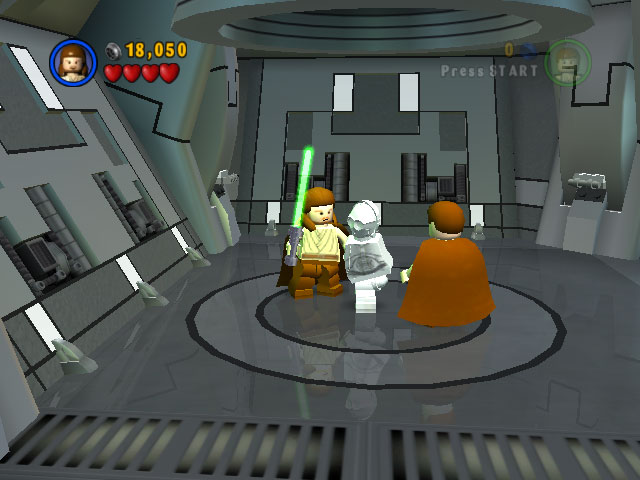
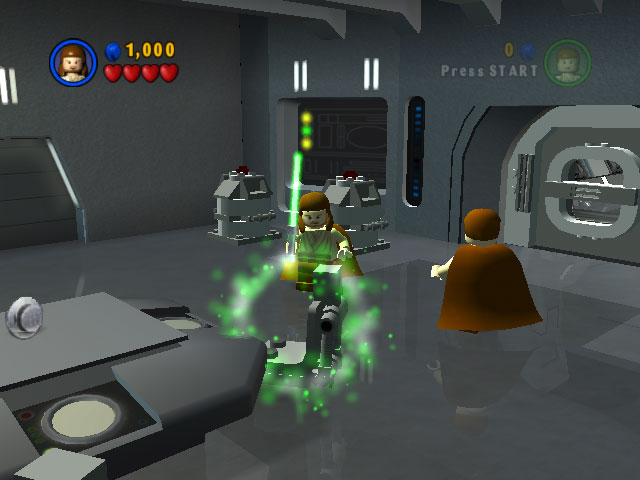
Lego Star Wars is without a doubt a fun game. Ostensibly it's a platform game, with the mix of reflex-based jumping and puzzles that genre entails. It is Star Wars seen through the eyes of Lego playtime. Everything is made of Lego bricks and to stay true to the genre you'll spend much of the game collecting items. Of course, they're Lego - studs for simple points, and pieces for mini-kits hidden in every level.
Lego Star Wars lets you play through the major plot points of Episodes I, II, and III. This is Story mode, and you play as Lego mini-figures of the hero at that point of the story (thankfully, the Dread Gungan, Jar Jar Binks, plays very little part, even in Episode I). As soon as you've played through the first chapter of Episode I (Negotiations with the Trade Federation), Episodes II and III are unlocked.You can also go back and start playing "Free Play," where you can play as any character you've managed to unlock. If you are far enough along in Story mode for a character to have a major role in the game, you can play as that character. After defeating Darth Maul, you can play as a mini-figure Darth Maul. After battling Count Dooku at the end of Episode II, you can bounce around as a mini-figure Yoda yourself. Some of the major characters you purchase with studs you collect (e.g., Jango Fett), and even minor characters are available (playing as a droideka is a bit absurd, but still fun).
Lego bricks don't really push the boundaries of what a modern game system can do. Despite that, the game looks very nice. Solid, smooth motion is everywhere, with very few aliasing artifacts. Collision detection, shooting, moving through space, all of it just works well.
If this was all there was to the game, it would be yet another licensing dud. A good one, but still all concept, no substance. Lots of time and money squandered on a "sure fire" hit, but with no real fun to the game.Too often, developers forget that the real point is content, not licensing. Fortunately, the developers of this game didn't forget to make it a fun game. The developers followed the plot of the movies, but not slavishly so. They took the germ of a scene in the movie and made a fun level or mini-game out of it. No game possibility? That scene didn't make it in, except perhaps as a cut scene. Thankfully, this means Jar Jar is limited to a cut scene or two (though you can play as Jar Jar if so inclined), and the painful "love scenes" between Anakin and Padmé are absolutely no where to be found.
And make no mistake, the levels of this game are fun. The puzzles can be challenging, but not real stumpers. The mini-games are zippy and sometimes tough, but not impossible. Frustration is not this game's point - entertainment is what it is all about.
Furthermore, it's family entertainment, because this game is at its best when it's a two-player game. A second player can plug in a second controller, press "Start", and show up as a nearby friendly character. Most of the scenes in the game (as in the movies) have several key characters involved, so if you're playing Obi-Wan running after Count Dooku, a second player will start controlling Anakin (who has been running alongside all along). Either player can switch control to a different character at any time. Either player can pause and opt to drop out at any time, too.
Needless to say, this is just perfect for parents who want to play along a bit, but need to get up to answer the phone or make dinner. For that matter, it works well for kids who want to take a break from a parent's focused gaming jag.
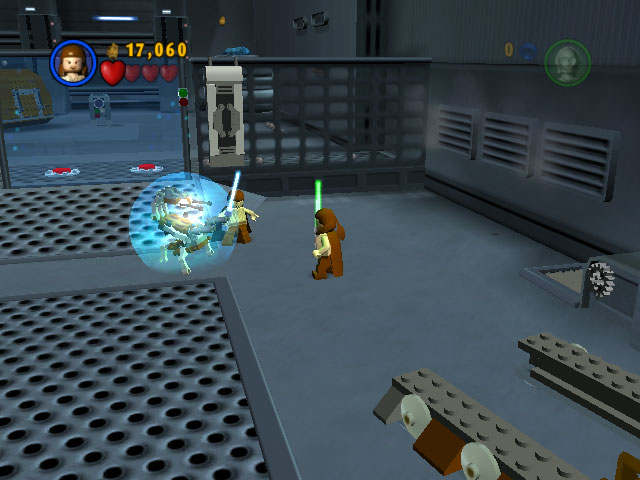
This two-player mechanism works into the content of the game as well. If two players are active, the puzzles often require cooperation (characters follow the lead of the single player if only one player is active). Your weapons can hurt friendly players, too, so games become social and interactive - "You take the ones on the right, and I'll get the ones on the left" is a common refrain when two Jedi are faced with a crowd of battle droids.
The game also gives some screen time to relatively minor characters (like TC-14, Kit Fisto, and a young Boba Fett), and is liberally sprinkled with Easter Eggs. (Such as the Cantina song, and the disco synthesizer version of the main theme that came out when disco was still a new thing). Finally, the whole entire game is done with a tongue-in-cheek attitude. The game knows it is made out of Lego. For instance, all the baby clone troopers on Kamino are single-stud bricks, and plants are Lego plants. None of the mini-figures take the proceedings too seriously either, with knowing winks and rolling eyes at all the right moments.All in all, it's a fun family game, well done, and a great buy. It's easy enough to play that a grade school student can pick it up, and engaging enough that the grade schooler's parents (or even teen siblings) will want to play too. If you buy one "Revenge of the Sith" tie-in, this is one that won't disappoint.
Slashdot welcomes readers' game reviews. To submit them, head to the submission page. -
Review - Lego Star Wars
nellardo writes "Put three topics dear to a typical Slashdotter's heart in one product and you are faced with the possibility of excellence warring with the possibility of crapulence. Take Lego, add Star Wars, and make a video game out of it, just in time for the release of Revenge of the Sith. That's Lego Star Wars, and it is in stores now. Fortunately, it turns out to be a fun gem of a game, good for a light afternoon for the hard-core LAN gamer, and great for kids and other family-like units.- Title: Lego Star Wars
- Developer: Eidos Interactive
- Publisher: Traveller's Tales
- System: PC/Xbox/PS2/GBA
- Reviewer: nellardo
- Score: 7/10
Lego Star Wars is without a doubt a fun game. Ostensibly it's a platform game, with the mix of reflex-based jumping and puzzles that genre entails. It is Star Wars seen through the eyes of Lego playtime. Everything is made of Lego bricks and to stay true to the genre you'll spend much of the game collecting items. Of course, they're Lego - studs for simple points, and pieces for mini-kits hidden in every level.
Lego Star Wars lets you play through the major plot points of Episodes I, II, and III. This is Story mode, and you play as Lego mini-figures of the hero at that point of the story (thankfully, the Dread Gungan, Jar Jar Binks, plays very little part, even in Episode I). As soon as you've played through the first chapter of Episode I (Negotiations with the Trade Federation), Episodes II and III are unlocked.You can also go back and start playing "Free Play," where you can play as any character you've managed to unlock. If you are far enough along in Story mode for a character to have a major role in the game, you can play as that character. After defeating Darth Maul, you can play as a mini-figure Darth Maul. After battling Count Dooku at the end of Episode II, you can bounce around as a mini-figure Yoda yourself. Some of the major characters you purchase with studs you collect (e.g., Jango Fett), and even minor characters are available (playing as a droideka is a bit absurd, but still fun).
Lego bricks don't really push the boundaries of what a modern game system can do. Despite that, the game looks very nice. Solid, smooth motion is everywhere, with very few aliasing artifacts. Collision detection, shooting, moving through space, all of it just works well.
If this was all there was to the game, it would be yet another licensing dud. A good one, but still all concept, no substance. Lots of time and money squandered on a "sure fire" hit, but with no real fun to the game.Too often, developers forget that the real point is content, not licensing. Fortunately, the developers of this game didn't forget to make it a fun game. The developers followed the plot of the movies, but not slavishly so. They took the germ of a scene in the movie and made a fun level or mini-game out of it. No game possibility? That scene didn't make it in, except perhaps as a cut scene. Thankfully, this means Jar Jar is limited to a cut scene or two (though you can play as Jar Jar if so inclined), and the painful "love scenes" between Anakin and Padmé are absolutely no where to be found.
And make no mistake, the levels of this game are fun. The puzzles can be challenging, but not real stumpers. The mini-games are zippy and sometimes tough, but not impossible. Frustration is not this game's point - entertainment is what it is all about.
Furthermore, it's family entertainment, because this game is at its best when it's a two-player game. A second player can plug in a second controller, press "Start", and show up as a nearby friendly character. Most of the scenes in the game (as in the movies) have several key characters involved, so if you're playing Obi-Wan running after Count Dooku, a second player will start controlling Anakin (who has been running alongside all along). Either player can switch control to a different character at any time. Either player can pause and opt to drop out at any time, too.
Needless to say, this is just perfect for parents who want to play along a bit, but need to get up to answer the phone or make dinner. For that matter, it works well for kids who want to take a break from a parent's focused gaming jag.
This two-player mechanism works into the content of the game as well. If two players are active, the puzzles often require cooperation (characters follow the lead of the single player if only one player is active). Your weapons can hurt friendly players, too, so games become social and interactive - "You take the ones on the right, and I'll get the ones on the left" is a common refrain when two Jedi are faced with a crowd of battle droids.
The game also gives some screen time to relatively minor characters (like TC-14, Kit Fisto, and a young Boba Fett), and is liberally sprinkled with Easter Eggs. (Such as the Cantina song, and the disco synthesizer version of the main theme that came out when disco was still a new thing). Finally, the whole entire game is done with a tongue-in-cheek attitude. The game knows it is made out of Lego. For instance, all the baby clone troopers on Kamino are single-stud bricks, and plants are Lego plants. None of the mini-figures take the proceedings too seriously either, with knowing winks and rolling eyes at all the right moments.All in all, it's a fun family game, well done, and a great buy. It's easy enough to play that a grade school student can pick it up, and engaging enough that the grade schooler's parents (or even teen siblings) will want to play too. If you buy one "Revenge of the Sith" tie-in, this is one that won't disappoint.
Slashdot welcomes readers' game reviews. To submit them, head to the submission page. -
C++ Templates: The Complete Guide
nellardo writes "The book C++ Templates: The Complete Guide, by Vandevoorde and Josuttis, Addison-Wesley 2003, is an authoritative treatment of exactly what it claims: the template mechanism of C++. If you are a C++ programmer, you should have this book on your shelf. If you aren't a C++ programmer, move along -- this book is highly specific to C++, and won't be much help in understanding the template mechanisms of other languages. Of course, if you aren't a C++ programmer, you probably wouldn't even give this book a second glance in the first place." Read on for the rest of Brook's review. C++ Templates: The Complete Guide author David Vandevoorde & Nicolai M. Josuttis pages 528 publisher Addison Wesley rating 10 for C++ programmers, 0 for anyone else. reviewer Brook Conner ISBN 0201734842 summary A thorough, exhaustively complete treatment of a complex subject. An essential reference for C++ programmers and a lengthy and boring book for anyone else.The C++ programming language is widely regarded as a good systems programming language, albeit a complex one fraught with low-level details and issues (though arguably this is what makes it good for certain kinds of systems programming). For perhaps a decade now, C++ has had a template mechanism - in programming language circles, it might more properly be called a form of parametric polymorphism. The template mechanism, like many other forms of parametric polymorphism, is potentially extremely powerful, but the complexity of C++ makes it tough to thoroughly master. That's where this book comes in.
Most likely, an experienced C++ programmer has at least used templates. If nothing else, use of the Standard Template Library (or STL) requires at least knowledge of how to use templates. If you use C++ enough to care about templates, you probably know what they are, at least roughly, and if you don't, this isn't the book from which to learn about them. It very clearly requires (and explicitly states in the introduction) that you need to know C++ before making effective use of the book.
Designing template classes, however, is another kettle of fish, and if you're in a position where you're building template classes for someone else to use, you probably need this book. Unless, like the book's authors, you moderate comp.lang.c++.moderated. If you are such a super C++ guru, you may still find this book useful - it is a truly stupendous catalog of the capabilities and subtleties of C++ templates. If nothing else, you'll find examples for well nigh every use to which you are likely to put C++ templates.
The book's strengths, then, are its authoritative and exhaustive detail. On the downside, its examples are dry and flavorless. Perhaps this is intentional, as a way to suggest how some feature can be used in a variety of situations. I prefer a combination of specific, concrete examples, followed by a generic example. The specifics motivate the need for a capability, while the generic showcases the broad, interrelated aspects of the capability. The authors didn't follow that approach. I would suspect this comes in part from their mutual roles in C++ standards bodies - a specific example could be seen as too limiting, and so were left out.
Another drawback, to my thinking, is its resolute focus on C++ to the exclusion of all other languages. Don't get me wrong - I read the title, and it's a C++ book, so I don't expect it to teach me Scheme, much less Haskell. However, I think the complexities of C++ templates might have been easier to tackle and understand with at least pointers to other ways it could have been (and has been) done. If nothing else, citations of alternative approaches would be a useful source for the motivated reader. As it is, it doesn't even deal with differences between C++ implementations - it doesn't even list GCC in the index.
All in all, though, C++ Templates: The Complete Guide is exactly what it claims to be. It's an in-depth treatment of C++ templates and how they work. It isn't a cookbook for practical applications, nor is it a guide to further in-depth exploration of parametric polymorphism. But it is definitely a handy reference for the working C++ programmer to have on her shelf. If you're a working C++ programmer, I'd recommend it. If you aren't, you might want to pass on this one.
You can purchase C++ Templates: The Complete Guide from bn.com. Slashdot welcomes readers' book reviews -- to see your own review here, read the book review guidelines, then visit the submission page. -
Solaris: Another View
nellardo writes "Solaris is Steven Soderbergh's newest film and ostensibly a major departure for him -- it's a science-fiction film, a remake of the earlier Tarkovsky film of the even earlier Stansilaw Lem novel. Soderbergh is known for his many introspective, character-oriented art house films. His more recent work has been moving towards more marketable Elmore-Leonard-style "thrillers" (including Out of Sight, which is in fact based on a Leonard book, Traffic, and Ocean's Eleven). So a "science fiction film" seems like an inventive departure. Sadly, it isn't - it's more of Soderbergh's usual schtick." Read on for more of nellardo's review.Fundamentally, it's about a man (George Clooney) mourning about his suicide wife (Natascha McElhone, best known from the incomparably better Ronin). The science fiction is there only to provide a mirror for Clooney's moping about his lost love. It could have been done with drugs, dreams, insanity, spirits, reincarnation, or any number of other conceits (and in other movies, it has been done, with all of those), but Solaris does it with a huge sentient planet capable of reading minds and reforming matter at subatomic levels. What does this stupendous cosmic power do? Create replicas of whoever the people on the nearby space station dream about. Like Clooney's dead wife.
This is a bit like using a Jedi Knight and her light saber to get at a can of soup.
The Jedi Knight and the light saber will definitely get the can, and get it open in a jiffy. But the contents are a mess. And one never seems to have a light saber around when one needs one. Much less a light saber attached to a willing Jedi Knight -- "Follow our mandate from the Jedi Council, we must! Mmmm!"
Like the light saber and the soup can, Solaris the sentient planet mostly just gets in the way of the real substance of the film. Solaris the planet looks pretty on the screen, but so does iTunes when you turn on the visualizations -- they've got about the same level of emotional content. We need clumsy faux-jargon exposition: "Are you or are you not made of sub-atomic particles?" (of course -- everything is made of subatomic particles, usually organized in the form of atoms, duh) -- to even know that Solaris the planet has anything to do with what is going on.
Comparisons with Kubrick's 2001: A Space Odyssey are as inevitable as they are inaccurate. Both films are set in space. And both films have a slow pace, driven largely by beautifully shot scenes of some space-scape. But that's the extent of the similarity. If this is Soderbergh's tribute to Kubrick, it falls short. Thematically, they have little to do with each other. Kubrick's long space shots establish tone and realism for a film shot before the Apollo moon walks. They are always placed to make a point relevant to the plot, whether it is the mind-numbing isolation of a long space journey or a parallel between the first bone weapons of proto-humans and the incomparably more sophisticated weapons of mass destruction of the near future. Soderbergh's long space shots show off some very pretty particle system effects and convince us, over and over again, that, despite all indications to the contrary, this film is taking place in a Strange Place.
What interesting shots Soderbergh does come up with tend to be film-studenty tricks like a dream-like tracking shot that suggests that there might be more than one replica of a particular character. Of course, by the point we start seeing these kinds of shots, we've already seen multiple replicas of the same character come and go. And he never goes anywhere with it. Even the supposedly trick ending is as obvious as the end of The Sixth Sense ("I see dead people" -- well, duh, we can see what the end is right there). Soderbergh brings this loaded gun on stage and never really fires it. The science fiction conceit of this super-powerful planet never goes anywhere.
Which just brings us back to the fact that this isn't really a science fiction movie. It's a character study. Unfortunately, I don't think Clooney's a good enough actor to really pull that off. He's got tremendous charisma and screen presence. But he doesn't do emotional depth well, and when he does, it either comes across as lust (the problem with his role in Out of Sight) or as bad melodrama (which is his problem here). The other actors are decent -- Jeremy Davies is good in a truly neurotic and twitchy role, but saying Jeremy Davies is good at playing neurotic is like saying that Jack Nicholson is good at playing crazy macho -- they can sleep through the role and still do it. McElhone is suitably cryptic, but again, it's something she does well. Viola Davis strikes me as perhaps the best of the lot, but I'm unfamiliar with her work, so she may be similarly snoozing through the role.
Soderbergh started his film career with a bit of sexual obsession, in the highly-regarded sex, lies, and videotape (yes, the title is all in lowercase -- never seen a satisfactory explanation for that little bit of conceit either). In the end, Solaris comes across much the same. Clooney sees McElhone on a train, they play a little eye footsie, and end up going to the same party at the home of a mutual friend. Breathy lines and bare butts soon ensue. Eventually, McElhone kills herself over a misunderstanding (Clooney walks out in a snit and she thinks he's not coming back). This is barely sexual obsession, and more like a pretentious drama student trying to redo the tragedies of Shakespeare. It just isn't compelling, and Clooney getting emotional distraught over it was silly (the New York audience I was with broke out into laughter -- maybe that's just New York cynicism, but I don't think so).
So in the end, what are we left with? Some pretty pictures of a purple planet. George Clooney's angst-ridden mug. A "trick" ending that is broadcast throughout the movie. And a conceit somewhat larger than a fully grown blue whale, lying in the middle of the movie doing nothing.
I wanted to like it, really I did. Soderbergh has done better, and we sure can use better directors on science fiction films than we usually get. Alas, this ain't it.
Slashdot welcomes reader-submitted features and reviews. Thanks to nellardo for this one! -
War of Honor
nellardo writes "War of Honor is out, complete with the aforementioned CD-ROM full of free, unencrypted novels. If you're a true fan of Honor Harrington, you probably don't need this review - you've already bought the book. If you're just waiting for paperback, don't, because the CD-ROM included with the book is worth the price of the book. If you're new to the Honor Harrington series, reading the book itself is not the place to start, but with the entire series (and then some) on the CD, you might want to pick up the book anyway, just for the CD-ROM." War of Honor author David Weber pages 869 + CD-ROM publisher Baen Books rating 9 reviewer Brook Conner ISBN 0743435451 summary Essential for fans of Honor Harrington. Sometimes turgid and complex political sci-fi. CD-ROM worth the cover price by itself.War of Honor is the tenth full novel in David Weber's Honor Harrington series, and thirteenth book (there being three collections of stories set in the so-called "Honorverse"). For those of you that have read the earlier novels, this is more of the same, though Honor herself figures perhaps somewhat less prominently in it than in previous novels. It's got Weber's usual rich and detailed plot, along with Weber's occassionally turgid and expository writing.
One thing that makes this novel different from the others is that Weber has fully incorporated characters and plot lines from the short stories set in the "Honorverse" but penned by other authors. Earlier novels had made allusions to some of Weber's own short stories, but none had integrated another author's work to the extent that War of Honor does. Of course, this does nothing to simplify the plot or reduce the expository interludes (Weber includes enough explanation so that you can follow the plot without having read the prior short story). It does add to the flavor though, and helps keep Weber from simply retreading old ground.
Discussion of the plot, even aside from spoiler concerns, is well-nigh impossible. There's simply too much that happens. This isn't a book that could be a film - it's a mini-series, even without the prior nine novels. War of Honor is not a light and fluffy read. It's a good two hundred pages longer than the previous novel (Ashes of Victory) and doesn't have some of the breezy, happy passages of its predecessor. In fact, you might want to take a break halfway through - I did, with a complete novel in a much lighter vein (bad pun - it was an Anita Blake, Vampire Hunter novel). Suffice it to say that Weber knows how to write the next installment in a series: this one resolves enough threads to make it satisfying and opens enough new ones that readers will continue to scream for the next novel.
What Slashdotters are most familiar with, though, is the CD-ROM that's been discussed here before. And it's a nice one, to be sure. While the books on the CD themselves are available at Baen's Free Library, the CD contains more.
One of the most wonderful resources is the art gallery: the covers of the most recent editions of the Honor Harrington books as jpg images, all at 800x1200 pixel resolution or greater. Not scans of the covers but images of the original art, without the title graphics or anything else. I predict some very nice wallpapers coming soon to a site near you.
The CD-ROM also has other lovely tidbits, such as audio selections from several novels and MP3s of songs from the group Echo's Children. So even if you haven't caught this filk group at a sci-fi con, you still get their songs and lyrics based on events in the Harrington novels.
And all of this is on top of all the books on the CD-ROM. All ten Harrington novels, and yes, that includes War of Honor itself. All three collections of Harrington stories. And twenty five (not the previously-reported twenty two) other books, from the likes of David Drake, Eric Flint, Dave Freer, Mercedes Lackey, Keith Laumer, Larry Niven, Jerry Pournelle, John Ringo, and James H. Schmitz. No encryption. No copy protection. In several formats each, including HTML, Microsoft Reader, Mobipocket, Rocket, and RTF files.
Put it all together in one no-download place and the CD-ROM is arguably worth the price of the hardcover book all by itself. Certainly, no new release CD-ROM sold by itself is going to sell for much less than US$26 (the cost of the book).
I'm of course reminded of Tim O'Reilly's (and many others) numerous comments to the effect that obscurity is a bigger problem for publishers than piracy. Jim Baen evidently agrees. He's just put the full text of a brand new flagship property (another bad pun, I'm sorry) in the clear. The disk even says you can copy it. Stamped right on the disk: "This disk and its contents may be copied and shared but NOT sold." Even the copyright notice says "All commercial rights reserved." Not "All rights reserved."
Given the popularity of the Honor Harrington series over all, it's just possible that this novel will make the NY Times (free reg, blah blah :-) best sellers list. And if it did, with its entire text freely and legally available on the net, wouldn't that be an interesting place for publishing to be?
You can purchase War of Honor from bn.com. Slashdot welcomes readers' book reviews -- to see your own review here, read the book review guidelines, then visit the submission page.