Slashdot Mirror
Domain: nrao.edu
Stories and comments across the archive that link to nrao.edu.
Stories · 26
-
A Naked Black Hole Is Screaming Through the Universe (gizmodo.com)
New submitter PongoX11 writes: Millions of years ago, B3 1715+425 was just an ordinary supermassive black hole. It had a comfortable life, of devouring stars and belching deadly x-rays, at the center of its distant galaxy. Now, starless and alone, it's screaming through space at 2,000 kilometers per second -- and it may never stop. BC 1715+425's troubles began when its galaxy bumped up against another. This isn't all that unusual: in fact, astronomers believe that the largest galaxies in our universe formed during ancient mergers. Normally, when two galaxies collide, the supermassive black holes at their centers start to orbit one another, moving closer and closer together in an inescapable gravitational attraction. Eventually, those black holes can fuse, releasing a burst of energy as gravitational waves and completing the cosmic joining. Most of the time, this process seems to work out for all parties involved, judging from the fact that nearly all supermassive black holes reside at the center of galaxies, and nearly all galactic centers contain a supermassive black hole. But every now and then, something goes wrong and cosmic wreckage ensues. B3 1715+425, speeding away from the core of a bloated galactic merger 2 billion light years from Earth, is living proof of this. The working theory is that millions of years ago, B3 1715+425's galaxy passed through a much larger galaxy (one that had formed during many previous mergers) and got shredded to bits, a bit like a paper airplane flying into a hurricane. The leftovers include a faint galactic remnant, just 3,000 light years across, and the supermassive black hole itself, nearly naked and hemorrhaging ionized gas as it tears through the void. "We were looking for orbiting pairs of supermassive black holes, with one offset from the center of a galaxy, as telltale evidence of a previous galaxy merger," said James Condon, the astronomer at the National Radio Astronomy Observatory who led the study. "Instead, we found this black hole fleeing from the larger galaxy and leaving a trail of debris behind it." -
Astronomers Discover Earth-Sized Diamond
ygslash (893445) writes Astronomers at the National Radio Astronomy Observatory announced that they have discovered what appears to be the coolest white dwarf ever detected. The white dwarf is formerly a star similar to our own sun which, after expending all of its fuel, has cooled to less than a chilly 3000 degrees Kelvin and contracted to a size approximately the same as Earth. A white dwarf is composed mostly of carbon and oxygen, and the astronomers believe that at that temperature it would be mostly crystallized, forming something like a huge diamond. -
New Views of Supernova 1987A Reveal Giant Dust Factory
New submitter ihtoit writes "Astronomers using the ALMA radio telescope in Chile have released images and data showing the oft-postulated but unobserved (until now) dust shell ejected by the supernova remnant SN1987A. 'We have found a remarkably large dust mass concentrated in the central part of the ejecta from a relatively young and nearby supernova,' astronomer Remy Indebetouw, of the National Radio Astronomy Observatory (NRAO) and the University of Virginia, said in a statement. 'This is the first time we've been able to really image where the dust has formed, which is important in understanding the evolution of galaxies.' SN1987A was the first cataloged supernova event in our Galactic neighborhood in 1987. It lies 168,000 light years (987 quadrillion miles) away in the Large Magellanic Cloud, which means that at the time of the explosion, woolly mammoths still roamed Europe and Mitochondrial Eve saw her first sunrise." From the article, the significance: "'Really early galaxies are incredibly dusty and this dust plays a major role in the evolution of galaxies,' Mikako Matsuura, a scientist associated with the study ... said ... 'Today we know dust can be created in several ways, but in the early universe most of it must have come from supernovas. We finally have direct evidence to support that theory.'" -
Are Shuttered Gov't Sites Actually Saving Money?
Lots of U.S. government agencies' websites are partly or fully shut down, many of them with messages like this one, from the front page of the National Radio Astronomy Observatory: "Effective 7 p.m. EDT, Friday, 4 October 2013, the National Radio Astronomy Observatory (NRAO) temporarily suspended all US operations because of the US Federal government shutdown. All NRAO facilities and buildings are closed; NRAO personnel, other than a skeleton crew, are on furlough and cannot respond to emails or phone calls." Brian Doherty argues at Reason that many of these shutterings don't actually seem to make any financial sense, and that the sites are down more as a public statement than out of fiscal prudence. If you're involved with running an organizational web site (government-funded or not), do you agree? -
Another Science Facility Bites the Dust, Temporarily
An anonymous reader writes "Today, the latest victim of the U.S. government shutdown, the National Radio Astronomy Observatory shut its doors and essentially mothballed all three of its radio telescope facilities: the Very Large Array or VLA (think Jodie Foster, Contact); the Green Bank Telescope, and the Very Long Baseline Array or VLBA. While the ALMA telescope is not yet affected (mainly due to it being run by a consortium of European, Japanese, Chilean and U.S. organizations), the U.S. funds for that will soon also dry up. Not only does this furlough most of the ~550 employees, it has also thrown a monkey wrench into many long-term carefully planned observations (to the tune of wasting half a million dollars and a year's worth of work). Emily Lakdawalla of the Planetary Society also has a commentary on the closure — and a plea to 'stop the madness.'" -
Milky Way Magnetic Fields Charted
eldavojohn writes "Using radio telescope data, scientists from around the world have plotted the Milky Way Galaxy's magnetic field in the form of Faraday Depth. From the article, 'For 150 years, scientists have measured cosmic magnetic field by observing the Faraday effect. They know that when polarized light passes though a magnetized medium, the plane of polarization turns. This concept is called Faraday rotation. The strength and direction of the magnetic field governs the amount of rotation that occurs. So scientists observe the rotation to investigate the magnetic fields' properties. Radio astronomers study the polarized light from distant radio source, passing through the Milky Way on the way to Earth, in order to measure our Galaxy's magnetic field. By measuring the polarization of the light sources at different frequencies, researchers can determine the amount of Faraday rotation.' In the future, radio telescope technologies like LOFAR, eVLA, ASKAP, MeerKAT and the SKA hope to provide enhanced Faraday rotation data so scientists can better understand turbulence in galactic gas and these galactic magnetic field structures." -
Renaming the Very Large Array
New submitter mercurywoodrose writes "To commemorate a decade-long electronics upgrade, the Very Large Array in New Mexico is up for renaming. Submissions may be made at the National Radio Astronomy Observatory's website until December 1." -
"Wi-Fi Refugees" Shelter in West Virginia Mountains
The 13,000 sq mile U.S. Radio Quiet Zone is an area in West Virginia where all wireless transmissions are banned because of the large number of radio telescopes located there. (This official page shows a map of the Zone; an old Wired article is fascinating reading.) These high-tech telescopes have attracted unlikely neighbors, people who claim to have Wi-Fi allergies. In recent years, scores of people have moved to the area to escape the "damage" that electromagnetic fields can cause them. From the article: "Diane Schou is unable to hold back the tears as she describes how she once lived in a shielded cage to protect her from the electromagnetic radiation caused by waves from wireless communication. 'It's a horrible thing to have to be a prisoner,' she says. 'You become a technological leper because you can't be around people. It's not that you would be contagious to them — it's what they're carrying that is harmful to you.'" -
15-Year-Old Student Discovers New Pulsar
For the second time in as many years, a student has made a discovery while participating in the Pulsar Search Collaboratory (PSC), a joint program between the National Radio Astronomy Observatory and West Virginia University designed to get students and teachers involved in analyzing data from the Robert C. Byrd Green Bank Telescope (GBT). This time it was high school sophomore Shay Bloxton, who discovered a brand new pulsar. "For Bloxton, the pulsar discovery may be only her first in a scientific career. 'Participating in the PSC has definitely encouraged me to pursue my dream of being an astrophysicist,' she said, adding that she hopes to attend West Virginia University to study astrophysics. Late last year, another West Virginia student, from South Harrison High School, Lucas Bolyard, discovered a pulsar-like object called a rotating radio transient. His discovery also came through participation in the PSC." -
Water Detected At Record Distance From Earth
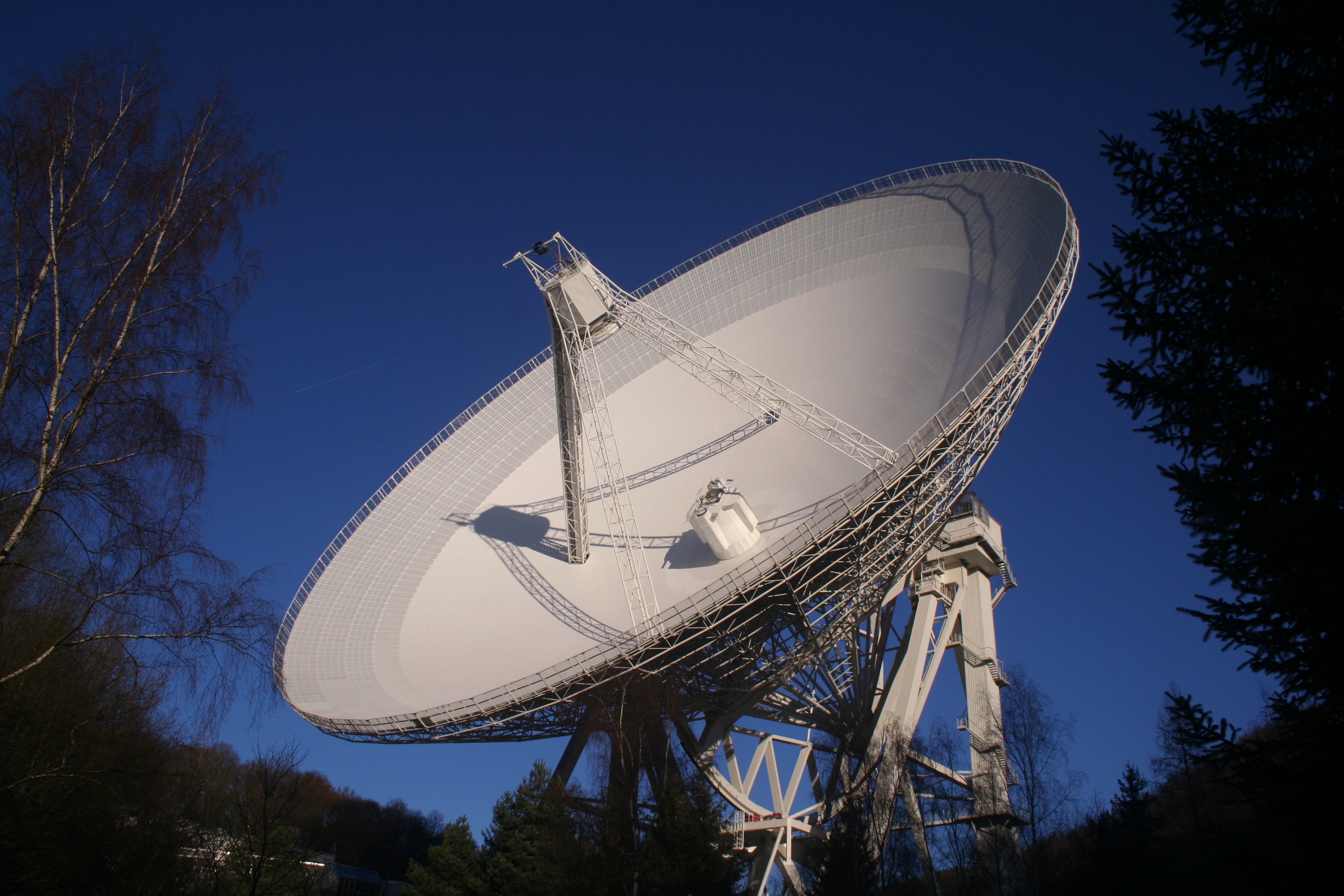
Matt_dk writes with news that scientists have detected water in a galaxy 11.5 billion light-years from Earth. Evidence came in the form of emissions from water masers around a quasar at the center of the galaxy. Detection at such a large distance was made possible by a closer, intervening galaxy which acted as a gravitational lens. "'We were only able to discover this distant water with the help of the gravitational lens,' said Violette Impellizzeri, an astronomer with the Max-Planck Institute for Radioastronomy (MPIfR) in Bonn, Germany. 'This cosmic telescope reduced the amount of time needed to detect the water by a factor of about 1,000,' she added. The astronomers first detected the water signal with the Effelsberg telescope. They then turned to the VLA's sharper imaging capability to confirm that it was indeed coming from the distant galaxy. The gravitational lens produces not one, but four images of MG J0414+0534 as seen from Earth. Using the VLA, the scientists found the specific frequency attributable to the water masers in the two brightest of the four lensed images. The other two lensed images, they said, are too faint for detecting the water signal. The radio frequency emitted by the water molecules was Doppler shifted by the expansion of the Universe from 22.2 GHz to 6.1 GHz." -
Water Detected At Record Distance From Earth
Matt_dk writes with news that scientists have detected water in a galaxy 11.5 billion light-years from Earth. Evidence came in the form of emissions from water masers around a quasar at the center of the galaxy. Detection at such a large distance was made possible by a closer, intervening galaxy which acted as a gravitational lens. "'We were only able to discover this distant water with the help of the gravitational lens,' said Violette Impellizzeri, an astronomer with the Max-Planck Institute for Radioastronomy (MPIfR) in Bonn, Germany. 'This cosmic telescope reduced the amount of time needed to detect the water by a factor of about 1,000,' she added. The astronomers first detected the water signal with the Effelsberg telescope. They then turned to the VLA's sharper imaging capability to confirm that it was indeed coming from the distant galaxy. The gravitational lens produces not one, but four images of MG J0414+0534 as seen from Earth. Using the VLA, the scientists found the specific frequency attributable to the water masers in the two brightest of the four lensed images. The other two lensed images, they said, are too faint for detecting the water signal. The radio frequency emitted by the water molecules was Doppler shifted by the expansion of the Universe from 22.2 GHz to 6.1 GHz." -
Water Detected At Record Distance From Earth
Matt_dk writes with news that scientists have detected water in a galaxy 11.5 billion light-years from Earth. Evidence came in the form of emissions from water masers around a quasar at the center of the galaxy. Detection at such a large distance was made possible by a closer, intervening galaxy which acted as a gravitational lens. "'We were only able to discover this distant water with the help of the gravitational lens,' said Violette Impellizzeri, an astronomer with the Max-Planck Institute for Radioastronomy (MPIfR) in Bonn, Germany. 'This cosmic telescope reduced the amount of time needed to detect the water by a factor of about 1,000,' she added. The astronomers first detected the water signal with the Effelsberg telescope. They then turned to the VLA's sharper imaging capability to confirm that it was indeed coming from the distant galaxy. The gravitational lens produces not one, but four images of MG J0414+0534 as seen from Earth. Using the VLA, the scientists found the specific frequency attributable to the water masers in the two brightest of the four lensed images. The other two lensed images, they said, are too faint for detecting the water signal. The radio frequency emitted by the water molecules was Doppler shifted by the expansion of the Universe from 22.2 GHz to 6.1 GHz." -
Black Hole Particle Jets Explained
Screaming Cactus writes "A team of researchers led by Boston University's Alan Marscher have apparently worked out the physics behind the particle streams emanating from many black holes. According to the researchers, 'twisted, coiled magnetic fields are propelling the material outward.' By watching an 'unprecedented view' of a black hole in the process of expelling mass, they were able to confirm their theory, predicting where and when bursts of energy would be detected." -
Huge Hydrogen Cloud Will Hit Milky Way
diewlasing points us to a story about a hydrogen cloud, eleven thousand light-years long, which will collide with the Milky Way in a devastating crossfire of shock waves and star formation...in 20-40 million years. Mark your calendars. At least it will give us something to watch while we're waiting for Andromeda to hit us in a few billion years. Hopefully, it will look at least this cool. "The detailed GBT study dramatically changed the astronomers' understanding of the cloud. Its velocity shows that it is falling into the Milky Way, not leaving it, and the new data show that it is plowing up Milky Way gas before it as it falls. 'Its shape, somewhat similar to that of a comet, indicates that it's already hitting gas in our Galaxy's outskirts,' Lockman said. 'It is also feeling a tidal force from the gravity of the Milky Way and may be in the process of being torn apart. Our Galaxy will get a rain of gas from this cloud, then in about 20 to 40 million years, the cloud's core will smash into the Milky Way's plane,' Lockman explained." -
Software Telescope
An anonymous reader writes "The BBC News is running the story 'Pyramid power' probes universe which is about LOFAR's software telescope for radio astronomy. The heart of the system is a IBM Blue Gene which processes data from an array of simple pyramidal radio antennae. The array of antennae are also multitasking in the fields of geophysics and agriculture." -
Huygens Wind Experiment Salvaged
SeaDour writes "Earlier, it was reported that the data from a critical wind speed experiment onboard the Huygens probe to Titan was completely lost due to someone forgetting to turn on one of Cassini's communications channels. However, it now appears that ground-based radio telescopes from the National Radio Astronomy Observatory were able to record the transmission's many subtle doppler shifts and reconstruct that lost wind data. The winds altered the probe's horizontal rate of descent, thereby producing a change in the frequency of the signal received on Earth. Additionally, the resolution of the radio telescopes was good enough to track Huygen's position to within one kilometer, allowing for the creation of a three-dimensional model of Huygen's descent." -
Worlds Largest Telescope?
AndersBrownworth writes "With a unique take on "Distributed Computing", the PhotonStar Project aims to search for laser transmissions from extra terrestrial life by harnessing amateur astronomers who have an optical telescope with a laser detector, a GPS and a computer with a net connection. I think it would be interesting to get a large number of computer controlled optical telescopes together that have GPS and CCD capabilities and build the world's largest optical telescope. The concept wouldn't be much different from New Mexico's VLA Radio Telescope. Given the falling prices of computer controlled optical telescopes, a project like this might not be far off." -
Resolving Beachballs in the Crab Nebula
Stranger4U writes "Researchers at New Mexico Tech and the NRAO have used the Aricebo radio telescope in Puerto Rico and some specilized equipment to more closely examine the pulses from the Crab Nebula pulsar. Some of the signals lasted less than two nanoseconds, meaning the originated from a volume no bigger than beach ball. Stories are here(1) and here(2)." -
Experiment This Weekend To Measure Speed Of Gravity
An anonymous reader writes: "Is gravity an instantaneous phenomenon, as we were taught in high school, or is its speed, like all other Einsteinian phenomena, bounded by the speed of light? A radical new experiment, proposed by Sergei Kopeikin, and involving the Very Long Baseline Array, is set to occur this weekend, and results should be known within about two weeks." -
NYT on the Very Large Array
jonerik writes "Today's New York Times has this article on the current renovation of the Very Large Array; the Y-shaped collection of 27 movable large dish antennas in New Mexico that are collectively one of the most important radio telescope systems in the world. The Times article details plans currently underway to upgrade the system with new electronics, as well as the eventual addition of eight more telescopes to the array. 'The planned renovation is scheduled to be completed in 2011. The National Science Foundation, the observatory's principal supporter, will pay for most of the $75 million project, with smaller amounts coming from Canada and Mexico.'" -
Age Of Most Pulsars Is Now A Mystery
Guinnessy writes "A pulsar that has been viewed by the Very Large Array in New Mexico for the past ten years, is only 65,000 years old not 107,000 years as astronomers previously thought. The new results suggest that the main techniques that astronomers use for measuring the age of pulsars is completely wrong. There's a press release about it the NRAO's web site." -
Age Of Most Pulsars Is Now A Mystery
Guinnessy writes "A pulsar that has been viewed by the Very Large Array in New Mexico for the past ten years, is only 65,000 years old not 107,000 years as astronomers previously thought. The new results suggest that the main techniques that astronomers use for measuring the age of pulsars is completely wrong. There's a press release about it the NRAO's web site." -
Age Of Most Pulsars Is Now A Mystery
Guinnessy writes "A pulsar that has been viewed by the Very Large Array in New Mexico for the past ten years, is only 65,000 years old not 107,000 years as astronomers previously thought. The new results suggest that the main techniques that astronomers use for measuring the age of pulsars is completely wrong. There's a press release about it the NRAO's web site." -
Green Bank Telescope Goes Live
ptbrown writes: "The world's largest steerable radio telescope is being dedicated today at Green Bank, W.Va. The 100 meter Robert C. Byrd Green Bank Telescope (named after a West Virginia senator) is 485 feet tall, weighs 16 million pounds, cost $75 million, took almost 10 years to build, and is expected to last for at least 25 years. The telescope it replaces (designed to last 10 years) collapsed in 1988 after only 26 years. This is a pretty unique dish: assymetrical, side-mounted feed arm, movable surface panels, and laser-assisted ranging. And they give tours, so if you're ever around southern West Virginia think about stopping by. " -
Scientists Discover Interstellar ... Sugar?
Vicnice writes: "The discovery of simple sugars in the cosmos raises the possibility of life elsewhere in the universe a notch or two. Specifically, the sugar molecules were located in a gas cloud near the center of our galaxy. From the National Radio Astronomy Observatory release: "The scientists identified glycolaldehyde by detecting six frequencies of radio emission in what is termed the millimeter-wavelength region of the electromagnetic spectrum -- a region between more-familiar microwaves and infrared radiation." -
Scientists Discover Interstellar ... Sugar?
Vicnice writes: "The discovery of simple sugars in the cosmos raises the possibility of life elsewhere in the universe a notch or two. Specifically, the sugar molecules were located in a gas cloud near the center of our galaxy. From the National Radio Astronomy Observatory release: "The scientists identified glycolaldehyde by detecting six frequencies of radio emission in what is termed the millimeter-wavelength region of the electromagnetic spectrum -- a region between more-familiar microwaves and infrared radiation."