Slashdot Mirror
Domain: oilcrisis.com
Stories and comments across the archive that link to oilcrisis.com.
Comments · 15
-
Re:Obama's false premise
> to last for decades at minimum
That is a gross overestimate of the actual resources available.
-
Re:And yet the public...
you will never get enough energy through renewables unless solar platforms in orbit start working -- they will, but I would not count on them this century.
This is way out of date. The government's National Renewable Energy Lab concluded in 2004 that solar panels produce the energy needed to manufacture them in 2 years. Those panels can last 30 years so for 28 years they contribute more energy than it took to make them. Wind turbines can produce as much energy in a few months as it took to make them.
Of course nuclear power supporters disagree with anything that shows nuclear power is not needed.
Falcon
I'll disagree with anything that attempts to be the end, all be all solution that supporters of Renewables attempt to pitch them as.
As someone said earlier, no one is saying "no renewables, period", we're saying we don't have time to play with them right now when our biggest problem isn't something they can actually help with.
No one has ever even contemplated replacing a Coal-fired plant with a renewable source of energy because renewable in no way, shape, or form have the dependability to be counted on to produce 24 hour a day, 7 day a week, 365 days a year Electricity. I'm not making this stuff up, it's simply a fact of life right now.
Does that mean it will always be true? Of course not. The problem I have is that we could be replacing Coal with nuclear NOW, even if we later discover a better way forward.
You can't try and solve every problem at once because all you'll end up doing in NOTHING AT ALL. We can solve a big chunk of our pollution problem right now by switching to Nuclear. We'll tackle the well understood problems with Nuclear when we get to that bridge.
Oh, before I forget, Nuclear Plants repay their "energy to build" bill in about six months of constant operation (to show I didn't forget the original point of the post
-
Re:And yet the public...
you will never get enough energy through renewables unless solar platforms in orbit start working -- they will, but I would not count on them this century.
This is way out of date. The government's National Renewable Energy Lab concluded in 2004 that solar panels produce the energy needed to manufacture them in 2 years. Those panels can last 30 years so for 28 years they contribute more energy than it took to make them. Wind turbines can produce as much energy in a few months as it took to make them.
Of course nuclear power supporters disagree with anything that shows nuclear power is not needed.
Falcon
-
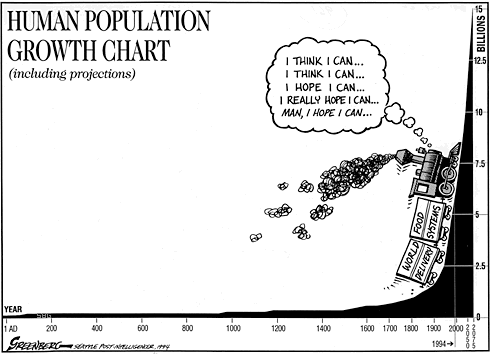
Nevertheless. 3% growth it has been.
human power
animal power
wind/water power
wood powered steam
coal powered steam
oil power
nuclear powered steamhttp://greenberg-art.com/.Toons/.Toons,%20Environ/qqxsgPopulation%20chart.gif
Whether it's unreasonable or not is irrelevant. It's fact.
If the energy is made available there will be economic growth. Then there will be a continuing requirement for continuing growth.
3% per year gives what? How long will billions of years of uranium last? 250 years? 300? (I haven't run the numbers, but what I can tell you is that the emeritus professor from Stanford is wrong (or irrelevant) because his starting assumptions are wrong)
You also might want to acquaint yourself with Olduvai Gorge theory.
http://www.oilcrisis.com/duncan/road2olduvai.pdf
-
Israel is in trouble.
Ah! Back home again.
And look at everything which has happened while I was away! Miss a few news cycles and Gaza winds up in flames. I wonder if the timing of this even was deliberate. No. Actually, I don't wonder that at all.
The whole situation in Israel and Gaza looks to me like the result of a long and slow mind-programming effort, largely through the use of religion, to annihilate everybody of Semitic blood lines. Jew and Muslim alike.
One possible scenario I see unfolding. . .
The propaganda war being waged by Israel while it bombs Gaza is seen for what it is; (nobody seems to be buying it except those who already owned it), and the world stands well back while Israel is attacked with far more than just home made rockets. The Zionist-owned puppet leaders in the West respond by going to war against the Muslim world, (more so than already), and the destruction of humanity is jump-started.
Destruction of 94% of the world's population. That appears to be the goal, starting with the Semites.
Isn't it weird how the Zionist movement in it's early days used coercion and underhanded tactics to move Jewish communities to one convenient location? All eggs in one basket. Isn't it also weird how some of the more powerful Zionists weren't even Jewish?
I've been telling my Jewish friends for years to stay the heck away from the 'promised land'. I can't see how this can possibly end well.
To get a snippet of some of the thinking circulating in the darker corners, read Dave McGowan's essay with attention to one Dr. Colin Campbell and his advice on the matter of Peak Oil. (Take a look at the list of institutions he's been invited to lecture at.)
-FL
-
Re:Valuable as PR move more than anything?
Solar input to the planet is on the order of 10^17 watt.
US generation is on the order of 10^12 already.
Multiply that by 10^3 to 10^5 when energy gets really cheap, and suddenly we're producing a significant fraction of the heat of the sun. That'll be plenty to keep the earth nice and toasty.
A few sources:
http://www.phy.syr.edu/courses/modules/ENERGY/ENER GY_POLICY/tables.html
http://en.wikipedia.org/wiki/Earth's_energy_budget
http://www.oilcrisis.com/debate/oilcalcs.htm -
Re:Gas prices
I'm not disagreeing with you, there is a vast difference between the USA and China.
I find some of the differences interesting.
From the CIA World Fact Book:
USA:
Area: 9,629,091 sq km
Oil consumption: 19.65 million bbl/day (2001 est.)
Population: 290,342,554 (July 2003 est.)
China:
Area: 9,596,960 sq km
Comparative Area: slightly smaller than the US
Oil consumption: 4.975 million bbl/day (2001 est.)
Population: 1,286,975,468 (July 2003 est.)
So their population is 1 billion higher, but in roughly the same total area as the US.
They consume 1/4 of the oil the US does, but this is increasing rapidly.
The average daily oil consumption in the US is 0.06767 bbl/day.
If we apply that number to the Chinese population, their consumption becomes a staggering 87,100,797 bbl/day!
We know there isn't enough oil available, as world production is around 75 million bbl/day, and there aren't any significantly large new fields being discovered (fig 4 on the page).
Read http://www.lifeaftertheoilcrash.net/
-
Re:More big numbers
Don't nuclear power plants extract one heckuva lot more energy per unit of fuel than oil?
Per unit mass of fuel yes. But that is not the appropriate measure of their usefulness. For a start uranium is relatively rare and a huge expansion in the use of nuclear power would soon run into problems with fuel shortages. Also the net energy return from nuclear, while postive, isn't vast. Large amounts of energy must be invested to mine and enrich the fuel and to build and operate the reactors. This all cuts into the net energy you get out in the end.
We have 50 years to come up with alternatives to oil
Do you now where that 50 years number comes from? They take known reserves of oil and divide it by present consumption to get years left. However consumption rises at an exponential rate and so would be much higher in the future, shortening the time to exhaustion. Secondly the physics of oil extraction is ignored. You cannot pump oil out of the ground at any rate you like. At first it is easy but as the well empties it be comes increasingly difficult to extract the remaining oil. After half the oil is gone production will fall year on year, whatever you do.
This physical effect for a single oil well is mirrored in the overall oil production figures. It was predicted by M. King Hubbert in the 1950's that US oil production would peak around 1970 and then start to steadily fall. This is what happened and we are fast approaching the peak predicted for global oil production, likely within the next decade. It will be possible to produce oil well past the end of the 21st century but it will be in smaller and smaller quantities. What matters is when oil production peaks and the shortages begin, not when the very last barrel is pumped.
Also as I said before a barrel of oil is not a barrel of oil. The oil that is left in the ground is has less net energy in it than the oil that has already been used because it takes so much more energy to get it out of the ground. The Energy Return On Investment (EROI) of oil has been steadily falling and when it gets near unity, oil is no longer an energy source, no matter how much is left in the ground. Other fossil fuels are affected in a similar way. The EROI of coal has been falling steadily as it becomes necessary to dig deeper to find it.
-
Hubbert Curve and the World Production of Oil
I posted this comment a few days ago on the energy poll but the poll changed before anyone had a chance to read it. Here it is again.
While googling around for information on world oil production I came across something called the Hubbert Curve.
The Hubbert Curve is a mathematical model that predicts petroleum production levels. It was developed in 1956 by M. King Hubbert, a petroleum geologist at Shell Oil.
It basically says that the rate of production of oil over the life of the reserve roughly follows a normal (ie, "bell curve") distribution. In other words, the rate of production will increase until half of the available oil has been produced, then the rate of production will begin to decline.
Here is a Hubbert curve plotted in 1996 using the latest available data at the time. The first graph shows the world output of conventional oil in millons of barrels per day over a 100 year span starting in 1950. It assumes an Ultimate Recovery (total amount of oil in the world) of 1750 Gb (gigabarrels). The plot does not include non-conventional sources such as oilsands. The full report is here
The graph predicts that global production will peak in the early 2000's and will decline steadily over the next fifty years. By 2050 production from conventional sources will have decrease by 70%. The second graph shows the Hubbert curve for conventional, non-conventional and gas liquid sources, plus the combined curve for conventional and non-conventional oil. Although production from non-conventional sources is predicted to double over the next 50 year it will not offset the predicted decline in production from conventional sources.
The graph has both its supporters and detractors. One of the inputs to calculating the curve is the Ultimate Recovery and its hard to know exactly what will be. I've found figures on the web that range from 1750 Gb to as high as 2300 Gb. However, as this article states, even if ultimate recovery is as high as 2600 Gb, the peak will only be delayed till 2019. Here is a critique of the Hubbert Curve.
What I find interesting about the curve is that oil production will not suddenly drop to zero when the oil runs out (the doomsday scenario). Rather production will steadily decline over a long period as existing sources dry up and new sources become harder and more expensive to exploit. At the same time, increasing oil prices will lead to the development of new sources of energy. As new energy production expands demand for oil will probably decrease, leading to lower oil prices. Oil production will finally stop when the cost of extracting the remaining oil exceeds market price. -
Um, the big one?
An economy not entirely dependent on oil? Depending on who you ask - and, oh boy, does it depend - we've already passed the global midpoint where we're using it up faster than we can possibly find it.
No, I'm not screaming that we're going to run dry in ten years, I'm saying that oil prices are only going one way, and that it's a risky strategy to rely on a supply of new oil from Arab countries.
How about just for once we plan further ahead than the next election and begin the wholesale switch to renewable energy sources now? We put man on the moon in under eight years from declaring it. If we had eight years warning, could we we build and drive a vehicle through every mainland US state without using a drop of oil, directly or indirectly? Oh, sure we could, we'd just use solar. And, uh, no plastics. And, um, build it in a plant powered by wind turbines. And ship the parts by, uh, yuh, we'll come back to that one. And our factory workers will use geothermal power to heat their homes, and they'll, erm, cycle to work. You see how it goes? Sure, in theory we could do it, and sooner or later, we'll have to. Are we going to wait until the last possible moment to put that theory to the test?
Oil is a one off bonanza in human history. We should be investing that wealth in our childrens' future, not blowing it on wide screen TVs and leaving them to clean up the mess.
While I'm ranting, sooner or later China is going to get rich enough to support an unhealthy population of lawyers, and then we can forget shipping our toxic garbage there to be melted down. Again, we can keep building the tire mountains and circuit board cities higher and higher and leave our kids to work out what to do with them. I just hope they're not such selfish short sighted bastards when it comes to looking after us in our collective old age.
-
Re:Oil seems to be the missing ingredient
Maybe you missed the memo, but Iraq hasn't been able to sell oil anywhere near capacity for more than ten years. Have you heard the phrase 'Food for Oil'? That's about Iraq.
Iraq has at least 100 billion barrels of oil by conservative estimates, and 300 billion by some people's estimates.
Start with Oil Crisis and educate yourself from there. -
Re:Fighting the Greenhouse EffectIf this solution were to scale up, then people would be growing huge amounts of sugar cane. As with US large scale agriculture, that will require fertilizer, and that will require fossil fuel as an input (for large scale production)
From The Coming Global Oil Crises:
"The major energy inputs in U.S. corn production are oil, natural gas, and/or other high grade fuels. Fertilizer production and fuels for mechanization account for about two-thirds of these energy inputs for corn production (Pimentel, 1991)." -
How much oil is leftI am deeply curious if any of us here know how much oil is left.
Nobody knows how much oil is left. The best we have are "estimates", which themselves have have significant degrees of uncertainty. Based on my reading, I'd say the amount of actual known reserves might vary by a factor of 2-3x due to various players hiding their cards and understating or overstating their known/suspected reserves. It's not in each players' interest to disclose how little or large their reserves are.
And I'd guess current estimates of reserves could underestimate actual supply by 10-1000x based on what we don't know about geological areas around the world, about how oil is formed, about how to efficiently extract it. While these might not effect "reserves" under a strict version of your definition, they obviously would affect "supply" which I think was what your initial question was asking ('how much oil is left?')
With those caveats in mind, I offer you two links to address your question.
The US Department of Energy's global reserve estimates, and
a mid-2001 analysis of defining and analyzing the primary sources of global reserve figures by Jean Laherrere. I can't vouch for his analysis (the chart on the bottom of page 5 shows reported reserves going up but his analysis of them going down, something I haven't read closely enough to understand) since I've only run across it today, and a website named oilcrisis.org might indicate some bias, but I've seen his name before and its a resource worth checking out if you want to know how much oil is left.
--LP
-
more about oil dependence
Another posted mentioned that alternative energy sources will not replace oil, because oil is so cheap. The poster also said that another reason for oil to be replaced is if we run out, or if supplies dwindle enough that we can no longer provide enough oil for everybody (which ties into the rising cost argument).
According to Oilcrisis.com, when we hit the point (within the first quarter of this century) that we need to switch over to an alternative energy source, it will be too late. Our infrastructure depends on oil, and switching every motor vehicle, truck, airplane, cargo ship, and train to an alternative energy source will be a massive endeavor. Perhaps impossible to perform without the support of the infrastructure itself.
I would like to encourage everyone to support alternative energy before this point. We can't afford to wait until it is cheap. -
Re:Natural Gas Prices
Unfortunatly this is just wrong.
a) Estimates for reserves of oil and gas are usually severly flawed and horribly inaccurate.
i)Is USGS 2000 Assessment Reliable?
ii)Reserve Growth: Technological Progress, or Bad Reporting and Bad Arithmetic?
b) As demand for gas increases its true we could just drill more wells, but all the easy stuff is gone. It gets more expensive and more difficult to extract hydrocarbon resources from the ground and therefore prices remain high.
i)What goes up must come down: when will it peak?