Slashdot Mirror
Domain: pagetable.com
Stories and comments across the archive that link to pagetable.com.
Comments · 23
-
Paul Allen, others, wrote the code, or most of it?
See Microsoft BASIC for 6502 Original Source Code [1978].
My understanding from reading a book by Paul Allen, Idea Man: A Memoir by the Cofounder of Microsoft and from other sources, is that others wrote the code, or most of it. However, that was never openly stated, apparently.
Quote from that Amazon page, taken from the book:
"While much has been written about Microsoft's early years, Allen has never before told the story from his point of view. Nor has he previously talked about the details of his complex relationship with Gates or his behind-closed-doors perspective on how a struggling start-up became the most powerful technology company in the world. Idea Man is the candid and long-awaited memoir of an intensely private person, a tale of triumphant highs and terrifying lows."
My impressions: The book is definitely NOT "candid". Allen's relationship with Bill Gates was definitely "complex". Allen is definitely an intensely private person.
Paul Allen's relationship with Bill Gates was so intensely unfriendly at times that Allen decided to disconnect from Microsoft. Allen had a lot of Microsoft stock; that's why he is rich. -
Re: Why design it from scratch?
I thought the Terminator had a 6502 compatible processor.
-
If there is such a compiler
A good, modern C compiler is a lot better than you to find serendipitous optimization points in structured code
Provided that a developer can find and afford a "good, modern C compiler" targeting a given platform. What's the state of the art in compilers for 6502-based* microcontrollers again? Last I checked, code produced by ca65 was fairly bloated compared to equivalent hand-written assembly language. And I'm told that for years, GCC severely lagged behind $6000-per-seat Green Hills compilers.
* Why 6502? Maybe I'm making an NES game for the competition. Or maybe I need to code a hash table for the storage controller in a Terminator.
-
Re:Saw Apple ][ DOS 3.3 6502 Source during Termina
I'm going to guess it was faster to type your last post than:
https://www.google.com/search?q=terminator+nibble+magazine
But here's the first result, which explains how it came from Nibble magazine:
-
Re:Saw Apple ][ DOS 3.3 6502 Source during Termina
Here's a reference, from my earlier comment: here.
It was recognizable in real time to an alert moviegoer at the time.
-
Saw Apple ][ DOS 3.3 6502 Source during Terminator
During the first showing of The Terminator they already showed the source code, or disassembled and re-commented source code for Apple ][ DOS 3.3! While nice this is a wee bit late.
As a hardcore 6502 programmer who wrote successful apple ][ assembly language video games in that era it was quite funny seeing Apple Dos 3.3 Listings, likely from the amazing book Beneath Apple Dos, on the big screen.
http://www.youtube.com/watch?v=zgb763elfok
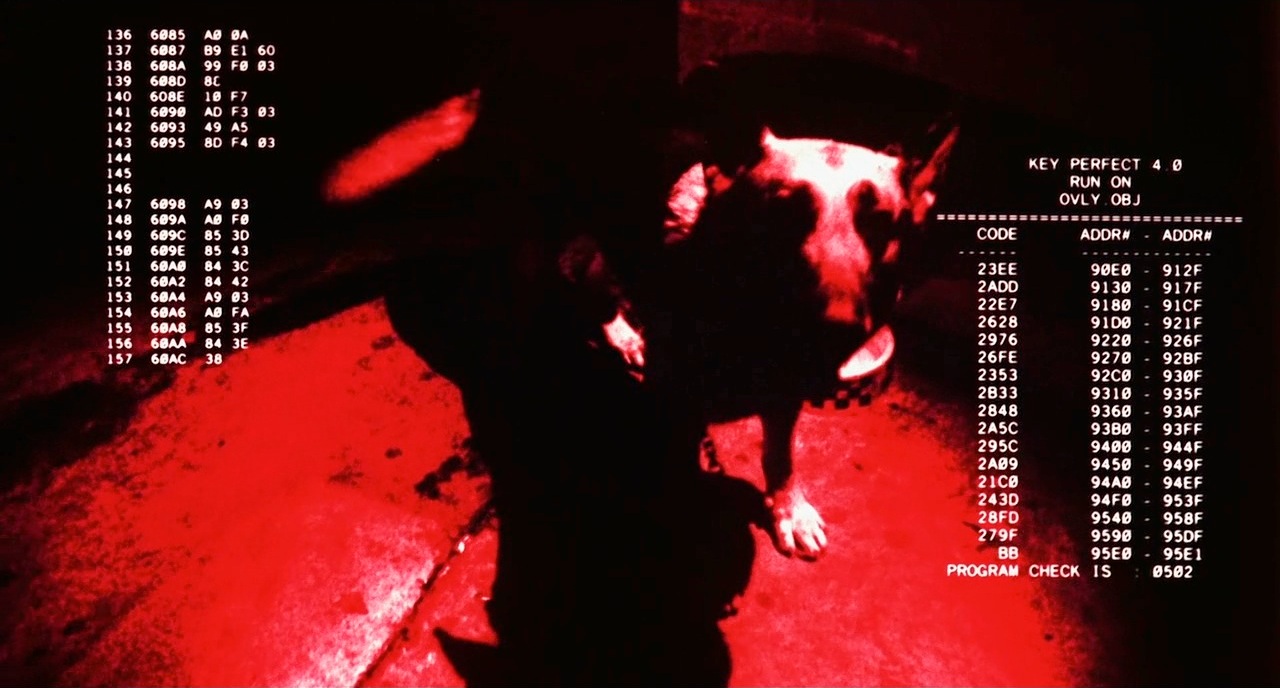
http://www.pagetable.com/docs/terminator/00-37-19.jpg
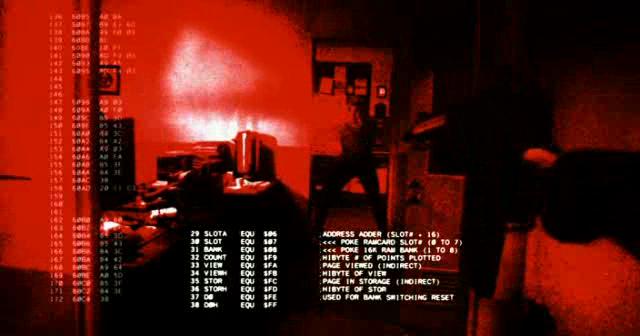
http://www.pagetable.com/docs/terminator/01-23-13.jpg
http://www.eeggs.com/images/items/3290.full.jpg -
Saw Apple ][ DOS 3.3 6502 Source during Terminator
During the first showing of The Terminator they already showed the source code, or disassembled and re-commented source code for Apple ][ DOS 3.3! While nice this is a wee bit late.
As a hardcore 6502 programmer who wrote successful apple ][ assembly language video games in that era it was quite funny seeing Apple Dos 3.3 Listings, likely from the amazing book Beneath Apple Dos, on the big screen.
http://www.youtube.com/watch?v=zgb763elfok
http://www.pagetable.com/docs/terminator/00-37-19.jpg
http://www.pagetable.com/docs/terminator/01-23-13.jpg
http://www.eeggs.com/images/items/3290.full.jpg -
Re:"Beneath Apple DOS" was available then
My memory was that the scrolling Terminator listings were assembly source code from Nibble magazine. I'm not sure what particular program, but it was a very recognizable format even when it just flashed on the screen briefly. I think there was some checksum code that came with the printed Nibble magazine that could you could check to make sure that you'd typed in things correctly. So I was probably one of the few people in the theatre who was amused that just as the Terminator robot was about to hunt and kill something (or whatever it was), he appeared to be doing a quick check to make sure that the "Hunt and Kill Something" code that had been typed in from the magazine was typed correctly.
The internet is good at these types of things: here is a site with screenshots from the Terminator movie and indeed it was Nibble magazine source code, and the checksum program was KeyPerfect. The source appears at a quick look to be for some kind of disk utility, perhaps a RAMdisk or something. The code seems to be named OVLY (overlay?) and I recognize VTOC as a virtual table of contents on a disk sector.
-
Re:Apple ][ easter egg
On that note, Microsoft had secret easter eggs in their BASIC interpreter:
http://www.pagetable.com/?p=43 (bonus confirmation by Bill Gates in the comments)
-
Re:Opaque
X64? Weren't the Taliban still using C64s? Can GCHQ crack this Commodore 64 crypto: ; WAIT Command B82D 20 EB B7 JSR $B7EB B830 86 49 STX $49 B832 A2 00 LDX #$00 B834 20 79 00 JSR $0079 B837 F0 03 BEQ $B83C B839 20 F1 B7 JSR $B7F1 B83C 86 4A STX $4A B83E A0 00 LDY #$00 B840 B1 14 LDA ($14),Y B842 45 4A EOR $4A B844 25 49 AND $49 B846 F0 F8 BEQ $B840 B848 60 RTS
-
Re:Don't forget to Canadianize your C64
The fact that I still know exactly what that does, and what colors those poke values represent, almost brings a tear to my eye, literally. I pretty much owe my entire current way to life to the C64. If there was ever a product that deserved to succeed and carry on but didn't....sigh.
Commercially, the C64 was a huge success worldwide. According to Wikipedia (and cited), the C64 is the best-selling single computer of all time. Here's a blog post with some heavy analysis of the numbers.
-
Terminator source code
The Terminator uses Apple II code. It was published on Nibble magazine so, yes, it is open source.
-
Re:Seems their server runs on a 6502
That's no excuse. The T-800 series Terminators and Bender both ran a 6502 at their core and performed quite well.
-
C64 BASIC emulator-Not a magazine, but still...
If you still have any of the older Commodore 64 magazines, you might want to try to re-use the code in this Commodore BASIC interpreter to see if it still holds up.
Related:
-
C64 BASIC emulator-Not a magazine, but still...
If you still have any of the older Commodore 64 magazines, you might want to try to re-use the code in this Commodore BASIC interpreter to see if it still holds up.
Related:
-
Re:Deranged facts
"Bill Gates's Personal Easter Eggs in 8-bit BASIC":
-
basic aint what it used to be
when you think of basic - you talk of GOTO statements & line numbers.
but modern Basics just havent used Goto statements or Line numbers in almost 2.5 decades!except for some syntactical curiosities - the code you write with basic
supports the same structures as C, pascal, or java for decades already.when's the last time you've seen Basic code? did it have line numbers or goto statements?
how about variable records (structs), function passing, and C-like dimensioning:| local FN generateRawMoves(board as ^boardRecord, moves(0) as moveRecord)
|
| dim as long pieceMoves, numMoves, querySquare
|
| numMoves = 0
|
| for querySquare = 1 to 64
| pieceMoves = 0
| long if board.square[querySquare] 0
| pieceMoves = FN pieceTree(board, moves(0), querySquare)
| end if
|
| numMoves = numMoves++
| next querySquare
|
| end FN = numMovesbasic as it was 20-30 years ago is not what basic has become.
on the mac, there's currently a very useful (free!) futurebasic5 to C
cross-compiler available here, with an active 20yr+ user community:FBtoC: http://www.4toc.com/fb/
|
| FBtoC 5.4.4 creates Mac OS X universal applications
| (Mach-O executables) from FutureBasic source.real basic allows object oriented (cocoa) code, and is cross-platform:
RealBasic:
http://www.realsoftware.com/realbasic/basic has also been adopted to some new paradigms.
it used to be that basic wasn't compiled, and interpreted languages
were considered too slow -- now basic is compiled, and java abounds.or -- instead of using csh for scripting -- how about basic??
Apple I BASIC as a Mac OS X Scripting Language
http://www.pagetable.com/?p=35
|
| $ cat reverse.bas
| #!/usr/bin/apple1basic
| 10 DIM A$(100)
| 20 INPUT A$
| 30 FOR I = LEN(A$) TO 1 STEP -1
| 40 PRINT A$(I,I);
| 50 NEXT I
| 60 PRINT
| 70 END
| $ chmod a+x reverse.bas
| $ echo MICHAEL STEIL |
| LIETS LEAHCIMbasic aint what it was - so stop this thirty-year old gripe against goto & line numbers... aaargh.
-
Nonsense. I was there.
As someone who read the legendary Inside Macintosh (1983 draft; I still have it) cover to cover before even touching a Mac (some time around 1985), I don't understand this contention that the original Mac was "closed" to developers. The *case* was not easy to open, but the programmer model was not locked up in any real way. Almost from the beginning, Apple offered assembler- and compiler-level toolsets. Initially these were Lisa-hosted, simply because the Mac porting hadn't been done yet. I personally used Macintosh Development System (1984) and Whitesmiths C in the very beginning, before reverting to Pascal for a while, using powerful toolchains such as TML and Lightspeed Pascal. Consulair C was available in 1985.
From the first moment, third party developer tools sprang up like kudzu around the original Mac, most of them cutting edge in some way. Many innovative development technologies were pioneered on the Mac: interpreted Pascal with a sophisticated GUI (Mac Pascal), Object Pascal and MVC systems (MacApp), Neon, 4GLs, incremental compilers (Lightspeed/THINK/Symantec C), etc. Does anyone even remember that in the 80s, Apple pushed out several full releases of their own Mac Smalltalk-80 system, which Squeak is now based on? (Harvey Alcabes, I remember you.)
And few now remember that the Lisa itself, despite appearances better described as a "minicomputer" than micro, ran about six different operating systems, including UCSD P-system and XENIX, and had several full-fledged language systems from Object Pascal through COBOL and Fortran.
-
Overlay source code?
Does the Terminator vision for the iPhone also overlay Apple II assembly code?
-
Microsoft/Applesoft/Commodore/... BASIC
I think another important contribution to the industry early on was that of Microsoft BASIC, originally written by Allen and Gates with help from Davidoff. They ported it and _sold_ (not licensed) it to multiple companies for multiple processors.
Most notably in my mind are Commodore (CBM) BASIC and Applesoft (Apple-Microsoft) BASIC for various Commodore and Apple computers (on MOS 6502/6510 processors).
On the Commodore PET, type "wait 6502,1" and it will reply with "Microsoft!", an easter egg said to have been added by Gates himself when he had an argument with Tramiel about when there was doubt whether Commodore would admit that the code was from Microsoft.
Bill Gates' Personal Easter Eggs in 8 Bit BASIC
My only problems with Microsoft are the same gripe I have with most _huge_ companies. Growing companies tend to be innovative and important to their respective industries, supplying much, but stagnant companies often contribute less and can actually slow down or stall an entire industry if they are big enough, simply in an effort to maintain their size. Now, this may not always happen, but IMHO it is the norm.
I think the reason for this is when too many people work as a group, they tend to go too many directions unless they are serendipitously all moving in the same direction (possible with small groups) or if there is a shining, uniform vision at the top for them to follow-- and whose to say that if there is such a vision that it is in a good direction?
If a company continues to grow, generally doing good things for its industry, it will invariably become huge after a time, and, I believe, most huge companies will invariably hurt themselves and possibly the industry until they are either small either to grow again or they disband. The circle of corporate life. I believe that Microsoft is no exception to this.
My two cents.
--Dave Romig, Jr. -
Re:Commodore BASIC
The Commodore Basic interpreter was made by Microsoft (Bill Gates programmed part of it himself) and licensed to Commodore. To say it's different then the 'other Basics' makes no real sense when you consider that most of the interpreters from that era came from the same source. http://www.pagetable.com/?p=43
-
I am not suprised
We already knows that Skype records a lot of other information including your BIOS : http://www.pagetable.com/?p=27
-
I warned about this on my weblog
I warned about the true purpose of the Vista 64 driver signing on my weblog in June. I got a lot of crap from people saying that I'm paranoid, and that I'm against security features in Vista. I even tried to post a Slashdot story about it (rejected of course). The problem is that I'm a nobody.
At Black Hat on August 3, Joanna Rutkowska announced her exploit to get around Vista 64 driver signing. I had come up with the same idea in June (see link above), although it's obvious that she had the idea long before me. I was insensed, however, that Joanna would give such a clear announcement to the world about how this works, and go as far as proclaiming her support for the "feature". I wanted to wait for Vista's release to really give a demonstration of the trick, because I wanted to do anything that would undermine Microsoft's imposition of driver signing.
I knew that this "feature" had little to do with rootkits, even though Microsoft had promoted it as such. It simply does not prevent rootkits. Rootkits are somewhat uncommon - the day-to-day trojans are almost all user-mode crap that adds itself to Run in the registry. Driver signing does nothing against them. Also, Administrator user-mode programs are allowed raw disk access, so what really stops a rootkit from overwriting the MBR and rebooting the system? They could ever cause a bugcheck to make it look like Windows crashed 3 hours after you ran the trojan.
I was hoping that a set of exploits would be made prior to Vista's released, then released one at a time on every second Wednesday of the month so as to cause maximum credibility damage to Microsoft. These would not be rootkits, just ways of getting a custom driver to run. I'd even try to make it difficult to use a real rootkit with it. I'm against viruses and rootkits, and have never made such a thing myself, but this isn't a virus issue.
Another thing that Microsoft has disclosed is that in future Windows versions (NT 6.1?), it will not be possible to run unsigned programs as Administrator anymore, even in user mode. The "elevation" system would be there still, but only signed programs could request it. I thought of a social attack against this system. I had planned to tell Microsoft because I believe in the user/Administrator separation, but now I'm not going to. I will not help a system that's against my morals.
Signature checks should be applied by the computer owner, not Microsoft. A PC is not an Xbox 360.
Melissa