Slashdot Mirror
Domain: potaroo.net
Stories and comments across the archive that link to potaroo.net.
Comments · 117
-
IPV4 shortages
Sig Reply
--
Shortage of IPv4 addresses? lynx -dump http://www.iana.org/assignments/ipv4-address-space | grep "IANA - Reserved"
Whoa - that's freaky... No wonder there's no real incentive to go to IPV6....
Although to be fair, thats only 89 class A's (or should I say, "/8"s) which means that it represents only 35% of the total address space. We don't have enough room to double - and with the exponential growth in network-capable devices, the doubling time is steadily getting shorter...
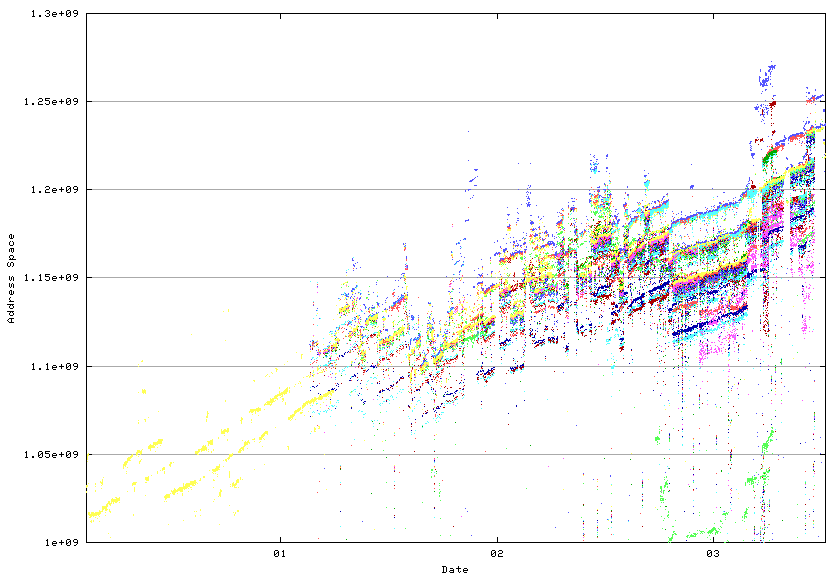
FWIW, a good read on the matter is at http://bgp.potaroo.net/ipv4/. Geoff's analysis concludes that we run out of addresses somewhere between March 2014 and February 2022.
-
Re:Missed the boatI think this is what you're referring to:
Automatically assign an address on the 169.254.0.0/16 network if no DHCP server is found. Continue making DHCP requests every 2-4 minutes until DHCP server does respond...
-
Re:Most people don't care about IPv6
The entire world (including the U.S.) is predicted to run out of IP addresses by next year.
Sorry to disappoint you, but that's unlikely to happen for another 35 years. Looks like there's plenty left to me.
-
Re:MCI will peer if you are actually a _peer_
But that the "Big 4" refuse to peer with the other Tier-1 ISP's down here.
I still don't think you understand what peering is.
It is a prerequisite that both parties who are going to enter a peering agreement consider the other to be a peer (in the true sense of the word, an equal).
As much as the other ISPs think they are peers (equals, remember) with the big guys, they aren't. The big guys don't consider them peers, so they won't peer with them.
It appears to me that you haven't read that Interconnection and Peering article I posted. It covers what peering is, and the issues entailed, quite well. You'll then understand why the big ISPs are ignoring the little ones.
ISP's have been going to the ACCC about it, funny since it was a ACCC decision in 1998 which forced the 4 to peer.
I could be wrong, however, from memory, Ozemail was one of the proponents behind this ruling.
Ask yourself why the current enquiry into this is taking so long (at least a year now). Maybe there isn't really an issue, just that the smaller ISPs have a different agenda to what they are saying in the press.
So how could the smaller ISPs become peers of the large ones? Well, if they all got together and agreed to aggregate their networks, they might have a network that is equal enough to one of the large ISPs networks. Then the large ISPs might be interested in peering. Of course, that is unlikely to happen, as I'd very much doubt the small ISPs would get together like this, because, after all, they would be helping out their competitors, the other smaller ISPs.
Some of the 'in the press' articles at PIPE networks provide some insight into the state of peering in Australia.
And what business are PIPE networks in ? Wouldn't it be in their interests to portray the peering situation in Australia to be a certain way, which will increase their business ? Do you think they'll ever be a press release from PIPE saying they are happy with the peering arrangements of the large ISPs (who are their competitors after all) ? I'd doubt it, that wouldn't be in their interests.
You can't get independent news from any corporate entity. There is always a PR spin on it, which furthers the interests of the corporate entity.
In fact, this is why I care about it. I don't like the fact that the smaller ISPs are hiding their agenda for cheaper bandwidth from their upstream suppliers behind the "they won't peer with us" story. The public are being told only half the truth.
BTW, want another example of the public being tricked. ARIA (the Australian Recording Industry Association) complain all about music copyright breaches, how the artists are getting ripped of etc. All sounds good. Hang on, are they the "Australian Music Artists Association", or are they the "Australian Recording Industry Association". Oh, so they don't directly represent the artists, they actually represent the record companies ! They pretend they represent the artists, and I think a lot of artists believe it. However, their agenda is driven by what is firstly good for the record company members, not the artists.
From their web page (http://www.aria.com.au/)
Our members range from major record labels to small independents - ARIA works to protect their interests, acts as an industry advocate, compiles the weekly ARIA charts, and promotes initiatives to support local music.
If you had to attribute any of that statement to directly representing the interests of the artists, it could only be the promotes initiatives to support local music part. Even then, those initiatives would be ones that the record companies have a chance of making money off of.
The first step in determining the real truth behind a statement is to determine the possible motives and agenda of the entity making that statement.
-
MCI will peer if you are actually a _peer_
Sending traffic across the road to the "Big 4" (Telstra, Optus, MCI/Ozemail, Telco NZ/AAPT) costs a fortune, since they refuse to peer with anybody else. In fact, bringing your own link from the U.S is cheaper than transit bandwidth from the Big 4, that is, if your in Sydney with lots of money. Only 6 ISP's actually have their own international links.
I'm afraid I don't really believe this. Have you priced a transit link to the US ?
I don't think you truely understand what peering is. If you did, you would understand why the Big ISPs won't peer with the little ones - which, simplified, is that fact that they aren't approximately the same size AKA peers.
Have a read of this article for an overview of what peering actually is - Interconnection and Peering.
Once you've done that, have a read of the MCI peering terms and conditions at WorldCom's Policy for Settlement-Free Interconnection with Internet Networks.
Now, if all the little ISPs could meet those terms and conditions, and offered equal benefit to MCI, I'm sure MCI would be interested in talking. Otherwise, the smaller ISPs are just customers who want cheaper bandwidth, and are using the "they won't peer with us, they must be evil" reason to further their cheaper bandwidth adgenda.
And no, I don't work for any of the organisations above.
-
Re:Client / Server is only defined at layer 4
I'm tempted to answer your points directly, however, I think it would be better to spend my time pointing you towards the following documents, which, firstly, describe the Internet architecture, and why it was designed the way it is, and secondly, describe how NAT / overlapping address spaces break the architecture. I don't think a debate on NAT can take place until both the design of the Internet and how NAT breaks that design are understood.
- RFC 1958 - Architectural Principles of the Internet - Section 2.3 "It is also generally felt that end-to-end functions can best be realised by end-to-end protocols." is the property that NAT breaks.
- RFC 1631 - The IP Network Address Translator (NAT) - even the original NAT RFC suggests limitations - from section 4. "Conclusions" - "NAT may be a good short term solution to the address depletion and scaling problems. This is because it requires very few changes and can be installed incrementally. NAT has several negative characteristics that make it inappropriate as a long term solution, and may make it inappropriate even as a short term solution. Only implementation and experimentation will determine its appropriateness."
- RFC 3022 - Traditional IP Network Address Translator (Traditional NAT) - the update to RFC1631 lists a number of limitations as well.
- RFC 2993 - Architectural Implications of NAT - a very good document, well worth reading.
- RFC 1627 - Network 10 Considered Harmful (Some Practices Shouldn't be Codified)
- Deprecating Site Local Addresses - an IPv6 oriented document, discussing "site local" addresses, and the problems they cause. They are the equivalent of IPv4 RFC1918 addresses eg. Network 10. The same problems it discusses also occur with RFC1918 addresses.
- Things that NATs break - listed just for completeness.
- The Middleware Dilemma - NAT is a form of middleware, as it does more than just forward IP packets - it maintains state within the network (see RFC1958 for why maintaining state in the network is a problem).
- The Digital Imprimatur : How big brother and big media can put the Internet genie back in the bottle. - The Firewalled Consumer section discusses what NAT is doing to the Internet at a higher level.
Once you've read through these documents, at least to the point of having a basic understanding of them, go through the comment I'm responding to, and look for ways as to how some of your solutions can be better and much more simply achieved via public addressing and the removal of NAT.
-
BGP
This is absurd. It undermines the basic principles that led the internet grow up to the currect scale. Those who understand BGP and AS-es as well as Provider Independent and Provider Aggregatable Ip space, know this is the end. And the BGP tables are growing faster than most routers can hold anyway. No more soft inbound I quess...
-
Re:MIT is one to talkOh come on, how does this junk get moderated up? The notion that we're somehow running out of IPv4 address space is a MYTH. We are perfectly capable of continuing to 2020 or past, even when you extrapolate out current growth rates. Yes, it was rather nearsighted at the time to assign whole class-A blocks, but CIDR notation was not around at the time and so there was really no other viable alternative. That a handful of organizations still have class-A's does NOT in any way have anything to do with the so-called address shortage, which has been shown to be complete hogwash.
A quote from this paper from July concludes that we easily have another two decades of life left in IPv4.Assuming a smooth continuity of growth in demand where growth rates are proportional to the size of the Internet, and assuming a continuation of the current utilization efficiency levels in the Internet, and assuming a continuing balance between public address utilization and various forms of address compression, and assuming the absence of highly disruptive events, then it would appear that the IPv4 world, in terms of address availability, could continue for another two decades or so without reaching any fixed boundary.
-
double standards are being called out
First off - the internet content is clearly dropping because the telecomunications uindustry has found a way to sit on the golden egg and squash it.
Second - it is quite clear that the telecommunications carrier technology is about as computerized as any other aspect of the tech revolution and hense they enjoy the same cost reductions as everyone else. The exception is that these cost reductions are generally not passed on to the customers.
If you look here: Interconnection, Peering, and Settlements You can read a very good analysis of one aspect of the industry.
The problem is that peering arrangements are "negotiated" and the flip side of this is that the organisation with the most power is able to generally impose ineterconnection fees on smaller organisations. This means that your ISP has to pay for bandwidth you use with no regard whatsoever to the cost of providing the capacity or for that matter Who is providing a service to whom
Quoting from the paper: This assertion of role reversal is perhaps most significant when the generic interconnection environment is one of a zero sum financial settlement, in which the successful assertion by a client of a change from client to peer status results in the dropping of client service revenue without any net change in the cost base of the provider's operation. The party making the successful assertion of peer interconnection sees the opposite, with an immediate drop in the cost of the ISP operation with no net revenue change. "
This means that small fish always pay big fish. It was pointed out in an Australia study that when the client of a small ISP sends an email to the client of a large ISP, that the small ISP pays the large ISP for the data transfer. When the client of the large ISP reply to the email then the small ISP pays again for the delivery. At the time this was used to evaluate a review of Australian Perring arrangments. I have not heard the results.
Now - as it applies to you - it means that even though a fiber optic line for instance can easily carry say 100 mb/sec with the use of two allied telesyn ethernet to fiber line drives which cost under $1000 bux and will drive for over 75 km... and even though the cost of 6 pair overhead fibre cable for instance is only about 25% more than copper - and costs less than $1.50 per foot - that the telecomunications company who installs it feels they should be able to charge upwards of $50,000 bux per month for the rent of each "circuit". This is what your ISP faces. Wholesale usary charges.
I calculated a while back that 100baseT is about 2/3 of a T3 (155mb/sec) and on a short haul dedicated circuit to connect our servers for instance to the local backbone - the local telco would recover their total capital outlay in less than a month. Of course - once the data from our servers is in their backbone they can ship it to their customers about as easily as if they had obtained that data from the POP's that connect into the US backbone.
The simple matter is that if we for instance choose to co-locate in the US that our local telcos will be viewed as "customers" of the larger USA carries and be expected to pay very heafty fees to connect via the POP's (Point of Presence - IE a router). On the other hand any content their customer base obtains locally from our servers results in us paying them instead of them paying the USA. So they really try to put the screws on and their "bandwidth charges" would make you choke.
What you are looking at is the consequence of a system that is totally broken and not in anyone's interests... not even the biggest carriers. The reason it is not in the biggest carriers interest is that in order to be the biggest carrier they have to overbuild and take on massive debt that they cannot in many cases handle. This is why PSINET for instance didn't make it.
So we have stupid risks to be the biggest shark and everyo
-
Behold the Aurora Borealis!
-
Re:again?
I would have ignored this as a troll, but it's been modded "+4 Interesting" so it's probably worth providing some perspective to the points raised..
1. Cisco routers suck at IPv6
Even if true, this can hardly be described as a shortcoming with the protocol (though I agree it might be a problem in its deployment).
2. There are too many addresses
In what way is it a problem to have too many addresses available? It's not compulsory to use them all
NAT is not a solution to everything. In particular it prevents a lot of peer-to-peer type applications (and I don't just mean downloading MP3s - IP telephony is a good example!)
3. IPv6 addresses are too large.
Erm... 128 bits is four times the size of IPv4's 32 bits. That means that the routing tables will take up at most four times what they do at the moment. Even assuming 200,000 prefixes (an overestimate according to this, the full FIB can be stored in under 10Mb. The full BGP table (including attributes) would obviously be larger - but we're hardly talking "extreme amounts of memory"!
4. The IPv6 header is too large
This is plain misleading. For most links the MTU is 1500 bytes or larger, so the difference is closer to 1%. For links where the overhead is significant (e.g. dial-up links) it's normal to use PPP header compression, which all but eliminates the extra overhead.
-
Re:Why do you keep talking nonsense?
>cisco is clueless with manageing route tables, a typical router can't cope with more than 10,000 or so entries
the current size of the internet routing table is just over 120,000 entries. there are certainly cisco routers being used with that routing table.
-
ISP != common carrierThis issue will certainly be moved up on appeal, and I'd have to believe it will lose as it violates the framework of common carrier.
ISPs are not common carriers. However, this is a case of where the government is trying to "legislate the internet" to their gain. Ephemeral as it is, and boundaryless, it definitely looks like a nice ripe fruit for the picking by your average clueless politician for their personal gain.
-
ISPs are NOT common carriers
-
Some Handy Links
This is going to be a bit long but bear with me, I hope I can explain it a little.
The fundamental limit of high bandwidth technologies is due to the physical nature of copper wire.
Any digital signal is essentially a composition of a series of sine waves. Don't worry if this doesn't make sense - what happens is that the sharp 'edges' of a digital pulse are effectively very high frequency. So although it is conventient to think of a digital signal having a single frequency that is effectively the data rate, its not actually true.
One of the properties of copper wire is that different frequencies travel at different speeds in the wire, and get attenuated (lose power) at different rates.
Now we combine these two thoughts and what happens is that the well defined pulse get smeared as the frequencies that make them up seperate as the pulse goes down the line, and misshaped as attenuation kicks in. At some point this smearing will make it impossible to reconstruct the pulse. Also every single joint in the cable causes reflection of the siganl to some point.
In a transmission system this is not a problem, as the great thing with a digital signal is we know it only has two states - 1 or 0 - so we can regenerate and clean up the signal and transmit it again. This is what repeaters in undersea cables do (even fibre has to have these, but at much greater lengths than copper). But to your house there is no point in the cable to put a repeater - if the signal can be read when it gets to where you are then it works, if not then it doesn't.
Now in reality digital signals are not transmitted as a single stream of on/off pulses, but encoding systems are used that turn the signals into ranges of tones - which is why when you listen to you modem you here a range of tones, rather than a single one.
All of these techniques aim to minimise the effect of the smearing due to the different speeds the different frequencies travel, and to make the signal more resiliant to noise issues. But at some point either the pulses will become so corrupted they cannot be recognised, or the signal to noise ratio will get so bad that they can't be distinguished from noise.
Generally the problems get worse as the frequency goes up, and in data terms this is roughly the same as baud rate. This is why faster DSL rates are only available nearer the exchnage.
The reasons why ADSL2 isnt a great improvement is we are hitting fundamental limitations of copper wire transmission systems as used for analogue telephones (and it is analogue in the local loop no matter what the exchnage is) and tweaking the encoding techniques is not bringing great increases.
Remember with normal modems we hit the limit at 36Kbaud due to the fact that normal voice is limited to 0-4Khz - a bit of clever engineering managed to boost this to 56Kbaud on the downlink because you avoid one of the anti aliasing filters in the exchange.
So modems are limited to 4Khz and Shannons Law tells us the maximum data rate we can do at 4Khz, and 56Kbaud modems are damn near the limit.
ADSL is carried as a piggy back signal on your analogue line - below 4khz is the normal voice signal, above 25Khz is the ADSL signals. There is no 'hard' upper limit to ADSL due to filters like there is for voice, but there is a 'soft' limit where the problems discussed above mean its not possible to get reliable transmission.
Current ADSL is pretty close to those 'soft' limits - ADSL2 tweaks it a bit to get more in and increase the range.
The bad news is its not going to get much better on copper wire - the modem limit was due to filtering, but ADSL is down to basic physics.
Explanation of the local loop technologies - mostly found via ADSLGuide (These guys do a great job of keeping on top of UK ADSL issues)
The Last Mile - personal site, but a good heads up. Significantly shows the bandwidth limits as related to the type of wire the signal is transmitted down.
The Trouble With DSL great well written article that summarises some of the technical and practical issues with DSL.
ADSL Techincal Summary
DSL Source Book - PDF (registration required) - very good for technical geeks. -
Re:Common carrier doesn't applyCommon Carrier doesn't apply to ISPs. That precedent has already been set.
Here's some links:
the pdf file explaining why, and the
html-ization of the pdf from google -
what's the sound of BGP flapping?
BGP statistics pertaining to KPNQwest AS286 also, keep your eye on NANOGfor any info related to the impact of the shutdown.