 Slashdot Mirror
Domain: raizlabs.com
Stories and comments across the archive that link to raizlabs.com.
Comments · 9
-
Re:Eyecandy in cost of usability
Yes - what they are doing is more Chrome-like. They are aiming to reduce visual and UI clutter/redundancy and add better support for things like Vista Glass.
If Firefox were to ribbonise, it would look something like this: http://www.raizlabs.com/blog/uploaded_images/firefox_6-793488.JPG (yuck!)
-
Re:Stupid.
There's a reason our screens are wider than they are tall, though: we need horizontal space more, because we read from side to side. This means things with text in them generally need to be (much) wider than they are tall.
Actually, you're just about 100% wrong on that point. Studies on human reading have demonstrated that it is much easier on the reader's eyes if text width is thinner rather than wider:
- http://www.maxdesign.com.au/presentation/em/
- http://hid.fidelity.com/q31998/column.htm
- http://desktoppub.about.com/cs/finetypography/ht/line_length.htm
- http://www.ronreason.com/personal/bodytext.html
- http://english.unitecnology.ac.nz/resources/resources/exp_lang/print.html
- http://www.raizlabs.com/blog/?p=187
On the web, vertical space is used for skimming text and scrolling content, and is hence much more important.
-
Re:The point being....
The problem is sometimes that we, the users, are not listened.
My proposal: Fix the fucking GTK-file-selection box! http://www.gnome.org/~seth/designs/filechooser-spec/
Why on earth is "Browse other folders" taking huge amount of screen estate (in save dialog)???
Do hidden files work (when I type ".bashrc" will gedit open it)?
Vista: http://www.tmssoftware.com/atbdev6.htm (?)
XP: http://www.microsoft.com/library/media/1033/windowsxp/images/using/setup/tips/68222-click-save.gif
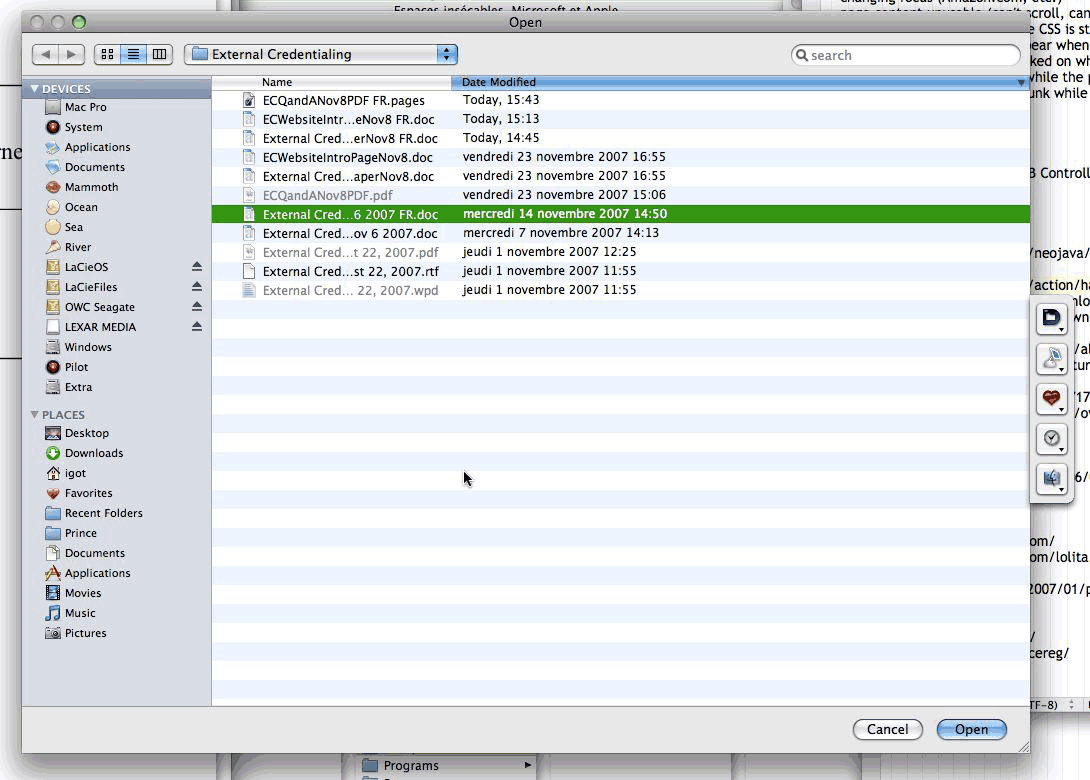
Leopard: http://www.betalogue.com/images/uploads/finder/OpenDialogBox-ListView.gif
Java: http://java.sun.com/docs/books/tutorial/figures/uiswing/components/FileChooserOpenMetal.png
Other: http://www.guidebookgallery.org/screenshots/openfile
More: http://www.raizlabs.com/interface/hall-of-shame/default.asp
There is even a theme to change it to KDE style!!!
KGtk: http://www.kde-apps.org/content/preview.php?preview=1&id=36077&file1=36077-1.png&file2=36077-2.png&file3=36077-3.png&name=KGtk+(Use+KDE+Dialogs+in+Gtk+Apps)&PHPSESSID=83fa01cf68ec222d01626c20f3ebe9af -
You are a little bit uninformed.
-
Just part of the story
This posted snippet is just part of the stuff that Linus said. You can read some more of this interesting thread here: The Linux Attitude
-
The Basic Premise is WrongHere's what I wrote on my blog...
Greg's Head is part of my daily reading and he always has interesting things to say about the field of user interfaces. His latest post is Linux Thoughts. While the post has some very shrewd observations, there was something that nagged at me while I read it.
Going back through the post, I think his basic premise is wrong. The first paragraph of the post opens with,For years the open-source Linux community has been competing with Microsoft to become the dominant desktop operating system.
And I think that's where he's wrong. I think there are definitely players in the Linux arena who want to use Linux to compete with Microsoft, but I don't think that's true for Linux as a whole. The drive behind Linux isn't to compete with Microsoft, to replace Windows, or even to provide a mom-and-pop OS to the mainstream. As with almost all open source software, the drive behind Linux is the scratching of an itch. No more, no less.
Looking from that point of view greatly changes some of the things Greg had to say. For instance,Right now there are dozens and perhaps even hundreds of different Linux distributions. Each one has its own quirks, bugs and issues. Linux is currently an idea it's not a brand. There doesn't seem to be a central floodgate to dictate the standard interface. Each distribution creates its own icons, interface elements, configurations and sometimes even their own shell. To gain momentum some level of standardization is necessary to be called "Linux."
If Linux was trying to be a brand, this would hold very true. However, from the standpoint that Linux progress comes from people scratching an itch, it doesn't hold any water. Part of why Linux is where it is today is because there are "dozens and perhaps even hundreds of different Linux distributions."
If you are trying to understand how Microsoft could compete against Linux, it becomes easier if you take the viewpoint that Linux is trying to be a brand that is competing back against Microsoft. But I believe you would be fooling yourself to take that viewpoint. The simple fact that it's not trying to be a brand is why it's so hard to compete against Linux.
As I said before, there are players in the Linux arena who would like to use Linux to compete against Microsoft, and the most obvious player that comes to mind is Novell. With Linux as a whole, though, there's nothing really for Microsoft to compete against. Microsoft could crush SuSe into the dust and it wouldn't really affect Linux.
Keeping all that in mind, I want to stress that this does not invalidate anything Greg has said about Linux in his post. He brings up some excellent points, lays some very good directions for Linux developers to take, and really hits the nail on the head with a lot of things with regard to how Linux could expand to the masses. But...
As long as there are a handful of programmers who are happy with their Linux distribution and are continuing to tinker with it, Linux will be wildly successful. Why? Because that handful of programmers are scratching an itch. It's as simple as that. -
The Basic Premise is WrongHere's what I wrote on my blog...
Greg's Head is part of my daily reading and he always has interesting things to say about the field of user interfaces. His latest post is Linux Thoughts. While the post has some very shrewd observations, there was something that nagged at me while I read it.
Going back through the post, I think his basic premise is wrong. The first paragraph of the post opens with,For years the open-source Linux community has been competing with Microsoft to become the dominant desktop operating system.
And I think that's where he's wrong. I think there are definitely players in the Linux arena who want to use Linux to compete with Microsoft, but I don't think that's true for Linux as a whole. The drive behind Linux isn't to compete with Microsoft, to replace Windows, or even to provide a mom-and-pop OS to the mainstream. As with almost all open source software, the drive behind Linux is the scratching of an itch. No more, no less.
Looking from that point of view greatly changes some of the things Greg had to say. For instance,Right now there are dozens and perhaps even hundreds of different Linux distributions. Each one has its own quirks, bugs and issues. Linux is currently an idea it's not a brand. There doesn't seem to be a central floodgate to dictate the standard interface. Each distribution creates its own icons, interface elements, configurations and sometimes even their own shell. To gain momentum some level of standardization is necessary to be called "Linux."
If Linux was trying to be a brand, this would hold very true. However, from the standpoint that Linux progress comes from people scratching an itch, it doesn't hold any water. Part of why Linux is where it is today is because there are "dozens and perhaps even hundreds of different Linux distributions."
If you are trying to understand how Microsoft could compete against Linux, it becomes easier if you take the viewpoint that Linux is trying to be a brand that is competing back against Microsoft. But I believe you would be fooling yourself to take that viewpoint. The simple fact that it's not trying to be a brand is why it's so hard to compete against Linux.
As I said before, there are players in the Linux arena who would like to use Linux to compete against Microsoft, and the most obvious player that comes to mind is Novell. With Linux as a whole, though, there's nothing really for Microsoft to compete against. Microsoft could crush SuSe into the dust and it wouldn't really affect Linux.
Keeping all that in mind, I want to stress that this does not invalidate anything Greg has said about Linux in his post. He brings up some excellent points, lays some very good directions for Linux developers to take, and really hits the nail on the head with a lot of things with regard to how Linux could expand to the masses. But...
As long as there are a handful of programmers who are happy with their Linux distribution and are continuing to tinker with it, Linux will be wildly successful. Why? Because that handful of programmers are scratching an itch. It's as simple as that. -
As a compensation prize...for hardy
http://www.rha.com/ui_hall_of_shame.htm
http://www.pixelcentric.net/x-shame/
http://www.raizlabs.com/interface/hall-of-shame/d
e fault.aspThese sites all appear to have similar concepts. Don't worry, folks, I'm sure the Meatloafers will be busy guffawing in mulish fashion as they forward the house/UI anology to your inbox for the next ten years after it's no longer funnny.
-
One other tool...
Another tool that wasn't mentioned has a very simple to use interface. http://www.raizlabs.com/software/magicfile/ I wrote the software myself almost a year ago. It doesn't do everything these web tools do, but I think it does do certain things better. Take a look, it's currently shareware.



&PHPSESSID=83fa01cf68ec222d01626c20f3ebe9af)