Slashdot Mirror
Domain: realclimate.org
Stories and comments across the archive that link to realclimate.org.
Stories · 10
-
In Progress: Fastest Sea Rise In At Least 2800 Years (www.cbc.ca)
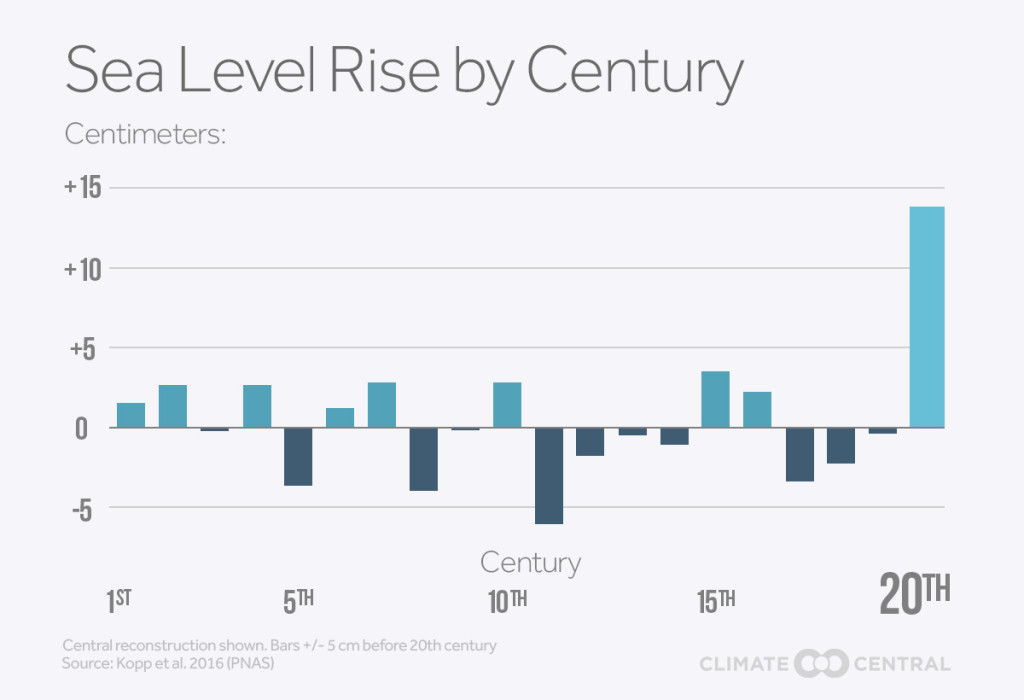
Layzej writes: A new study finds that sea levels on Earth are rising several times faster than they have in the past 2,800 years and are accelerating. Co-author Stefan Rahmstorf explains that the fact that the rise in the 20th century is so large is a logical physical consequence of man-made global warming. This is melting continental ice and thus adds extra water to the oceans. In addition, as the sea water warms up it expands. The data from the past can also be used for future projections, using a so-called semi-empirical model calibrated with the historically observed relationship between temperature and sea level. With the new data, this results in a projected increase in the 21st century of 24-131 cm, depending on our emissions and thus on the extent of global warming. -
In Progress: Fastest Sea Rise In At Least 2800 Years (www.cbc.ca)
Layzej writes: A new study finds that sea levels on Earth are rising several times faster than they have in the past 2,800 years and are accelerating. Co-author Stefan Rahmstorf explains that the fact that the rise in the 20th century is so large is a logical physical consequence of man-made global warming. This is melting continental ice and thus adds extra water to the oceans. In addition, as the sea water warms up it expands. The data from the past can also be used for future projections, using a so-called semi-empirical model calibrated with the historically observed relationship between temperature and sea level. With the new data, this results in a projected increase in the 21st century of 24-131 cm, depending on our emissions and thus on the extent of global warming. -
Global Warming Since 1997 Underestimated By Half
Layzej writes "A new paper shows that global temperature rise of the past 15 years has been greatly underestimated. The reason is that the weather station network covers only about 85% of the planet. Satellite data shows that the parts of the Earth that are not covered by the surface station network, especially the Arctic, have warmed exceptionally fast over the last 15 years. Most temperature reconstructions simply omit any region not covered. A temperature reconstruction developed by NASA somewhat addresses the gaps by filling in missing data using temperatures from the nearest available observations. Now Kevin Cowtan (University of York) and Robert Way (University of Ottawa) have developed a new method to fill the data gaps using satellite data. The researchers describe their methods and findings in this YouTube video. 'The most important part of our work was testing the skill of each of these approaches in reconstructing unobserved temperatures. To do this we took the observed data and further reduced the coverage by setting aside some of the observations. We then reconstructed the global temperatures using each method in turn. Finally, we compared the reconstructed temperatures to the observed temperatures where they are available... While infilling works well over the oceans, the hybrid model works particularly well at restoring temperatures in the vicinity of the unobserved regions.' The authors note that 'While short term trends are generally treated with a suitable level of caution by specialists in the field, they feature significantly in the public discourse on climate change.'" -
Arctic Sea Ice Hits Record Low Extent
mdsolar writes "Arctic sea ice has hit a record low extent for the period of satellite observation. Further, this record has been set in August when the minimum annual sea ice extent (and the prior record) has always come in September. Further still, the ice is still retreating as rapidly as it was in June and July when normally the decrease of sea ice extent slows in August. It is thus possible the the final minimum sea ice extend for 2012 will be seen in October rather than September as has always occurred in the past. More than one monitoring effort agree on the existence of a new record." -
1981 Paper's Predictions for Global Temperatures Spot-On
Layzej writes "The Register reports on a paper published in Science in 1981 projecting global mean temperatures up to the year 2100. 'When the 1981 paper was written, temperatures in the northern hemispheres were declining, and global mean temperatures were below their 1940 levels. Despite those facts, the paper's authors confidently predicted a rise in temperature due to increasing CO2 emissions.' The prediction turns out to be remarkably accurate — even a bit optimistic. The article concludes that the 1981 paper is 'a nice example of a statement based on theory that could be falsified and up to now has withstood the test.'" -
Droughts Linked To Global Warming
Layzej writes "Two new papers indicate that we are likely already seeing some of the predicted impacts of global warming. The first used Monte Carlo simulations to analyze how many new record events you expect to see in a time series with a trend. They applied the technique to the unprecedented Russian heat wave of July 2010, which killed 700 people and contributed to soaring wheat prices. According to the analysis, there's an 80 percent chance that climate change was responsible. The authors have described their methods and how they improved on previous studies. The second group studied wintertime droughts in the Mediterranean region. They found that 'the magnitude and frequency of the drying that has occurred is too great to be explained by natural variability alone. This is not encouraging news for a region that already experiences water stress, because it implies natural variability alone is unlikely to return the region's climate to normal.'" -
Where the Global Warming Data Is
Several readers noted the latest fallout from the Climate Research Unit's Climategate: the admission by the University of East Anglia that the raw data behind important climate research was discarded in the 1980s, "a time when climate change was seen as a less pressing issue" according to the Times (UK) article. The Telegraph quotes Phil Jones, beleagured head of the CRU: "Our global temperature series tallies with those of other, completely independent, groups of scientists working for NASA and the National Climate Data Centre in the United States, among others. Even if you were to ignore our findings, theirs show the same results. The facts speak for themselves; there is no need for anyone to manipulate them." Some of the data behind these other results can likely be found in a new resource that jamie located up at the Real Climate site: a compilation of links to a wide variety of raw data about climate. From the former link: "In the aftermath of the CRU email hack, many people have come to believe that scientists are unfairly restricting access to the raw data relating to the global rise in temperature. ... We have set up a page of data links to sources of temperature and other climate data, codes to process it, model outputs, model codes, reconstructions, paleo-records, the codes involved in reconstructions etc." -
Where the Global Warming Data Is
Several readers noted the latest fallout from the Climate Research Unit's Climategate: the admission by the University of East Anglia that the raw data behind important climate research was discarded in the 1980s, "a time when climate change was seen as a less pressing issue" according to the Times (UK) article. The Telegraph quotes Phil Jones, beleagured head of the CRU: "Our global temperature series tallies with those of other, completely independent, groups of scientists working for NASA and the National Climate Data Centre in the United States, among others. Even if you were to ignore our findings, theirs show the same results. The facts speak for themselves; there is no need for anyone to manipulate them." Some of the data behind these other results can likely be found in a new resource that jamie located up at the Real Climate site: a compilation of links to a wide variety of raw data about climate. From the former link: "In the aftermath of the CRU email hack, many people have come to believe that scientists are unfairly restricting access to the raw data relating to the global rise in temperature. ... We have set up a page of data links to sources of temperature and other climate data, codes to process it, model outputs, model codes, reconstructions, paleo-records, the codes involved in reconstructions etc." -
An Inconvenient Truth
There's a movie teaser line that you may have seen recently, that goes like this: "What if you had to tell someone the most important thing in the world, but you knew they'd never believe you?" The answer is "I'd try." The teaser's actually for another movie, but that's the story that's told in the documentary "An Inconvenient Truth": it starts with a man who, after talking with scientists and senators, can't get anyone to listen to what he thinks is the most important thing in the world. It comes out on DVD today.
The scariest horror film of 2006 was a documentary.
The first thing everyone wants to know, or at least to argue about, is whether Al Gore has his facts straight. The short answer is yes, he does. There are minor errors. They don't detract from Gore's main point, on which the scientific debate has ended.
And the main point is scary, and almost too big to think about or talk about. The earth is warming, because of us. Sometime in the next hundred years, our environment is going to change in big ways. We can't predict it with much accuracy yet, but the best estimates we have are that it's going to be -- measured in lives and dollars -- really bad.
In a way this film isn't really about that story. It's about a man telling that story -- someone who, after suffering a bit of a setback, asked himself, well, what can I do now? What's important to me? How do I want to spend my time?
What's important is a question a lot of nerds may be familiar with. We like to talk about important things. But how do you respond when you try to say something serious and the cool kids laugh at you? What do you do, when you put yourself out there, try to engage people's minds, and instead they make fun of your clothes?
The good news for anyone who's had a prom invitation rejected is that people can come back from worse disasters. His presidential bid didn't go so well in 2000. Gore had given talks on global warming before; after he was forcibly retired from public service, he took a Powerbook and Keynote on the road, sharpening and expanding his slideshow talk in airports and hotels.
Half of the film is that talk, and it's an engrossing talk. There are charts and diagrams and footnoted stats (and a Futurama clip) and it's about as fun as numbers and chemicals get. Turns out Al Gore has a sly sense of humor (but not a nasty one -- the film's only two political nudges are pretty gentle). Unless you're a climate scientist you'll probably learn something too.
But the other half, interwoven with the lectures, is a man picking up the pieces and rediscovering something important in his life, a message that he has to tell. That succeeds as a film.
And Gore's lecture succeeded too. Somehow, I'm not sure how, this documentary changed the way Americans look at global warming. In early 2006, global warming was still seen as one of those things that may be true or may not. Pundits were fairly evenly divided and both positions were routinely heard. It's now late 2006 and the debate has moved from "is global warming happening?" to "it's happening, we've caused it, and what if anything should we do about it?"
Most of the warming-deniers left are the real extremists out in Rush Limbaugh territory. We're not yet all the way to a serious, scientifically-informed debate, but somehow, overnight, this film pulled most of the fence-sitters over to where the scientists were years ago.
As for actually fixing global warming, it will take a miracle. Maybe two miracles. I think in the next few decades we're going to need to start an Apollo moonshot-type miracle of technology and engineering to beat back the greenhouse effect. Nanorobots. Reflective dust in the stratosphere. Giant mirrors at the Lagrange point. Bioengineered plankton to sink carbon or change the oceans' albedo. Something. That's just a guess.
But meanwhile, though we hope someone can build us an airbag before we crash the car into the tree, that doesn't absolve us from stepping on the brakes. Right now, we need a change in attitude, in our community and our politics, to start slowing the damage we're doing every day to our grandchildren's Earth -- to buy them time, and give them more options. The only way that happens is when the governments of industrialized and developing nations decide this is a priority.
And the only way that happens is for people everywhere to stop listening to the cool kids and, once again, pay attention to the nerds.
-
Kyoto Protocol Comes Into Force
Cally writes "The controversial Kyoto Treaty regulating CO2 emissions finally comes into force today. The BBC has several stories and backgrounders, and notes that international pressure is now mounting on the USA to take action as well, as the scientific consensus is well established. A key question is whether the US economy will benefit relative the rest of the world, with some arguing that new technologies such as clean power generation and energy efficient appliances will provide an economic boost."