Slashdot Mirror
Domain: robohub.org
Stories and comments across the archive that link to robohub.org.
Comments · 6
-
Re:I think I know where they're going with this
Lighting?: The use of focusing the sun for sky lighting from the roof is way overdue and quite simplistic. This would negate most of the light consumption used in a factory. And what about the watts that AI's consume to get the job done? Humans are far more efficient in using energy for manufacturing; both mentally and physically: http://robohub.org/what-would-...
-
Re:Citation needed
Definitely decades to be so ubiquitous and AI'd that labor is so dead even robodigging is cheap.
If the goalposts are "market disruption" we're already there though. Why hire proles that need paychecks and benefits? All that matters is your bottom line, so the only number you need to know is how much upfront a robopicker costs.
Turns out the answer is "not cheap yet". Big Corporate does it, sure (even though they're quite good at using bottom tier humans like tissues) but because they know how to play long game; They don't skimp on parts. -
Re:Yes, Haber's life is an example of that irony
"And where does nitrogen in food come from?"
It's in part a cycle -- land to humans to waste to land. Only in part as nitrogen can oxidize to go back to the air, so it needs to get fixed again by bacteria.
"Very little fertilizer is lost in modern agriculture in relative terms."
First, 40% of food in the USA is wasted. So, all that fertilizer is wasted. Food produced closer to home might not incur so much waste.
http://www.washingtonpost.com/...But that is not what I meant. This is what I meant:
http://www.scientificamerican....
"Fertilizer Runoff Overwhelms Streams and Rivers--Creating Vast "Dead Zones"
The nation's waterways are brimming with excess nitrogen from fertilizer--and plans to boost biofuel production threaten to aggravate an already serious situation""Pathogens are not a problem, they are outcompeted by soil bacteria during composting."
Composting doesn't always get everything, as compost piles have edges and heat zones, and all that depends on careful management. Also, compost is contaminated by chemicals people dispose in the waste stream (chemicals from home darkrooms used to be a big issue) and also pharmaceuticals flushed down toilets.
"China's population grew 3 _times_ during the last century virtually without increasing the land use, because of the fertilizers and pesticides."
The fact that China's population may now need more inputs given growth in the last century since the Haber process does nothing to invalidate that they managed large (but not quite so large) populations for 3900 years before that without the Haber process. What that shows is that alternatives have worked. China is one of the most densely populated places on the planet. If they could do it, it shows the US could do it and other countries could do it.
"Still won't work. You'll need livestock for manure (to concentrate nitrogen and other nutrients). "
I agree that much current "organic agriculture" is dependent on livestock manure from conventional farming which is based mostly on feeding conventionally farmed grain (not pasture grass) to animals, and so there is a big nitrogen input there. That said, given a change in land uses patterns (especially away from agriculture), and with more nutrient recycling, and with intercropping and crop rotations and ground up rock dust, likely we could feed the planet well without the Haber process. I'll admit it would be good to back that with more numbers.
"And agricultural robots are a pipe dream."
Did you do the slightest research on them?
"Are agricultural robots ready? 27 companies profiled"
http://robohub.org/are-agricul..."Unlike you, I actually helped to grow my own food (lean years after the USSR collapse) so I appreciate the amount labor required for that."
I'm sorry you had to go through that involuntarily due to crazy geopolitics and economics that cause that crisis. Still, you can't compare what you presumably had to do with limited tools and limited materials and limited information in a (probably) limited climate on impoverished soils with what is really possible with good tools, abundant materials, abundant information, in a good climate on well prepared soils.
Still, how do you know what foods I've grown or what I've studied?
"And I also worked with the Great Evil (Monsanto) on actual modern agriculture to appreciate the difference."
I see. I'll try not to assume that context might explain a lot.
-
Working the numbers.
To assess the costs, D'Andrea initially uses two assumptions:
Payload of up to 2 kg.
Range of 10 km with headwinds of up to 30 km/h.Is package delivery using drones feasible?
I don't know the situation where you live.
But I don't see many warehouses here within 6 miles/10 km of a middle class residential district. 30 to 60 km would be closer to the truth. The central warehouse of our largest regional supermarket chain is 150 miles/240 km east.
-
Robots increasingly help with manual labor
http://robohub.org/tag/agricul...
http://en.wikipedia.org/wiki/A...
http://www.ieee-ras.org/agricu...Indoors agricultural is also rising, given cheaper energy costs for LED lighting and more consistent results in controlled environments...
Yes, hunting/gatherering in a large home range is easier than pre-modern century farming styles, which seem to have only increased because of increasing population densities and tribes pushes to marginal lands or smaller lands.
http://www.primitivism.com/ori...Anyway, I applaud the trend in the original article. Of course, living next to a farm can pose health challenges (like from contaminated ground water) depending on what pesticides, herbicides, fungicides, and fertilizers are used (even "organic" ones).
If you look at the "Biosphere II" project, or similar intensive agricultural projects (as in the book "Survival Gardening") it looks like a few people per acre can be supported with intensive methods in favorable climates, especially if you grow a lot of beans and return sterilized human manure to the land..
http://www.permies.com/t/12422...
"It is realistic to suppose that the absolute minimum of arable land to support one person is a mere 0.07 of a hectare -- and this assumes a largely vegetarian diet, no land degradation or water shortages, virtually no post-harvest waste, and farmers who know precisely when and how to plant, fertilize, irrigate, etc. [FAO, 1993] "Intensive agriculture is knowledge intensive though, even if robots might mean it would not be so labor intensive. But no doubt eventually we will see plug-in (or cold fusion-powered) containers that have seeds and lights and robots in them and just output food given water and some other inputs. But it won't be as picturesque as a diversified semi-hobby organic farm. But it might not be as unsightly as, say, parts of Iowa where much of year the devastated industrialized farmland looks like a moonscape, and the soil is essentially only used to prop up the plants, only ~10% of calories per acre is created compared to intensive practices, and most of the result is fed to animals where ~90% of the calories are wasted relative to human consumption (so, only ~1% efficient overall compared to intensive cultivation of vegetarian foods, in round numbers).
Info on sustainable farming practices:
"Towards holistic agriculture: a scientific approach" by R. W. Widdowson"
http://books.google.com/books/...And on economics:
http://www.juliansimon.com/wri...
"Of course an increase in consumption imposes costs in the short
run. But in the long run, population pressure reduces costs as
well as improves the food supply in accord with the general theory,
which I'll repeat again: More people, and increased income, cause
problems of increased scarcity of resources in the short run.
Heightened scarcity causes prices to rise. The higher prices
present opportunity, and prompt inventors and entrepreneurs to
search for solutions. Many fail, at cost to themselves. But in a
free society, solutions are eventually found. And in the long run
the new developments leave us better off than if the problems had
not arisen. That is, prices end up lower than before the increased
scarcity occurred, which is the long-run history of food supply.
Some people wonder whether we can be sure that food production
will increase, and whether it would be "safer" to -
Re:Generally ...
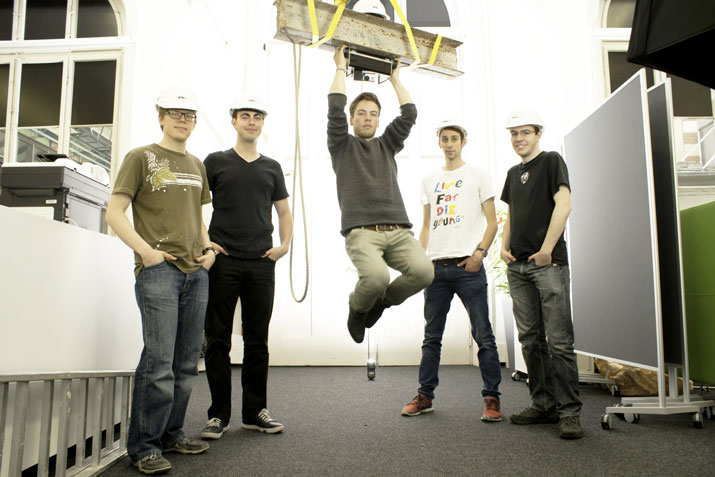
I like the picture of the guy hanging off the robot as it hangs on the underside of a horizontal I-beam. Reminds me of the http://www.youtube.com/watch?v=SXZv2KZKCCo>old krazy-Glue commercial.