Slashdot Mirror
Domain: sciencecodex.com
Stories and comments across the archive that link to sciencecodex.com.
Comments · 6
-
Re:Pretty sure
Here's a link to brain wave synchronization:
http://www.sciencecodex.com/insync_brain_waves_hold_memory_of_objects_just_seen-101396 -
Re:Night?
1) Quite true. Nonetheless, the figure is still quite extreme. The *entire day*'s power consumption for *50 days*? I mean, that's ridiculous, especially on an interconnected grid. If the sun's not shining in Germany, it's probably shining in Morrocco. If the wind isn't blowing in Scotland, it's probably blowing in Greece. Etc. And for those rare cases when *all types* of renewables are underperforming at the *same time*, you then fire up fossil peaking to make up that ~5% or so of your total electricity production. In such a scenario you should need no more than a couple days' worth of storage at most.
2) While wind doesn't track consumption requirements, solar generally does pretty well. Inter-seasonal variations are handled by geographic and generation-mix diversity.
3) This list contradicts your "most expensive" price claim. Plus, citing raw price figures is horribly distorting as so much can affect them (especially taxes and subsidies which vary a lot between countries regardless of levels of subsidy for renewables). Look at Ireland, for example - overwhelmingly fossil fuels, tiny renewable segment, yet they pay more than you for power. Or Sweden for an even more ridiculous example - they're 44% hydropower, which is generally cheap, almost no wind or solar, and yet they pay more than you.
4) "Assured production" for a single wind farm is one of the most stupid and meaningless metrics you could possibly come up with. The figures I've seen cited for wind distributed among farms across a couple hundred kilometers is that about a third of it is as reliable as baseload.
5) The concept that the grid can't deal with intermittency is absurd, because *demand* is already intermittent. Having intermittent demand is for all practical purposes the same as intermittent supply. And the same solutions apply - diversity, distribution, storage, and peaking.
-
Re:Man up!I can see 2 solutions:
- Mexico could be used for the same purpose. It would even create a better balance. The US can use cheap Mexican electricity during the day and expensive African electricity during the night (expensive due to long submarinal cables).
- You could use (part of) the solar energy to create fuels, which you can burn during the night
-
Re:Venus and Mars
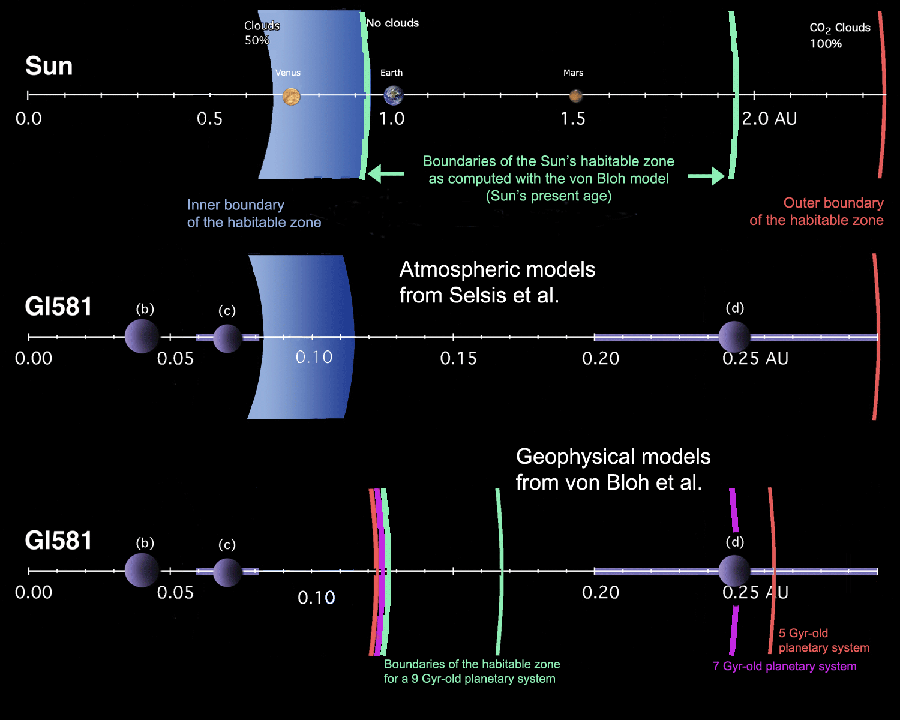
Habzone boundary computations are fuzzy when one takes things like clouds and stellar variability into account. Selsis et al calculate an inner boundary (for present-day Sol) at between 0.7 and 0.9 AU (Venus is at ~0.72 AU), and an outer boundary between 1.7 and 2.4 AU (Mars is at 1.4-1.7 AU). W. von Bloh et al define the habzone in terms of the range in which Earth-like photosynthesis can take place, which is narrower.
Article here, better image here. (The Gl581 diagrams do not show the recently announced f and g planets.)
-
Re:Ebonics, etc
And usually, the irregularities are shorter than the regular versions.. "ate", one syllable, "eated", two. The words that get used the most are the ones that get the most irregular.
That's true, and a good point about efficiency. Although it seems it's actually the reverse - the ones that get used the most can STAY irregular (because we hear them enough to remember their oddities), whereas less common words become regular (because their oddities are forgotten). This is a great article on the subject: http://sciencecodex.com/harvard_scientists_predict_the_future_of_the_past_tense. They predict that words like "wed" are next in line for regularization - "we wedded last summer" as opposed to "we wed."
-
Re:"Don't worry too much about the myrrh next time
Most mythology is usually based on some fact or event and then is taken way out of context and embellished, take the star of Bethlehem for instance. It was most likely a planetary conjunction... http://www.sciencecodex.com/astronomer_explains_star_of_bethlehem