Slashdot Mirror
Domain: sealevel.info
Stories and comments across the archive that link to sealevel.info.
Comments · 7
-
Re:6.5 inches by 2100?
You are right. Since the 1906 earthquake sea-level at San Francisco has risen at 2.0 ±0.2 mm/year (7.1 to 8.7 inches per century), and there's been no "acceleration" in rate, at all.
The claim that higher CO2 levels cause significantly accelerated coastal sea-level rise is falsified by the measurement data.
Here's a graph showing sea-level measured at San Francisco juxtaposed with CO2 level:
https://www.sealevel.info/MSL_graph.php?id=san+francisco&boxcar=1&boxwidth=3&c_date=1906/5-2019/12
That includes both global sea-level rise (about 1.5 mm/yr) and local subsidence (my guess is about 0.5 mm/yr, though Prof. Richard Peltier estimates 0.32 mm/yr [ICE6G/VM5a] or 0.42 mm/yr [ICE5Gv1.3/VM2]).
As you can see from the graph, CO2 level has no perceptible effect on the (minuscule) rate of sea-level rise.
The rate of sea-level rise at San Francisco is slightly higher than average (because of subsidence), but the lack of acceleration is typical. Most sites have seen little or no sea-level rise acceleration since the 1920s or earlier. Coastal sea-level is rising no faster now, with CO2 level at 407 ppmv, than it was nine decades ago, with CO2 level 100 ppmv lower.
Although the Earth's climate has warmed modestly, the increase in CO2 level and the resultant warming have had no detectable effect on the rate of sea-level rise. -
Re:6.5 inches by 2100?
You are right. Since the 1906 earthquake sea-level at San Francisco has risen at 2.0 ±0.2 mm/year (7.1 to 8.7 inches per century), and there's been no "acceleration" in rate, at all.
The claim that higher CO2 levels cause significantly accelerated coastal sea-level rise is falsified by the measurement data.
Here's a graph showing sea-level measured at San Francisco juxtaposed with CO2 level:
https://www.sealevel.info/MSL_graph.php?id=san+francisco&boxcar=1&boxwidth=3&c_date=1906/5-2019/12
That includes both global sea-level rise (about 1.5 mm/yr) and local subsidence (my guess is about 0.5 mm/yr, though Prof. Richard Peltier estimates 0.32 mm/yr [ICE6G/VM5a] or 0.42 mm/yr [ICE5Gv1.3/VM2]).
As you can see from the graph, CO2 level has no perceptible effect on the (minuscule) rate of sea-level rise.
The rate of sea-level rise at San Francisco is slightly higher than average (because of subsidence), but the lack of acceleration is typical. Most sites have seen little or no sea-level rise acceleration since the 1920s or earlier. Coastal sea-level is rising no faster now, with CO2 level at 407 ppmv, than it was nine decades ago, with CO2 level 100 ppmv lower.
Although the Earth's climate has warmed modestly, the increase in CO2 level and the resultant warming have had no detectable effect on the rate of sea-level rise. -
Re:This is bad reporting
You are certainly right that 2mm/yr is a great big nothingburger -- just 6 to 7 inches by 2100. But it is possible for earthquake-prone locations to experience a huge rise in sea-level (though not from climate change, of course -- that's just leftist superstitious nonsense).
I give you Seward, Alaska, which experienced a full meter of sea-level rise in one day:
https://www.sealevel.info/MSL_graph.php?id=seward&boxcar=1&boxwidth=3&c_date=1964/2-2019/12 -
Re:For most of SF, it's not really relevant.
Right. At the current rate of sea-level rise there, which is only 2.0 ±0.2 mm/year (7.1 to 8.7 inches per century) since the 1906 earthquake, with no "acceleration" (increase in rate) evident in more than a century, just the height increase from occasional resurfacing of the runways will far outstrip sea-level rise.
-
Not dire at all
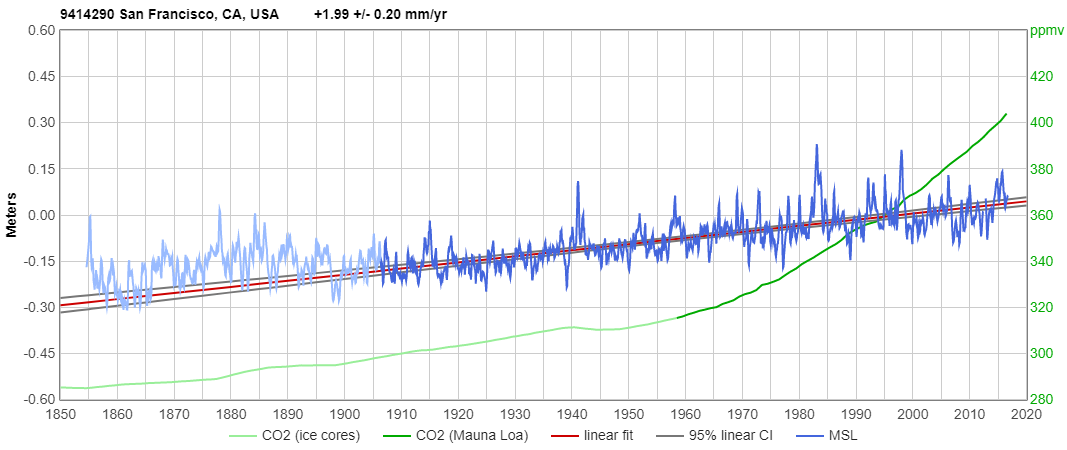
The claim that higher CO2 levels cause significantly accelerated coastal sea-level rise is falsified by the measurement data. As it happens, one of the USA's best long sea-level measurement records is from San Francisco. Since the 1906 Earthquake, sea-level at San Francisco has risen at just 2.0 ±0.2 mm/year (7.1 to 8.7 inches per century), and there's been no "acceleration" in rate, at all.
Here's a graph showing sea-level measured at San Francisco juxtaposed with CO2 level:
http://sealevel.info/9414290_SanFrancisco_2016-12_since_1906-05.png
That includes both global sea-level rise (about 1.5 mm/yr) and local subsidence (my guess is about 0.5 mm/yr, though Prof. Richard Peltier estimates 0.32 mm/yr [ICE6G/VM5a] or 0.42 mm/yr [ICE5Gv1.3/VM2]).
As you can see from the graph, CO2 level has no perceptible effect on the (minuscule) rate of sea-level rise.
The rate of sea-level rise at San Francisco is slightly higher than average (because of subsidence), but the lack of acceleration is typical. Most sites have seen little or no sea-level rise acceleration since the 1920s or earlier. Coastal sea-level is rising no faster now, with CO2 level at 407 ppmv, than it was nine decades ago, with CO2 level 100 ppmv lower.
Although the Earth's climate has warmed modestly, the increase in CO2 level and the resultant warming have had no detectable effect on the rate of sea-level rise.
BTW, if you aren't sure what "acceleration" looks like in a graph, here's a little primer that should help:
http://sealevel.info/acceleration_primer.html
From the combined effects of global sea-level rise and local land subsidence, San Francisco is on track to experience only 6 to 7 inches of sea-level rise by 2100.
-
Not dire at all
The claim that higher CO2 levels cause significantly accelerated coastal sea-level rise is falsified by the measurement data. As it happens, one of the USA's best long sea-level measurement records is from San Francisco. Since the 1906 Earthquake, sea-level at San Francisco has risen at just 2.0 ±0.2 mm/year (7.1 to 8.7 inches per century), and there's been no "acceleration" in rate, at all.
Here's a graph showing sea-level measured at San Francisco juxtaposed with CO2 level:
http://sealevel.info/9414290_SanFrancisco_2016-12_since_1906-05.png
That includes both global sea-level rise (about 1.5 mm/yr) and local subsidence (my guess is about 0.5 mm/yr, though Prof. Richard Peltier estimates 0.32 mm/yr [ICE6G/VM5a] or 0.42 mm/yr [ICE5Gv1.3/VM2]).
As you can see from the graph, CO2 level has no perceptible effect on the (minuscule) rate of sea-level rise.
The rate of sea-level rise at San Francisco is slightly higher than average (because of subsidence), but the lack of acceleration is typical. Most sites have seen little or no sea-level rise acceleration since the 1920s or earlier. Coastal sea-level is rising no faster now, with CO2 level at 407 ppmv, than it was nine decades ago, with CO2 level 100 ppmv lower.
Although the Earth's climate has warmed modestly, the increase in CO2 level and the resultant warming have had no detectable effect on the rate of sea-level rise.
BTW, if you aren't sure what "acceleration" looks like in a graph, here's a little primer that should help:
http://sealevel.info/acceleration_primer.html
From the combined effects of global sea-level rise and local land subsidence, San Francisco is on track to experience only 6 to 7 inches of sea-level rise by 2100.
-
Misinformation on protein
That's nonsense. Almost all plants benefit dramatically from higher CO2 levels. That's why commercial greenhouse operators commonly use CO2 generators to increase CO2 levels to 800-1200 ppmv above average outdoor levels: because it makes the plants much healthier, faster-growing, and more productive. Plants do not "have a harder time producing proteins" (unless underfertilized), they do not have "trouble reproducing," and they are not "weaker" with higher CO2 levels. Crops grown in greenhouses with CO2 levels 3x outdoor levels are just as nutritious as when grown outdoors, and plants are just as hardy, but at 3x higher CO2 levels they are much more productive.
Nor is there any evidence of harm to marine life from CO2. The most significant change seen is the increase in calcifying coccolithophores, which remove CO2 from the water.
Higher CO2 levels are dramatically beneficial for both agriculture and natural ecosystems. That fact has been known to science for about a century! In fact, way back in 1920 Scientific American called anthropogenic CO2 "the precious air fertilizer," because it is so highly beneficial for plants.