Slashdot Mirror
Domain: solarviews.com
Stories and comments across the archive that link to solarviews.com.
Stories · 6
-
Triple Eclipse on Jupiter
An anonymous reader writes "The Hubble Space Telescope captured a stunning image of a rare triple eclipse. Three of Jupiter's three big moons--Io, Ganymede and Callisto--eclipsed large portions of face of the giant planet. Such an event happens about once a decade." -
Triple Eclipse on Jupiter
An anonymous reader writes "The Hubble Space Telescope captured a stunning image of a rare triple eclipse. Three of Jupiter's three big moons--Io, Ganymede and Callisto--eclipsed large portions of face of the giant planet. Such an event happens about once a decade." -
Triple Eclipse on Jupiter
An anonymous reader writes "The Hubble Space Telescope captured a stunning image of a rare triple eclipse. Three of Jupiter's three big moons--Io, Ganymede and Callisto--eclipsed large portions of face of the giant planet. Such an event happens about once a decade." -
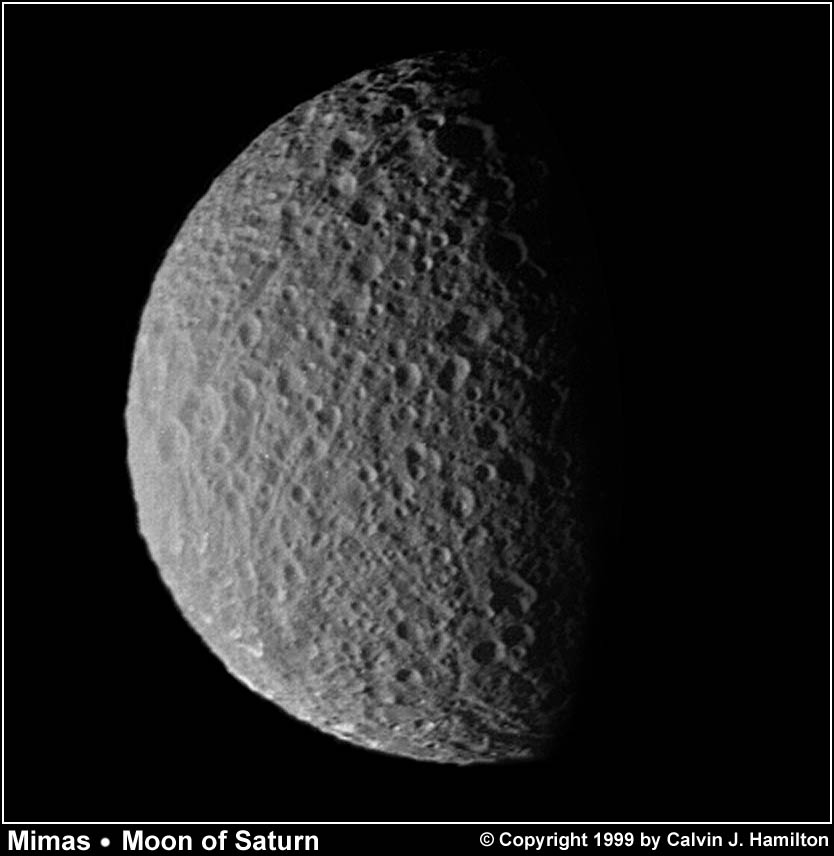
Tiny Moon is No Space Station
An anonymous reader writes "With today's image release, Cassini's tour of Saturn's remarkable system of 31 moons has taken the probe past one of the ringed planet's natural wonders: Mimas. The 250 mile wide satellite suffered a catastrophic impact that opened a wound one third of its diameter and nearly split the moon in half. Today, Mimas bears a striking resemblance to the original Star Wars' Death Star, which wreaked havoc on planets using its laser-focusing dish. In place of the laser dish, Mimas carries a crater peak the size of Mount Everest." -
Cassini-Huygens Reaches Phoebe
Anonymous Explorer writes "The Cassini-Huygens probe is set to fly by the largest outer Saturn moon of Phoebe today. Cassini will be roughly 2000 km from the surface of Phoebe at 1:56 Pacific time Friday, June 11. Thats pretty darn close. The newest images of Phoebe are already thousands of times better than the previous ones taken by the Voyager 2 mission in 1981. Phoebe is interesting in that it maintains a retrograde orbit around Saturn. This has lead to the hypothesis that it is an ancient asteroid that has been captured by the gravitational pull from Saturn. Phoebe may provide some important insights into the composition of early building blocks of our planets. Phoebe was discovered in 1898 by American astronomer William Pickering. As always, discussion about this mission can be found at #cassini on irc.freenode.net." -
Hubble Telescope Shows Giant View of Saturn
An anonymous reader writes "The giant planet, Saturn, offers the best Southern view of its spectacular rings only three times a century. The Hubble Space Telescope astronomers published this seasonal glimpse today, in infrared, ultraviolet and visible spectral bands. The Hubble also first penetrated the changing face of Saturn's biochemically rich moon, Titan, which will be the ambitious target of a landing mission - the Cassini-Huygens probe in 294 days (July 1, 2004). Because Titan changes both spatially and temporally based on observations of its atmosphere, speculation of what drives these variations derives from the moon's high content of methane and other organic building blocks."