Slashdot Mirror
Domain: talosintelligence.com
Stories and comments across the archive that link to talosintelligence.com.
Stories · 9
-
Elasticsearch Clusters Face Attacks From Multiple Hacker Groups (csoonline.com)
itwbennett writes: If you're running Elasticsearch 1.4.2 and lower, you should make sure your patches are up to date. That's because researchers from Cisco's Talos group have "detected an increase in attacks targeting unsecured Elasticsearch clusters." At least six different groups are responsible for the increase, each deploying different malware, but regardless of the method, the potential impact of a breach is huge because Elasticsearch is designed to work with big data and companies use it to process sensitive data. "Given the size and sensitivity of the data sets these clusters contain, the impact of a breach of this nature could be severe," the Talos researchers warned. -
MPlayer, VLC Media Player Hit By Critical Vulnerability (hackread.com)
A critical remote code execution vulnerability has been spotted in the LIVE555 media streaming library used by popular media players such as VLC and MPlayer. "Maintained by the company Live Networks, the library works with RTP / RTCP, RTSP or SIP protocols, with the ability to process video and audio formats such as MPEG, H.265, H.264, H.263 +, VP8, DV, JPEG, MPEG, AAC, AMR, AC-3, and Vorbis," reports Hackread. From the report: These findings (CVE-2018-4013) have left millions of users of media players vulnerable to cyber attacks, according to Lilith Wyatt, a researcher at the Cisco Talos Intelligence Group. In this case, the flaw lies in the HTTP packet parsing functionality, which analyzes HTTP headers for RTSP tunneling over HTTP, explains. An update has already been issued to address the vulnerability. Therefore, if you are using any of the vulnerable media players make sure they are updated to the latest version. -
Bugs In Samsung IoT Hub Leave Smart Home Open To Attack (threatpost.com)
secwatcher writes from a report via Threatpost: Cisco Talos researchers found flaws located in Samsung's centralized controller, a component that connects to an array of IoT devices around the house -- from light bulbs, thermostats, and cameras. SmartThings Hub is one of several DIY home networking devices designed to allow homeowners to remotely manage and monitor digital devices. "Given that these devices often gather sensitive information, the discovered vulnerabilities could be leveraged to give an attacker the ability to obtain access to this information, monitor and control devices within the home, or otherwise perform unauthorized activities," researchers said in a report. Threatpost goes on to detail the "multiple attack chain scenarios." Thankfully, Samsung has since patched the bugs. "We are aware of the security vulnerabilities for SmartThings Hub V2 and released a patch for automatic update to address the issue," a Samsung spokesperson told Threatpost. "All active SmartThings Hub V2 devices in the market are updated to date." The company released a firmware advisory for Hub V2 devices on July 9th. -
Hacking Campaign Targets iPhone Users With Data-Stealing, Location-Tracking Malware (zdnet.com)
ZDNet reports of a new mobile malware campaign that is "gaining access to iPhones by tricking users to download an open-source mobile device management (MDM) software package." From the report: Once in control, the unidentified hackers can steal various forms of sensitive information from infected devices, including the phone number, serial number, location, contact details, user's photos, SMS, and Telegram and WhatsApp chat messages. Thirteen users -- all in India -- have been been compromised in the attacks, which have been detailed by Cisco Talos. Those infected use a range of iPhone models and are running iOS versions ranging from 10.2.1 to 11.2.6. The campaign has been active since August 2015. The attackers take control by using the MDM package, which can give attackers complete control of the device and the ability to install fake versions of real apps.
Two different MDM services are used in the campaign, enabling system-level control of multiple devices from one location and the ability to install, remove and exfiltrate data from apps. One method of stealing data comes via malicious versions of messaging services like Telegram and WhatsApp being pushed onto the compromised device via fake updates. The apps look legitimate to the user, but malicious code sends information -- including messages, photos and contacts -- to a central command and control server. Deploying these apps requires a side-loading injection technique, which allows for the ability to ask for additional permissions, execute code and steal information from the original application. -
FBI Seizes Control of Russian Botnet (thedailybeast.com)
The Daily Beast reports that the FBI has seized control of a key server in the Kremlin's global botnet of 500,000 hacked routers. "The move positions the bureau to build a comprehensive list of victims of the attack, and short-circuits Moscow's ability to reinfect its targets," writes Kevin Poulsen. From the report: The FBI counter-operation goes after "VPN Filter," a piece of sophisticated malware linked to the same Russian hacking group, known as Fancy Bear, that breached the Democratic National Committee and the Hillary Clinton campaign during the 2016 election. On Wednesday security researchers at Cisco and Symantec separately provided new details on the malware, which has turned up in 54 countries including the United States.
VPN Filter uses known vulnerabilities to infect home office routers made by Linksys, MikroTik, NETGEAR, and TP-Link. Once in place, the malware reports back to a command-and-control infrastructure that can install purpose-built plug-ins, according to the researchers. One plug-in lets the hackers eavesdrop on the victim's Internet traffic to steal website credentials; another targets a protocol used in industrial control networks, such as those in the electric grid. A third lets the attacker cripple any or all of the infected devices at will. -
'Vigilante Hackers' Strike Routers In Russia and Iran, Reports Motherboard (vice.com)
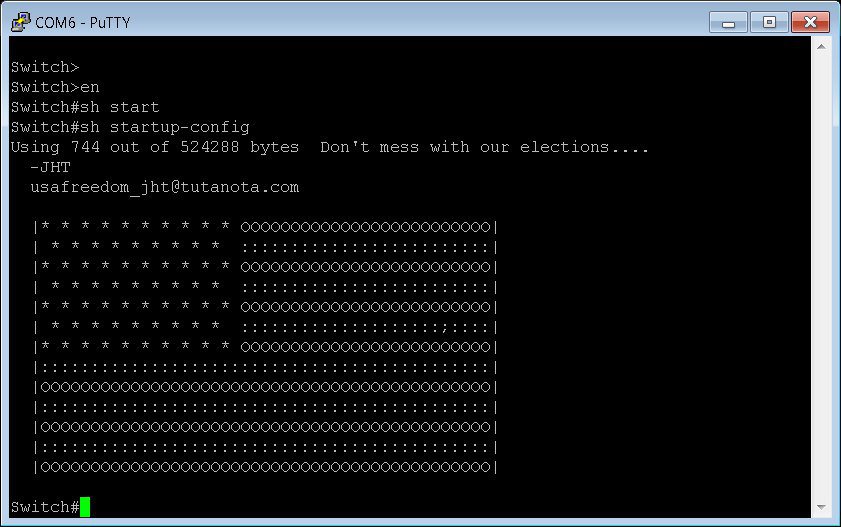
An anonymous reader quotes Motherboard: On Friday, a group of hackers targeted computer infrastructure in Russia and Iran, impacting internet service providers, data centres, and in turn some websites. "We were tired of attacks from government-backed hackers on the United States and other countries," someone in control of an email address left in the note told Motherboard Saturday... "We simply wanted to send a message...." In addition to disabling the equipment, the hackers left a note on affected machines, according to screenshots and photographs shared on social media: "Don't mess with our elections," along with an image of an American flag...
In a blog post Friday, cybersecurity firm Kaspersky said the attack was exploiting a vulnerability in a piece of software called Cisco Smart Install Client. Using computer search engine Shodan, Talos (which is part of Cisco) said in its own blog post on Thursday it found 168,000 systems potentially exposed by the software. Talos also wrote it observed hackers exploiting the vulnerability to target critical infrastructure, and that some of the attacks are believed to be from nation-state actors...
Reuters reported that Iran's IT Minister Mohammad Javad Azari-Jahromi said the attack mainly impacted Europe, India, and the U.S.... The hackers said they did scan many countries for the vulnerable systems, including the U.K., U.S., and Canada, but only "attacked" Russia and Iran, perhaps referring to the post of an American flag and their message. They claimed to have fixed the Cisco issue on exposed devices in the US and UK "to prevent further attacks... As a result of our efforts, there are almost no vulnerable devices left in many major countries," they claimed in an email.
Their image of the American flag was a black-and-white drawing done with ASCII art. -
Attackers Drain CPU Power From Water Utility Plant In Cryptojacking Attack (eweek.com)
darthcamaro writes: Apparently YouTube isn't the only site that is draining CPU power with unauthorized cryptocurrency miners. A water utility provider in Europe is literally being drained of its CPU power via an cryptojacking attack that was undetected for three weeks. eWeek reports: "At this point, Radiflow's (the security firm that discovered the cryptocurrency mining malware) investigation indicates that the cryptocurrency mining malware was likely downloaded from a malicious advertising site. As such, the theory that Radiflow CTO Yehonatan Kfir has is that an operator at the water utility was able to open a web browser and clicked on an advertising link that led the mining code being installed on the system. The actual system that first got infected is what is known as a Human Machine Interface (HMI) to the SCADA network and it was running the Microsoft Windows XP operating system. Radiflow's CEO, Ilan Barda, noted that many SCADA environments still have Windows XP systems deployed as operators tend to be very slow to update their operating systems." Radiflow doesn't know how much Monero (XMR) cryptocurrency was mined by the malware, but a recent report from Cisco's Talos research group revealed that some of the top un-authorized cryptocurrency campaigns generate over a million dollars per year. The average system would generate nearly $200,000 per year. -
Petya Ransomware Outbreak Originated In Ukraine Via Tainted Accounting Software (bleepingcomputer.com)
An anonymous reader quotes a report from Bleeping Computer: Today's massive ransomware outbreak was caused by a malicious software update for M.E.Doc, a popular accounting software used by Ukrainian companies. According to several researchers, such as Cisco Talos, ESET, MalwareHunter, Kaspersky Lab, and others, an unknown attacker was able to compromise the software update mechanism for M.E.Doc's servers, and deliver a malicious update to customers. When the update reached M.E.Doc's customers, the tainted software packaged delivered the Petya ransomware -- also referenced online as NotPetya, or Petna. The Ukrainian software vendor appears to have inadvertently confirmed that something was wrong when, this morning, issued a security advisory. Hours later, as the ransomware outbreak spread all over Ukraine and other countries across the globe causing huge damages, M.E.Doc denied on Facebook its servers ever served any malware. According to security researcher MalwareHunter, this is not the first time M.E.Doc has carried a malicious software update that delivered ransomware. Back in May, the company's software update mechanism also helped spread the XData ransomware. -
Apache Servers Under Attack Through Easily Exploitable Struts 2 Flaw (helpnetsecurity.com)
Orome1 quotes a report from Help Net Security: A critical vulnerability in Apache Struts 2 is being actively and heavily exploited, even though the patch for it has been released on Monday. The vulnerability (CVE-2017-5638) affects the Jakarta file upload Multipart parser in Apache Struts 2. It allows attackers to include code in the "Content-Type" header of an HTTP request, so that it is executed by the web server. Almost concurrently with the release of the security update that plugs the hole, a Metasploit module for targeting it has been made available. Unfortunately, the vulnerability can be easily exploited as it requires no authentication, and two very reliable exploits have already been published online. Also, vulnerable servers are easy to discover through simple web scanning. "Struts 2 is a Java framework that is commonly used by Java-based web applications," reports SANS ISC in their blog. "It is also known as 'Jakarta Struts' and 'Apache Struts.' The Apache project currently maintains Struts." Cisco Talos also has a blog detailing the attack.