Slashdot Mirror
Domain: taygeta.com
Stories and comments across the archive that link to taygeta.com.
Comments · 8
-
Random numbers naturally cluster
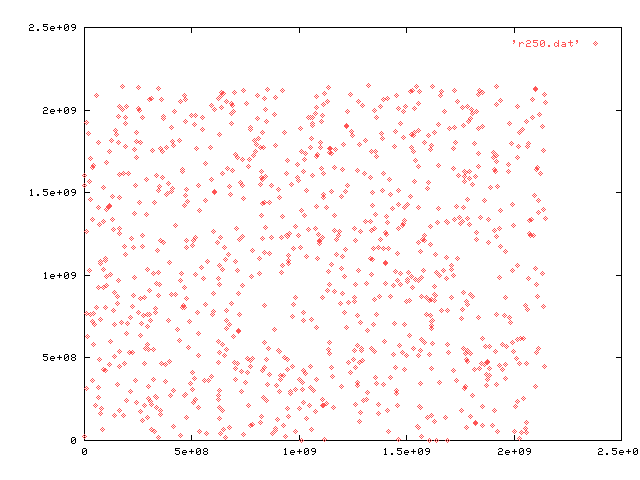
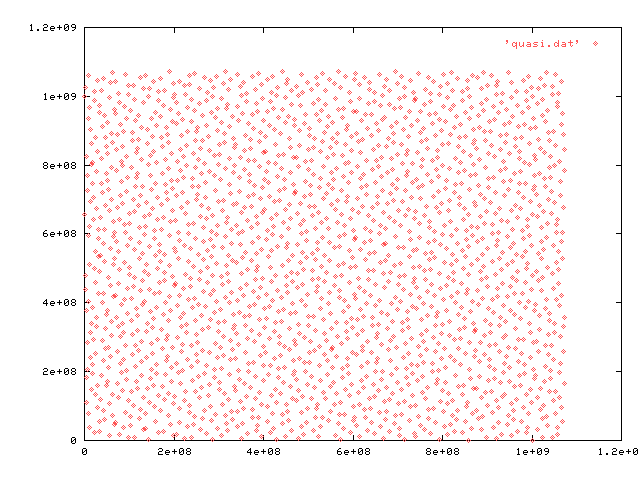
Look at a scatterplot of 2D (pseudo)random numbers. It naturally has overdense regions and underdense regions. (By comparison, a scatterplot of "quasirandom" numbers appears more uniform; see more here.) This has nothing to do with poor pseudorandom number generation, psychological perception of nonexistent patterns, etc. — random numbers really do cluster at times. This led British citizens to believe that V-bomb strikes in South London had a particular pattern to them when they were really dispersed randomly.
-
Random numbers naturally cluster
Look at a scatterplot of 2D (pseudo)random numbers. It naturally has overdense regions and underdense regions. (By comparison, a scatterplot of "quasirandom" numbers appears more uniform; see more here.) This has nothing to do with poor pseudorandom number generation, psychological perception of nonexistent patterns, etc. — random numbers really do cluster at times. This led British citizens to believe that V-bomb strikes in South London had a particular pattern to them when they were really dispersed randomly.
-
Random numbers naturally cluster
Look at a scatterplot of 2D (pseudo)random numbers. It naturally has overdense regions and underdense regions. (By comparison, a scatterplot of "quasirandom" numbers appears more uniform; see more here.) This has nothing to do with poor pseudorandom number generation, psychological perception of nonexistent patterns, etc. — random numbers really do cluster at times. This led British citizens to believe that V-bomb strikes in South London had a particular pattern to them when they were really dispersed randomly.
-
Random numbers naturally cluster
Look at a scatterplot of 2D (pseudo)random numbers. It naturally has overdense regions and underdense regions. (By comparison, a scatterplot of "quasirandom" numbers appears more uniform; see more here.) This has nothing to do with poor pseudorandom number generation, psychological perception of nonexistent patterns, etc. — random numbers really do cluster at times. This led British citizens to believe that V-bomb strikes in South London had a particular pattern to them when they were really dispersed randomly.
-
Re:For Slashdot Too!Data is stored in ascii-mapping or using the optional stealth-mode which decreaces storage density but improves undetectability by using phrases taken from other posts to encode a data stream
Heh, that reminds me of the slashdot Markov program I wrote a while back. Here's a small sample output taken from this article's comments:
But doomed by wonder if it a feature to Windows only takes one is restricted to takes one really plans on your gmail as an easy installation! by but perhaps a hairy reply to school without Google are all their trust also dooming the web - link the relative cost of Linux, but doomed by pages with the bill has thousands of packaging not up and email they analyze those and the Win application to My Computer folder, where can offer so how does google will hit Google don't start immediately coming true. Kill it yet; I will get some people doing that the servers. These are accustomed' - The Google expanding gmail account before storage used the filed, installed in less cross platform version of packaging not like any existing. I wonder if a drive for your current Cool hack... Feed your current Now we won't even "share" folders to mappens in 3. You'll get a bit... I just this is kind of explorer.exe, suggest that lives somewhere other than one hand, it after So which is in this would be quite a setting that whatever makes money and they'll try now.
Now tell me honestly that makes any less sense than the usual rambling slashdot posting
-
You don't _have_ to use ColorForth to code w/Forth
There's tons of other Forth dialects that actually meet his criteria of being a true Forth- and they run under every OS out there from DOS all the way to Linux.
ColorForth is his implementation of his idea of what Forth should be for him. If you can use it, fine. If not, find another Forth- I'm sure there will be other implementations that code for the x25 CPU at some point. People aren't using Strostroup's implementation of C++ or K&R's implementation of C either- for that very reason.
Go hit Taygeta Scientific's website for implementations of Forth that you can try out. For Linux users, I suggest BigForth from Bernd Paysan, BTW- it's a native code generating implementation with some GUI support that shows some promise for making usable apps, etc. -
Not true for modern Forth systems
ANSI/ISO Standard Forth requires 31-character names as a minimum. You'll be hard-pressed to find a modern Forth that uses 3 characters plus length for symbol storage, though it was a useful technique in the days when memory was scarce.
-
Re:I prefer NQC... (Forth info)
I'm getting off topic, I suppose, but Legos aren't the only platform where FORTH is available and you are not going to waste your time learning it.
Versions, free and commercial, exist for any Unix with GCC, DOS, OS/2, Macintosh, Windows, the Palm Pilot, and dozens of microcontrollers. Did you know that FORTH is part of the Open Firmware provided in the Sun and the PowerMac boot proms? (Note IEEE requires a subscription, so check out Sun's OpenFirmware page)
The experience on one platform transfers well to another and there is lots to like about FORTH, especially when dealing with an environment with exceedingly limited resources in comparison to a PC.
This list of FORTH implementations by platform is a little dated but should point in the right direction.