Slashdot Mirror
Domain: troyhunt.com
Stories and comments across the archive that link to troyhunt.com.
Stories · 19
-
TicTocTrack Smartwatch Flaws Can Be Abused To Track Kids (threatpost.com)
secwatcher shares a report from Threatpost: A popular smartwatch that allows parents to track their children's whereabouts, TicTocTrack, has been discovered to be riddled with security issues that could allow hackers to track and call children. Researchers at Pen Test Partners revealed vulnerabilities in the watch (sold in Australia) on Monday, which could enable hackers to track children's location, spoof the child's location or view personal data on the victims' accounts. The parent company of the TicTocTrack watch, iStaySafe Pty Ltd., has temporarily restricted access to the watch's service and app while it investigates further. Researchers found that the service's back end does not make any authorization attempt on any request -- besides the user having a valid username and password combination. That means that an attacker who is logged into the service could remotely compromise the app and track other accounts that are based in Australia.
The smartwatch, available in Australia for $149 (USD), is designed for children and uses GPS to track the movement of the wearer every six minutes, and offers voice calling and SMS features. The smartwatch's API can be attacked by changing the FamilyIdentifier number (which identifies the family that the user belongs to), which then could give a bad actor complete access to the user's data -- including the children's location, parent's full names, phone numbers and other personal identifiable information. Researchers with Pen Test Partners collaborated with security researcher Troy Hunt to test the attack. Hunt uploaded a video showing how the smartwatch vulnerability could be exploited to call his daughter -- and how her smartwatch would answer automatically without any interaction needed from her end. -
8-Character Windows NTLM Passwords Can Be Cracked In Under 2.5 Hours (theregister.co.uk)
HashCat, an open-source password recovery tool, can now crack an eight-character Windows NTLM password hash in less than 2.5 hours. "Current password cracking benchmarks show that the minimum eight character password, no matter how complex, can be cracked in less than 2.5 hours" using a hardware rig that utilizes eight Nvidia GTX 2080Ti GPUs, explained a hacker who goes by the pseudonym Tinker on Twitter in a DM conversation with The Register. "The eight character password is dead." From the report: It's dead at least in the context of hacking attacks on organizations that rely on Windows and Active Directory. NTLM is an old Microsoft authentication protocol that has since been replaced with Kerberos. According to Tinker, it's still used for storing Windows passwords locally or in the NTDS.dit file in Active Directory Domain Controllers. It's dead at least in the context of hacking attacks on organizations that rely on Windows and Active Directory. NTLM is an old Microsoft authentication protocol that has since been replaced with Kerberos. Tinker estimates that buying the GPU power described would require about $10,000; others have claimed the necessary computer power to crack an eight-character NTLM password hash can be rented in Amazon's cloud for just $25.
NIST's latest guidelines say passwords should be at least eight characters long. Some online service providers don't even demand that much. When security researcher Troy Hunt examined the minimum password lengths at various websites last year, he found that while Google, Microsoft and Yahoo set the bar at eight, Facebook, LinkedIn and Twitter only required six. Tinker said the eight character password was used as a benchmark because it's what many organizations recommend as the minimum password length and many corporate IT policies reflect that guidance. So how long is long enough to sleep soundly until the next technical advance changes everything? Tinker recommends a random five-word passphrase, something along the lines of the four-word example popularized by online comic XKCD, "correcthorsebatterystaple." That or whatever maximum length random password via a password management app, with two-factor authentication enabled in either case. -
Collection 1 Data Breach Exposes More Than 772 Million Email Addresses (zdnet.com)
A collection of almost 773 million unique email addresses and just under 22 million unique passwords were exposed on cloud service MEGA. Security researcher Troy Hunt said the collection of data, dubbed Collection #1, totaled over 12,000 separate files and more than 87GB of data. ZDNet reports: "What I can say is that my own personal data is in there and it's accurate; right email address and a password I used many years ago," Hunt wrote. "In short, if you're in this breach, one or more passwords you've previously used are floating around for others to see." Some passwords, including his own, have been "dehashed", that is converted back to plain text. Hunt said he gained the information after multiple people reached out to him with concerns over the data on MEGA, with the Collection #1 dump also being discussed on a hacking forum. "The post on the forum referenced 'a collection of 2000+ dehashed databases and Combos stored by topic' and provided a directory listing of 2,890 of the files," Hunt wrote. The collection has since been removed. You can visit Hunt's Have I Been Pwned service to see if you are affected by this breach. -
'Have I Been Pwned' Is Being Integrated Into Firefox, 1Password (troyhunt.com)
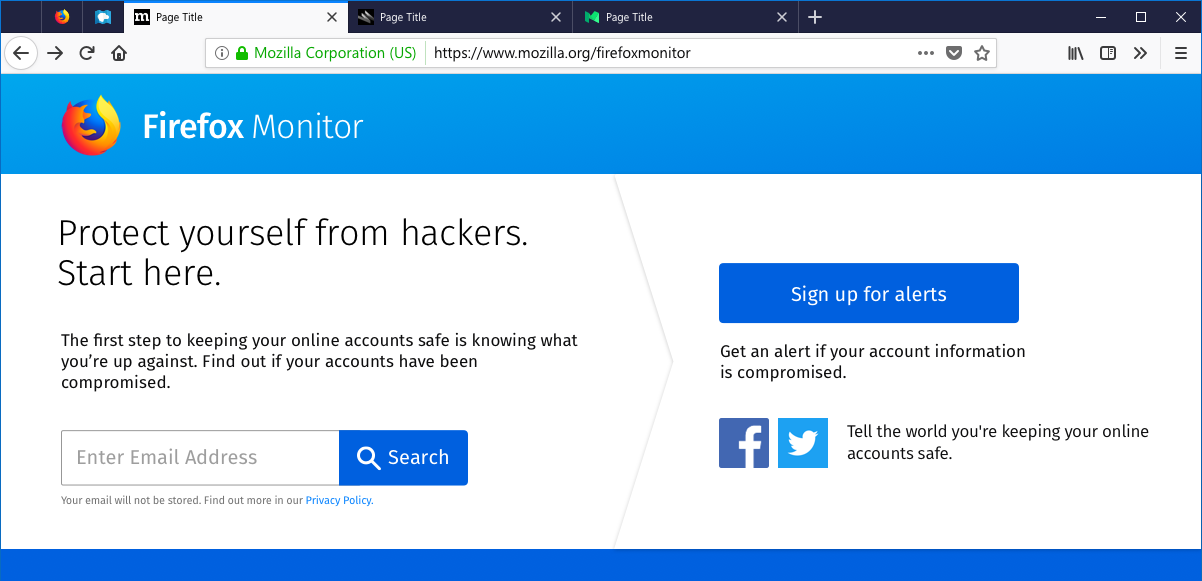
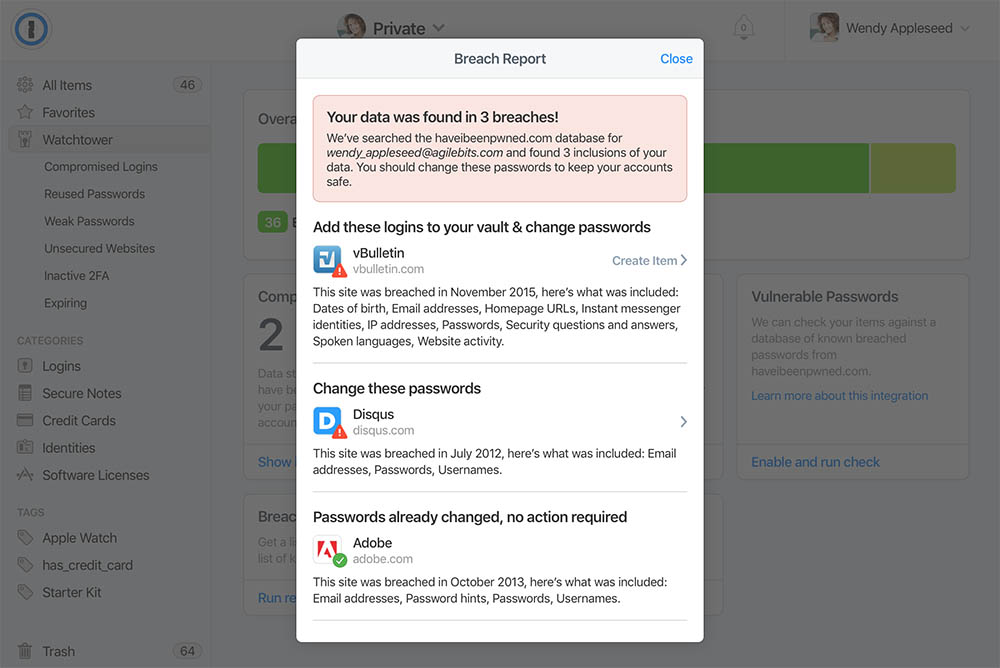
Troy Hunt, web security expert and creator of the website Have I Been Pwned (HIBP), wrote a blog post announcing his partnerships with Firefox and 1Password. For those unfamiliar with the site, Have I Been Pwned allows you to search across multiple data breaches to see if your email address has been compromised. The service is especially handy now that data breaches are becoming a daily occurrence. Hunt writes: Last November, there was much press about Mozilla integrating HIBP into Firefox. I was a bit surprised at the time as it was nothing more than their Breach Alerts feature which simply highlighted if the site being visited had previously been in a data breach (it draws this from the freely accessible breach API on HIBP). But the press picked up on some signals which indicated that in the long term, we had bigger plans than that and the whole thing got a heap of very positive attention. I ended up fielding a heap of media calls just on that one little feature - people loved the idea of HIBP in Firefox, even in a very simple form. As it turns out, we had much bigger plans and that's what I'm sharing here today. Over the coming weeks, Mozilla will begin trialling integration between HIBP and Firefox to make breach data searchable via a new tool called "Firefox Monitor." Here's what Hunt has to say about 1Password: As of now, you can search HIBP from directly within 1Password via the Watchtower feature in the web version of the product. This helps Watchtower become "mission control" for accounts and introduces the "Breach Report" feature. If you're a 1Password user you can use this feature right now, just head on over to the 1Password login page. -
'Have I Been Pwned' Is Being Integrated Into Firefox, 1Password (troyhunt.com)
Troy Hunt, web security expert and creator of the website Have I Been Pwned (HIBP), wrote a blog post announcing his partnerships with Firefox and 1Password. For those unfamiliar with the site, Have I Been Pwned allows you to search across multiple data breaches to see if your email address has been compromised. The service is especially handy now that data breaches are becoming a daily occurrence. Hunt writes: Last November, there was much press about Mozilla integrating HIBP into Firefox. I was a bit surprised at the time as it was nothing more than their Breach Alerts feature which simply highlighted if the site being visited had previously been in a data breach (it draws this from the freely accessible breach API on HIBP). But the press picked up on some signals which indicated that in the long term, we had bigger plans than that and the whole thing got a heap of very positive attention. I ended up fielding a heap of media calls just on that one little feature - people loved the idea of HIBP in Firefox, even in a very simple form. As it turns out, we had much bigger plans and that's what I'm sharing here today. Over the coming weeks, Mozilla will begin trialling integration between HIBP and Firefox to make breach data searchable via a new tool called "Firefox Monitor." Here's what Hunt has to say about 1Password: As of now, you can search HIBP from directly within 1Password via the Watchtower feature in the web version of the product. This helps Watchtower become "mission control" for accounts and introduces the "Breach Report" feature. If you're a 1Password user you can use this feature right now, just head on over to the 1Password login page. -
'Have I Been Pwned' Is Being Integrated Into Firefox, 1Password (troyhunt.com)
Troy Hunt, web security expert and creator of the website Have I Been Pwned (HIBP), wrote a blog post announcing his partnerships with Firefox and 1Password. For those unfamiliar with the site, Have I Been Pwned allows you to search across multiple data breaches to see if your email address has been compromised. The service is especially handy now that data breaches are becoming a daily occurrence. Hunt writes: Last November, there was much press about Mozilla integrating HIBP into Firefox. I was a bit surprised at the time as it was nothing more than their Breach Alerts feature which simply highlighted if the site being visited had previously been in a data breach (it draws this from the freely accessible breach API on HIBP). But the press picked up on some signals which indicated that in the long term, we had bigger plans than that and the whole thing got a heap of very positive attention. I ended up fielding a heap of media calls just on that one little feature - people loved the idea of HIBP in Firefox, even in a very simple form. As it turns out, we had much bigger plans and that's what I'm sharing here today. Over the coming weeks, Mozilla will begin trialling integration between HIBP and Firefox to make breach data searchable via a new tool called "Firefox Monitor." Here's what Hunt has to say about 1Password: As of now, you can search HIBP from directly within 1Password via the Watchtower feature in the web version of the product. This helps Watchtower become "mission control" for accounts and introduces the "Breach Report" feature. If you're a 1Password user you can use this feature right now, just head on over to the 1Password login page. -
Massive New Spambot Ensnares 711,000,000 Email Addresses (zdnet.com)
An anonymous reader quotes ZDNet: A huge spambot ensnaring 711 million email accounts has been uncovered. A Paris-based security researcher, who goes by the pseudonymous handle Benkow, discovered an open and accessible web server hosted in the Netherlands, which stores dozens of text files containing a huge batch of email addresses, passwords, and email servers used to send spam. Those credentials are crucial for the spammer's large-scale malware operation to bypass spam filters by sending email through legitimate email servers.
The spambot, dubbed "Onliner," is used to deliver the Ursnif banking malware into inboxes all over the world. To date, it's resulted in more than 100,000 unique infections across the world, Benkow told ZDNet. Troy Hunt, who runs breach notification site Have I Been Pwned, said it was a "mind-boggling amount of data." Hunt, who analyzed the data and details his findings in a blog post, called it the "largest" batch of data to enter the breach notification site in its history... Those credentials, he explained, have been scraped and collated from other data breaches, such as the LinkedIn hack and the Badoo hack, as well also other unknown sources.
The data includes information on 80 million email servers, and it's all used to identify which recipients have Windows computers, so they can be targeted in follow-up emails delivering Windows-specific malware. -
'Don't Tell People To Turn Off Windows Update, Just Don't' (troyhunt.com)
Security researchers Troy Hunt, writing on his blog: Often, the updates these products deliver patch some pretty nasty security flaws. If you had any version of Windows since Vista running the default Windows Update, you would have had the critical Microsoft Security Bulletin known as "MS17-010" pushed down to your PC and automatically installed. Without doing a thing, when WannaCry came along almost 2 months later, the machine was protected because the exploit it targeted had already been patched. It's because of this essential protection provided by automatic updates that those advocating for disabling the process are being labelled the IT equivalents of anti-vaxxers and whilst I don't fully agree with real world analogies like this, you can certainly see where they're coming from. As with vaccinations, patches protect the host from nasty things that the vast majority of people simply don't understand. This is how consumer software these days should be: self-updating with zero input required from the user. As soon as they're required to do something, it'll be neglected which is why Windows Update is so critical. -
CloudPets IoT Toys Leaked and Ransomed, Exposing Kids' Voice Messages (androidpolice.com)
"According to security researcher Troy Hunt, a series of web-connected, app-enabled toys called CloudPets have been hacked," reports Android Police. "The manufacturer's central database was reportedly compromised over several months after stunningly poor security, despite the attempts of many researchers and journalists to inform the manufacturer of the potential danger. Several ransom notes were left, demanding Bitcoin payments for the implied deletion of stolen data." From the report: CloudPets allow parents to record a message for their children on their phones, which then arrives on the Bluetooth connected stuffed toy and is played back. Kids can squeeze the stuffed animal's paw to record a message of their own, which is sent back to the phone app. The Android app has been downloaded over 100,000 times, though user reviews are poor, citing a difficult interface, frequent bugs, and annoying advertising. Hunt and the researchers he collaborated with found that the central database for CloudPets' voice messages and user info was stored on a public-facing MongoDB server, with only basic hashes protecting user addresses and passwords. The same database apparently connected to the stored voice messages that could be retrieved by the apps and toys. Easy access and poor password requirements may have resulted in unauthorized access to a large number of accounts. The database was finally removed from the publicly accessible server in January, but not before demands for ransom were left. -
HTTPS Adoption Has Reached the Tipping Point (troyhunt.com)
Security expert Troy Hunt, who is perhaps best known for creating Have I Been Pwned data breach service, argues that adoption of HTTPS has reached the tipping point, citing "some really significant things" that have happened in the past few months. From a blog post: We've already passed the halfway mark for requests served over HTTPS -- This was one of the first signs that we'd finally hit that tipping point and it came a few months ago. This is really significant -- Mozilla is now seeing more secure traffic than it is non-secure traffic. Now that doesn't mean that most sites are now HTTPS because that figure above has a huge portion of traffic served from a small number of big sites. Twitter, Facebook, Gmail etc. all do all their things over HTTPS and that keeps that number quite high. Hunt also cited security aficionado Scott Helme's recent analysis which found that the number of websites listed in Alexa's top one million websites that have adopted to HTTPS has more than doubled year from August 2015 to August 2016. Troy adds: Browsers are holding non-secure sites more accountable. Chrome 56 is now holding sites using bad security practices to account (by flagging a "not secure" label in the address bar when you visit such websites). Many sites you wouldn't expect are now going HTTPS by default. (He cites websites such as ArsTechnica, NYTimes as examples). Making more cases for his argument, Hunt adds that HTTPS sites are not slow as they used to be, and that services such as Let's Encrypt and Cloudflare have made it free and east to bring this security feature. -
HTTPS Adoption Has Reached the Tipping Point (troyhunt.com)
Security expert Troy Hunt, who is perhaps best known for creating Have I Been Pwned data breach service, argues that adoption of HTTPS has reached the tipping point, citing "some really significant things" that have happened in the past few months. From a blog post: We've already passed the halfway mark for requests served over HTTPS -- This was one of the first signs that we'd finally hit that tipping point and it came a few months ago. This is really significant -- Mozilla is now seeing more secure traffic than it is non-secure traffic. Now that doesn't mean that most sites are now HTTPS because that figure above has a huge portion of traffic served from a small number of big sites. Twitter, Facebook, Gmail etc. all do all their things over HTTPS and that keeps that number quite high. Hunt also cited security aficionado Scott Helme's recent analysis which found that the number of websites listed in Alexa's top one million websites that have adopted to HTTPS has more than doubled year from August 2015 to August 2016. Troy adds: Browsers are holding non-secure sites more accountable. Chrome 56 is now holding sites using bad security practices to account (by flagging a "not secure" label in the address bar when you visit such websites). Many sites you wouldn't expect are now going HTTPS by default. (He cites websites such as ArsTechnica, NYTimes as examples). Making more cases for his argument, Hunt adds that HTTPS sites are not slow as they used to be, and that services such as Let's Encrypt and Cloudflare have made it free and east to bring this security feature. -
Hackers Stole Account Details for Over 60 Million Dropbox Users
The Dropbox hack is more severe than we expected. Motherboard has the details: Hackers have stolen over 60 million account details for online cloud storage platform Dropbox. Although the accounts were stolen during a previously disclosed breach, and Dropbox says it has already forced password resets, it was not known how many users had been affected, and only now is the true extent of the hack coming to light. Motherboard obtained a selection of files containing email addresses and hashed passwords for the Dropbox users through sources in the database trading community. In all, the four files total in at around 5GB, and contain details on 68,680,741 accounts. The data is legitimate, according to a senior Dropbox employee. Security expert Troy Hunt has corroborated on Motherboard's claims, and has updated Have I Been Pwned website where you can go and see if you're among one of the victims. -
Ashley Madison Hack Claims First Victims
wired_parrot writes: Toronto police are reporting that 2 unconfirmed suicides have been linked to the data breach. This follows pleas from other users of the site for the hackers to not release the data before it was exposed- an anonymous gay Reddit user from Saudi Arabia, where homosexuality is illegal, pleaded for the data to be kept private: "I am about to be killed, tortured, or exiled," he wrote. "And I did nothing." And when The Intercept published a piece condemning the puritanical glee over the data dump, one user who commented on the article said she's been "a long term member" of the site because her spouse's medical condition has affected their intimate life. Her spouse knows she's engaged with other Ashley Madison members, she says, but now fears she will likely lose friends and have to find a new job now that her association with the site is out there. Ashley Madison has now offered a $380,000 reward for information that leads to the arrest and conviction of the hackers who leaked the data. Security researcher Troy Hunt has also posted about the kind of emails he's received from users after the data leak. -
Browsing the Broken Web: a Software Developer Behind the Great Firewall of China
troyhunt writes "While we've long known that China takes a fairly aggressive stance on internet censorship, I thought a visit to Shanghai this week would pose a good opportunity to look at just how impactful this was to software developers behind the Great Firewall of China. It turns out that the access control policies make life very difficult at all sorts of levels when accessing simple technology resources we use every day from other countries. But I also found an amazing level of inconsistency with sites and services intended to be off limits being accessible via other means. It's an interesting insight into how our developer peers can and can't work in the country with the world's largest internet population." -
Browsing the Broken Web: a Software Developer Behind the Great Firewall of China
troyhunt writes "While we've long known that China takes a fairly aggressive stance on internet censorship, I thought a visit to Shanghai this week would pose a good opportunity to look at just how impactful this was to software developers behind the Great Firewall of China. It turns out that the access control policies make life very difficult at all sorts of levels when accessing simple technology resources we use every day from other countries. But I also found an amazing level of inconsistency with sites and services intended to be off limits being accessible via other means. It's an interesting insight into how our developer peers can and can't work in the country with the world's largest internet population." -
The Science of Password Selection
troyhunt writes "We all know by now that most people do a pretty poor job of choosing passwords, but what's behind the selection process? What's the inspiration for choosing those short, simple passwords that so often adhere to such predictable patterns? It turns out there's a handful of classic routes that people follow to consistently arrive at the same poor choices – and some of them are pretty shocking." -
The Science of Password Selection
troyhunt writes "We all know by now that most people do a pretty poor job of choosing passwords, but what's behind the selection process? What's the inspiration for choosing those short, simple passwords that so often adhere to such predictable patterns? It turns out there's a handful of classic routes that people follow to consistently arrive at the same poor choices – and some of them are pretty shocking." -
A Brief Sony Password Analysis
troyhunt writes "With all this [Sony] customer data now unfortunately out there for public viewing, I thought it would be interesting to do some analysis on password practices. There are some rather alarming (although not entirely surprising) findings including: 36% of passwords appear in a common password dictionary. 50% of passwords are 7 characters or less. 67% of accounts on both Sony and Gawker use the same password. 82% of passwords are lowercase alphanumeric of 9 characters or less. 99% of passwords don't contain a single non-alphanumeric character." -
A Brief Sony Password Analysis
troyhunt writes "With all this [Sony] customer data now unfortunately out there for public viewing, I thought it would be interesting to do some analysis on password practices. There are some rather alarming (although not entirely surprising) findings including: 36% of passwords appear in a common password dictionary. 50% of passwords are 7 characters or less. 67% of accounts on both Sony and Gawker use the same password. 82% of passwords are lowercase alphanumeric of 9 characters or less. 99% of passwords don't contain a single non-alphanumeric character."