Slashdot Mirror
Domain: ukoln.ac.uk
Stories and comments across the archive that link to ukoln.ac.uk.
Comments · 7
-
I worked on this project - it was 1996 -ish !
cheers! I worked on this project - it was about 1995 -1997 so really fun to see it's still alive and useful. All praise to the Arts and Humanties Data Service for keeping it up there.
So for folks wondering why it's so basic - a little more info.. short answer: it was a small project and it was about ten years ago.
I think we started about 1995 or 1996 - description here. Pat Batley is a visionary librarian who could see the value of digitisation and pushed to get archive resources digitised. She got in contact with my boss in our small research group in the London College of Printing (about 4 people), and got him on board. So the project's original goal (as far I know) was to put ten years of Design magazine on CD-ROMs (this was 1994, 95? so CD-ROMs were still the way to go...). We got funded for a project manager and a couple of assistants and these guys scanned page by page all ten years, about 12,000 pages. Then ran the scans through an OCR program and then manually proof read them. We poured this into the database and produced the CD-ROMs. Towards the end of the programme (about 1996, 97) we decided it would be cool to put it online, it was a hack. So hence the very minimal web pages. Very limited time and money towards the end of the project and in 1997 it didn't look so bad! Plus the main thing we wanted was high res images of each of the pages, as the design of the journal itself as well as the content was important to archive (hence full pages rather than just the images). So the ascii text underneath we felt was fine, people could refer to the images of the whole pages for information about the layout. Would be great to update the site, anybody fancy sending some funding to AHDS?
But I'm really glad we did it because the web feels a lot better place right now than CD-ROMs for it to be on, and those Design editions cover an amazing period of the journal itself and what was going on in the world at the time. Take a look at the difference between the 1965 issues and the 1974 issues for how the magazine itself changes.
Cheers for your positive feedback! ten years later and it's still alive and useful, I'm really pleased. Enjoy -
Looooosers.
According to this:
http://www.ukoln.ac.uk/web-focus/events/workshops/ webmaster-2002/materials/savory/slides/img18.html
the XML draft specification was prepared in November 1996. Good luck with that January 28, 1997 filing date.
As the article points out, XML is an outgrowth of SGML, which goes way before these filings. Yet somehow both patents manage to recognize neither SGML nor XML as prior art. Patent trolls indeed, I'm looking forward to the crunching sound their company makes when it is crushed. XML is too entrenched for the big players to ignore these losers. -
Steamboat Willie
Nice to see he thinks the right way, but Mr. Boucher should check his facts. Steamboat Willie was created by Disney. The character was later renamed Mickey Mouse, but it is certainly their original creation.
For a far better example, compare Robert Louis Stevenson's Treasure Island and Disney's Treasure Planet.
-
Or maybe another hidden use...
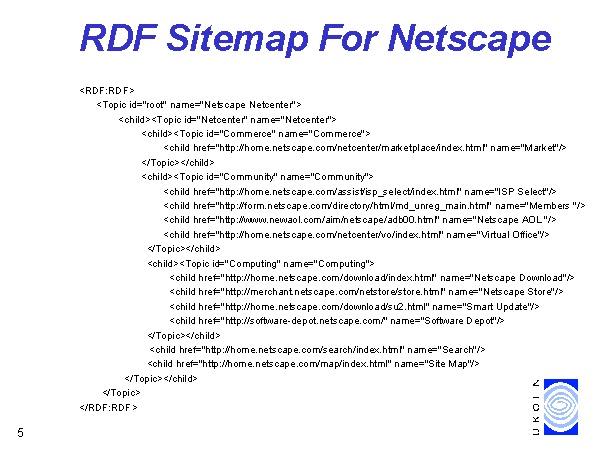
Navigation is sometimes the hardest part on the internet. A tree structure is sometimes the second easiest way of searching/browsing for information (1st being keyword searching). So maybe if more web designers set up server side solutions, it will lower the burden on web designers. More importantly, move navigation away from web designers to users just as Google displaced content from web designers unto Searchers. So instead of overburdening web servers like this Firefox extension Firefox extension with screenshot which automatically generates a sitemap br crawling a site. Sites can access a sitemap using a favicon.ico like or link rel="sitemap.rdf or sitemap.xml" protocol. Just as netscape NAVIGATOR originally proposed a while back. I think web designers should pay attention - at least those that don't use flash for their whole site. The web is slowly become a database of content rather than style. See the webmonkey wired article on netscape sitemap feature Sitemap rdf or the sitemap slide here Slide from seminar
-
RDF vocabulary
If you're looking for a standard "vocabulary" to use in the context of RDF, W3's RDF FAQ has a link to suggestions about how to implement the Dublin Core tags via RDF. For a more specific and extensive vocabulary, you're probably right - there's very little agreement about what sort of standard to use. It's kind of ironic actually; libraries have been using one of two different organizational systems (Dewey or LOC) for roughly a century, either of which seems like it would lend itself handily to indexing the web topically. Yet in the quickest-growing body of knowledge on the planet, nobody wants either of those, and nobody seems to be able to agree on anything new either.
-
How about Universal Decimal Classification?
I'we been wondering why none of the library classification systems have emerged on the net? Back in the good old days when I relied on the library for the information Universal Decimal Classification system was extremely handy. Even if you didn't know the name of the book you could browse thru a certain category that interested you.
The idea is that a book can belong to a single class that is marked by a decimal schema. Top categories are:
0 Generalities. Information. Organization.
1 Philosophy. Psychology.
2 Religion. Theology.
3 Social Sciences. Economics. Law.Government. Education.
4 (vacant)
5 Mathematics and Natural Sciences.
6 Applied Sciences. Technology. Medicine.
7 The Arts. Recreation. Entertainment. Sport.
8 Language. Linguistics. Literature.
9 Geography. Biography. History.The main categories are defined further down:
61 Medical Sciences. Health.
62 Engineering and Technology Generally.
63 Agriculture, Forestry, Stockbreeding,Fisheries.
64 Domestic Science; Household Economics.and further and further:
631 AGRICULTURE
631.1 Farm Management
631.15 PlanningThe classification would be used like KEYWORD meta tag in HTML and search engines would index it. This would enable user to specify word as well as the topic they are looking the information on.
To prevent the misuse of the classification, only one or two classes should be allowed per page. Like
"Marketing of agricultural products" -> 380.13:631
(38 = Trade. Commerce. Communication. Transport.)UDC is language independed and it has already been translated to numerous languages. Also most libraries use some kind of numerical classification so many people are familiar with the concept
To help page authors to classify their pages a special website could be created. It should contain at least
- Information about UDC and why it should be used
- Complete browsable UDC listing in various languages
- Easy to use "wizard" that guides you thru the classification and spits out the correct HTML-tag.
- UDC aware search engine
- Petition list for other search engines to enable UDC classification
How about it? Is it a good idea?
One major problem in the matter is that the UDC classification is copyrighted. I couldn't find more than a skeleton listing from the web! So the first step would be to negotiate the licence for it or to the competing Dewey Decimal Classification. I don't think it would be wise to start building a own scheme without negotiations since both UDC and DDC are in extensive use. But if everything else fails, Gnu Decimal Classification to the rescue!
More information about classification on internet see:The role of classification schemes in Internet resource description and discovery
-
MELDEX
The Melody Index (MELDEX) from is designed to do just that. You sing a few bars and in theory it will come up with the song. I doubt that it will be too successful, as anyone who's ever had a friend who just had to sing that new techno song to you knows. Still, pretty interesting stuff. Pertinent links: http://nt.excite.com/news/r/990419
b /dlib/may97/meldex/05witten.html http://www.cs.waikato.ac.nz/~nzdl/meldex