Slashdot Mirror
Domain: venuslabs.org
Stories and comments across the archive that link to venuslabs.org.
Comments · 13
-
Venus Labs
I started Venus Labs http://venuslabs.org/ to research and promote exactly this idea! Join us and we can live in stratospheric penthouses on Venus, rather than basement tunnels on Mars...
-
Re:But what do you *do*, floating over Venus?
What are the resources in the clouds above Venus?
How do you get the raw materials to maintain the balloons?
Chapter 8.
What's the economy there? What's the draw?
Chapter 8.
How come we're not living in blimps floating above Earth?
People live in the easiest location where it is to live, near where there's economic activity to sustain their presence. See Chapter 8 re: economic activity, and if you think you have an easier location to base operations for accessing Venus's resources than an aerostat habitat, then by all means, elaborate.
The one thing I see is more solar gain for energy, but that's better gotten in space.
If you're skeptical about how hard it is to get physical resources at an aerostat habitat, you should be all the more skeptical about how hard it is to get physical resources at a habitat drifting in a vacuum.
Terraforming?
An unrelated topic to aerostat habitats, but... Chapter 10.
places where we can dig in for protection from radiation
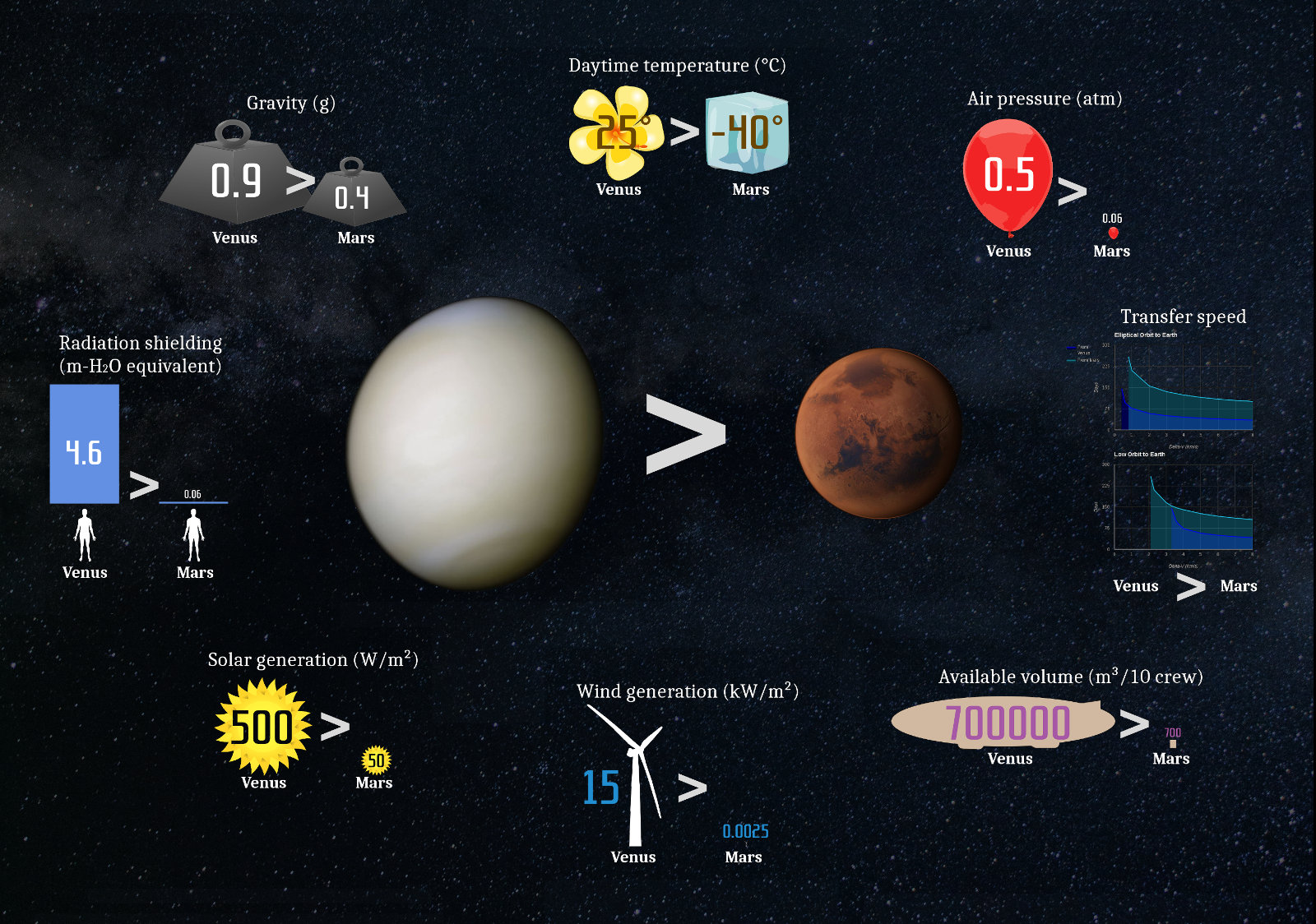
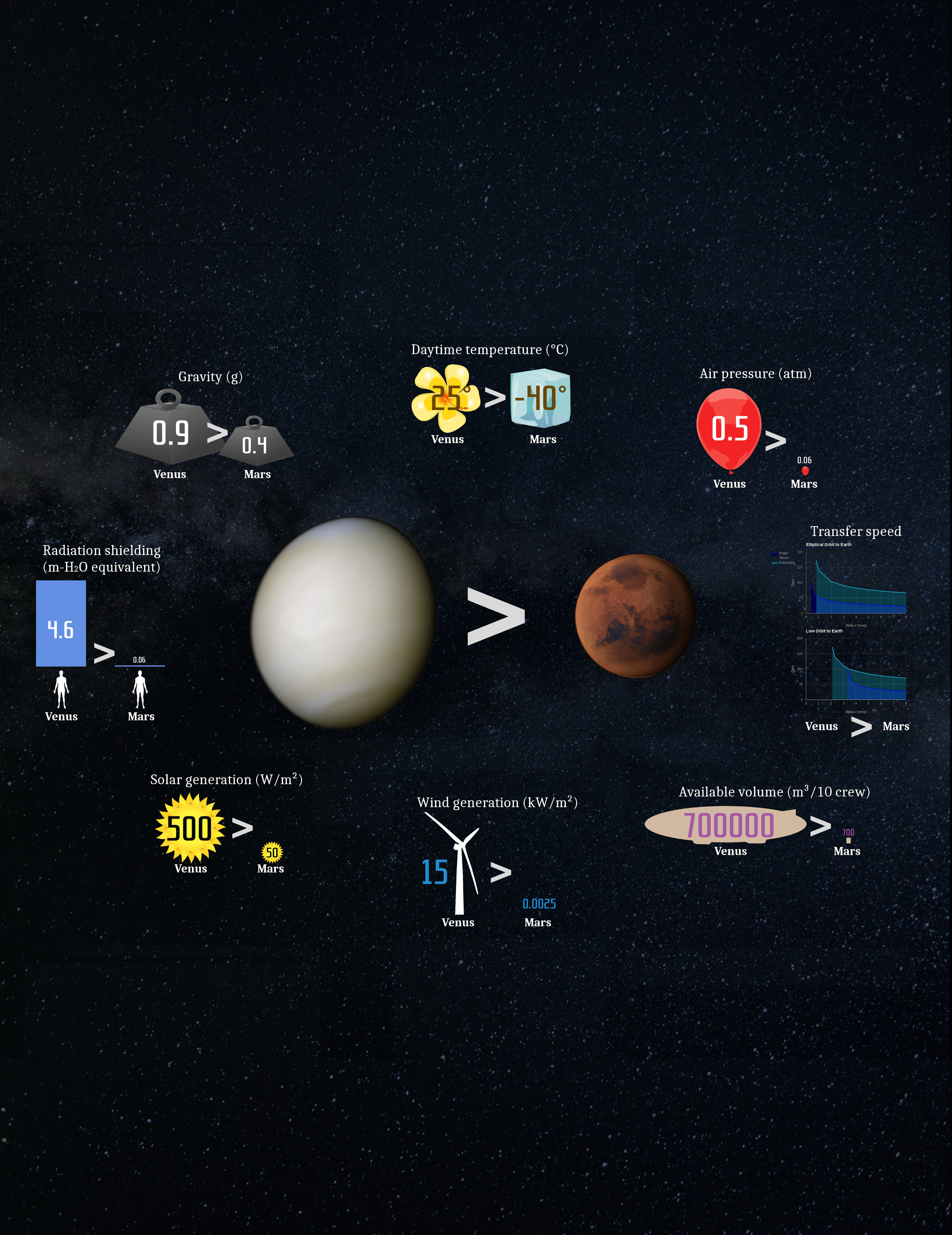
In a Venus habitat, you have the equivalent mass of five meters of water over your head as shielding. No digging required.
seal up a breathable atmosphere
The very air that lofts you on Venus is breathable. And is not difficult to acquire.
and try to sustain an ecosystem.
Abundant light and space (rather than living in a cramped pressure vessel) = much easier for agriculture.
-
Re:Yes, seriously
There's much more detail about surface access and resources in much more detail in Chapter 8 here. Contrary to your assertion, Venus has all of the signs for heavy differentiation, both theoretical and observed: abnormally large melts, abnormally low viscosities, abnormally long cooling times, repeated remelting, structures associated with secondary differentiation on Earth (such as rhyolite domes, which are the most likely explanation for Venus's pancake domes), etc. Venera 8 and 13 measured U, Th and K levels that were so enriched over what's normally found in basalt that Venera 8 was initially thought to have sampled granite instead. Venus also shows signs of potential widespread carbonatite volcanism, which on Earth form some of the most valuable ores for a number of elements. Venus also has its own unique ore-forming processes, to the point that the planet literally vaporizes and plates out metals and/or semiconductors in the form of high-altitude frosts. Venus has no liquid water to assist in forming ores, but its dense, acidic atmosphere provides it with unique ore-forming properties not found anywhere else in the solar system.
In some ways, Venus is a natural refinery, separating out different compounds into layers - there are three separate cloud decks (with a virga underlying the lowest). For example the dominant species in the upper two cloud layers is sulfuric acid, the most likely dominant species in the lower cloud layer (or at least a major species) is phosphoric. Even metals appear to be found in Venus's upper atmosphere - for example, iron has been detected, most likely in the form of iron chloride. There are some metals that we don't even know what's happened to them - for example, our models show that mercury should be common in Venus's atmosphere, yet it hasn't been detected at all; we have no clue what's happened to it.
And as for "how to harvest" materials from the surface, the simplest method is one that we can't do effectively on Earth or Mars: dredging. Venus's atmosphere is dense enough that one could dredge fines using the same fan that the lander uses for propulsion. And as for the ability to land on Venus's surface, come on - that was achieved with 1960s/1970s Soviet technology. Yes, we're talking more complex systems, but nothing remotely beyond our reach.
-
Re:Yes, seriously
Nice to see you back, Geoffrey
I am curious what you think of the early-phase HAVOC approach, of having the crew slung underneath a lift envelope rather than living inside it. I have to admit, I'm not a fan (I also found some of their mass budget numbers in the initial proposal rather questionable). But it's still nice to see some work being done towards any Venus habitation concepts.
I guess on the upside they can be freed from the need for a transparent envelope, and thus use, say vectran or similar. Liquid crystal polymers have such nice properties for an environment like Venus. But there's still great options for (layered) transparent envelopes. When analyzing possibilities it looked like optimal layers would be along the lines of a PCTFE outer layer, an EVOH or PVDC gas barrier layer, a potential fluoropolymer coating for antifouling / anticondensation properties, and CF reinforcement, if sustainability is taken into account (PCTFE minimizes the amount of F required, since it's only found in lower ppb quantities and can be melt-bonded with other layers; it's also extremely resistant to water permeation); EVOH is simpler to produce than the more commonly considered PET and also opens up a production path for adhesives. PVDC also looks attractive, at the cost of requiring more chlorine, which isn't in huge abundance (although certainly more abundant than fluorine). As for reinforcing fibres, CF is harder to produce than UHMWPE, but its low creep, UV resistance, and wettability probably makes this worth it.
For our sample habitat, with an envelope fabric comprised of 20um PCTFE, 70um PVDC, and another 10um PCTFE, that worked out to 183g/m (not counting reinforcement) and had the following daily permeation rates w/continuous atmospheric scrubbing:
H2O: -1.44 kg
O2: -0.29 kg
N2: -0.22 kg
HF: 2.91 ppb
H2S: 19.1 ppb
HCl: 23.3 ppb
H2SO4: 294 ppb
SO2: 92.7 ppm
CO: 98.8 ppm
CO2: 11.9 kgLooks like that would (naively) require interior air scrubbing around 15 times per day to avoid reaching gas levels which would be harmful to agriculture. But probably not that bad in practice, as problematic gases like HF are hygroscopic and would be prone to being absorbed into condensation films and hydroponics channels, and with such tiny permeation rates, it might be worth considering just neutralizing them in the envelope itself. If the minor species can be dealt with, the bulk CO2 only requires about 1% of the envelope be scrubbed daily to maintain comfortable levels (and that's assuming no plant uptake). Oxygen and nitrogen losses are trivial, although the water losses are annoyingly high, even with the use of PCTFE; still, the losses are only about 5% of the water recovery rates we calculated for our scrubber.
This is sort of a long-winded way of saying... a transparent envelope like your '93 paper called for looks perfectly workable, and sustainable.
-
Re: coal?
What is going to keep them afloat?
Normal Earth air. Both nitrogen and oxygen are lifting gases on Venus.
Try building one on earth first.
That would be a prototyping step, yes. Just like Mars habitats are also first tested on Earth. On Earth, however, you'd have to use heliox as the lifting gas.
Venus has a much harsher atmosphere and is literally raining acid.
Actually 1) we don't know whether there's any sulfuric acid rains, snows or frosts in Venus's middle cloud layer, and B) it would actually be preferable if they were there!
There's no shortage of polymers that can withstand sulfuric acid well (particularly, although not exclusively, fluoropolymers). Sulfuric acid, however, is a huge resource on Venus. It's the primary available source of hydrogen, and extremely easy to decompose into useful resources. Simple heating first off drives off free water. Further heating decomposes H2SO4 into SO3 and more H2O. Further heating of SO3 over a vanadium catalyst yields SO2 + O2. Contrarily, the SO3 can be used as a conditioning agent in the scrubber for nucleating more H2SO4 and capturing free H2O.
The main disadvantage of sulfuric acid in Venus's middle cloud layer is that there just isn't that much of it! It's more like a bad smog (or more accurately, vog). Visibility can be several kilometers, it's that sparse. You have to process a lot of air to get the hydrogen you need for ascent vehicle propellant.
How do you expect it work?
-
Re:"We're going back to Mars"?
Most of the mission proposals for Venus have been much cheaper than those for Mars. It's Mars that they're spending many hundreds of millions to the lower billion dollars on these flagships, not Venus. As mentioned, Venus was first explored using 1960s Soviet technology. It does not require some sort of a breakthrough. There are of course new technologies that can yield new options for exploring Venus - high temperature processors for non-cooled probes, high temperature radiators for RTG probes, surface wind and solar (yes, solar actually works on the surface, for low power probes), inflatable bellows for the ability to fly up and down at will (including e.g. only short stays on the surface, then climbing to go to a new location and cool), and a whole range of others. But we can get massive science returns from little budget on Venus even as things stand.
Concerning floating long-term habitats on Venus: Link
Concerning testing technologies: your mention of "volcanoes" refers only to the surface, not most of the challenges in entry, descent, etc, and only applies to surface probes, and even in that case, only to the portions exposed to the heat and pressure. And that's not how they test probes for the surface, they use what's basically a big autoclave. But you cannot just test a Mars probe in the Atacama. That's a vastly different environment from Mars (orders of magnitude different pressure, major differences in gravity, radiation, etc), and does not remotely test the vehicle. You don't have to take my word on the testing differences, read some of the old interviews from the Soviet scientists who worked on their various programmes. Testing for Venus probes was found to be a lot simpler in most regards.
And, don't discount the science that will come from Mars once real people and geologists and chemists can get there with a rock hammer, a microscope, and a sense of adventure.
You may be surprised to learn that it's actually not that unrealistic - with modern technology, nothing far future - to have humans walking around on the surface of Venus. As usual, see the above link. More to the point, they could even fly in the process.
We do have the budget for both Venus and Mars. Mars is used like a dumping ground for money; there is no reason whatsoever why Mars probes have to (in some of the cases) be multi-billion-dollar craft. The budget requests for Venus probes are tiny by comparison.
-
Re:"We're going back to Mars"?
it's a potential destination for humanity
Mars is not a broken-down version of Earth; Venus is. As tough of a "fix-it-upper" Venus, Mars is even worse. You're never going to fix Mars' gravity. Good luck even fixing its nitrogen deficiency; the three main approaches to dealing with Venus's atmosphere (freezing, chemical sequestration, and ejectionrealistic all much more practical than replacing Mars' missing nitrogen, which in turn is far from its hardest problem.
Of course, any discussion of terraforming is an "extreme-long-term" theoretical concern. Hence, the above graphic concerning the short term.
-
Re:"We're going back to Mars"?
And as Mars is the only reasonable planet to colonize and terraform
-
Re:I agree - moon first
As far as long term goals go, I wish that Venus would be put on equal footing with Mars. It really is an excellent, and far too neglected, destination.
Venus is only attractive if you are a climate change denier. Its excellency has definitely taken a hit in the last few billion years.
-
Re:I agree - moon first
I agree that Venus deserves some consideration for exploration as well, but equal to Mars?
Superior, really, in most regards.
Sure you can float some atmospheric habitats and use some resources but that's about it.
You've literally described a colony. And life on Earth (minus the "floating" part). Self-sustaining societies using local resources is the goal.
On Mars you can actually explore (dig, bore, etc), build,
Digging and boring is work, something you want to avoid having to do as much as possible. On Venus you can dredge the surface and get resources straight from the air. Mind you, you can also dig and bore - NASA has worked on drilling on Venus, and of course, explosives work everywhere - but that's activity that you don't want to have to do if you don't need to. And again, building / sustaining is the whole point of "using resources".
and there is a whole lot less risk (you have ground
Ground is a risk. If you don't believe so, look at the number of probes that have failed on landing for a wide range of reasons. On Venus, your "landing" ellipse is massive.
the atmosphere isn't acid, etc
1) Acid mists are, as have been mentioned many times, rather sparse on Venus - not even that much more concentrated than OSHA workplace standards. It would actually be easier if they were more concentrated.
2) Mars's atmosphere is hardly extant. A Venus habitat has only a bare minimum overpressure (~500 Pa). A Mars habitat has a 50-100 kPa overpressure. The latter is much more at risk in the event of failures.
3) The dust in Mars' environment is extremely hazardous - not just due to standard PM / silicosis risks, but also because of hexavalent chromium, arsenic, and enough perchlorates to burn your skin.
lso one of the major reasons for going to Mars is the search for past life (or perhaps even limited current life), there is virtually no chance that anything lives on Venus.
The possibility of life on Mars makes missions to (and especially from) Mars much more expensive. There's still the possibility of finding fossils on Venus, in some of the highland terrae - Venus once used to have Earthlike oceans, and before Earth did at that. But because it's judged to be unlikely to host life today, you don't have to perform such onerous sterilization efforts, both inbound and outbound.
And think about what you're saying. Do you think there's life on Mars today? So are you totally okay mass imports of bacteria hitching rides from Earth, and conversely back from Mars? Because that's an inevitable accompaniment to colonization. If you really think there's life on Mars, you should want to declare it a human-free zone.
-
Re:I agree - moon first
Mostly because it's way, way harder to do than Mars. Personally, I'd guess it's pretty much impossible with current technology to do a manned mission to Venus.
The above link argues otherwise, in excruciating detail.
And I'm not even talking about the atmosphere yet. The dV budget required to get to a stable low orbit around Venus is already higher than for Mars
Not with aerocapture; it's actually slightly less. Venus also allows for much faster transfers, especially on return.
and as soon as you wish to land you are really in trouble
The requirement for an additional ascent stage is really Venus's one significant downside, but offset by numerous upsides relative to other destinations. And the very reason for that difficulty is itself a good thing: it's because Venus is so earthlike, and has the sort of gravity our bodies are adapted to.
Note also that I wouldn't use the word "land". Again, another one of the advantages of Venus is that you don't actually have to "land". There are no obstacles to avoid and your timing is much less critical; your deployment ellipse can be massive.
From the surface of Venus
Nobody is talking about the surface of Venus. And even if we were, you wouldn't be using rockets plowing through the dense lower atmosphere; Venus sample return mission designs use balloons to get out of the dense lower layers.
-
Re:I agree - moon first
As far as long term goals go, I wish that Venus would be put on equal footing with Mars. It really is an excellent, and far too neglected, destination.
-
Onward to Venus [Re:Moon- not perfect, but has...]
Hey, we're thinking along parallel lines!!
I'm part of a group called Venus Labs that's actually developing the concept further, doing more detailed studies on each component of the concept that Landis presented.
Wow, nice graphic! I'll be fascinated to see what you come up with!