Slashdot Mirror
Domain: wikihow.com
Stories and comments across the archive that link to wikihow.com.
Stories · 2
-
Your High School Wants You To Install Snapchat
Bennett Haselton writes: They would never admit it, but your high school admins would probably breathe a sigh of relief if all of their sexting-mad students would go ahead and install Snapchat so that evidence of (sometimes) illegal sexting would disappear into the ether. They can't recommend that you do this, because it would sound like an implicit endorsement, just like they can't recommend designated drivers for teen drinking parties -- but it's a good bet they would be grateful. Read on for the rest.Five teenagers at Warren Township High School in Gurnee, Illinois were arrested in November in conjunction with a girl's topless photo being distributed throughout the school. Last Thursday, in Rochester Hills, Michigan, a prosecutor announced that contemplating filing child pornography charges against "dozens" of students for distributing explicit pictures to other students at Rochester Adams High School. In Portland, Oregon, police are investigating a group of Grant High School students for making videos of each other having sex at the school and off campus. (And, of course, these are just the incidents that police found out about.) Naturally, schools everywhere have been falling over themselves to institute strict anti-cyber-bullying and anti-sexting policies (not to mention that sending and forwarding sexually explicit pictures of children under 18 is a federal crime as well).
Schools have rules for reasons that are a mixture of cynical protection against lawsuits and sincere concern for the students. When education system teach students not to smoke cigarettes, they're presumably doing that out of genuine concern for students' welfare, since it would be hard to sue the school for not teaching about the dangers of smoking. When a school installs a railing by the side of a walkway to keep students safe from passing cars, they're probably motivated by a mixture of concern over being sued, and legitimate concern for students' safety. When the school installs software on their computers to block Facebook and Reddit (even outside of class time, when computers are sitting idle and students have nothing else to do), they're probably motivated entirely by liability concerns - because they know virtually all of those students can get on those websites at home, so they're not affecting the students' long-term welfare by keeping them off of those websites, but they just don't want to be liable for anything if the students access those sites at school.
In the case of anti-sexting policies, I'm not cynical enough to think that schools are motivated entirely by liability concerns. There are actual risks to sexting pictures of yourself, even if you're never charged with violating child pornography laws: the embarrassment of your picture being forwarded around the school, or ending up in the archive of a porn site. On the other hand, worse things happen to dozens of high school students every month, but only a handful of schools get dragged into the national spotlight as a result of a child porn investigation. So let's call it about 25% due to legitimate concern for students and 75% due to liability reasons and concern for adverse publicity.
But sexting students could vastly reduce schools' concerns about both issues, by sending pictures using an app like Snapchat, which automatically deletes photos after the recipient has viewed them -- in order to greatly reduce the chance of a picture being saved or forwarded after it's sent. Please note, I'm not saying the photos can't be saved anyway, or recovered by computer forensics. And take heed: I'm not saying you should do it either way! But if you greatly reduce the chances of an image being saved, you greatly reduce the chances of it leading to a scandal that engulfs the school, or leads to a federal child pornography charge.
Of course there are cases where teens were arrested for sending child pornography through Snapchat as well. But these high-profile stories don't address the relevant question, which is: Are you less likely to get arrested (or expelled, or humiliated) for sending these pictures if you do it through Snapchat, even if the likelihood doesn't drop to zero? Obviously, yes.
Now even someone with no phone-hacking knowledge can figure out that if they receive an image over Snapchat, they can "save" it by taking a photo of their screen with another phone or camera, and the sender won't know. (You can also take a normal screen shot with the phone, but that will notify the sender that you took a screen shot, unless you download a third-party app or try some other hack which may or may not even work by the time you read this.) However, this assumes that the trust relationship between the sender and the recipient is already broken at the time the message is being sent, if the recipient is saving the message without the knowledge or consent of the sender. Some of these sexts are presumably being sent in the context of a relationship in which some (sweet, naive, misguided) trust still exists, so that if the sender sends the message and the recipient doesn't use some sneaky workaround, the picture will get deleted on schedule. If trust only falls apart later, then the recipient won't have a copy of the image any more if it was sent by Snapchat, but they will if it was sent via text.
Actually, it may be possible for the recipient to recover a snapchat image after their smartphone Snapchat app has supposedly "deleted" it -- a company called Digital Forensics offers Snapchat image recovery as a service, but they charge $300-$500 per incident, and even they haven't figured out how to do it on an iPhone yet.
So, in terms of boolean logic, if you send an explicit photo via Snapchat, it might end up being saved permanently and forwarded if:
(
the recipient is already being dishonest with you (saving pics without your permission) at the time that you send the picture
AND
the recipient is smart enough to figure out how to save Snapchat pictures without notifying you -- not that hard, but eliminates some people
)
OR
(
you later go through a nasty breakup with the recipient and they're determined to humiliate you or get you in trouble with the law
AND
they don't mind the fact that they could also get in trouble with the law, for saving or forwarding the picture
AND
they're willing to spend $300 to recover the image
AND
they don't have an iPhone
)Whereas if you send a photo via regular text, all it takes to get in trouble is either (a) the recipient going through a nasty breakup with you, that puts them in a vindictive frame of mind, while they still have a copy on their phone, or (b) the recipient's family member snooping through their messages.
Your high school would never tell you so out loud, but between Snapchat and texting, you can guess which they would prefer you to use.
Of course, this advice wouldn't have done much good for the Portland students who made and distributed their own sex videos, since creating the illegal permanent recording was their entire goal. Snapchat can help protect people from mild levels of stupid, but it's a barrier you can overcome if you aim high and truly believe in yourself.
Got something to say about privacy, technology, or other topics of interest? Long-form submissions are welcome.
-
2014 Geek Gift Guide
With the holidays coming up, Bennett Haselton has updated his geek-oriented gift guide for 2014. He says: Some of my favorite gifts to give are still the ones that were listed in several different previously written posts, while a few new cool gift ideas emerged in 2014. Here are all my current best recommendations, listed in one place. Read on for the list, or to share any suggestions of your own.Most annual gift guides would only list new items. It would be considered a mortal sin of click-baiting to tell the reader, "Well, the coolest stuff we could tell you about, was stuff that we mentioned this time last year, so first and foremost we're just going to direct you to that."
Well, my job in writing a gift guide is not to dazzle people with "all new hottest gift item" recommendations, my job is to recommend the things that I think you would most enjoy giving and the recipient would most enjoy receiving, and the fact of the matter is that most of the gifts I would most highly recommend, were listed in different previously written articles. I'll provide that list in a second (with links back to the older articles describing them in more detail), but first some criteria for how I make the recommendations.
First, I'm assuming you want to go inexpensive. If you have unlimited cash, you don't need my help finding cool presents -- although for the record, the online store of New York's Museum of Modern Art has the best collection of things that incorporate "visual puns" that I really like, but which are usually overpriced for what the item does. (Check out this image of a set of nesting tables, for example -- which isn't even that much of a "neat idea", by their standards -- and try to guess how much they cost, before looking at the answer on the product page.) If you don't mind spending the money, they also sell a dandelion encased in acrylic ($375), a lamp in the shape of an open book ($190), a necklace of small rectangular mirrors creating an interesting 3D effect ($190), a porcelain vase that kind of looks like a crinkled paper bag ($120), a pair of candleholders that interlock without touching ($170), a serving tray that looks like the splash from a drop of water ($130), a clock that evokes an M.C. Escher "infinite staircase" optical illusion ($80), and a vase that exists in the shape of an outline ($65, which at this point sounds cheap). At the end of this gift guide I list some MoMA items that are somewhat more reasonably priced.
Second, I'm assuming you don't need help finding branded merchandise. I'm sure literally every combination of [Star Wars / LOTR / Game of Thrones / Star Trek / Hunger Games] and [coffee mug / beach towel / earrings / Christmas tree ornaments / shot glass / cufflinks] is available somewhere. It's not that these are bad gifts for the hardcore fan, it's that all you need to find them is to Google "Game of Thrones Christmas tree ornaments" and you'll find something. And occasionally you'll will find something in this "branded" category that jumps out as a pretty cool idea, like the TARDIS Tea Infuser or the Game of Thrones Dragonclaw Goblet or the light-up lightsaber chopsticks.
Third, I look mostly for novelty or decorative items that confound your senses or demonstrate some interesting scientific principle (or both), but that can still fit in to a semi-elegant environment without garishly calling attention to themselves. These color changing beads are kind of neat, but it would look weird having them lying around on top of a living room dresser along with a UV flashlight to demonstrate what they do. On the other hand, a Galileo thermometer can blend in pretty well the decorations on a mantlepiece.
The following are my current most-recommended gift ideas:
Custom Photomosaic
In this December 2013 post I described how to create a photomosaic (a patchwork of smaller pictures that, when viewed from a distance, take on the appearance of a larger picture) using two free (donation-supported) programs, one to download and save pictures en masse from a friend's Facebook profile, and the other to create the photomosaic using those photos. I still think they make amazing gifts, and the only cost is the cost of printing and framing it. You can even give the digital-only version as a gift that costs nothing at all, making a photomosaic from a friend's photos and sending it to them on the other side of the world, where they can print it themselves or use it as a desktop background. Everyone that I've given one of these to, has loved it.
Strandbeest kit
With this $35 kit, which I recommended as a Christmas gift last year, you can assemble a tabletop version of the legendary full-size Strandbeests, the eerily lifelike creatures created by Dutch artist Theo Jansen which walk across the beaches of Holland powered only by the wind. Assembly of the creature takes about 90 minutes, less if you make a family activity out of it and share the labor.
In the last year, a second model has been released, dubbed the "Rhinoceros Mini-Beest (technically, it was available a year ago, but the assembly instructions were only printed in Japanese; now it's available with English directions). I haven't assembled one of these myself yet, but it looks fine in the video.
There is also now a pre-assembled, motorized, remote-control version of the Strandbeest, although honestly, where's the fun in that? Part of the effect of the Strandbeest assembly kit is the feeling that you've breathed life into an inanimate object by putting it together from static parts. A remote-control toy that moves forwards and backwards on the ground is a little underwhelming when you can get an RC helicopter for the same price.
Levitron Revolution and Levitron Cherrywood
The Levitron Revolution ($70) consists of a circular magnetic disc that levitates about half an inch above an electrically powered square base, and can support up to a pound of weight on top of it while maintaining levitation. The Levitron Cherrywood ($35) consists of a top that has to be spun by hand, which levitates almost a full two inches above the cherrywood base containing an embedded magnet. As described in the first gift guide, the Levitron Cherrywood is more visually impressive because of the extra height of levitation, but the top almost always falls if you touch the top or move the base while the top is spinning. The Levitron Revolution only levitates the disc by half an inch, but you can embellish the appearance by placing other objects on top of it, like the pyrite crystal levitating in this video. (Also, the Levitron Revolution will continue levitating as long as power is supplied to it, making it a good decorative item; the Levitron Cherrywood has to be spun by hand and levitates for only about two minutes before air friction slows it down, so it works better as a toy or party activity.) Both of them take some practice to operate (the Levitron Cherrywood takes considerably more), but they're worth it.
Spare batteries for your friend's phone
I mentioned this in January 2013 as a life hack for smartphones and got pilloried for promoting what people called an "obvious" idea. But two years later, almost nobody that I know is carrying around fully charged extra batteries for their phones. It's easy, it works, and the spare batteries in my jacket pockets have gotten me out of a jam multiple times. If you know what type of phone your gift recipient uses, get them some extra batteries. (T-Mobile sent me extra batteries for my LG Optimus for free.)
The iPhone is the only phone I'm aware of that does not support this, because the battery is not meant to be removed or replaced by the user.
And yes, I know about the portable external battery products that can be used to charge a phone. These aren't as big or expensive as they used to be, but you still have to leave them plugged in to your phone while they're charging it, which is awkward if you're using your phone or carrying it in your pocket (compared to the 10 seconds it takes to swap out the battery).
Heat Wave car heater
This $40 device from Canadian company "Heat & Clean" sits on your dashboard and turns itself on at a pre-determined time, blowing hot air into the interior of the car for 20 minutes, all without starting the car. If all goes well, this means your car will be warm (or at least not as cold as it would have been) when you first get into it in the morning, and you don't have to wait several minutes for the air ventilation system to heat up. The Heat Wave is powered by the car's 12V charger, although Heat & Clean states that "has built-in circuitry to ensure that the health of the vehicle's battery is never compromised."
I can't vouch for the device's respect for your battery (the device unfortunately isn't sold on Amazon, which is usually where I go to find out if something does what it's supposed to), but I ordered one and verified that it works, then gave it to my aunt for her birthday. (If it kills her car, I will promptly make it up to her by taking it out of the gift guide.) Even though I tested the functionality, I didn't get the chance to see if the device actually helps much, because it's not cold enough yet here in Seattle to really feel the bite of the cold when you get into your car in the morning. (The other reason I personally won't get much benefit from this, is that I work from home and leave the house at a different time every day, so I never know in advance what time I'll be getting into my car the next morning.)
Most cars can be modified so they can be started remotely, so that they're warmed up by the time you go outside and get into them, but that modification usually costs a few hundred dollars. You might as well try the Heat Wave first to see if it does the job almost as well.
(To me, the obvious question is: Why not make a version of the Heat Wave that can be turned remotely, as well? For people like me who usually don't know the night before what time they'll be getting into their car the next day, but who often do know at least 20 minutes in advance, so they can turn it on remotely and start heating the car. The company does make a very different-looking product called the Heat Stick which can be activated remotely -- but at $300, that's more than it costs to add remote start to the actual car.)
It's Nuts 3D puzzle
Distributed by Grand Illusions in the UK, the It's Nuts 3D puzzle consists of a bolt and a pair of nuts threaded onto the bolt. As you can see in the video, when you rotate one nut, it moves in the direction that you'd expect, following the threading on the bolt -- but when you rotate the other nut the same way, it moves in the opposite direction. There are no hidden moving parts to make the illusion work, and you can unscrew both nuts right off of the bolt and examine them.
Having acquired one, I can say that the secret is a little bit easier to figure out when you're holding it in your hand and looking at it closely, than when you're watching the video. But it still makes a nice novelty conversation piece.
As a brain-tickler, this feels a bit overpriced at $40 - costing more than the aforementioned Levitron Cherrywood, which actually levitates. I bought It's Nuts mainly to fill out my collection off oddities since I already owned most of the other items in this list. Of course, unlike the Levitron, this takes no skill to operate (only a little bit of smarts to figure out the secret). I wouldn't foist the Levitron on my grandfather, but he would probably enjoy this one.
(Note that if you buy from the Grand Illusions website to ship to the United States, you'll pay the non-VAT rate -- but then you'll have to add about $14 in air mail shipping to the U.S. So you might want to combine this order with some other items from Grand Illusions -- search this article for "Grand Illusions" for the other recommended items, or browse their site and pick your own.)
Inverter Magnet
The Inverter Magnet, from Grand Illusions (also available from Amazon at a slightly higher price), consists of one disc magnet encased in rubber, which holds a second disc magnet in a permanent "force field" a few millimeters away when the two are slid across a table.
At $40, this might be more of a "collection filler-outer", since especially as a magnetic toy it compares unfavorably with the Levitron Cherrywood, which, to repeat, can actually fly. But again, the Inverter Magnet also takes no skill to operate.
Magna Nails
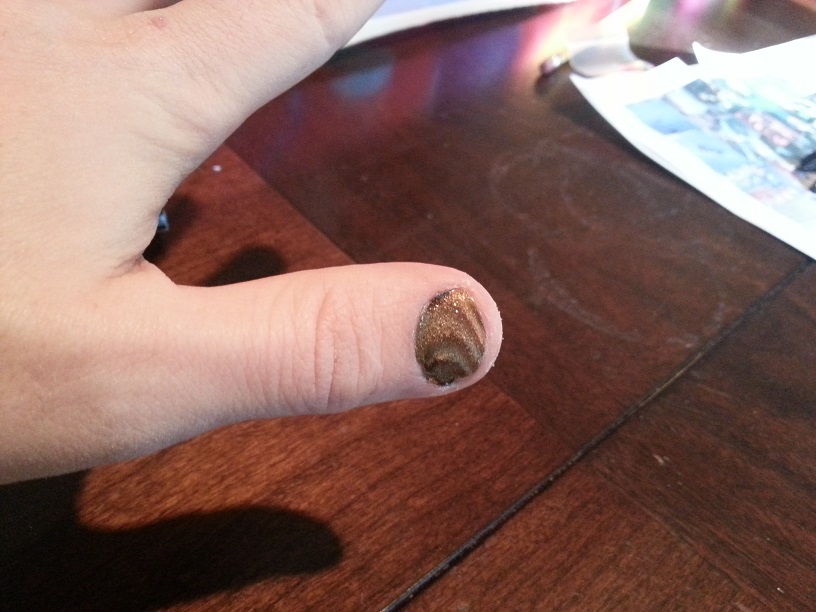
This nail polish (about $7 used on Amazon) forms a stripe pattern when you hold a magnet near your fingernail while the polish is trying. (There are many similar products on the market, searchable under "magnetic nail polish.") The appeal to young science geeks is that the iron filings in the nail polish align themselves along magnetic field lines in the vicinity of the magnet, forming the stripes.
I don't wear glittery nail polish (at least not as "Bennett Haselton"...), but I took one for the team to see if this works. It does. That's my thumb. (Apparently it looks better if you apply a "top coat" after the nail polish dries, but I didn't have any.) If you plan on testing it out before giving it as a gift, remember to pick up some nail polish remover to get it off.
A few things from MoMA that we can actually afford
- An appetizer serving dish complete with toothpick holder that looks like a porcupine ($28). This item probably has the highest price-to-cool-factor ratio of anything on this list, just barely within the limit of what I'd recommend, but it's elegant in addition to being funny, and the recipient would probably use it.
- A faux-wood cube clock ($38). This is interesting mostly for looking like a visual impossibility -- how can the digital numbers appear on the side of a block of wood, even fake wood? Unfortunately I think the photo is doctored, because this youtube video shows an undoctored shot of the cube clock, and you can easily see the un-illuminated LEDs on the side, which don't quite blend in with the wood. But it still makes for an elegant optical illusion.
Miscellaneous "Visual Puns"
- The ambiguous vase ($33) from Grand Illusions -- a real-life version of the Rubin vase optical illusion, where a vase suddenly takes on the appearance of two faces in profile.
- The glass water faucet ($50)
- The sliced grandfather clock ($36)
- Ulexite "television stones" ($10) - a rock that, when placed on a flat surface, will cause the markings on that surface to re-appear on the top face of the rock, due to the naturally occurring fiber optics in ulexite.
Of course, if you're now craving one of these items for yourself, order one and try it out before re-gifting, or set up an Amazon wish list in the last two weeks before Christmas. And remember to be good!