Slashdot Mirror
Domain: wolfcrow.com
Stories and comments across the archive that link to wolfcrow.com.
Comments · 8
-
Re:Is there a limit?
> But the human eye has its limits too. What's the actual N, beyond which we, the humans -- even those with the sharpest eyes -- can no longer distinguish between N and 2N pixels per inch?
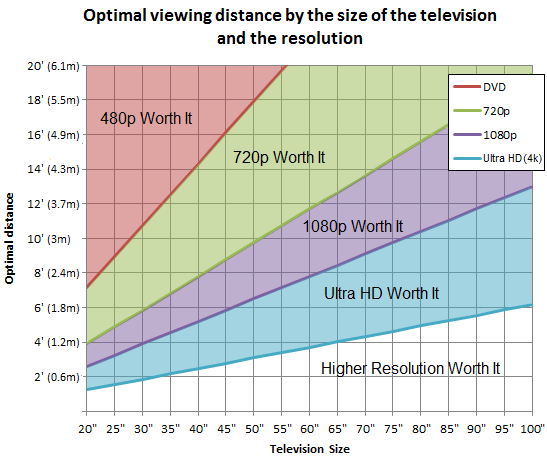
The TL:DR; version is: Use a 4K distance calculator
* Distance Graph (PNG)
The Long version: It's complicated
From a well known and respected Photography:
http://clarkvision.com/imagede...
How many megapixels equivalent does the eye have?
The eye is not a single frame snapshot camera. It is more like a video stream. The eye moves rapidly in small angular amounts and continually updates the image in one's brain to "paint" the detail. We also have two eyes, and our brains combine the signals to increase the resolution further. We also typically move our eyes around the scene to gather more information. Because of these factors, the eye plus brain assembles a higher resolution image than possible with the number of photoreceptors in the retina. So the megapixel equivalent numbers below refer to the spatial detail in an image that would be required to show what the human eye could see when you view a scene.
But if we do the math
Based on the above data for the resolution of the human eye, let's try a "small" example first. Consider a view in front of you that is 90 degrees by 90 degrees, like looking through an open window at a scene. The number of pixels would be
90 degrees * 60 arc-minutes/degree * 1/0.3 * 90 * 60 * 1/0.3 = 324,000,000 pixels (324 megapixels).
At any one moment, you actually do not perceive that many pixels, but your eye moves around the scene to see all the detail you want. But the human eye really sees a larger field of view, close to 180 degrees. Let's be conservative and use 120 degrees for the field of view. Then we would see
120 * 120 * 60 * 60 / (0.3 * 0.3) = 576 megapixels.
Another calculation estimates around ~2200 dpi.
http://wolfcrow.com/blog/notes...
Maximum Resolution of the Eye
So this is how it is. If a healthy adult brings any display screen or printed paper or whatever 4 inches (100 mm) from his or her face, the maximum resolution he/she can see at is 2190 ppi/dpi. It doesn't get any better than this for 99.99% of us, except maybe during pre-kindergarten years.
But the legally accepted norm of 20/20 vision only asks for 876 ppi/dpi at 4 inches!
But since we don't view things from 4 inches away
Cinema
The width of a cinema screen can vary from 30 to 70 feet (360' to 840', 9144 mm to 21,336 mm). The closest viewing distance recommended is about 40 feet (3x height) -- 12,192 mm. If one is projecting 2K on these screens, the ppi is about 2.4 ppi to 5.7 ppi. If one is projecting 4K, it is about 5 ppi to 11.4 ppi.Is this what the eye needs?
p@0.4 works out to be 1.4 mm or 18 ppi.
p@1 works out to be 3.5 mm or 7 ppi.As you can see, 4K comes very close to what the human eye can fully resolve in a cinema screen at average viewing distances. Obviously, many people sit in the front row, and they'd definitely appreciate higher resolution. Which is why we are moving towards:
8K and UHDTV
A 30 to 70 feet screen at 8K (8192 horizontal) gives me from 9.75 ppi to 22.8 ppi. This resolution beats what the eye can resolve at these distances. The future belongs to 8K.
But, to get 18 ppi (the best possible resolution) for a 70 feet screen, we'll need a horizontal resolution of 15120 or 16K. This is about 128 Megapixels. Is anybody working on this?
-
Re:I'm sure there's a reason...
wolfcrow made a mistake in that blog, of which was pointed out a few times in the comments. A 50" TV seated 6' away @2k only has a dpi of ~38dpi, well shy of the 100dpi required. A 65" TV seated 6' away @4k still only has 67dpi. A 65" TV seated 6' way @8k has 135dpi, which based on his calculations done correctly, would be indistinguishable. Of course that still makes a number of assumptions, like you have average eye sight, and you are sitting 6' away from your TV, eye sight towards the center of the eye isn't more precise (which it is), and your eye can only resolve 0.4arc min, which on his complimentary blog article, two independent sources say 0.2 arc min. Article found here: http://wolfcrow.com/blog/notes...
-
Re:I'm sure there's a reason...
Be careful with your comparisons, today's TV's have more differences than just number of pixels... hence the whole "HDR" bandwagon these days, which is all about setting a standard for color space for TV's that is comparable between manufacturers. The real "Wow" factor is not resolution, it's color reproduction and speed.
The resolution of the human eye is measured in arc seconds, not pixels. Someone with 20/20 vision cannot differentiate 1080p from a higher resolution 50" T.V. when seated 6 feet away. That's the same as roughly 15" for a 24 inch 1080p monitor. So, unless you're sitting really close, or you just have a simply massive screen, those extra pixels are pretty useless. -
Re:When do we move from diminishing returns...
Well...resolution is nice but if your pixels are massive you need a larger screen and a farther away viewing distance.
The human eye has a theoretical "limit" of 2194ppi at 4" distance. The further you are from the screen the more pixels you can notice. And densities under 550ppi the vast majority of people can notice pixels. A higher resolution might not translate to smoother pictures at a certain distance because of pixel sizes.
So you have to workout the size of the screen and resolution (assuming you are at a distance in which you can see the entire screen) to figure out of there is additional benefit for most people. Some interesting reading -> http://wolfcrow.com/blog/notes...
That's the short story if this is "overkill" and really it is not. We may be reaching the human eye's minimum discernible ppi but we would still benefit from a better standard. For a 90" display we should still be able to tell the difference between 8k and 12k resolution.
We still need to catch up in terms of refresh rate. The human vision system can be tricked into deciphering motion at close to 24 FPS but we can still see jitter, lag and notice that this is not as smooth as vision. 60 FPS is still not quite there and 90FPS is amazing but not if the screen does not refresh as fast and SMOOTHLY (no tearing etc)
8K is not overkill. It's not reaching the limits of human vision. Consider density, colour spectrum, reproduction, accuracy, contrast and uniformity and so on. We're still a distance from going beyond the limits of the eye and vision system. I think there's still 10-15 years until we get there. -
Re:Does Sony also provide...
The maximum physically possible resolution for the human eye to see is 2190 dpi. But that's not an average eye, but rather a flawless eye limited only by the size of the pupil; and viewed from as close as an adult can focus, 4 inches.
If we downgrade from a perfect eye to an average eye, the resolution drops down to 876 dpi... but still at 4 inches.
At a more practical 12 inches, this drops to around 300 dpi. Which is why magazines are printed at 300 dpi - it's good enough for most practical circumstances.
Also note some additional limitations:
* These sort of resolution figures are based on the ability to distingish bright white lines from bright black lines without them blurring together into gray. The smaller the contrast and the dimmer the light, the less the eye can resolve.
* The human eye also loses a great deal of ability to make out resolution when objects are moving.
* Obviously the further away one is from the center of the field of view, the lower the resolution - with a rather fast dropoff.Yes, 808 dpi is complete and total overkill, unless you've got superb eyes and are in the habit of holding your phone as close to them as you can focus while looking at high contrast stationary images.
-
Re:And Apple are still listed why?
Says who? When people tell you that 300 PPI is the most that the human eye can resolve at 12 inches do you just accept it or do you question whether it is based on scientific fact? Some quick research indicates that this oft quoted "fact" is actually incorrect. It's closer to 1000 PPI.
http://www.cultofmac.com/173702/why-retina-isnt-enough-feature/
http://wolfcrow.com/blog/notes-by-dr-optoglass-the-resolution-of-the-human-eye/Anyhow, ppi relates more to visual acuity which is a function of distance and density - and unless you're holding your phone to your nose, there aren't very many people complaining that a "retina" display has very noticeable pixels. Hell, the most common "retina" display one has is the humble HDTV - most people sit way too far back that 20/20 vision cannot resolve individual pixels, making even the low-dpi 1080p screen "retina" by definition. (Of course there are eagle eyes out there with 20/40+ vision who can benefit from being able to buy a cheaper smaller HDTV and still enjoy the high-resolution image).
Yes, the resolution of our eyes depends on distance. Most people hold their phones about 12 inches away from their faces, which is why Apple uses this measure. The rest of the comment is interesting, but has no bearing on how we look at phones nor does it invalidate any of the conclusions reached by the linked articles that around 1000 PPI is the physical limit of our eyes at, or around, 12 inches.
-
Re:And Apple are still listed why?
Says who? When people tell you that 300 PPI is the most that the human eye can resolve at 12 inches do you just accept it or do you question whether it is based on scientific fact? Some quick research indicates that this oft quoted "fact" is actually incorrect. It's closer to 1000 PPI.
http://www.cultofmac.com/173702/why-retina-isnt-enough-feature/
http://wolfcrow.com/blog/notes-by-dr-optoglass-the-resolution-of-the-human-eye/Only by interpolation.
The resolution of the eye is NOT constant. In fact, the highest resolution part of the eye is the central vision - quite a narrow part of the entire field of vision. Peripheral vision is horrendous, and really only optimized for one use case - motion detection.
It's possible to conduct a simple experiment to show this - simply have a friend show a photo of two people only about 3' apart while you stare at a dot 2' feet away (so the photos are about 1 1/2' away from the dot). Whilst staring at the dot, have your friend mix the order up and have you identify the people without moving your gaze away.
Most people can't tell much beyond color. A more "fun" version involves cheerleaders and people on a field, and half of the "cheerleaders" were dudes in a cheerleading outfit. The test subjects routinely weren't better than random guesses on picking the real cheerleader.
The reason the eye has such "high resolution" is because the eyes are always in motion - they're constantly scanning around and interpolating the image data.
The eye itself is a relatively poor image capture device - but when coupled with a VERY powerful imaging processor and VERY powerful image processing software, it can achieve super-high resolutions and very advanced processing including motion detection, recognition, and other things. Unfortunately, it also means it's easily fooled - see optical illusions and blind spot detection as ways to fool it.
Anyhow, ppi relates more to visual acuity which is a function of distance and density - and unless you're holding your phone to your nose, there aren't very many people complaining that a "retina" display has very noticeable pixels. Hell, the most common "retina" display one has is the humble HDTV - most people sit way too far back that 20/20 vision cannot resolve individual pixels, making even the low-dpi 1080p screen "retina" by definition. (Of course there are eagle eyes out there with 20/40+ vision who can benefit from being able to buy a cheaper smaller HDTV and still enjoy the high-resolution image).
-
Re:And Apple are still listed why?
Above 300 PPI, you are just wasting battery life and hurting performance to display pixels the human eye can't even resolve. I wish more android manufactures had the guts to follow Apple's engineering wisdom here.
Says who? When people tell you that 300 PPI is the most that the human eye can resolve at 12 inches do you just accept it or do you question whether it is based on scientific fact? Some quick research indicates that this oft quoted "fact" is actually incorrect. It's closer to 1000 PPI.
http://www.cultofmac.com/173702/why-retina-isnt-enough-feature/
http://wolfcrow.com/blog/notes-by-dr-optoglass-the-resolution-of-the-human-eye/