Slashdot Mirror
Domain: yaleclimatemediaforum.org
Stories and comments across the archive that link to yaleclimatemediaforum.org.
Comments · 8
-
Re:Do electric cars actually produce CO2?
Well, the consensus seems to be that at current fossil fuel consumption projections we'll cross the tipping point sometime this century, worst-case we may already have done so.
Given that some reputable scientists consider it possible we have already crossed the tipping point, as heating would still continue if we drastically reduced emissions starting today, and emissions are actually still *rapidly* increasing, I don't think there is much room left for hope of things happening without a bang. Even if we get some amazing new technology in the near future, with all the recently built coal-fired plants and those to come online within the next decade, no government is going to throw those investments away without recouping at least a good amount back. Most of that is also in places that are very important economically (like China and India) and relatively unstable, particularly if economic growth is threatened there. I seem to remember reading the gas infrastructure that would need to be replaced for a switch to electric amounted to well over a trillion dollars.
On the tipping points, my understanding was that there were several rough equilibria points but that might well be something dodgy I read a while ago or simply a false memory
I do think that it is absolutely key to acknowledge that top scientists have been proposing reasonable solutions with existing tech for a while now and other top scientists have been screaming for ages about the phenomenal costs that will be incurred if we don't reduce emissions significantly now, let alone continue to increase them rapidly. Any change is painful but some of the economic work currently being done points to it being a dull throb if we act now as opposed to the carnage we are now almost certain to see. We really needed strong, joint leadership from both the US and Europe on this one, and the US has dropped the ball - big time. Conspiracy theorists and creationists ("God will save us") are simply far too powerful over there and there are far too many politicians that get re-elected with donations from lobbyists.
It won't get funky for a while though (and I very much enjoyed the record temperatures here in France at the beginning of the month, I even got a bit of a tan!), and I'm now placing my hope on bio/nano/AI-tech. It will be a bit of a case of Russian roulette but if worst case projections are borne out, then geo-engineering gone wrong might still be better.
-
Re:Basic Statistics Deception
So, you bring up two different questions; I will try to respond to both, one at a time.
First, there is Hans von Storch's interview with Der Spiegel.
Hans von Storch is a German climate scientist. As far as being "the lead author" of "the IPCC report" is concerned, I'm not really sure which report you are referring to. Each of the 11 chapters of IPCC Fourth Assessment Report (the most recent one) has around ten or more lead authors, and as far as I can tell Storch isn't among them. He isn't even among the even larger group of contributing authors. Nevertheless, as a climate scientist who has been in the field for a long time, he raises some valid points.
Storch is discussing temperature data from the last 15 years (not 20 as you first said -- when he mentions 20 years, he is talking about the hypothetical scenario that the current trend would continue for another 5 years, and what that could mean).
Essentially, his point is that we are currently observing a slower increase in surface temperature than many of the models had predicted. While we are certainly talking about a rather short time period on a geological time scale, the models used by Storch's team indicate that these observations are unlikely to have occurred through random fluctuations. Hence, he concludes there is probably something going on that hasn't been modelled properly.
At the same time as we are seeing this reduced increase in surface temperatures, other climatological changes, such as rising sea levels and ocean water temperatures, have carried on.
Based on measurements of incoming and outgoing radiation, it has also been observed that the Earth absorbed more net energy between 2004 and 2008 than surface temperatures would suggest. This has led researchers to wonder where this energy has gone.
One suggested explanation is that heat is being transferred to deep ocean water, to a greater extent than previously anticipated. (Since water has a very high heat capacity, the oceans can buffer a significant portion of the thermal energy.) A recent study by Balmaseda, Trenberth and Källén concludes that this is in fact happening, and that it is the result of certain weather phenomena in recent years, such as El Niño.
In fact, Storch brings the heating ocean water explanation up himself, further down in the same interview.
The thing is though, if increased heat transfer to deep ocean water is happening, it doesn't actually change our long-term fate. Deep ocean water is expected to heat as we reach a new thermal equilibrium, just not this early. In other words, assuming this theory proves to hold water (no pun intended), the end result is the probably more ro less the same; things just heat up in a slightly different order.
Throwing CO2 out of the equation, on the other hand, isn't really anywhere on the map. It would immediately make historical data inexplicable and put into question a lot of fundamental physics. And nor is Storch suggesting any such thing. What we can hope for is that the Earth's sensitivity to CO2 forcing has been overestimated somewhat -- that could make the soon hopelessly out of reach maximum 2 degrees warming target perhaps more attainable.
All in all, I think it would be fair to say that the jury is still out on exactly how the recent apparent stagnation in surface temperature increases should be interpreted. We should not get carried away. No doubt, the coming few years will shed light on the issue. Additionally, it's not exactly like the current pace of climate negotiations will get around to doing
-
Re:Basic Statistics Deception
So, you bring up two different questions; I will try to respond to both, one at a time.
First, there is Hans von Storch's interview with Der Spiegel.
Hans von Storch is a German climate scientist. As far as being "the lead author" of "the IPCC report" is concerned, I'm not really sure which report you are referring to. Each of the 11 chapters of IPCC Fourth Assessment Report (the most recent one) has around ten or more lead authors, and as far as I can tell Storch isn't among them. He isn't even among the even larger group of contributing authors. Nevertheless, as a climate scientist who has been in the field for a long time, he raises some valid points.
Storch is discussing temperature data from the last 15 years (not 20 as you first said -- when he mentions 20 years, he is talking about the hypothetical scenario that the current trend would continue for another 5 years, and what that could mean).
Essentially, his point is that we are currently observing a slower increase in surface temperature than many of the models had predicted. While we are certainly talking about a rather short time period on a geological time scale, the models used by Storch's team indicate that these observations are unlikely to have occurred through random fluctuations. Hence, he concludes there is probably something going on that hasn't been modelled properly.
At the same time as we are seeing this reduced increase in surface temperatures, other climatological changes, such as rising sea levels and ocean water temperatures, have carried on.
Based on measurements of incoming and outgoing radiation, it has also been observed that the Earth absorbed more net energy between 2004 and 2008 than surface temperatures would suggest. This has led researchers to wonder where this energy has gone.
One suggested explanation is that heat is being transferred to deep ocean water, to a greater extent than previously anticipated. (Since water has a very high heat capacity, the oceans can buffer a significant portion of the thermal energy.) A recent study by Balmaseda, Trenberth and Källén concludes that this is in fact happening, and that it is the result of certain weather phenomena in recent years, such as El Niño.
In fact, Storch brings the heating ocean water explanation up himself, further down in the same interview.
The thing is though, if increased heat transfer to deep ocean water is happening, it doesn't actually change our long-term fate. Deep ocean water is expected to heat as we reach a new thermal equilibrium, just not this early. In other words, assuming this theory proves to hold water (no pun intended), the end result is the probably more ro less the same; things just heat up in a slightly different order.
Throwing CO2 out of the equation, on the other hand, isn't really anywhere on the map. It would immediately make historical data inexplicable and put into question a lot of fundamental physics. And nor is Storch suggesting any such thing. What we can hope for is that the Earth's sensitivity to CO2 forcing has been overestimated somewhat -- that could make the soon hopelessly out of reach maximum 2 degrees warming target perhaps more attainable.
All in all, I think it would be fair to say that the jury is still out on exactly how the recent apparent stagnation in surface temperature increases should be interpreted. We should not get carried away. No doubt, the coming few years will shed light on the issue. Additionally, it's not exactly like the current pace of climate negotiations will get around to doing
-
Re:Sadly...
'mon, really? You're going to sit there with a straight face and accept that not measuring 75% of the earth's surface temp is fine and dandy?
Sounds pretty good to me. Polls can obtain highly reliable statistical results by sampling a much smaller % of a population. Do you have any evidence that 75% is insufficient? For example, a model in which sampling 75% of the earth's surface yields substantially incorrect conclusions?
Sure. Volanoes
BZZZT! Wrong. It is a myth that volcanos emit anything approaching the CO2 released into the atmosphere by man . But it is true that one way in which climate models are tested is by examining whether the predicted climate effects of volcanos match observations.
They reproduce it by hard coding it in, not by actually running the simulation.
BZZZT! Wrong again
Yes, in the 1800s ships took temperature readings of the ocean. And just how accurate, precise and numerous were those readings?
There were about 280,000 such readings, covering most of the world's oceans. With that many readings, you'd expect the means to be pretty accurate and precise. Unless, of course, you have some kind of model that demonstrates that more readings are required?
I love Fermi as much as the next guy, but a systemic bias isn't going to "cancel out".
Any fixed bias cancels out in determination of a trend. Try it yourself. Take a set of x,y values, do a linear regression. Then add a fixed value to all of the y values and do it again. You'll find that the slope of the fitted line does not change at all.
I'm arguing that the default here is an assertion of ignorance, not an assertion of culpability. Identifying gaps does not mean I've got a better idea, it just means that your idea isn't as good as you think it is.
In other words, you are engaging in exactly the same reasoning as the creationists, pointing to "gaps," and trying to suggest that current theory would be unable to account for the unknown contents of those gaps. When you assert with no theoretical basis that the number, accuracy, and precision of measurements is inadequate to evaluate climate change, you are making just such a "gap" argument.
And here's the rub -> negative feedbacks. Is climate highly sensitive to CO2, or insensitive? And here's where your basic physics kick AGW in the nards -> CO2 has a specific maximum spectrum it can absorb, after which, you get no additional warming.
BZZZT! False. This was an error in early modeling which has been known to be mistaken for half a decade. See here, here, and here. But just like creationists, who are still trotting out arguments that were debunked in the time of Darwin, anti-AGW debaters continue to trot out ancient fallacies. For estimates of climate sensitivity derived from a wide variety of observations, see here.
Look, in the end, if you're really thinking like a scientist here, tell me what evidence, either in the various proxy records or in direct observation, would convince you that the climate is not highly sensitive to CO2?
To have even minimal credibility, you need a mathematical model showing that it is possible to reasonably model historical and prehistorical climate change and the climatic effects
-
Causality vs correlation in climate models
What skeptics are saying is that the data shows a correlation, but that that doesn't necessarily mean causation. You can't point to a computer model to prove them wrong because the way computer models are generated and validated guarantees they will agree with the statistical result
It sounds as if you imagine that global climate models are statistical models that fit historical correlations and extrapolate them forward into the future. This is not correct.
Rather, they are physical models. They model causal links, not statistical correlations. So if the model exhibits a correlation between two measures, such as e.g. temperature and CO2, it is because the fundamental physics--the spectral properties of CO2, the temperature dependence of CO2 solubility in water, etc. predicts a causal link which will result in a correlation. So to come up with a model that does not predict that increased CO2 will result in increased temperatures, one would need to hypothesize and model additional physical mechanisms that would limit or compensate for the warming effect of CO2, thereby reducing the magnitude of the correlation. However, to be credible, your model would have to remain consistent with the observed correlations seen in current and historical data, as well as the climate response to "natural experiments" such as volcanic eruptions.
-
Re:A couple errors in a 3,000 page document
For more on the Amazon http://scienceblogs.com/deltoid/2010/02/leakegate.php#more
and http://news.mongabay.com/2010/0204-amazongate.htmlAn analysis on Himalayas http://www.yaleclimatemediaforum.org/2010/02/anatomy-of-ipccs-himalayan-glacier-year-2035-mess/
-
Re:got to love the ignorant crowd at /.
Look, past facts don't matter, they have a document which claims that we are causing it.
Which is based on, you know, facts.
They can totally ignore the cooling trend over the last ten years,
There isn't a cooling trend over the last 10 years. The only way you get a cooling trend is if you pick the trend start time precisely at the time of the 1998 super-El Nino.
In fact, if you continue the pre-1998 trend line through to today, there are more months which are warmer than the extrapolated trend than there are cooler (see here).
At best you can say that the recent warming has been modest, yet well within the range of natural variability and within the range of the variability predicted by the AOGCM models.
the major shift in sunspot activity which neatly explains other such periods,
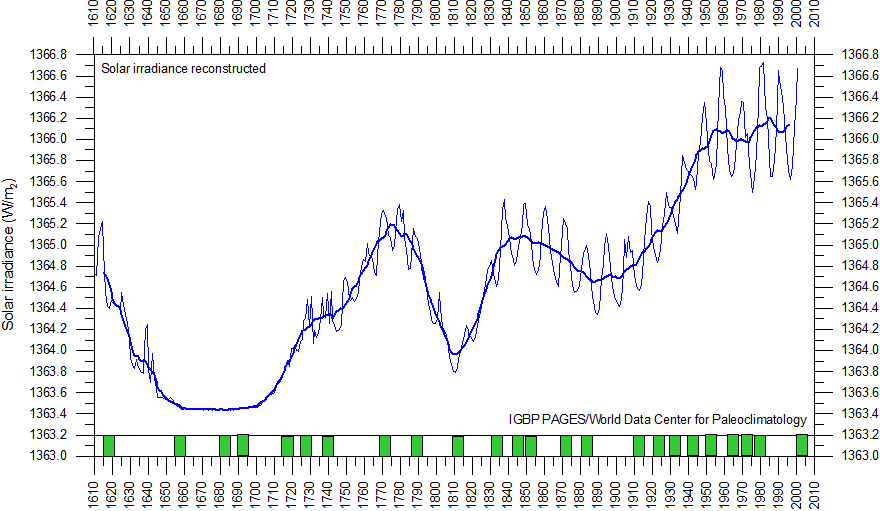
There isn't a major shift in sunspot activity which neatly explains "other such periods". The solar irradiance trend has been nearly flat since 1950 (e.g., here), and so fails to explain the subsequent warming.
all because they have passed the point of reason and now it is a purely emotional issue.
Given statements like "In other words, they are the Christians proving their stand by using the Bible. However since these people refuse to see beyond their own narrow view you are the new form of heretic.", you're the one here who is being emotional. And your supposed "reason" is in direct contradiction with actual facts.
-
Re:Hydrogen? Carbon?
No. At best your going to have an average of different locations at certain temperatures but that has no real reflection of the situation.climate zones depend on climate falling within a given statistical range or anything, or that changing that range would be a change to a completely different zone. What was I thinking?
First, A feedback can have a forcing effect.
Look, you can argue against definitions all you want. Feedback is, by definition, not forcing.
That is to say that a feedback can raise temperatures which under the Co2 model would generally be a forcing.
No! That is feedback. It occurs in response to a long-lasting stimulus, and only in response to that stimulus. Feedback can be positive or negative. What you described is known as "positive feedback".
Water vapor is a feedback and a forcing though, I though I made that clear.
You made it clear that you're wrong.
But under the Co2 models, they aren't prepared to account for water vapor as a variable which is why you see explanations using it as a constant.
In *NO* model is water vapor a constant.
And no, water doesn't average 10 days in the atmosphere because the saturation points differ.
Wow, do we need to go all the way back to the definition of the word average?
I suggest you quite getting your information from loaded sites designed to convince you regardless of the truth. Real science and at least one of the scientist contributing to it is one of them.
I suggest you get your data from somewhere other than your a**^H^H^Himagination.