Slashdot Mirror
Domain: zenoss.com
Stories and comments across the archive that link to zenoss.com.
Comments · 21
-
Re:Sales figures
Meanwhile, Red Hat has now a yearly revenue of one billion dollars (source). Clearly OSS doesn't work.
-
Zenoss
I have tried almost every NM platform for my clients and Zenoss is a well rounded management system. It also helps that they have both community and "Enterprise" editions. The support that we receive as an Enterprise customer is well worth the price of admission. http://www.zenoss.com/community/open-source-network-monitoring-software
-
Zenoss it is
Bias alert, I'm the Zenoss Community Manager.
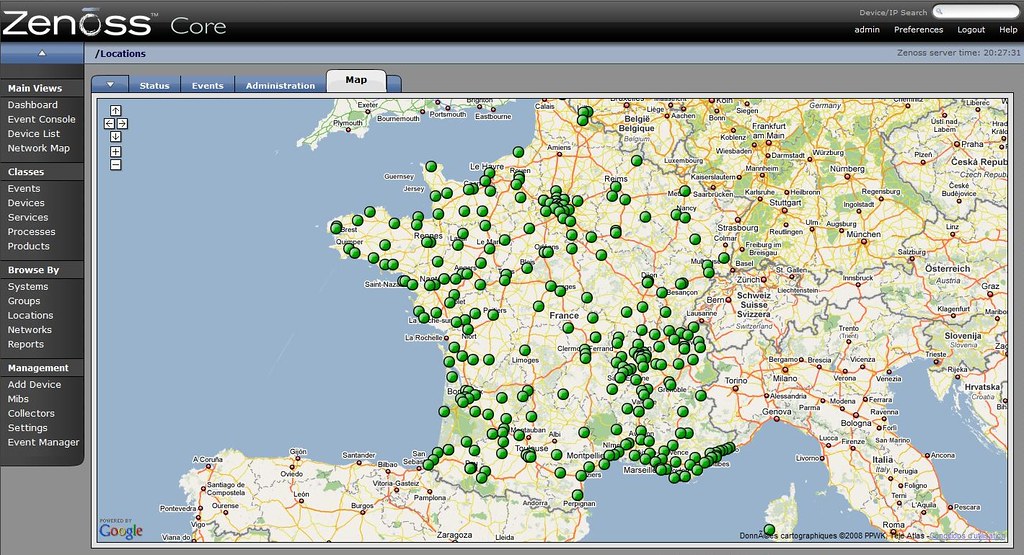
Zenoss was written with the intention of making it easy to monitor and manage tens of thousands of network devices remotely. By using templates and device classes, once you have a single machine monitored the way you like, you can apply that to thousands of other devices, making individual changes as necessary. Zenoss handles network hardware, servers (Linux, Unix and Windows), databases, applications and just about anything else you need to monitor. There's a network map and a Google map mashup for mapping. No need to start from scratch, there's already an Open Source (GPLv2) Python-based solution with a large community and installers for Linux and OSX and a VMware image to get started (plus source for everything else). Lots of documentation and frequent releases, with commercial support available. If you're coming from Nagios or Cactii, you can reuse any custom plugins you've developed.
-
Zenoss it is
Bias alert, I'm the Zenoss Community Manager.
Zenoss was written with the intention of making it easy to monitor and manage tens of thousands of network devices remotely. By using templates and device classes, once you have a single machine monitored the way you like, you can apply that to thousands of other devices, making individual changes as necessary. Zenoss handles network hardware, servers (Linux, Unix and Windows), databases, applications and just about anything else you need to monitor. There's a network map and a Google map mashup for mapping. No need to start from scratch, there's already an Open Source (GPLv2) Python-based solution with a large community and installers for Linux and OSX and a VMware image to get started (plus source for everything else). Lots of documentation and frequent releases, with commercial support available. If you're coming from Nagios or Cactii, you can reuse any custom plugins you've developed.
-
Zenoss it is
Bias alert, I'm the Zenoss Community Manager.
Zenoss was written with the intention of making it easy to monitor and manage tens of thousands of network devices remotely. By using templates and device classes, once you have a single machine monitored the way you like, you can apply that to thousands of other devices, making individual changes as necessary. Zenoss handles network hardware, servers (Linux, Unix and Windows), databases, applications and just about anything else you need to monitor. There's a network map and a Google map mashup for mapping. No need to start from scratch, there's already an Open Source (GPLv2) Python-based solution with a large community and installers for Linux and OSX and a VMware image to get started (plus source for everything else). Lots of documentation and frequent releases, with commercial support available. If you're coming from Nagios or Cactii, you can reuse any custom plugins you've developed.
-
Zenoss it is
Bias alert, I'm the Zenoss Community Manager.
Zenoss was written with the intention of making it easy to monitor and manage tens of thousands of network devices remotely. By using templates and device classes, once you have a single machine monitored the way you like, you can apply that to thousands of other devices, making individual changes as necessary. Zenoss handles network hardware, servers (Linux, Unix and Windows), databases, applications and just about anything else you need to monitor. There's a network map and a Google map mashup for mapping. No need to start from scratch, there's already an Open Source (GPLv2) Python-based solution with a large community and installers for Linux and OSX and a VMware image to get started (plus source for everything else). Lots of documentation and frequent releases, with commercial support available. If you're coming from Nagios or Cactii, you can reuse any custom plugins you've developed.
-
Re:Zenoss
And yet they guarantee you'll save 50% or more on licensing compared to HP, CA, IBM and BMC. Sounds like those are the vendors with outrageous pricing. I guess the market will decide.
-
Re:Zenoss
Zenoss's commercial support prices are hilarious, I mean, literally, hilarious. The CHEAPEST support (silver) is $100 per managed host (including virtualized hosts) most expensive (platinum) is $180 per node. So your 5,000 hosts would be $500,000-$900,000 per year in support.
Yes. Seriously.
The other problem I have with Zenoss is the reporting is basically non-existant. It may sound like I'm being hyper-critical, but it's only because I've looked at Zenoss and I so wanted it to be the NMS for me (I particularly like the fact that it's both open source and written in python) but at this point I just don't think it's going to work.
We use What's Up Gold from ipswitch right now, but we're only monitoring a few hundred hosts. It's slow, runs on windows, requires ms sql, but it's surprisingly full featured and gets the job done I suppose. Oh and its $900. -
ZenOSS all the wayWe use ZenOSS exclusively at work and have enjoyed every minute of it. Pro's include:
- 2D map with status of all nodes or submaps, organized by network
- Application monitoring, with more advanced maps available for purchase (Oracle, JBoss, Cisco) for those things you already paid a lot of money for
- Performance monitoring via SNMP or other data sources using RRDtool internally which includes graphs linked to each other during zoom in/out or panning
- Nagios plugins already do some of the heavy lifting
- Built-in support for watching Windows servers (any metric accessible via WMI)
- Access control using at least LDAP and Active Directory
- Secondary data collectors for those networks which are too big for just one central source
- Highly customizable through Python
- It has so, so much more than pathetic commercial solutions like OpenView
Cons:
- You have to keep your eye on the back end database
- It still takes a long, long time to tune it to remove noise events
- If you don't know Python, it can be tough in a few places
- Proper support is not cheap
-
Zenoss
I was really impressed by Zenoss, which has all the slick features that cost the earth from vendors like HP for Openview. You get automatic discovery, CMDB inventory, availability monitoring, alerting, and performance graphs all in a web portal.
You get open source, commercial support, and a good community of users and plug-in developers. The best of both worlds IMHO.
-
There are Contributors at Every Level
I'm the Community Manager for Zenoss, an open source enterprise network monitoring application. We have thousands of installations and even more users, and we see a lot of the same participation percentages seen by Linux and Wikipedia. There's a great article call Participation Inequality, pointing out that about 90% of users are never heard from again and 10% participate in forums, mailing lists and other indirect ways. We see similar numbers ourselves, and we get really great contributions from hundreds of users from enterprise IT staffs. Extensions, patches, testing and documentation are all provided by our community, you just have to work with them to lower the barriers to entry.
-
Zenoss
If you haven't already, take a look at Zenoss. Aside from having a pretty well designed UI (which as I get older I'm beginning to feel deserves more credit in the usefulness dept), supports SNMP by default (I'm not a big fan of clients unless I REALLY need them) *plus* it supports Nagios plugins.
And I'm not trying to steal any thunder here, I think Nagios is a great option. -
Availability /and/ performance monitoring
Agreed; basically Nagios a mess, but it's pretty-much the standard unfortunately, as it kinda-sorta gets the job done.
My main problem with the current crop of monitoring tools is that they are all either about availablility (Nagios, et al) or performance (MRTG, Cacti). Currently I'm using Nagios+Cacti, which kinda-sorta works for me, but it would be nice to have a single coherent interface to my systems. Zenoss also looks interesting, although I haven't tried it yet, but I'd like to hear of any other possibilities. -
download w/o giving up registration info
i read about this and thought, "hrm, this is worth checking out." when i went to zenoss.org and clicked download, it asked me to fill out a registration form. submitting the form w/o entering anything causes a popup that indicates email is required. disabled javascript, and was able to submit the form and get to the download page (which, btw is here). i wonder who the email for confirming my registration will be sent to.....
-
Re:Documentation
Sure they did - under the Project tab under "Zenoss Core - Enterprise IT Monitoring" is a link call "Web Site". It will take you to the project's web site, which includes documentation, comparisons, a tour, etc.
-
Re:Documentation
Sources for documentation from their main website;
http://zenoss.com/docs/zenwin - Windows documentation, rather brief. Supports 2003/XP apparently.
http://zenoss.com/docs - Main documentation website for Linux / BSD. -
Re:Documentation
Sources for documentation from their main website;
http://zenoss.com/docs/zenwin - Windows documentation, rather brief. Supports 2003/XP apparently.
http://zenoss.com/docs - Main documentation website for Linux / BSD. -
Re:Documentation
Check out: http://zenoss.com/docs
-
Re:Documentation
Take a look at http://www.zenoss.com/. They just didn't link it in on the Source Forge site.
-
Re:Other alternatives
Another that I have been using and is great for *NIX AND windows is Zenoss. http://www.zenoss.com/
-
The list
1. Zenoss
2. Qumranet
3. rPath
4. Simula Lab
5. MontaVista Software
6. SugarCRM
7. OpenAir
8. Themis Computer
9. Scalix
10. Incumbents and Dealmakers (non-entry)