 Slashdot Mirror
Frameworks 5: KDE Libraries Reworked Into Portable Qt Modules
jrepin writes "The KDE libraries are being methodically reworked into a set of cross platform modules that will be readily available to all Qt developers. The KDE Frameworks, designed as drop-in Qt Addons, will enrich Qt as a development environment with functions that simplify, accelerate and reduce the cost of Qt development. For example, KArchive (one of the first Frameworks available) offers support for many popular compression codecs in a self-contained and easy-to-use file archiving library. Just feed it files; there's no need to reinvent an archiving function."
This is a pretty major thing: "The introduction of Qt's Open Governance model in late 2011 offered the opportunity for KDE developers to get more closely involved with Qt, KDE's most important upstream resource. ... These contributions to Qt form the basis for further modularization of the KDE libraries. The libraries are moving from being a singular 'platform' to a set of 'Frameworks'. ... Instead it is a comprehensive set of technologies that becomes available to the whole Qt ecosystem."
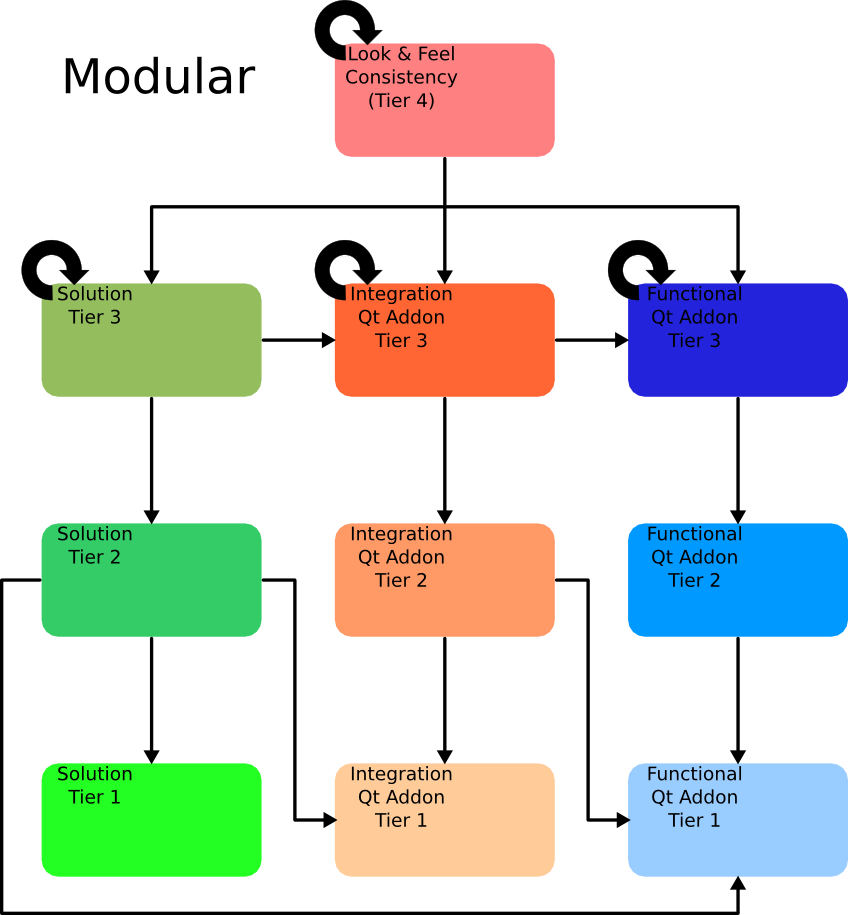
The new KDE Frameworks will be layered as three tiers of components, with each tier consisting of three semi-independent groups of libraries (the article explains the category/tier dependencies; it's a bit hairy for a quick summary). A dashboard shows the status of each component.
I must know!
"Don't meddle in the affairs of a patent dragon, for thou art tasty and good with ketchup." ~ohcrapitssteve
Release cycles of what? Release cycles of what?!?!?
But what about us ugly people?
UI development just always seems like a clusterfuck to me. Qt seems the least cluster-fucky of the available options and this will make working with it even easier.
KDE does so many interesting things. I love modular, general purpose, and cross-platform tools that combine into a greater whole. This news item and also their work on a common desktop framework for mobile and desktop fall into that category. QT also has so much going for it.
But why then is the KDE user experience so awful?? I just can't use it. Coming from Windows for Office, web, and gaming, and GNOME2 on my servers and workstations, trying KDE is like a huge regression. It looks bad, it feels clunky, it is always broken somehow. I just don't understand why they can't get it together. Does anyone actually use it?
"Here Lies Philip J. Fry, named for his uncle, to carry on his spirit"
There are many things Qt does very well, some not so well and some pieces completely missing. Opening up KDE as plug-in frameworks will fill in the holes in Qt for bringing very strong applications to a whole new generation of embedded and X-platform tools. Also, C11 C++ extensions and more specifically closures have really helped me fall back in love with C++ primarily through Qt.
That's not what I meant.
My fear is that QT will become almost dependent on KDE.
I like KDE well enough, but if I wanted KDE, I'd develop with it directly.
Having features overlap isn't good, but neither is using KDE plugins as an excuse for development that should really be in QT itself. Not that the current examples should be core QT, but in the future that may not be the case.
If tyranny and oppression come to this land, it will be in the guise of fighting a foreign enemy. - James Madison
Honestly not trying to start a flame war here, but what's the best Linux distro for running KDE? Which ones do a really decent implementation of it (and which distros get it really wrong and should be avoided)?
I'm really not trying to flamebait here, but I thought Qt was a GUI library. Why does a GUI library need a "self-contained and easy-to-use file archiving library"? Isn't that something totally separate?
I have been using PySide and Qt 4.8 which works great. However, the last time I looked PySide does not work with Qt5. Javascript was also supposed to be a first class citizen, and I can't find any info on how to get started with Javascript and Qt5 or any recent working examples. Finally Qt5 brought with it a new method for building interfaces(Qt Quick) and put the old widgets into maintenance mode only. However Qt Quick didn't have any widgets. Qt5 so far has been a huge disappointment to me.