Slashdot Mirror
Domain: atpm.com
Stories and comments across the archive that link to atpm.com.
Comments · 9
-
Leave us not forget that which came BEFORE iTunes
SoundJam MP was, perhaps, the first genuinely useful MP3 application for the Macintosh. One could easily rip CDs to MP3, mix songs as one wished in playlists, and then burn them to CD.
Rip. Mix. Burn. Where have we heard that before?
It even had support built in for the few MP3 players of the time.
Review of an early incarnation of SoundJam.
And, the ObWiki entry .
Without SoundJam MP. there would likely have been no iTunes, as Apple bought SoundJam MP, filed off the serial numbers, slapped a coat of paint on it and called it iTunes V1.0.
Well, yeah, there still would have been AN iTunes. Apple would have just bought Audion .
So, while the iPod was indeed a seachange for the portable music player (cassette/CD/digital) of the era, without the software to support it as easily and as elegantly as SoundJam, er, "iTunes", it was the software that made the iPod the success it was and remains to this day.
-
Re:Wish Apple put some work on OSX
Memory requirements are definitely a problem under OS/X. It is totally unacceptable that Safari requires 1/2 GB of RAM to display a few web pages like it does on my computer right now. mds, a simple background daemon, is using 400MB! The kernel is using 450 MB. The bloody mail client is using 150MB. This machine has been up for a grand total of 9h.
They aren't really using that all that memory. That's most likely data that has been accessed at one time and is kept around in case you need it again. Any good, modern operating system does the same thing. A good OS will fill up your RAM with stuff that you might possibly use so that when you need it you get it quickly. If some other app comes around and needs a chunk of memory then some of the data in RAM is either paged off to disk or simply thrown out, depending on whether the data is "dirty" (changed) or not.
I assure you that almost all modern flavors of Linux, BSD, and Windows do the same thing. They might do it in slightly different manners and they may report it to you differently but you'd be amazed at how similar they all are under the hood.
You might want to take a look at these articles to better understand your own system's memory usage and to see if you do have a problem:
http://www.atpm.com/12.12/activity.shtml
http://macperformanceguide.com/Mac-MonitoringTips.html
http://developer.apple.com/library/mac/#documentation/Performance/Conceptual/ManagingMemory/ManagingMemory.htmlJust some notes on what I'm seeing on my machine
MacBook Pro 13", one Intel Core 2 Duo 2.26 GHz, 4 GB RAM, Mac OS X 10.6.4 (10F569)
uptime: 24 hoursrsize (total memory actually in-use):
Safari: 180.2 MB
mds: 35.2 MB
kernel_task: 150.2 MB
mail: 63.2 MBI have a few windows open in each application and used the applications for about 1/2 an hour before testing them.
-
Re:Does anyone pay attention to battery life anymo
For writing purposes, I'm considering the AlphaSmart Dana. It's a PDA-like portable word processor that gets 25 hours of battery life without a backlit screen, which wouldn't be an issue for me since my favorite haunts (Bookstop cafe at Shepherd and W. Alabama, Agoura coffee house at Dunlavy and Westheimer, Borders cafe at Kirby and W. Alabama) are all well-lighted. The other option is a netbook. I'd really like someone to design a low-power laptop that allowed word processing and ssh access, because that's about all I need or want. (The web is great for leisure time, not work!)
-
Where's the market?
Really, I wonder where the market for such devices is. I personally have one of the earliest (to my knowledge) eBook readers to come to market, the Rocket eBook. (Link to review of one: http://www.atpm.com/6.05/rocketebook.shtml) I'll admit that at first I really liked it. I'm a gadget freak, and the eBook reader was a lot of fun, especially back in ~1998, 1999 when such concepts and devices were still new. Furthermore, Nuvomedia (or whomever actually manufactured and designed the devices) did a good job with the software allowing you to underline/highlight words and IIRC even take notes in the "margins." They also provided a built in dictionary in case you didn't know what a word meant. Oh, and they provided the software to convert from several different formats to their eBook format, meaning you could download books from Project Gutenburg for reading on your eBook reader.
That said, after the initial newness wore off, I realized that I still prefered the eBook's dead tree counterpart. There's just something about the whole experience of turning the pages yourself. Not to mention, a paper book seems much easier on the eyes, although I will admit that LCD technology has progressed quite a bit since those days. Weight and size was another factor against the eBook. I know that Sony's eBook is going to be smaller, but I have a hard time figuring out, subjectively, just how heavy 250g is.
Anyway, I'm still trying to figure out just who out there wants to spend so much more time staring at another screen. For me, that's part of the whole experience of reading a book - it's partly a way for me to get away from technology for a bit. -
Not as good as it can be...Have a look at this one:
http://www.atpm.com/7.05/datahand.shtml
That's what I call a keyboard..not even 20 keys..
-
Re:I don't get it ..
"An example of this is the sucess of Civ 3, which has essentially the same UI as Civ 2"
Huh? Graphic engine was completely changed in Civ 3.
Civ 2 had a flat 2D view to the world while Civ 3 is 3D, has animations and other improvements.
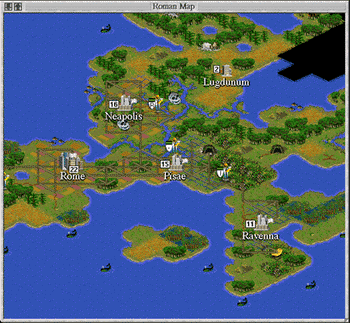
Here is a Civ 2 screenshot. Here is a Civ 3 screenshot.
If Freeciv would have Civ 3 style graphics, it would be a lot more attractive to the new players. -
Re:I've been dying to know....
Feeding a remote process data is not as difficult as you're describing. If the program you're using doesn't support ranges in arguments it isn't too difficult to wrap a script around it that does understand input ranges. The Xgrid client makes it pretty simple to use ranges as arguments for programs. It's possible to use the likes of Blender and Xgrid to do distributed rendering. Ergo input control doesn't seem to be a terribly difficult hurdle to overcome with Xgrid.
-
Re:I can see myself using thisThat's why nothing in Mac OS X requires the use of either a control-click or a second-mouse-button click. Some highly specialized applications like Shake and Maya do, but they're hardly common.
Exactly. You *can* right (or control) click to save an image, for instance. But you can also just drag it right off the document.
This three button/no button mouse argument is such a worn-out troll. OS X supports whatever you want: plug and play. Most Mac users are used to a single-button mouse, and that's all you need. But if Windows mouse behavior is what you prefer, just plug in your favorite Logitec or Kensington. Works fine. Sons of Redmond, rejoice!
About This Particular Mac had a review not long ago of MacMice's The Mouse, which seems like the sort of thing a Mac partisan might go for if he or she wants a traditional-looking mouse that also had two buttons and a scroll wheel. Looks like it just rolled off a Cupertino production line.
-
Re:iTunes != iPod (once again)