Slashdot Mirror
Domain: cloudynights.com
Stories and comments across the archive that link to cloudynights.com.
Comments · 25
-
Re:Both ...
Baader has several different films. Their silver/gold film is certified safe for visual observation under the ISO standard; their photo film is not. It lets through a little more UV than the ISO limit. It's designed for use on cameras, where the glass in the lens will block enough of the UV to make it ISO-compliant. But if you use it to view the sun directly, you're going to be slightly over the ISO limit.
While I'm sure AgenaAstro is fine, I wouldn't put it past some fly-by-night shop making glasses out of the photo filter film (because he was unable to purchase the visual filter film). So Amazon is justified in their caution. Where they're screwing up is in bringing up this issue so close to the eclipse, and not reviewing the documentation AgenaAstro sent them in a timely manner. -
Re:And making my link a link:
The more complete source article
As someone posted below, here is the forum post with some data, and here is the raw data with more plots. This is really awesome, but you have to temper your enthusiasm when you realize he knew exactly when to look and how much the brightness should drop, and he chose a relatively bright star (apparent magnitude +7.676, which is just barely too faint to see with the naked eye) with a relatively large exoplanet to image. There is some wiggle room there, but the data is pretty noisy, so it will be pretty tough to spot new exoplanets like this.
In comparison, Kepler-67b is a confirmed exoplanet 3610 light years away, orbiting a star with an apparent magnitude of +16. That is, take the light received from the star this guy imaged, divide it by 2000 (less than 0.05% the brightness), and Kepler can still detect exoplanets passing in front of it. The Hubble and Keck Telescopes have imaged stars with magnitudes of +30 or higher. So to answer the headline (in case it wasn't already obvious), we still kinda need NASA.
-
this isn't all that new
He's built his own tracking mount, which is nice, but many astrophotographers do this and you can also buy gear that will do it for you. This isn't new in any way. What's different is that he's shown he can detect a star's dimming due to an exoplanet pass using cheap detector gear. That's more impressive. You can see his raw data here.
-
Binoculars
I have had five scopes. My current primary scope is Celestron CGE 1100.
First, get a good set of binocs and a star atlas. I recommend either "Turn Right at Orion" and/or Sky & Telescope's Pocket Sky Atlas. I have the Orion Mini-giants 9x63 and they are wonderful for astronomy. They are also light enough to be used without a tripod. It really helps to know the basic constellations when starting. Also get http://www.stellarium.org/
Craigslist has used scopes all the time. You could pick up a Celestron C5, C6, or C8 for a few hundred and prob. not lose too much on resale. Stay away from "department store" scopes!
Check out your local astronomy club. Our club has 20+ scope for loaning and at a star party you could check out a bunch of scope live.
Finally, the is a great resource: http://www.cloudynights.com/to...
Clear Skies! -
Pics
You don't really appreciate what an awesome amateur effort this is until you see pics http://www.cloudynights.com/ubbthreads/showflat.php/Cat/0/Number/6146228/page/0/view/collapsed/sb/5/o/all/fpart/2/vc/1
Being the owner of an 8" Schmidt–Cassegrain scope, this blows my mind.
-
Some further info...
Cloudy nights thread and a another news article.
It was silvered with a spray-on solution using a weed sprayer; much too large for the regular vacuum deposition chambers.
-R C
-
Re:Out of curiosity...
How much of a penalty, relative to the penalties incurred for things like small size, subpar optics, etc. does putting up with the atmosphere impose?
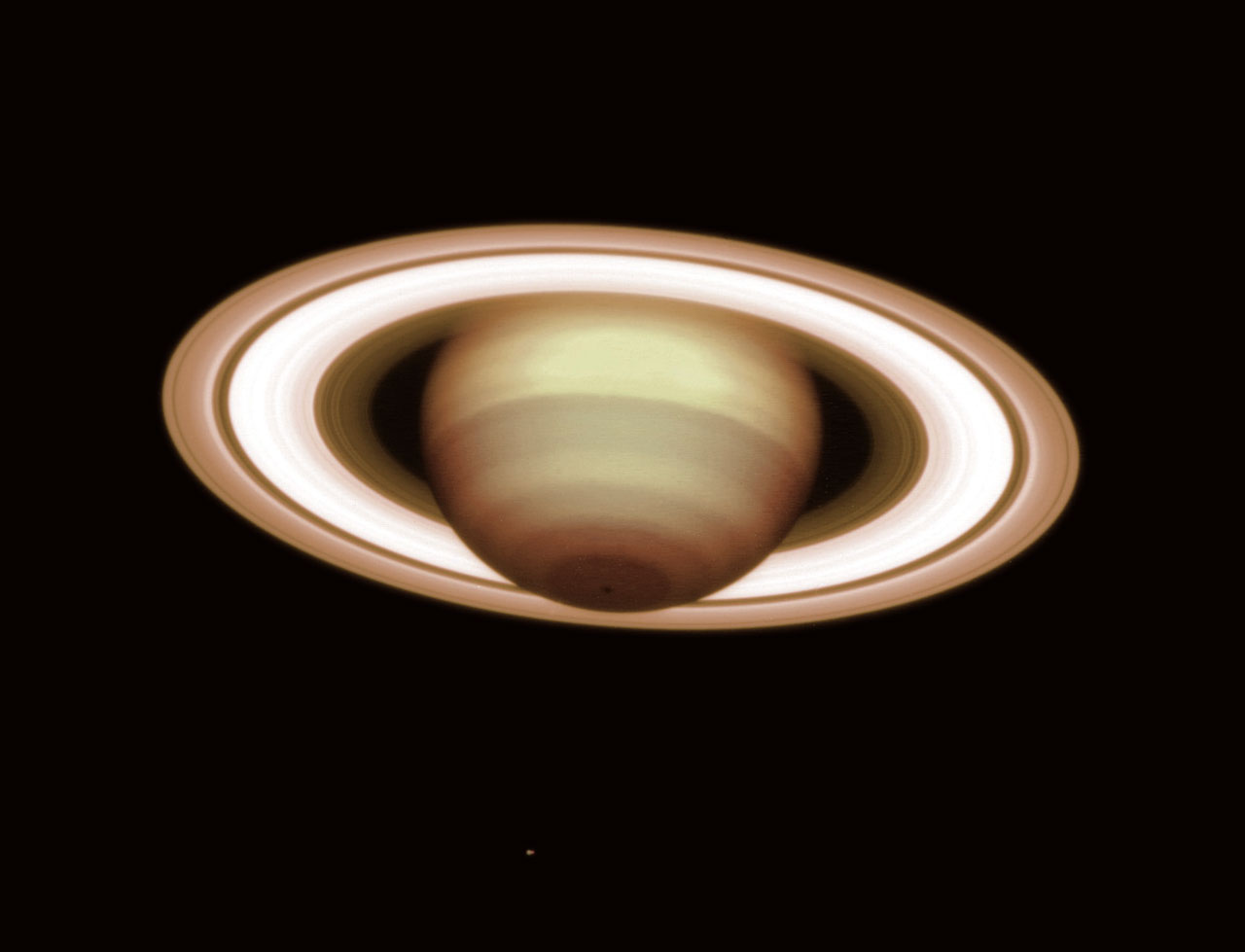
Here's Saturn as seen by ESO's Very Large Telescope in Chile (8.2m mirror, though it can combine 4 of them into an interferometer). The observatory is at 2635m above sea level, so is looking through about 70% of the air you'd be seeing through at sea level (air decreases in density with altitude, so there is diminishing returns for getting up high). The observatory's location was chosen for its perennial clear skies. The photo was taken with what was state of the art adaptive optics a decade ago (2002). I wasn't able to find a more recent photo of Saturn from a large, ground-based telescope in 15 minutes of googling.
Here's Saturn as seen by Hubble (2.4m mirror). Not much of a contest.
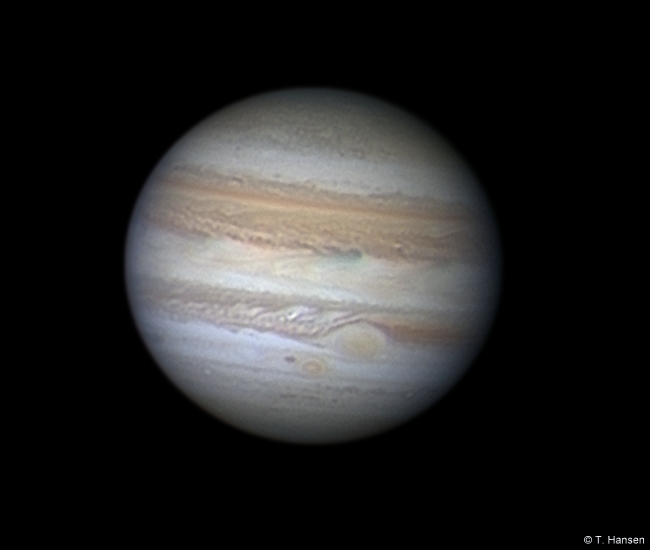
I picked Saturn as an example instead of Jupiter because Jupiter is bigger and closer than Saturn. So even at low resolution you can still get some impressive shots. Here's one taken by an 11" (28cm) telescope.I'm told, by people more closely involved with amateur astronomy than I, that a 200mm aperture is a pretty small instrument, especially for reflector-based designs.
200mm (about 8 inches) is about the size of your basic cheap but serious reflector for an amateur astronomer. It's pretty much the minimum you'd expect anyone doing astronomy as a serious hobby would own.
A quick calc of the Rayleigh criterion says a 200mm scope would have a maximum angular resolution of 0.6 arc-seconds (i.e. two stars closer than this separation would appear as a single dot). Hubble's Rayleigh criterion limit is 0.05 arc-seconds, so Hubble can resolve objects 12x smaller. The Hubble photo is 2150x1000 resolution. Reduce it by 12x to about 180x83 resolution, and that's about the amount of detail in you'd expect in a Saturn pic from a 200mm scope in orbit. IMHO it's not really worth it in the visible band. They'd better be planning to do a lot of UV work with it. -
Re:It all depends on detection...
I've been looking for a way to get into cheap astrophotograpy and found some people using webcams to detect stars down to magnitude 9.6 and even magnitude 14.5. Has anyone else found links to more recent work?
-
Re:wtf AGAIN
Yes, which was also first observed by same amateur astronmer (Anthony Wesley). Here was his post of the recent impact on CloudyNights
-
Re:easy stuffWrong on several points.
Saturn just passed its equinox; it may be hard to make out the rings at all.
But Mars just passed its closet approach to Earth this year, so you should see quite a bit (example)
But since Mars orbits beyond Earth's orbit, you won't see phases; it will always be more than half-full. (wikipedia citation)
And M31 and M42 can still look great in a 4" scope too.
-
Cloudy Nights
Astronomy site/forums. http://www.cloudynights.com/ubbthreads/ubbthreads.php?Cat= Possibly the beginner's forum would be a good place to ask. http://www.cloudynights.com/ubbthreads/postlist.php/Cat/0/Board/beginners
-
Cloudy Nights
Astronomy site/forums. http://www.cloudynights.com/ubbthreads/ubbthreads.php?Cat= Possibly the beginner's forum would be a good place to ask. http://www.cloudynights.com/ubbthreads/postlist.php/Cat/0/Board/beginners
-
Try CloudyNights Website
Try the forums on cloudynights.com http://www.cloudynights.com/ubbthreads/ubbthreads.php?Cat=
The nice thing about that site is
You didn't say whether you had a 4 inch reflector or a 4 inch refractor. I'm assuming a mirror scope. If you got it cheaply, the higher quality one would be the mirror one, but collomating a dobsonian, while easy, is not immediately obvious to newbies.
Also, ask this question from the point of view of binoculars. Many large objects in the night sky can be viewed with binoculars and those should also be good in a 4" dobsonian. Note, if you have a cheap 4" refractor, then it's a bit of a crap shoot as to whether you'll be able to get good views.
M42 - the great Orion Nebula should still be visible early evening in April. It's amazing
Double stars may be good. There's one in the handle of the big dipper. There's also one near Vega which will be rising starting in early evening in April. There are a ton of others, but these 2 (4?) should be pretty easy to find.
Also, "Carbon Stars" are fun. Just google and look around for them. Most stars do not show colors, but carbon stars are very obviously red and again they're all over the place.Unfortunately April is when the Andromeda galaxy is too low in the sky for the early evening. Try again in the summer.
-
Par for the course...Ralf, quite simply, takes amazing photos. From what I understand, these are manually tracked snapshots.
He has a number of photos posted at Cloudy Nights in the "Planetary and Solar System Observing" forum.
-
Re:No, Mythbusters!
That's too obvious. If you're going to make a "weapon" out of it, at least make a HERF gun. Don't even have to silver it for that
If you are going to silver it... hmm, how perfect of a parabola is it? If it's good enough, or if you could machine it to that good of precision, you could use it as the primary mirror on a huge truss tube telescope.
-
Re:A Great Camera?
I've read quite a few comparisons. ToUCam only beats the old Meade cams, and then only on lunar/planetary imaging because it can grab frames faster.
The NexImage *is* a $99 camera, and comparisons of it versus the ToUCam generally favor the NexImage (just to pick a random example). The NexImage uses the same CCD board as the ToUCam. Why pay $150 for a ToUCam plus adapter? -
Read first, buy later
It's most advisable to spend your money after gathering enough information. Joining the local astroclub is a good first move. You will get the chance to experience different types of scopes. There is a lot of good information on the Internet. Join http://cloudynights.com/ and read what other first buyers went trough. After you get a feeling about what do you really want as an astro-amateur and what equipment is more rewarding, it's time to start thinking about buying something.
Astrophotography on a $1000 budget will not get you too far. You might be able to get a Canon DSLR (used maybe) with a reasonable lens and a motorized equatorial mount(EQ5). A small achromatic refractor can be used for visual. It's up to you to decide if you are happy with this. I went for a 10" dobsonian and a few good eyepieces myself. There is always time for more investment later. Good luck and clear skies. -
You're seeing a lot of really discouraging thingsOne: Take a Deep Breath, and decide what you really want to do. Sadly, you do really need a much higher budget to get into Astrophotography. Entry level to get results that will give you satisfaction is probably in excess of $3000.
Now, are you still interested in Amateur Astronomy? It can certainly be a lot of fun, but unless you go the strictly Binoculars and Star Charts route, cheap it is not.
If you're still interested, what do you want to see? There are really three distinct classes of objects, with different requirements: Stars (looking at doubles and multi-star systems), Planets, and Deep-Sky (Faint Fuzzies, the Nebulae, galaxies, and globular clusters.) For Stars and planets, you want the best quality refractor you can buy, largely becase these are pursuits that push high magnifications. For the Faint Fuzzies, you need as much aperture as you can get, and the cheapest way to do that is a Newtonian Reflector.
Now, there is a third way, not mentioned by many of the other posts I see, the Catadiotropics, these are telescopes that contain compound Mirror/Lens combinations. They provide a way to the get much of the optical performance of Refractors, with the light gathering ability of Reflectors. Orion imports a number of Chinese made models that are rather well regarded of this type.
Resources for more information - You really need to learn as much before making a purchase. I recommend: Ed Ting's http://www.scopereviews.com/, which hasn't been updated much lately but has a lot of good information nonetheless. Also, as mentioned by others: http://www.cloudynights.com/ is an excellent resource with a great, and active forum community.
Now, just to give you more of the Kind of answer you wanted, for $1000, what do I like? In a Refractor, I like the William Optics http://www.williamoptics.com/ Zenithstar 80 ED Refractor, a nice budget OTA (optical tube assembly) with well regarded performance, and a very nice focuser. That will leave you enough money left over to buy a decent Mount and Tripod (a hugely complex subject in and of itself), and a decent eyepiece or two (I like the University Optics http://www.universityoptics.com/ HD Abbe Orthoscopics, which give a lot of Bang for the Buck Performance). Now, in a Reflector, the Orion http://www.telescope.com/ Skyquest XT12 Classic is a good buy and comes with everything you need to get started. And the Third way? The Orion 150mm Skyview Pro Maksutov Cassegrain is probably a good start. Note that the Skyquest XT12 will definitely show you the most things (Aperture wins!) BUT, it does not have an equatorial mount and it will NOT track the sky.
In closing, I strongly suggest thinking about what it is you want to see, and spending a good bit of time reading the Cloudy Nights Forum before making a purchase.
-
From someone experienced
I am getting in on this discussion a bit late, I hope my comments help.
1. Go and grab a few entry level books on naked eye astronomy and astronomy with backyard telescopes. Grab or subscribe to Astronomy Magazine and Sky and Telescope. Spend time LEARNING the night sky, learn the major constellations and features of the night sky. So many people do not take the time to learn the night sky before jumping in and buying a scope, they get frustrated soon after because they cannot find any object and quit the hobby. Believe me, this more than anything will ease your pains when moving up to binoculars and a telescope.
2. Buy some decent 7X50 - 15X80 binoculars. I would not recommend anything above 15-20 X 80 and would rather see someone stick to a decent pair of 7-10 X 50 binos. Start learning to find bright deepsky objects with the binos. An amazing number of objects are viewable with simple 7X50 binos. I used my binos far more than my 10" Eq. Newt when starting out. They are light, easy to take with you and easy to use. This will also help you learn the night sky.
3. Buy a dobsonian style scope that YOU WILL USE. In other words don't go too big on aperture. A big scope is great and can give amazing views but only if you use it. My first big scope was a 10" German equatorial mounted Newtonian. It was big and VERY heavy. However, I was young and only had to drag it out to the backyard. Setting it up wasn't too much of a problem - but breaking it down at 3am after a long night of observing was a pain. Sixteen years later I still have the scope but it doesn't get much use. I now live in Dallas and have to drive long distances to find dark skies. I just bought a smaller scope to replace it.
You can get GREAT dob style scopes from places like Orion Telescopes for well under your budget. You can even get models that have a computer that aid you in pointing the scope and will greatly reduce your frustration level in finding "faint nothings" in the sky.
You can even do some photography with a good dob. You will need to grab a webcam that is easily modified. The Phillips Toucam and SPC900 are the most popular as they use CCD chips instead of CMOS imagers. Get an adapter to slide into your focuser (http://webcaddy.com.au/astro/adapter.htm) and you are ready to start imaging the moon, planets and sun (with appropriate filter). You will not be able to guide but you can take short movies of the objects and use Registax to split the movie into frames and stack and average your frames. It does a GREAT job. I use it to take images of the moon and planets with an untracked and unguided scope.
Astrophotography of deep sky objects is out of your budget range for now. However, you may want to buy a scope that can be easily converted to astrophotography at a later date as you add equipment. I cannot recommend the Meade LXD75 SN-6 or LXD75 SN-8 enough. The SN-6 is within your current budget and the SN-8 is just outside of it. They are good visual scopes and are great astrophoto scopes. They are on decent enough mounts and have goto capability. Do NOT get the SN-10, its weight is just a bit much for the LXD75 mount to handle for astrophotography.
Right now, if you look you can find closeouts of the Meade DSI CCD camera for around $100.00. Great entry level camera, it is a bit outdated now but you cannot beat the price.
A great website is http://www.cloudynights.com/ - Tremendous user support forums, if you have a question, someone on there can answer it.
Id like to continue my post but I am out of time - Hope this helps. -
Re:I went through the same thingGoing straight to astro-imaging is an recipe for a letdown. The best thing the submitter could do would be to first grab an old pair of binoculars and just learn the sky. Once he can name most every constellation on site he will already know where all the really cool "big" stuff in the sky is (all the Messier objects, as most are very apparent in any pair of binoculars under dark skies) and he will know where he needs to point his scope. THe first scope should probably be an 8-12" Dobson as it is trivial to setup and operate (an F6 8" is especially forgiving collimation wise also). Once he has done the whole visual observing thing for a while he will know whether the hobby might mean enough to him go onto astro-photography. If so he can buy or build an equatorial platform for the Dob and do some basic imaging with a CCD device. This will get him experience in stacking photos, aligning the scope, etc. If he is still interested at that point he can drop the $3-5k on a serious astro-photography setup.
Or he can buy some cheap piece of junk mount and try to do astro-photography for ~ $1k and be very disappointed.
My biggest piece of advice to the newby: Green laser pointer, you can see the beam. Mount it to your telescope, I built a mount of wood (drilled 3 holes, glued on two rare-earth magnets from think-geek, it took 10 minutes) or you can buy a $100 setup, but any way you cut it the green laser pointer will help you locate things in scope much, much faster. You simply aim the "canon" by pointing the laser at the spot in the sky you want to see. Other accessories very useful for the newb: right-angle corrected finder, laser collimator (get the "deluxe" so you can align your primary with the barlowed-laser approach)
Get a barlow so you can use the barlowed laser approach to colimate your primary, it makes it dead-simple. The Barlow of course also can be used to double the "power" of all your eyepieces so you need less glass to get going (good glass is very expensive)
Pay the $12 so you can shop at Astromart, you can pick up most everything 30-50% off there.
You already joined your astronomy club, this is good, Cloudy Nights is a great resource too, the people in the beginners forum are extremely friendly and helpful. The one CloudyNights star party I went to (Buck-Eye-On-The-Sky) this summer was a great place to learn from the masters and it was a lot of fun too.
Stelarrium rocks, there are a lot of other programs that work too, but Stellarium is dead-simple to use, perfect for the beginner, OSS, free, and it runs on anything with any 3d card.
Most importantly, Have fun! Seriously though download Stellarium onto your laptop. Take it and any pair of binoculars you can find and go out tonight about an hour after dark. Look to the south for the "teapot" that is Sagittarius, the center of our galaxy. It is just exploding with star-clusters and is a delight through binoculars, and Stellarium will guide you through what there is to see in it. If that doesn't do it for you, then a telescope isn't gonna help
-
I went through the same thing
I went through the same thing. I was fresh to amateur astronomy and didn't know what to do. My first warning: Don't spend to little on a telescope. $180 for a StarBlast is the lowest I'd pay for anything decent (and it is, I drool over it as a quick 'plop down and observe' scope from time to time). Second Warning: Astrophotography is insanely expensive. As in 10+ times your budget. Don't do it. If you really want to do astrophotography take a camera, put it on a tripod, point at the sky, set it as wide as you can and expose for 15 seconds for digital, a few hours for film. The results are quite nice.
Here's what my own experiences have taught me: Get a Dobsonian. With $1000 you can get a 10"-12" Dobsonian and still have tons of room for accessories. A dobsonian is very portable compared to a refractor and with near zero setup and takedown using it is much easier than a refractor too. 10" is a lot of aperture and you won't catch the "aperture fever" for something bigger for a while. The scope I eventually got is an Orion XT10 Intelliscope, but you may not want the computerization with your budget.
I found the people at Cloudy Nights very, very helpful. They have reviews of lots of products as well as their forums and they tend to specialize in getting the most out of your money.
As far as books go, I use Nightwatch by Terence Dickinson every night I observe just for the charts. Star Watch by Philip Harrington goes well with Nightwatch as good place to find new objects for the beginner. A lot of people suggest Turn Left at Orion, but I fount it to be a bit slow and the charts lacking in lower magnitude stars for their size. -
get an Apochromatic Refractor
$1000 is not much. I've been doing research quite a long time on what should I buy, to get the best possible view both for planets and deep-sky. You know - usually for deeps skies a newton with huge mirrors is good, while they are not applicable for planets, because newtons cannot produce big magnification with enough detail. While for planet viewing the refractors are the best, because they can produce big magnifications without the distortions of newtonians. But refractors have too small aperture to collect enough light for comfortable deep-sky viewing.
The best balance in this big_mirror/refractor conflict is an apochromatic refractor. Because - apochromatic means that the lens are covered with special layers that give about 96+% of light transmission (so it's better than non-apochromatic refractor, where some light is wasted on the lens and you don't see deep-sky objects clearly), and special layer eliminates light dispersion like in an optical prism (otherwise each color would go on a different path and the resulting picture of something looked more like a rainbow instead of beight sharp). And also as a refractor it's good for planets. But... this APO refractor has to have big aperture, or it won't work for deep-sky anyway.
Refractors have some other advantages - for instance you don't have unnecessary air flow between the lens because they are inside a tube. Newtons are much brighter (good for deep-sky) but air turbulence blurries the view on planets.
Oh, and forget about cassegrains, they are compact, that's true (the only advantage). But the view is terrible.
Well if you have just $1000 you gotta decide: (1) want to see distant galaxies (newton), or (2) view to see planets (refractor). But I suggest to spend a bit more cash and get APO refractor. Should be good for both.
You can look at those reviews I had bookmarked long time ago: http://www.cloudynights.com/item.php?item_id=1260 and http://www.cloudynights.com/item.php?item_id=32&pr=2x6x17
You can consider Takahashi also, althought from my research it looks like TMB make better equipment, but you never know that for sure: http://www.tmboptical.com/itemsGrid.asp?cat_id=4 . -
get an Apochromatic Refractor
$1000 is not much. I've been doing research quite a long time on what should I buy, to get the best possible view both for planets and deep-sky. You know - usually for deeps skies a newton with huge mirrors is good, while they are not applicable for planets, because newtons cannot produce big magnification with enough detail. While for planet viewing the refractors are the best, because they can produce big magnifications without the distortions of newtonians. But refractors have too small aperture to collect enough light for comfortable deep-sky viewing.
The best balance in this big_mirror/refractor conflict is an apochromatic refractor. Because - apochromatic means that the lens are covered with special layers that give about 96+% of light transmission (so it's better than non-apochromatic refractor, where some light is wasted on the lens and you don't see deep-sky objects clearly), and special layer eliminates light dispersion like in an optical prism (otherwise each color would go on a different path and the resulting picture of something looked more like a rainbow instead of beight sharp). And also as a refractor it's good for planets. But... this APO refractor has to have big aperture, or it won't work for deep-sky anyway.
Refractors have some other advantages - for instance you don't have unnecessary air flow between the lens because they are inside a tube. Newtons are much brighter (good for deep-sky) but air turbulence blurries the view on planets.
Oh, and forget about cassegrains, they are compact, that's true (the only advantage). But the view is terrible.
Well if you have just $1000 you gotta decide: (1) want to see distant galaxies (newton), or (2) view to see planets (refractor). But I suggest to spend a bit more cash and get APO refractor. Should be good for both.
You can look at those reviews I had bookmarked long time ago: http://www.cloudynights.com/item.php?item_id=1260 and http://www.cloudynights.com/item.php?item_id=32&pr=2x6x17
You can consider Takahashi also, althought from my research it looks like TMB make better equipment, but you never know that for sure: http://www.tmboptical.com/itemsGrid.asp?cat_id=4 . -
Other free things that do the same job
There's a lot of free software out there that will give better skymaps than most books can. After all, the sky changes from minute to minute, not just day to day.
XEphem is my choice. The interface is pretty old-school, but the maps it prints out are perfect for my uses.
KStars has more bells and whistles but, in my experience, doesn't print as well.
As for advice on buying scopes, etc., check these places too.
-
Spent all that money and ended up with a Meade?If I were going to spend this much I'd have gone with a good refractor, like an Astro-Physics, Takahashi, or maybe something radical like an APO Max. Any of these would be worth a wait. If I absolutely had to have big aperture, I might choose one of the big Dobsonians like a Starsplitter or an Obsession.
With this guy's telescope budget alone, one could have a great Dobsonian plus a phenomenally performing APO refractor plus have enough left over to throw in a pair of good astro binoculars with a nice parallelogram mount. That's a whole lotta astronomy, much of it portable.
The Meade 16" is an impressive looking piece of equipment, and it does a job. But being impressive looking doesn't equate to impressive performance. I suppose some people are seduced by fancy advertising claims and the look of a beefy fork mount and pier. But the status of a fixed observatory is outweighed by the fact that astronomy is the most fun as a movable hobby/profession. Plus there's still the problem that a SCT has technical issues that limit its use. One could still spend $150,000 for an observatory for the binoculars + APO refractor + Dobsonian, but one doesn't need to. I'd spend much less on the observatory and use the savings to go to places of optimum seeing, taking my observatory with me.
To some people everything is form over function. This guy now has a minimally useful east coast observatory that cost him nearly $200,000. What a waste. I'll bet his friends are impressed, though. So maybe it serves it's true purpose.