Slashdot Mirror
Domain: commit-digest.org
Stories and comments across the archive that link to commit-digest.org.
Comments · 8
-
Re:No, proof of sanity
Linus is promoting the best option available at the time, without bias. Which is perfectly sane, and valid.
In all fairness, "best" is one of those things that is in the eye of the beholder. When KDE 3.5 was the latest, GNOME was still "the best" for many people.
Basically, KDE has great tech. BUT core developers seem to have some sort of arrogance about listening to the community
Please elaborate, without using mailing list threads where these core developers get flamed endlessly because people don't like something in KDE 4. On the other hand we are always interested in receiving reports of what we could do better (although reasons of "KDE 3.5 did it this way" does not exactly prove the point...)
and some sort of project-deathwish which manifests in a horrible release process,
Horrible?... How so? I ask because the release process is mostly unchanged since KDE 3.5, where apparently it worked well. What do you think has regressed since then?
minor versions that don't work until x.4 or so,
So you're saying that you've had issues for both 4.0 and 4.1 not working until 4.x.4? 4.1 would have been much the same as 4.0.4, with the exception of extra features. I personally did not notice tons of trouble from 4.1 on (although obviously I'm biased
and poor support for non-core developers.
No offense but this is a troll unless you have something in particular that you're talking about. The same mailing lists, API documentation, and support tools are available now as were available for KDE 3.5. In addition we now have a Wiki available instead of the crusty old KDE 2.x material, KDE TechBase, and the number of developers has only been increasing.
For instance, the latest KDE Commit Digest shows commits by 249 developers, up from 231 a year before. If we go back to the last Commit Digest from Derek Kite in October 2005 there were 195 developers. Argue about seasonal effects or whatever all you want but the data doesn't support your argument.
Moreover they've alienated some of the very groups they tried to encourage early in the KDE 4 brainstorming process.
Well there are definitely "alienated groups" but who are you talking about specifically?
Finally, they generally seem to suffer from lack of manpower, which they have never really tried to solve.
Well not only is that not true as I already mentioned, but your latter point is also not true. I know it's easy to blame the shift of focus that we employed in KDE 4 on everything, but the fact of the matter is that it actually brought in quite a few developers as well... We have people working on the art, basic desktop and games, areas which were mostly unmaintained in KDE 3. Things like the KDE TechBase I already mentioned were created as part of making it easy to develop for KDE. Again though, if you have something specifically that you have in mind then say so as developer support is a very high priority for KDE.
If you believed the hype the core devs were spouting, KDE 4 was going well, and no help was needed, until the product actually appeared as a release and everyone saw the real situation.
Here's the announcement about the Development platform release where the library API was declared stable. "With a lot of issues facing KDE hackers before 4.0 is a usable desktop, all work on new features and UI is stopped, and efforts focus on fixing the inevitable, long list of bugs." Where's the hype?
Here's the Plas
-
Re:No, proof of sanity
Linus is promoting the best option available at the time, without bias. Which is perfectly sane, and valid.
In all fairness, "best" is one of those things that is in the eye of the beholder. When KDE 3.5 was the latest, GNOME was still "the best" for many people.
Basically, KDE has great tech. BUT core developers seem to have some sort of arrogance about listening to the community
Please elaborate, without using mailing list threads where these core developers get flamed endlessly because people don't like something in KDE 4. On the other hand we are always interested in receiving reports of what we could do better (although reasons of "KDE 3.5 did it this way" does not exactly prove the point...)
and some sort of project-deathwish which manifests in a horrible release process,
Horrible?... How so? I ask because the release process is mostly unchanged since KDE 3.5, where apparently it worked well. What do you think has regressed since then?
minor versions that don't work until x.4 or so,
So you're saying that you've had issues for both 4.0 and 4.1 not working until 4.x.4? 4.1 would have been much the same as 4.0.4, with the exception of extra features. I personally did not notice tons of trouble from 4.1 on (although obviously I'm biased
and poor support for non-core developers.
No offense but this is a troll unless you have something in particular that you're talking about. The same mailing lists, API documentation, and support tools are available now as were available for KDE 3.5. In addition we now have a Wiki available instead of the crusty old KDE 2.x material, KDE TechBase, and the number of developers has only been increasing.
For instance, the latest KDE Commit Digest shows commits by 249 developers, up from 231 a year before. If we go back to the last Commit Digest from Derek Kite in October 2005 there were 195 developers. Argue about seasonal effects or whatever all you want but the data doesn't support your argument.
Moreover they've alienated some of the very groups they tried to encourage early in the KDE 4 brainstorming process.
Well there are definitely "alienated groups" but who are you talking about specifically?
Finally, they generally seem to suffer from lack of manpower, which they have never really tried to solve.
Well not only is that not true as I already mentioned, but your latter point is also not true. I know it's easy to blame the shift of focus that we employed in KDE 4 on everything, but the fact of the matter is that it actually brought in quite a few developers as well... We have people working on the art, basic desktop and games, areas which were mostly unmaintained in KDE 3. Things like the KDE TechBase I already mentioned were created as part of making it easy to develop for KDE. Again though, if you have something specifically that you have in mind then say so as developer support is a very high priority for KDE.
If you believed the hype the core devs were spouting, KDE 4 was going well, and no help was needed, until the product actually appeared as a release and everyone saw the real situation.
Here's the announcement about the Development platform release where the library API was declared stable. "With a lot of issues facing KDE hackers before 4.0 is a usable desktop, all work on new features and UI is stopped, and efforts focus on fixing the inevitable, long list of bugs." Where's the hype?
Here's the Plas
-
Re:No, proof of sanity
Linus is promoting the best option available at the time, without bias. Which is perfectly sane, and valid.
In all fairness, "best" is one of those things that is in the eye of the beholder. When KDE 3.5 was the latest, GNOME was still "the best" for many people.
Basically, KDE has great tech. BUT core developers seem to have some sort of arrogance about listening to the community
Please elaborate, without using mailing list threads where these core developers get flamed endlessly because people don't like something in KDE 4. On the other hand we are always interested in receiving reports of what we could do better (although reasons of "KDE 3.5 did it this way" does not exactly prove the point...)
and some sort of project-deathwish which manifests in a horrible release process,
Horrible?... How so? I ask because the release process is mostly unchanged since KDE 3.5, where apparently it worked well. What do you think has regressed since then?
minor versions that don't work until x.4 or so,
So you're saying that you've had issues for both 4.0 and 4.1 not working until 4.x.4? 4.1 would have been much the same as 4.0.4, with the exception of extra features. I personally did not notice tons of trouble from 4.1 on (although obviously I'm biased
and poor support for non-core developers.
No offense but this is a troll unless you have something in particular that you're talking about. The same mailing lists, API documentation, and support tools are available now as were available for KDE 3.5. In addition we now have a Wiki available instead of the crusty old KDE 2.x material, KDE TechBase, and the number of developers has only been increasing.
For instance, the latest KDE Commit Digest shows commits by 249 developers, up from 231 a year before. If we go back to the last Commit Digest from Derek Kite in October 2005 there were 195 developers. Argue about seasonal effects or whatever all you want but the data doesn't support your argument.
Moreover they've alienated some of the very groups they tried to encourage early in the KDE 4 brainstorming process.
Well there are definitely "alienated groups" but who are you talking about specifically?
Finally, they generally seem to suffer from lack of manpower, which they have never really tried to solve.
Well not only is that not true as I already mentioned, but your latter point is also not true. I know it's easy to blame the shift of focus that we employed in KDE 4 on everything, but the fact of the matter is that it actually brought in quite a few developers as well... We have people working on the art, basic desktop and games, areas which were mostly unmaintained in KDE 3. Things like the KDE TechBase I already mentioned were created as part of making it easy to develop for KDE. Again though, if you have something specifically that you have in mind then say so as developer support is a very high priority for KDE.
If you believed the hype the core devs were spouting, KDE 4 was going well, and no help was needed, until the product actually appeared as a release and everyone saw the real situation.
Here's the announcement about the Development platform release where the library API was declared stable. "With a lot of issues facing KDE hackers before 4.0 is a usable desktop, all work on new features and UI is stopped, and efforts focus on fixing the inevitable, long list of bugs." Where's the hype?
Here's the Plas
-
Re:evidence free
Wow, that article on the French is an evidence-free zone. The only actual French OSS project they mention is some middleware doodah that I've never even heard of. Trying to think of some myself... um:
1. Mandrake
2.
3.
I'm sure there are others but none springs to mind.Actually it's Mandriva. Using Mandrake is no more allowed, because of Mandrake the magician ( http://en.wikipedia.org/wiki/Mandriva_Linux#Name_changes )
Well Mandriva is just an example of software tagged "French" (not by Mandriva itself, but it's often referred as "French distro" or something).
As you guessed, we can find some other examples of software started by french people (videolan, Xfce, azureus, libcaca, sympa, frozen-bubble[2] etc.).
But is it important ? Is Mandriva really a French distro ? Mandriva now owns Conectiva (from Brazil) and Lycoris (from USA). So it's more 50% French, 25% US and 25% Brazilian. But wait it's using a kernel started by a Finnish guy, and a Desktop Environment born in (and still hugdely attached to) Germany...
You know were i'm heading. I don't think counting the number or "French OSS projects" is a good measure of how much France is involved or not in FLOSS. Perhaps we can find more valuables way to measure it. For instance by finding some projects where French people are really involved- Gnome :
- http://www.gnome.org/~jdub/random/GnomeWorldWideHuge.jpg (I agree, we don't see much here. Just a bunch of points somewhere in West Europa)
- KDE :
- Debian
- http://www.debian.org/devel/developers.loc (Same remark as Gnome)
We can also looks at studies and statistics :
- http://www.infonomics.nl/FLOSS/report/Final-2b.htm#_Toc14094379
- http://news.cnet.com/8301-13505_3-9992379-16.html
This part was only about FLOSS development, we could also study FLOSS use or lots of different things. Well, i think my post is long enough already (sorry when i start, i just can't stop) so i won't cover all this. One last thing : I have no clue about other countries, but there is a lot of movement around FLOSS : Events :
- RMLL/LSM (Libre Software Meeting) : http://2008.rmll.info/?lang=en
- Paris Capitale du Libre (Paris http://en.paris-libre.org/index.php?option=com_frontpage&task=&id=0&Itemid=1
- Solutions Linux : http://www.solutionslinux.fr/
- FOSSDEM http://fosdem.org/ (That's true i lied again, it's not in France, but in Belgium. In Brussels, the French speaking part of Belgium)
There are also powerful Associations and usersgroups like April ( http://april.org/index.html.en )
Well April is Involved in so many things (promotion of FLOSS, lobyying, meetings with politics, action groups against tying, against treacherous computing, against software patents, against OOXML normalizat - Gnome :
-
Re:Konsole disimproving?
Hello - as the maintainer of Konsole I'll explain what is going on. I'll address specific points first:
> The buttons for quickly closing/opening a tab are gone.
Konsole in KDE 4.0 is orientated more around keyboard shortcuts - which I think makes sense in a terminal. (Ctrl+Shift+N creates a new tab, Ctrl+Shift+W closes the current one, although I would recommend using the normal Ctrl+D combination to exit the shell)
Enough people complained (via bugs.kde.org) that I added the 'New Tab' button back in as an option in KDE 4.1. Plus there are Firefox-esqueue close buttons on tabs and support for re-arranging tabs by drag and drop or moving tabs between windows.
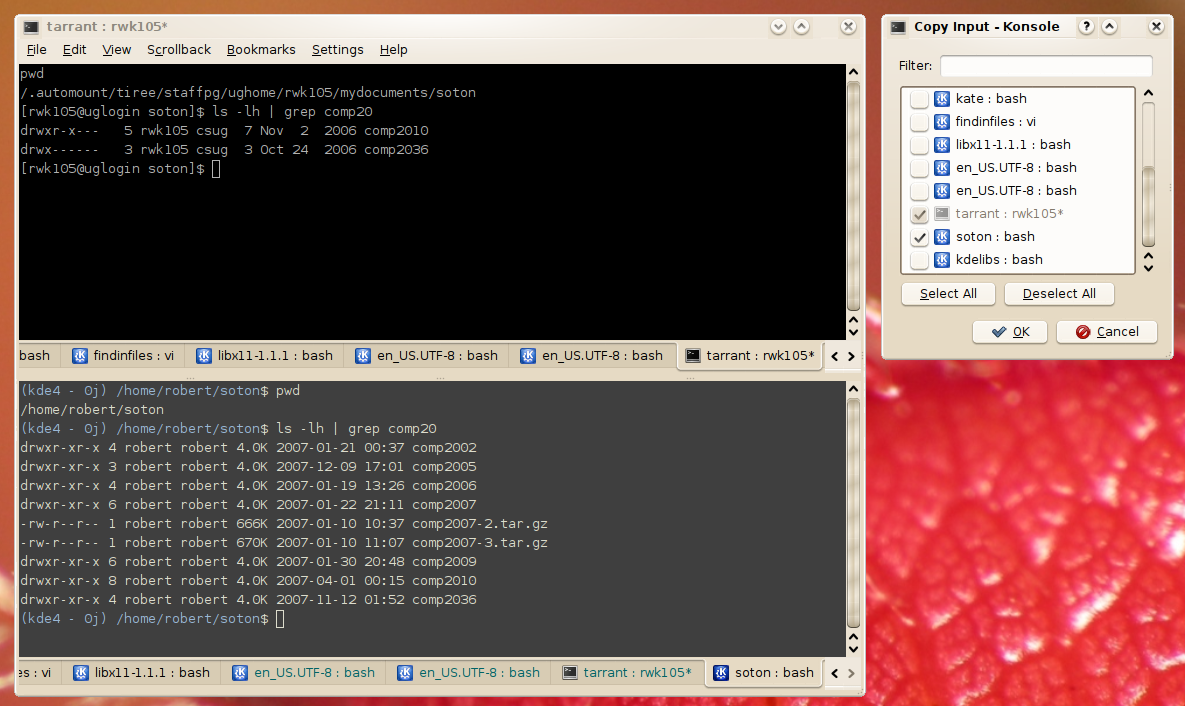
> The ability to send input to all tabs is completely gone
It didn't work at the time of the 4.0 release so it got cut. It has been reimplemented in KDE 4.1 with more flexibility in response to various RFE bug reports:
http://commit-digest.org/issues/2008-04-13/files/konsole-copy-input-to.png
It is not the case the Konsole in KDE 4.0 has 'less features' in total. The menus may look far emptier but there is actually not very much missing. In fact it has quite a few additions, mostly fulfilling a large backlog of feature requests in bugs.kde.org, which I think are very useful:
* The terminal setup UI was replaced with one which is simpler but also more flexible
* Split-view mode
* Incremental search
* Key binding editor
* Improved performance, especially scrolling in large windows
In any case, if you have a complaint then please report it at http://bugs.kde.org/ - I am much more likely to read about it there than on Slashdot. Plus it also allows users to vote on the issues most important to them which is helpful from my perspective trying to allocate the limited spare time I have.
Finally, as someone who followed KDE development discussion quite closely over the last two years, it is inaccurate to say that KDE is attempting to "copy" Windows Vista or is in some large measure "inspired" by it. The menu for example was originally developed by OpenSuSE for KDE 3 - a long time before Vista was released, based on openSuSE's own research. Evidence of this can be found in some notably different design decisions compared with Vista's menu. For example, both the Gnome SLED menu and KDE's "Kickoff" have a search facility but it is located at the top of the menu rather than the button because users couldn't find it when it was placed at the bottom.
I think the view that KDE is trying to "clone" Windows, if not trolling, boils down to the use of black on the bar at the bottom of the screen. I am not involved with that part of KDE but I understand that the look of it is quite likely to change somewhat for KDE 4.1. -
Re:Compare against the best.
This 2 links will be good lecture for you
http://commit-digest.org/issues/2007-01-14/
http://dot.kde.org/1168899755/ -
Re:Why not?
Well, nobody forces you to trust a search engine controlled by the German government (I, for one, won't trust it, either). The Point is "ability to choose".
Coincidentially I also happen to be a KDE user (and a critical one). Last time I checked, Lots of KDE work has been done outside of Germany -
K naming scheme and /.
Although that's offtopic: The KDE developers changed their naming scheme for KDE 4. The "K" is now considered mostly silly, new concepts and programs feature the "K" just very little: Solid, Plasma, Phonon, Oxygen,