Slashdot Mirror
Domain: computermuseum.li
Stories and comments across the archive that link to computermuseum.li.
Comments · 8
-
Re:Power Hog
From http://www.computermuseum.li/Testpage/IBM-SAGE-computer.htm
Technical Description
Size: CPU (50 x 150 feet, each); consoles area (25 x 50 feet) (total system=20,000 square feet)
Weight: 250 tons (500,000 lbs)
Architecture: duplex CPU, no interrupts, 4 index registers, Real Time Clock
Word Length: 32 bits
Memory: magnetic core (4 x 64K word); Magnetic Drum (150K word); 4 IBM Model 729 Magnetic Tape Drives (~100K words ea.); all systems with parity checking
Memory Cycle Time: 6us
I/O: CRT display, keyboard, light gun, realtime serial data (teletype, 1300 bps modem, voice line)
Performance: 75KIPS (single-address)
Technology: vacuum tubes (60,000); diodes (175,000); transistors (13,000)
Power Consumption: about 3 Megawatts
-
Re:I like my desktop.
-
Re:Two years from now, these will cost $25
Really, all this is, is a non-bootable hardcard.
Remember those? They were somewhat popular in the 1980s and late 1990s... Little ISA/EISA cards with a 20 to 40mb harddisk attached?
To me, this is just a rehash of 20 year old technology, that has been merficully forgotten by today's generation.
If you want something a little more interesting, look at this... Or This.
Both are SATA, but are potentially user-upgradeable. The latter is deffinately more price competative per GB, AND it's bootable!
-
Re:Technological Advancement
or this by ESR as well.
-
Re:Information free
No they didn't! The Polymorphic Personal Computer (1978)
-
A mechanical computer! The Digi-Comp 1
My first computer was a plastic and metal mechanical computer called the "Digi-Comp 1". Got it for Christmas in 1963 or 64 See http://www.computermuseum.li/Testpage/Digicomp-Ki
t -1963.htm and http://www.csparks.com/gallery/Digi-comp for pictures. It was a 3 bit machine and could do all the basic operations via mechanical connections of flip flops.
I later worked on a PDP-10 and PDP-8 in high school and PDP-11, IBM 1103, 360 and 370 series in college. Moved up to job programming PDP-11s. Later bought a Sinclair ZX-81, but it SUX0R3D, so I got an original IBM PC. -
digicomp
My first computer was a Digicomp. It had a hand operated clock and not much RAM (3 bits), but it was lots of fun. Never ever got a BSOD, either.
-
Re:Intel Launches NotebooksOK, I should have said ancient museum pieces.
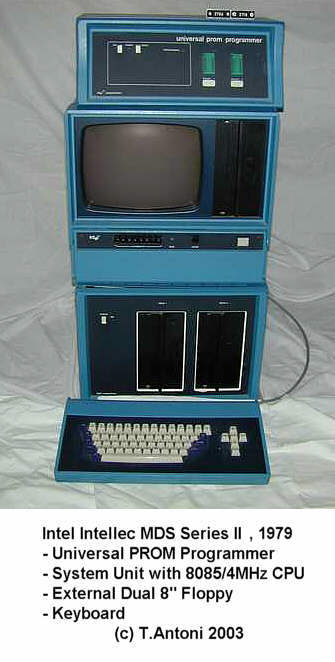
The first is a circa 1979 Intel MDS-235, the second generation of the MDS-800, the machine CP/M was written on. It was a Multibus machine, with a 2MHz 8085 processor (almost certainly the first production 8085 machine), 64K of static RAM (filled a full card), an integral 8" Single Density 128K floppy drive, and an external dual 8" Double Density 256K drive enclosure. My drive enclosure differs from the pictured one - the drives in mine are horizontal, so the unit is "only" about 6" high. I have the EPROM burner too, with 2716 (4K EPROM) and 2732 (8K EPROM) modules. The full package, new, cost $27,000.00 IIRC. I've got a ton of software for it (on 8" Dysan floppies), and all the books, too. My wife has been after me for 20+ years to get rid of it; at this point I'd like to find a good museum to donate it to. It was running OK the last time I used it, but I'm afraid the capacitors could be dried out by now, so I'm kind of afraid to turn it on.
The second is an Intel 310, which I can't seem to find any pictures of on the Internet. It's a Multibus box with a 12 MHz 80286 and a 10 MHz 80287 on one card and 512K static RAM filling another card. The disc drive was a full-height 5-1/4 20 MB (MFM) drive. It was a popular (??) box to run iRMX-86 (Intel's Realtime Multitasking OS) on, for controlling stuff. I used it to develop a controller for elevators in office buildings. I also had the Intel (licensed from Microsoft (licensed from the original SCO)) version of Xenix for it. I bought it about the time the PC-AT came out, for about $5000.00, and I've still got all the books and media for it.
Intel has made mass-market IBM-PC compatabiles in the past, but they haven't done that on a long time.
Christ I'm old; it's time for my nap.