Slashdot Mirror
Domain: couk.com
Stories and comments across the archive that link to couk.com.
Comments · 7
-
Re:May have missed ?
May have missed ? I'm fairly certain it definitely missed.
I don't think it was a comet, therefore I'm fairly certain a comet didn't miss as described so I think you're wrong.
A cometary fragment explanation is ridiculous. Bonilla's observations state that the time to cross the sun's disc was variable, between 1/3 and 1 second. If some of the bodies were moving three times as fast as others, there is no way they were fragments of the same comet.
His observations over the course of 25 hours along with a minimal escape velocity from Earth of 10 km/s give a stream that is 900,000 km long. To not be seen by Puebla or Mexico city, the stream would have to be less than 600 km wide. In the article's sample picture of a fragmented comet, the pieces are spread out over 80 pixels wide and 240 pixels long. Being generous with the figures I calculated, the stream would be 1 pixel wide and 1500 pixels long. Comets just don't break up like that. With the same 1/3 ratio as the given picture, the swarm would have been at least 300,000 km wide. Not only would that mean it was easily visible crossing the sun from anywhere on Earth (Bonilla had astronomers at Mexico City and Puebla look for them and they couldn't see them), but if it were not flat for some unthinkable reason then Earth would be well inside the swarm and many pieces would have hit us.
The more you increase the speed, the longer and narrower the stream becomes, making it even more ridiculous. The more you increase the altitude to make the stream able to be wider, the more you increase the speed. At 64,000 km the speed needs to be 593 km/s (563 km/s relative to the sun) to meet the observed crossing times. That's fast enough to leave the milky way (>= 525km/s) and certainly the Sun (40 km/s at Earth's orbit).
Now think about this: Why didn't any of this 900,000 km stream of objects impact Earth? The first object to pass would have moved 900,000 km relative to Earth, but the Earth moved 2,700,000 km relative to the sun in that time, so those objects moved either 1,800,000 or 3,600,000 km relative to the sun in that time. And every single object in this 900,000km long, 600km wide flat band was travelling at just the right speed to pass between the sun and Bonilla.
Now try to draw a graph of it, it is impossible. The comet must have been in a very similar orbit to Earth's. Imagine the Earth was not there. The first fragment would be at point A, 500-8000km from where Mexico would be in relation to the sun. 25 hours later the last observed fragment would be at point B, 2,700,000 km from point A and 500-8000km from where Mexico would be in relation to the sun at that time. There is no orbit that those two fragments could share that would make them hit those two points if they were together prior to that.
-
How Do You Classify Mine?What about the comments where I link to the original paper and its machine translation?
"STEP ON THE SOLAR DISK OF A SWARM OF OBSERVED corpuscle
Observatory in Zacatecas (MEXICO). "
"By Jose Tree and Bonilla (Director of the Observatory of Zacatecas, Mexico).
"I have the habit at the observatory in Zacatecas, located at two thousand 502
meters above sea level, daily observation of the surface state
solar drawing, via direct and projection, stains and grains, as
also the protuberances of the solar chromosphere, to borrow to do the
spectroscope.
To this end, I adapted the equatorial opening 0.16 m, a device
projection it receives on a sheet of paper a picture of Sun 0250 m
diameter, because the field of the lens does not project more than its surface
0260 m and is unclear. When the solar disk offers some interest took
photographs of 0067 m in diameter, through snapshots plates
Gelatin silver.
The dome of the Observatory has small windows and thick black curtains,
so that does not penetrate through the lens nothing but the image of the sun
His ever noticed provision allows, with precision and clarity, faculae
and the smallest details of sunspots and granulations, thanks to the
transparency of the atmosphere and the height to which it is located the
Observatory, under a tropical sky (22 ° 46 '34 "north latitude 9).
On August 12, 1883, at 08:00 am, I began to draw
spots when suddenly I perceived a small body of light that penetrated
the field of the lens, drawing on paper that I used to play
spots, and walk through the solar disk projecting a shadow almost circular.
He had not yet left my surprise when the same phenomenon was repeated again
and this is often such that two hours could count up to 283 bodies
across the solar disk.
Slowly, the clouds hampered the observation could not restart until
the time of passage of the sun across the meridian and only 40 minutes, during which
were counted again within another 48 bodies. The paths followed by these
bodies indicate a direct displacement from west to east, more or less inclined
north or south of the solar disk. In a few minutes of observation I noticed that these
bodies that looked black and gloomy, a perfectly round and more or
less elongated-, when projected on the solar disk offered bright images
leaving the edges and across the fields of the lens.
Intervals were variable steps, both passed a body or two-no
using more than one third, half a second, or a second maximum to cross
disk, and a minute or two passed before there others as well
spent 15 or 20 at a time, so it was difficult to count. I could fix the
history of many of these bodies on the solar disk, marking its entry
and outputs in the paper that I used to draw the traces, that role, as
equatorial lens followed, by a system clock, the movement
Sun's apparent diurnal on the sky. Figure 118 is a reduced copy
the drawing I made that day the solar disc (250 mm in diameter) with
trajectory of the bodies and sunspots.
Often taking pictures of the Sun, when your hard smudged and
faculae remarkable, I put in a position to photograph just the rare and
interesting phenomenon of these bodies pass through the solar disk.
For this reason, I replaced in the same equatorial target by another 0.16 m
of equal intensity, but chemical source (suitable for photographic work),
I adapted to the eyepiece and the camera. After several trials to
correctly approach these bodies, I managed to take some pictures, of which I
chosen what I consider more interesting to send to the journal Astronomy '.
While these photographs I took an assistant counted the bodies in the 'search'
the equator. The photograph was taken wet collodion 1 / 100 of a second.
This rate did not give me time to filter -
Re:3D Modelling Applications?
sony do a video camera with an extra channel for depth information
real world models need to be shot from 360degrees and thus are usually recorded while static, the camera revolves around them
we used such a system for our Boo Radleys video
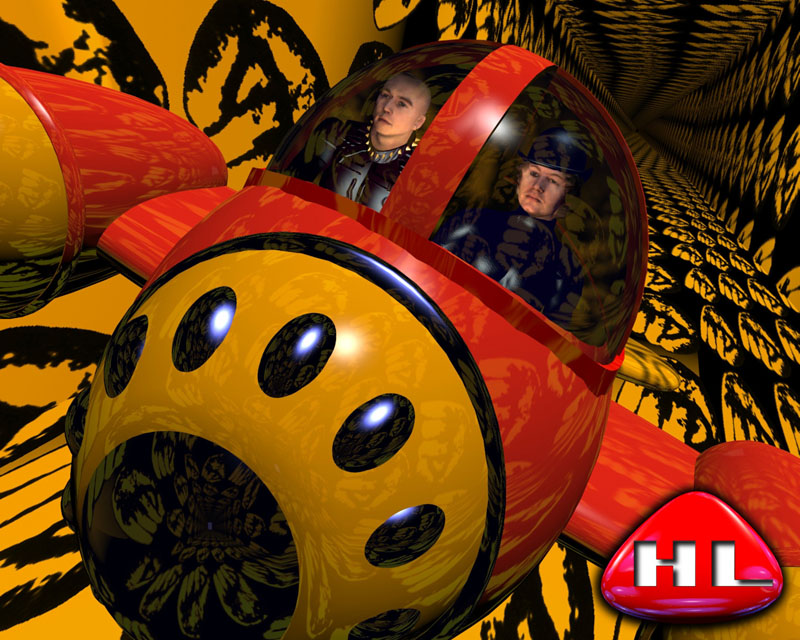
The band members were scanned in, two of which you can see pilotting the plane in this shot
however the tiger in this one I rotated and scanned in by hand on a flatbed scanner and then used photoshop to build profiles and then used the extruder to make it 3d, took me about 8 hours !
-
Re:3D Modelling Applications?
sony do a video camera with an extra channel for depth information
real world models need to be shot from 360degrees and thus are usually recorded while static, the camera revolves around them
we used such a system for our Boo Radleys video
The band members were scanned in, two of which you can see pilotting the plane in this shot
however the tiger in this one I rotated and scanned in by hand on a flatbed scanner and then used photoshop to build profiles and then used the extruder to make it 3d, took me about 8 hours !
-
Re:3D Modelling Applications?
sony do a video camera with an extra channel for depth information
real world models need to be shot from 360degrees and thus are usually recorded while static, the camera revolves around them
we used such a system for our Boo Radleys video
The band members were scanned in, two of which you can see pilotting the plane in this shot
however the tiger in this one I rotated and scanned in by hand on a flatbed scanner and then used photoshop to build profiles and then used the extruder to make it 3d, took me about 8 hours !
-
Re:NASA and Being Sexy
robat that touches stuff and messes around: SEXY
Mmmm... Sexy robot... Wouldnt mind getting my stuff touched and messing with one of these. -
Re:Rendering artefacts between cards?
I used to see that with 3ds4 as well when I was rendering this. One was a pentium and one was a pentium pro.
Ah those were the days. We were on a deadline and rendered it over Christmas. After four hours the disks would be full and it would be time to transfer it to the DPS-PVR. I spent six days where I couldn't leave the room for more than four hours, sleep included. Was pretty wild !
VH1 viewers voted it second best CGI video of all time, behind Gabriel's Sledgehammer so I guess it was worth it!