Slashdot Mirror
Domain: denisdutton.com
Stories and comments across the archive that link to denisdutton.com.
Comments · 20
-
Re:Really?
Sorry, you're wrong.
As a HS physics and math teacher during the 1970's I remember very well the alarmist warnings about the planet freezing due to natural cooling. Those alarmists were usually the sames ones who were spouting "nuclear winter" if we weren't more agreeable with the USSR concerning arms control. I include a link to a PDF of a Newsweek article
http://www.denisdutton.com/new...
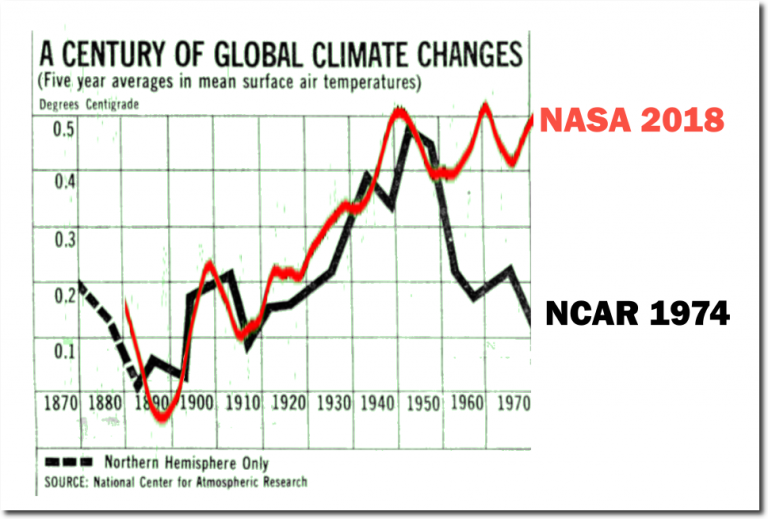
because it contains a graph by the gov's NCAR (National Center for Atmospheric Research) which showed the average temperature decline from 1940 to 1970. The graph is significant because this year NASA released their "data" for the same period and they have conveniently eliminated the 30 year drop in temperatures.
https://realclimatescience.com...There was no Internet back then, as you should know, so mass communication was done through newspapers and periodicals. Those sources were about evenly divided politically, and editors filtered letters to the editor, sometimes making them appear just the opposite of what the writer actually wrote (from personal experience).
Most trusted were the talking heads of the TV news casts. In the early 1980s 8' satellite TV dishes were set up in villages and at farm houses in rural areas because city based cable TV companies would not string cable out to those locations for economic reasons. When properly aligned (installing and aligning them was part of my business) the viewer could swing across the sky to tune in channels transmitted by 5watt transponders (thus the need for 8' dishes) on various satellites. One satellite was Westar IV, which contained the ABC news feeds. Folks would watch Max Robinson and Frank Reynalds discuss how they would present the news. One could watch the live feed, which was never broadcast and didn't include ads, then watch the actual news cast which was later broadcast. The difference between what one saw watching the live feed versus what the two talking heads said had happened destroyed my faith in the integrity of the evening news broadcasts. They had an agenda and they didn't mind lying about the news to spread it.
Folks in the rural areas began protesting to local TV affiliates, especially with tape recordings comparing what actually happened with what was presented. One I remember very clearly was President Reagan arriving at a NOW convention. He walked onto the stage and got a 10 minute standing ovation. He spoke for about 20-30 minutes and, as was customary with Reagan, he interspersed about a dozen jokes. All but one received raucous laughter. He got another 5 minute standing ovation as he left the stage. That's what I saw. The 5pm ABC World News Tonight started off with "Reagan received mixed approval at the NOW convention", played the video clip where the woman didn't laugh at that one joke, and then followed it with a 1 minute and 47 second rant by Eleanor Smeal about how Reagan was going to drag women by the hair back into the stone age. If Reynolds and Robinson were to be believed Reagan barely got out of the NOW convention alive. So it was with every political story, always slanted to favor the Democrats.
The national TV corporations began encrypting their transponder signals so the common folk could not see the ACTUAL news for themselves and make up their own minds. The response was a brief market in decryption chips, which Congress made illegal to make, sell or buy in the US, following intensive lobbying by the broadcasting companies. So, rural folks have not trusted national news for the last 30-40 years, which explains, in part, why rural areas are conservative. That big cities got their info from slanted news casts explains why they are mostly "Liberal".
With the Internet the big corporations and social websites do not control ALL of the news. Local news shows (radio or TV) and videos taken by
-
Re:Progress in Human Geography?
5 is BS: it would be impossible to write concise science papers without using technical language of the field you are in.
Sigh.
5) Never use a foreign phrase, a scientific word, or a jargon word if you can think of an everyday English equivalent.
6) Break any of these rules sooner than say anything outright barbarous.If there's no everyday English equivalent for "Cetacean"... then, according to Orwell, use "Cetacean".
Or, could this not be rewritten in a more clear manner:
As my story is an august tale of fathers and sons, real and imagined, the biography here will fitfully attend to the putative traces in Manetâ(TM)s work of âoeles noms du pÃre,â a Lacanian romance of the errant paternal phallus (âLes Non-dupes errentâ), a revised Freudian novella of the inferential dynamic of paternity which annihilates (and hence enculturates) through the deferred introduction of the third term of insemination the phenomenologically irreducible dyad of the mother and child.
http://denisdutton.com/bad_writing.htm -
Re:Someone doesn't undestand the Bechtel test.
I have yet to meet a woman who doesn't love to talk about relationships with other women.
Shame. Sound like you know only pretty boring women.
And while men may not talk about relationships per se, we do talk about women. A lot.
And men too!
Those conversations have their place, but if you spend most of your time on either of them it's dull, dull, dull.
In fact, there's a convincing argument to be made that everything we do is in the pursuit of securing or keeping a mate,
If there is such an argument, I've not seen it.
You need to read more research papers by real scientists and not sociology grads. Start with this - a talk given by a real scientist who did actual peer-reviewed double-blind controlled studies for decades. I'll take his conclusions over your skepticism; most ofwhat we do is driven by instincts honed by evolution over thousands of years. Those who did things differently didn't have any progeny and so their instincts aren't around anymore.
So, now you've seen the argument, peer-reviewed and backed by controlled studies, supported by the most respected academics in the field. You are not going to be able to say "I've not seen that argument before" when you see this argument again.
-
Re:Dog and cats! Living together! Mass hysteria!!!
You can worry about global cooling in five or ten thousand years.
Much like the world did when I was back in highschool in the 70's.
Hmm, yep, one article talking about the documented temperature decline between 1880 and 1950, which itself even included data showing the rate of decline was decreasing, sure does undo the past 40 years of climate science that has taken much more data into account. Surely, if we were wrong about something back when we had 1/10th the information we do today, that means we are always going to be wrong about it! I like where your head is.
-
Re:Dog and cats! Living together! Mass hysteria!!!
You can worry about global cooling in five or ten thousand years.
Much like the world did when I was back in highschool in the 70's.
-
Re:Some facts for everyone
Just for reference: Newsweek: Global Cooling (1975)
-
Re:I love to be the first to say this...
Sorry I can't find a link, but I know of which he speaks. In the late 70s Time, and IIRC Newsweek and several other of the big magazines of the day were running this story about how we were headed into another ice age. There were several scientists at the time just beginning to study ice cores and were claiming we appeared to be headed straight into another major cooling period, hence another ice age.
IIRC these guys got lots of grants, did more ice core drillings, and then quietly dropped off the radar. look up "Time 70s ice age prediction" and maybe you'll have better luck, as my Google Fu doth suckth. Correction, it was Newsweek and here is a PDF of the 1975 issue. Hey, maybe my Google Fu is getting better!
-
Re:Should not be a surprise
We have already noticed problems with soot. In fact I recall reading books about terraforming where soot was sprinkled on an ice cap, so the idea is pretty old.
The article you are referring to is HERE. It was in response to Global Cooling, which as we all know was false and THANK GOD we didn't do anything about it. Regardless of our arrogance back then, science in the 70's was no where near where it is today. If we had acted on our ignorant assumptions, it surely would have led to an enormous disaster today.
I wonder what we'll be saying about Global Warming in 35 years.
Actually, I recall reading that this was actually being done and on a large scale. Some countries did this for years on. It was done to decrease see ice. But you won't find it in IPCC report.
-
Re:Should not be a surprise
We have already noticed problems with soot. In fact I recall reading books about terraforming where soot was sprinkled on an ice cap, so the idea is pretty old.
The article you are referring to is HERE. It was in response to Global Cooling, which as we all know was false and THANK GOD we didn't do anything about it. Regardless of our arrogance back then, science in the 70's was no where near where it is today. If we had acted on our ignorant assumptions, it surely would have led to an enormous disaster today.
I wonder what we'll be saying about Global Warming in 35 years.
-
Re:Tax & Tax
You're so insistent on taking me out of context, I'm not sure it's even worth responding.
Ad Hominem.
Even among climate skeptics (at least, the subset of skeptics with scientific credentials in relevant fields), only a handful will go so far as to claim that the warming is imaginary.
Maybe you just don't hear them because they're being suppressed. example A
example B
And have you seen this?Who is this "we" who wanted to cover the polar ice caps in tar 30 or 40 years ago?
Scientists clamoring for government to do something about Global Cooling
I never claimed it was a consensus, and I didn't mean to imply that.the number of peer reviewed papers predicting warming outnumbered the number that predicted cooling by about 6 to 1.
Your link does not support this, but suppose I take that as fact. I for one do not care how many people say something is true. In 1300 everyone knew the Earth was flat and everything revolved around it. Just because there is some kind of "consensus" either then or now, doesn't mean it's true.
Remember, the cap doesn't even kick in until 2012, and the industries that are most affected will continue to receive a sizeable number of free carbon permits for at least a decade after that.
Finally some good news. If I work real hard, I can get a raise so that I can pay my taxes. *feel the sarcasm!*
Sure, if somebody burns down your house, it's suddenly "more economical" to live under a bridge than in the middle of a field.
We need to be mindful of the timescales involved here. Burning a house down is a very immediate thing, with no warning, and little that predisposes one to having such a problem to begin with. If you live on the beach, you run the risk of your house being flooded by a storm swell, global warming or not. If you're not smart enough to get insurance, that's what we call natural selection.
Frankly, I'm stunned that someone can simultaneously believe that "the market" is capable of uprooting thousands of coastal cities, and yet is so fragile that it will fall over the moment CO2 pollution gets a price.
I don't think the market will fail. It is very resilient. I'm not like the alarmists- I'm not predicting doom for the economy if we don't do what I want. It'll just be harder on everyone, and you yourself admitted we don't know for sure if it will be a huge disaster. If it ain't broke, don't fix it.
It seems that, in your mind, no disaster is truly epic so long as there are survivors, and that it wouldn't be worthwhile to you to take a $1500 pay cut to avert any disaster that leaves a handful of humans behind.
Putting aside your slight on my reasoning and risk evaluation, I maintain that it is not an epic disaster. New York may have to move a few miles up the Hudson. I admit that this is not cheap. But I submit that no one will die in the process. A slug could walk away from the rising sea it's happening so slowly (if it's happening). So it's a choice between economic hardship now, for something that could happen in the future, because of something that we might be causing, or we continue to prosper, allowing businesses to finance R&D that could produce a cheaper cleaner fuel- which they will, because who wouldn't buy that?
A made-up number from Heritage, an right-wing propaganda mill built from the ground up to oppose any and all regulation.
I suppose if Hitler had statistics supp
-
Re:So now we have theRather than letting the UN decide to ban DDT, how about we let the people affected decide if they want it banned. Why not ask them? Yeah, why not ask the people affected? But you didn't ask them. You cited an organization of African Americans talking about DDT in Africa. Why not ask the actual Africans? If you did, you might learn that DDT is not banned in Africa, and that both WHO and USAID recommend limited, targeted DDT use in anti-malarial campaigns. You might also learn that excessive DDT use in Africa has lead to malaria-resistant mosquitoes (particularly in west Africa), and that anti-malarial organizations in those countries recommend moderating DDT use and mixing it with other measures (netting, artemisinin-based combination therapy, etc.). The very web site you link admits that DDT is not banned in Africa for anti-malarial use.
So, tell me, how many millions have died due to "a ban on DDT"? Please be sure to cite the scholarly literature to support your answer. Methinks you need to find qualified sources. I've read the Newsweek article. It's a scare piece. Despite its dire insinuations, it says virtually nothing about actual scientific studies predicting an imminent ice age. Read it here.
The Newsweek quote above is a fine quote about how the climate cooled in the past — which it did! But that's got nothing to do with whether we were supposed to be "in an ice age right now".
In another comment, you cite Rasool and Schneider. Do you know why you cited Rasool and Schneider? Because that's pretty much the only paper published in the 1970s which predicted large cooling in the near future. The rest were generally either predicting warming, or were agnostic. See here for a literature review.
For that matter, have you even read Rasool and Schneider? Their prediction of strong cooling was based on their assumption that atmospheric pollutant emissions would outpace greenhouse gas emissions. In other words, their main error was not in the climate science, but in their economic/industrial forecasting. (True, they lowballed climate sensitivity as well, but that doesn't imply any cooling, just less greenhouse warming.) Their fundamental climate point was RIGHT: if aerosol emissions really had accelerated they way they speculated, they WOULD have a large cooling effect. In fact, that idea has been floated again recently as a means to combat global warming, under the name "aerosol geoengineering". (There turn out to be undesirable side effects.)
So, tell me, where are all the scientific studies predicting that "we should be in an ice age by now"? Be sure to cite the scholarly literature. And shall we ignore the studies which predicted the opposite? -
Re:The way things are goinghe global cooling issue was a 1 time tabloid issue. It was never in the science world other than 1 article. Only idiots point to that. Is Newsweek a tabloid? How about Time Magazine? How about the NY Times? Do not buy it. Just quit polluting and forcing your shit on me and mine. The pollution from my four-banger car is not causing people in underdeveloped countries to starve to death. Over reactions from GW Doomsday predictions are.
-
Re:Yes but...
There has been a warming trend over past 20 years or so. What this data does is support the notion that worldwide temperatures change constantly. That means they are either going up (global warming), or going down.
Not to mention, there was a cooling trend between the 1940s and the 1970s. There was some alarmism about it, but nothing compared to today. However, if the Internet as we know it had been in existence...
-
Re:Also well
However, having only 1 X chromosome sometimes create beneficial effects that would have been masked/averaged out by having 2 X chromosomes.
That's why statistically, the female aggregate more towards the average, while the male polarize from the extreme retarded to the extreme genius, from jails to Nobel Prizes.
To get back to the question. Is Men Obsolete? Read this article and make up your own mind.
http://www.denisdutton.com/baumeister.htm -
Re:Off the hook?
30 Years ago it was global cooling, now that the earth is starting to warm. The glacier has obviously decided to freeze.
-D. Cheney*
*this should really have a catchy name; "Cheney's Folly" maybe? -
Re:ID10T
Hmmm. I never considered Newsweek to be a tabloid, but your mileage may vary: http://denisdutton.com/newsweek_coolingworld.pdf
-
Re:Wrong Way
Perhaps the original poster meant this:
http://en.wikipedia.org/wiki/Global_cooling
Here's the article itself:
http://denisdutton.com/cooling_world.htm
Or other articles relating to it:
http://www.msnbc.msn.com/id/15391426/site/newsweek /
"How did NEWSWEEK--or for that matter, Time magazine, which also ran a story on the subject in the mid-1970s--get things so wrong? In fact, the story wasn't "wrong" in the journalistic sense of "inaccurate." Some scientists indeed thought the Earth might be cooling in the 1970s, and some laymen--even one as sophisticated and well-educated as Isaac Asimov--saw potentially dire implications for climate and food production. After all, Ice Ages were common in Earth's history; if anything, the warm "interglacial" period in which human civilization evolved, and still exists, is the exception."
I think the point is that the alarmist of 1975 appear to be cut from the same cloth as those in 2007 predicting exactly the opposite. If the experts were wrong in 1975, then it seems reasonable that experts could be wrong again. -
Re:Wrong Way
Actually, it's not entirely bullshit. There was a lot of talk about this at the time.
Here's a link that contains the text of the Newsweek article that talks about this.
http://denisdutton.com/cooling_world.htm
(The text doesn't contain the graphs that were included in the original article, but they are interesting in that they could be criticized for much of the same sorts of things that graphs in use today are being criticized for - i.e., they carefully choose their starting/ending points to support the argument, etc.)
Here's an example of one sentence from the article:
"The evidence in support of these predictions has now begun to accumulate so massively that meteorologists are hard-pressed to keep up with it."
Even if it were true that the concern over a coming Ice Age were not widespread among scientists at the time, a reasonable layman reading this article would believe it to be so. If there really were no scientists predicting this, was the journalist just making stuff up? (It does happen, but I haven't heard that in this case.) Or was the journalist talking to at least *some* scientists who thought that this might happen?
Global warming is clearly happening - it's not hard to see. I have lived almost all my life in the north of the US and the winters now are noticeably wimpier - I don't need a degree in meteorology to see it.
However, I don't think you are right to simply dismiss the "Ice Age" mini-scare of the 70s as not having happened. -
Ice Age Scare Article From Newsweek 1975
If they are Rubes (you know the writer wanted them seen that way) then they are at least correct the charade. Here is artcile from 1075 Newsweek calling for politicians "to act" before its too late.
"Here is the text of Newsweek's 1975 story on the trend toward global cooling. It may look foolish today, but in fact world temperatures had been falling since about 1940. It was around 1979 that they reversed direction and resumed the general rise that had begun in the 1880s, bringing us today back to around 1940 levels. A PDF of the original is available here ( http://denisdutton.com/newsweek_coolingworld.pdf )
There are ominous signs that the Earth's weather patterns have begun to change dramatically and that these changes may portend a drastic decline in food production - with serious political implications for just about every nation on Earth. The drop in food output could begin quite soon, perhaps only 10 years from now. The regions destined to feel its impact are the great wheat-producing lands of Canada and the U.S.S.R. in the North, along with a number of marginally self-sufficient tropical areas - parts of India, Pakistan, Bangladesh, Indochina and Indonesia - where the growing season is dependent upon the rains brought by the monsoon.
The evidence in support of these predictions has now begun to accumulate so massively that meteorologists are hard-pressed to keep up with it. In England, farmers have seen their growing season decline by about two weeks since 1950, with a resultant overall loss in grain production estimated at up to 100,000 tons annually. During the same time, the average temperature around the equator has risen by a fraction of a degree - a fraction that in some areas can mean drought and desolation. Last April, in the most devastating outbreak of tornadoes ever recorded, 148 twisters killed more than 300 people and caused half a billion dollars' worth of damage in 13 U.S. states.
To scientists, these seemingly disparate incidents represent the advance signs of fundamental changes in the world's weather. The central fact is that after three quarters of a century of extraordinarily mild conditions, the earth's climate seems to be cooling down. Meteorologists disagree about the cause and extent of the cooling trend, as well as over its specific impact on local weather conditions. But they are almost unanimous in the view that the trend will reduce agricultural productivity for the rest of the century. If the climatic change is as profound as some of the pessimists fear, the resulting famines could be catastrophic. "A major climatic change would force economic and social adjustments on a worldwide scale," warns a recent report by the National Academy of Sciences, "because the global patterns of food production and population that have evolved are implicitly dependent on the climate of the present century."
A survey completed last year by Dr. Murray Mitchell of the National Oceanic and Atmospheric Administration reveals a drop of half a degree in average ground temperatures in the Northern Hemisphere between 1945 and 1968. According to George Kukla of Columbia University, satellite photos indicated a sudden, large increase in Northern Hemisphere snow cover in the winter of 1971-72. And a study released last month by two NOAA scientists notes that the amount of sunshine reaching the ground in the continental U.S. diminished by 1.3% between 1964 and 1972.
To the layman, the relatively small changes in temperature and sunshine can be highly misleading. Reid Bryson of the University of Wisconsin points out that the Earth's average temperature during the great Ice Ages was only about seven degrees lower than during its warmest eras - and that the present decline has taken the planet about a sixth of the way toward the Ice Age average. Others regard the cooling as a reversion to the "little ice age" conditions that brought bitter winters to much of Europe and northern America between 1600 and 1900 - years -
Srinivasa Ramanujan was NOT Blind Tommentioned in an article about David Helfgott
"The mentally retarded Tom, born a slave in Georgia in 1850, was exhibited by his former owner, a Mr. P.H. Oliver, in the nineteenth century as "the greatest musical prodigy since Mozart." A contemporary description of one of his concerts "shrivels the soul," according to Harold Schonberg. Tom would sit at the piano to be bribed by Mr. Oliver with cakes and candy until he played. At the end of each piece he would applaud himself violently. Tom was lauded by the media of his day as "incredibly gifted." One critic was certain she detected in his playing the mark of genius: "Some beautiful caged spirit, one could not but know, struggled for breath under that brutal form and idiotic brain." According to Schonberg, Tom attracted in his day more attention than all other American pianists put together. He toured England and even played at the White House. Blind Tom died in obscurity in New Jersey in 1908. Where Mr. Oliver retired to is unrecorded."
It's unlikely that Tom's fame was due to any musical talent.