Slashdot Mirror
Domain: ditext.com
Stories and comments across the archive that link to ditext.com.
Comments · 17
-
Re:Wait, so dropping bombs on people isn't working
Worked against Japan due to the few (not a lot) big bombs on them and it broke the Japanese.
Not exactly. Japan was being firebombed like Germany was. Add to that the points that Japan has fewer natural resources for war, was being heavily blockaded from gaining more resources, the limited resources they had were pushed further into total war than most nations*, and it was clear by the time of the two nuclear bomb drops that a land invasion would be manned by malnourished recently-civilian mostly-unenlistable** men who only at a fanatical level*** would keep fighting, and I'd say Japan was on a razor's edge of having an internal coup, anyways.
I'd say most the rest is revisionist history on both sides. On the US side to justify the need for the use of nuclear weapons when people came to recognize the possible horrors of a nuclear war. On the Japan side to save face on just how utterly beaten Japan was and how broken they would have become if the fanatics had managed to run the country completely into the ground--because even though a coup would likely have occurred, it may well have occurred too late to make much difference. Really, the same thing appears in the US with the Civil War and I imagine in most any conflict that is personal enough to the population--total war tends to be--that you end up with the wildly opposite views of just how wrong/right one side was or how wrong/right war itself is.
*You're likely to give more of yourself to your emperor God (or an idea) than to a mere Fuhrer (or some vague notion of a "superior race" with its feel-good justification of genocide but dubious origins).
**The old, the feeble, minors, etc.
***A lot of those were lost in the kamikaze attacks which undoubtedly spurred a lot of people to, you know, give up on the notion of the emperor God or the glory of the Japan empire ruling the world.
-
Re:Food for thought
Well, the means that some anarchists (of the real deal) have chosen, weren't nice as well. There were a lot of anarchist terrorist (by the actual meaning of the word terrorism) organisations in tsarist Russia. The Black Banner is a good example.
-
Re:Yes. And. But.Unfortunately it is nothing new and we do not seem to have learned how to deal with it/prevent the rot. Intellectuals have betrayed us all many times in similar ways throughout history.
"You don’t have any other society where the educated classes are so effectively indoctrinated and controlled by a subtle propaganda system – a private system including media, intellectual opinion forming magazines and the participation of the most highly educated sections of the population. Such people ought to be referred to as “Commissars” – for that is what their essential function is – to set up and maintain a system of doctrines and beliefs which will undermine independent thought and prevent a proper understanding and analysis of national and global institutions, issues, and policies." - From Language and Politics
Example:
A more difficult task is to shift the moral onus of the war to its victims. This seems a rather unpromising enterprise -- rather as if the Nazis had attempted to blame the Jews for the crematoria. But undaunted, American propagandists are pursuing this effort too, and with some success. Things have reached the point where an American President can appear on national television and state that we owe "no debt" to the Vietnamese, because "the destruction was mutual."28 And there is not a whisper of protest when this monstrous statement, worthy of Hitler or Stalin, is blandly produced in the midst of a discourse on human rights. Not only do we owe them no debt for having murdered and destroyed and ravaged their land, but we now may stand back and sanctimoniously blame them for dying of disease and malnutrition, deploring their cruelty when hundreds die trying to clear unexploded ordnance by hand from fields laid waste by the violence of the American state, wringing our hands in mock horror when those who were able to survive the American assault -- predictably, the toughest and harshest elements -- resort to oppression and sometimes massive violence, or fail to find solutions to material problems that have no analogue in Western history perhaps since the Black Death.
-
largely ignored by most leading intellectuals....
Let's take Obama's Nobel Prize away and give it to Snowden.
I agree 100%. He's done more for liberty in the USA than any politician has done in 50 years. he's actually managed to push surveillance as a topic of conversation at the average american's dinner table. That alone is an excellent achievement, nevermind the rest he has done.
That all being true, no matter what Snowden or any other activist does to try and roll back the fascist encroachments of absolute power - the peace prize world is off limits. Heroes of the people like Manning, Snowden will continue to be labeled traitors and excluded from all significant high profile peace prizes, Time Person of the Year, in large part due to the failure of our intellectuals:
The article is an attack on the intellectual culture in the U.S., which Chomsky argues is largely subservient to power. He is particularly critical of social scientists and technocrats, who he believed were providing a pseudo-scientific justification for the crimes of the state
Intellectuals have betrayed us all before and it will continue to happen until a groundswell of people start to shun, exclude and shine a bright constant light on these mostly unnamed behind the scenes policy setters who have corrupted their purpose blinding following the "party line" subservience to power.
-
Re:So, by that logic...
No, they don't realize that. That is a big part of the problem.
The 'mystique' of nuclear warfare has overshadowed the truth of the Japan bombings. We wiped most of Japan's cities off the map before August 1945, with conventional bombings, using the high explosive and incendiary varieties of bombs. While their factories were modern steel and cement, the 'bamboo-n-rice-paper' style of their houses meant they burnt very well.
So, while the two bombs produced the largest numbers of victims from single weapons, they didn't kill as many people as many other bombing runs before them.
Links:
http://en.wikipedia.org/wiki/Strategic_bombing_during_World_War_II#Conventional_bombing
http://www.ditext.com/japan/napalm.html -
The Psychology of Politics
Ever since WW2 (even before, if you are prepared to acknowledge the existence of Wilhelm Reich) psychologists have taken an interest in politics. I've found these sources to be particularly enlightening:
Eysenck ('this country' refers to the UK)
Altemeyer (PDF)
Most Americans, in my view, have been deliberately confused by their authoritarians calling themselves 'social conservatives' and talking as if 'liberal' was the opposite of 'conservative', whereas it is really the opposite of 'authoritarian' and orthogonal to 'conservative' (whose opposite is 'radical'). -
Re:Why create the wheel?
The main piece of evidence in your lecture to the indolent and overweight Westerner was your experience of trying to find somewhere to sit during a Wyoming camping trip.
Have you considered that it might not be original poster, but you, who harbors outdated notions? Not that of the noble savage, but that pre-historic life was 'nasty, brutish, and short'. And, more generally, the progressivist view that every technological development is -- necessarily -- improves the quality of life?
In fact, its not that farming took so long to spread because it provided only slightly better conditions at first, but the evidence rather suggests that it drastically worsened the quality of life. Take a look at Jared Diamond's "The Worst Mistake in the History of the Human Race" (definitely worth a read!):
"Another example of paleopathology at work is the study of Indian skeletons from burial mounds in the Illinois and Ohio river valleys. At Dickson Mounds, located near the confluence of the Spoon and Illinois rivers, archaeologists have excavated some 800 skeletons that paint a picture of the health changes that occurred when a hunter-gatherer culture gave way to intensive maize farming around A. D. 1150. Studies by George Armelagos and his colleagues then at the University of Massachusetts show these early farmers paid a price for their new-found livelihood. Compared to the hunter-gatherers who preceded them, the farmers had a nearly 50 per cent increase in enamel defects indicative of malnutrition, a fourfold increase in iron-deficiency anemia (evidenced by a bone condition called porotic hyperostosis), a theefold rise in bone lesions reflecting infectious disease in general, and an increase in degenerative conditions of the spine, probably reflecting a lot of hard physical labor. 'Life expectancy at birth in the pre-agricultural community was bout twenty-six years,' says Armelagos, 'but in the post-agricultural community it was nineteen years. So these episodes of nutritional stress and infectious disease were seriously affecting their ability to survive.' "Yes, life was shorter than today, mostly due to increased child mortality --- a smaller population is, after all, why hunter gatherers can survive with less work, less disease and less crowding ("It turns out that [hunter-gatherers] have plenty of leisure time, sleep a good deal, and work less hard than their farming neighbors. For instance, the average time devoted each week to obtaining food is only 12 to 19 hours for one group of Bushmen, 14 hours or less for the Hadza nomads of Tanzania. One Bushman, when asked why he hadn't emulated neighboring tribes by adopting agriculture, replied, 'Why should we, when there are so many mongongo nuts in the world?' " - from Jared Diamond's piece). But, even accounting for this, it was not until well into the 20th century that life expectancy rates exceeded those of pre-agricultural Paelolithic humans. As Malthus pointed out, agricultural populations tended to grow until they reached famished equilibrium with the limits of food production (obviously, this has changed in the post-industrial world).
I actually don't have a strong opinion on all this -- I believe Diamond has his own political axes to grind, and there may be other evidence that paints all this in a different light. But I am especially bothered by unscrutinized notions about the horrors of pre-technological life, or that see technology is leading us invariably into an ever better future (as long as that technology is not socialized, of course -- God forbid!)
-
Re:Why create the wheel?
Jared Diamond wrote a famous article to that effect: "The Worst Mistake in the History of the Human Race."
"One straight forward example of what paleopathologists have learned from skeletons concerns historical changes in height. Skeletons from Greece and Turkey show that the average height of hunger-gatherers toward the end of the ice ages was a generous 5' 9'' for men, 5' 5'' for women. With the adoption of agriculture, height crashed, and by 3000 B. C. had reached a low of only 5' 3'' for men, 5' for women. By classical times heights were very slowly on the rise again, but modern Greeks and Turks have still not regained the average height of their distant ancestors. "
"Compared to the hunter-gatherers who preceded them, the [Native American] farmers had a nearly 50 per cent increase in enamel defects indicative of malnutrition, a fourfold increase in iron-deficiency anemia (evidenced by a bone condition called porotic hyperostosis), a threefold rise in bone lesions reflecting infectious disease in general, and an increase in degenerative conditions of the spine, probably reflecting a lot of hard physical labor."
-
Re:AI amature hour
Kids, kids, try this for some Sunday reading to get at what I mean by my analogy of it being a "software" and "networking" problem (man you guys can take crap way to literally):
EMPIRICISM AND THE PHILOSOPHY OF MIND by Wilfrid Sellars
http://www.ditext.com/sellars/epm.htmlSurprisingly his writings are best digested by those that have not had their brains tainted by too much study in things like Philosophy, Neurology, and the likes. Perhaps it will inspire someone that knows how to plug in the right wire to come up with an implementation. Call it one of the best road maps we have to date of getting to hard AI (without reinventing the wheal). It likly will not hurt anyone to chase down the 5,000 or so books and problems in Philosophy he mentions, but you can get by without them.
Here however is a short bit of the problem as I see it. "Consciousness", even if it can be generated by dumb luck through "emergence" (we call this a philosophical weasel word) is more than a mere state or property of brain/computer (in isolation). It has a whole rat's nest of linguistic and cultural conditions that have to be met for it to be "Consciousness" (with the big C), not just a simulation of something with consciousness (small c here). Essentially Consciousness does not just happen in the vacuum of a lab.
Obviously, and to my original point, this not one of those subject that can not be done justice to in a one hit wonder headline on slashdot. It is scientific trolling with overly sensational headlines on slashdot that gets all the computer geeks scifi fantasy panties in an uproar. There was likly over a 1,000,000 papers published last month in AI, linguistics, philosophy, neurology, and related fields on the same subject that could have been spun the same way if a slashdot poster had stumbled across them on the internet.
-
Re:Infrastructure considerationsEvidently they don't teach history outside the US, either... Considering that 31 Japanese cities were over 50% destroyed by US bombing. And that those 31 cities comprised half the Japanese population. I'd say that 50-99% destruction qualifies as leveled. Tokyo over 50% destroyed. Reduced to nothing but rubble.
Also interesting to note that Hiroshima and Nagasaki's atomic bombing caused LESS infrastructure damage than that delivered to Toyama or Tokushima, in terms of percentage of city destroyed.
-
Reasons why this may be true
OH NOES!!! The US lags behind Japan! This may be true. However...
1. Telcoms. Yes, the telcoms screwed the pooch. They were supposed to have this a lot farther along than it is. But they're getting to it. Currently, Verizon has ~4 million households wired for fiber. But they are they only company rolling out fiber? And I'm glad it's only one. I really don't want ALL of them digging up my yard every few months.
2. States vs countries. The US is not a monolithic block. Rather, it is a collection of 50 states, each with their own rules, etc.
3. Size. All you clowns saying size/density doesn't matter are FOC. It is significantly easier to wire 50 million houses than 105 million. And when you consider the physical distance between houses, it's even more expensive. Wiring up 20 houses per mile is harder/slower/more costly than 50 houses per mile. US houses generally have more land between. Which leads us to
4. But why aren't the cities wired? Equal density to Tokyo. Well...Tokyo doesn't have a 150 year old infrastructure. NYC infrastructure, for instance, is horrendous. Chicago the same. Pulling yet another new set of lines through there would be a nightmare. Tokyo and a host of other cities in Japan were leveled in WWII. Some almost totally. With a large influx of worldwide money, they started over in the 50's.
Verizon seems to be concentrating on the smaller midsize cities and suburbs first, rather than trying to tackle the hardest nuts first.
5. Customer inertia. Most of the US has had cable/DSL available for a while. Even with it available, a lot of people don't see a personal need for it. Now comes in fiber. Convince me to change. What type of connectivity did the average house in Japan have? Did they go through a long period of 'better than dialup'? I have fiber available, but am satisfied with my current cable connection. I haven't seen a need (yet) to restructure my house connections and billing again.
Are we behind? Maybe, maybe not. But there are a variety of reasons why this may be true, other than just "The Japanese are so much better than the US." -
Re:Personal experience of the MultiverseOccam's Razor and Bertrand Russell do a decent job of convincing me here:
In one sense it must be admitted that we can never prove the existence of things other than ourselves and our experiences. No logical absurdity results from the hypothsis that the world consists of myself and my thoughts and feelings and sensations, and that everything else is mere fancy. In dreams a very complicated world may seem to be present, and yet on waking we find it was a delusion; that is to say, we find that the sense-data in the dream do not appear to have corresponded with such physical objects as we should naturally infer from our sense-data. (It is true that, when the physical world is assumed, it is possible to find physical causes for the sense-data in dreams: a door banging, for instance, may cause us to dream of a naval engagement. But although, in this case, there is a physical cause for the sense-data, there is not a physical object corresponding to the sense-data in the way in which an actual naval battle would correspond.) There is no logical impossibility in the supposition that the whole of life is a dream, in which we ourselves create all the objects that come before us. But although this is not logically impossible, there is no reason whatever to suppose that it is true; and it is, in fact, a less simple hypothesis, viewed as a means of accounting for the facts of our own life, than the common-sense hypothesis that there really are objects independent of us, whose action on us causes our sensations.
The way in which simplicity comes in from supposing that there really are physical objects is easily seen. If the cat appears at one moment in one part of the room, and at another in another part, it is natural to suppose that it has moved from the one to the other, passing over a series of intermediate positions. But if it is merely a set of sense-data, it cannot have ever been in any place where I did not see it; thus we shall have to suppose that it did not exist at all while I was not looking, but suddenly sprang into being in a new place. If the cat exists whether I see it or not, we can understand from our own experience how it gets hungry between one meal and the next; but if it does not exist when I am not seeing it, it seems odd that appetite should grow during non-existence as fast as during existence. And if the cat consists only of sense-data, it cannot be hungry, since no hunger but my own can be a sense-datum to me. Thus the behaviour of the sense-data which represent the cat to me, though it seems quite natural when regarded as an expression of hunger, becomes utterly inexplicable when regarded as mere movements and changes of patches of colour, which are as incapable of hunger as triangle is of playing football.
But the difficulty in the case of the cat is nothing compared to the difficulty in the case of human beings. When human beings speak -- that is, when we hear certain noises which we associate with ideas, and simultaneously see certain motions of lips and expressions of face -- it is very difficult to suppose that what we hear is not the expression of a thought, as we know it would be if we emitted the same sounds. Of course similar things happen in dreams, where we are mistaken as to the existence of other people. But dreams are more or less suggested by what we call waking life, and are capable of being more or less accounted for on scientific principles if we assume that there really is a physical world. Thus every principle of simplicity urges us to adopt the natural view, that there really are objects other than ourselves and our sense-data which have an existence not dependent upon our perceiving them.
As for objective vs. subjective realities, that's a pretty steep stretch to make what you said fit the common definition of reality. Like with Russell's simplicity argument above, I'd rather just believe you used the wrong word. -
Re:I call troll
Reading Socrates' thoughts on justified true belief might give you some perspective on this.
Before you quote Socractes and JTB, read Gettier's response to it. Give you some persepective on the problems of JTB and epistemology. -
Re:False presumptionAn interesting demonstration (Kripke's argument? or Chisholm's??). I think you would do better with a little doubt. Read Sellars' EPM, maybe. You seem to think that "semantics" is given—but it is very like that nothing is given, except some very rudimentary "syntax" (or something like that). The process of acquiring "semantics" in human beings is mysterious and by no means a solved problem.
And while this does not imply that one must have concepts before one has them, it does imply that one can have the concept of green only by having a whole battery of concepts of which it is one element. It implies that while the process of acquiring the concept of green may — indeed does — involve a long history of acquiring piecemeal habits of response to various objects in various circumstances, there is an important sense in which one has no concept pertaining to the observable properties of physical objects in Space and Time unless one has them all — and, indeed, as we shall see, a great deal more besides. — Sellars, 19 [bold added]
-
Re:False presumptionAn interesting demonstration (Kripke's argument? or Chisholm's??). I think you would do better with a little doubt. Read Sellars' EPM, maybe. You seem to think that "semantics" is given—but it is very like that nothing is given, except some very rudimentary "syntax" (or something like that). The process of acquiring "semantics" in human beings is mysterious and by no means a solved problem.
And while this does not imply that one must have concepts before one has them, it does imply that one can have the concept of green only by having a whole battery of concepts of which it is one element. It implies that while the process of acquiring the concept of green may — indeed does — involve a long history of acquiring piecemeal habits of response to various objects in various circumstances, there is an important sense in which one has no concept pertaining to the observable properties of physical objects in Space and Time unless one has them all — and, indeed, as we shall see, a great deal more besides. — Sellars, 19 [bold added]
-
Re:Great. A flexible clock!
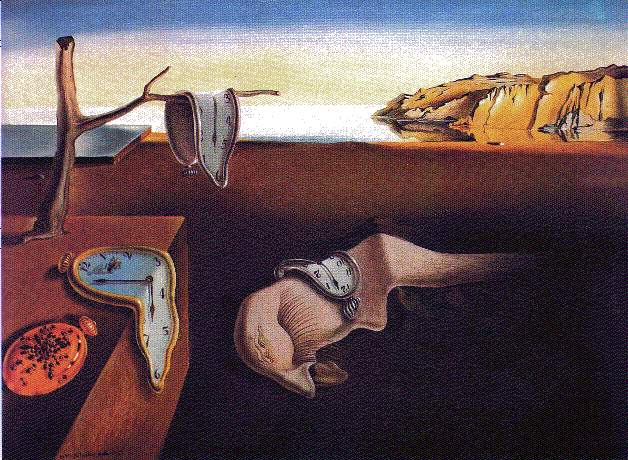
Salvador Dali (the "inventor" of bending clocks if you like) would have died again if he saw this. I thought they were going to recreate the clock in Dali's painting Persistence of time but they've made a digital one!?!
-
Re:Corrupt Health Care System
So, in order to have these databases do the trick, first you'd need to create amazingly complex diagnosis devices, that could scan a human being, measure every possible symptom, and punch all of the data it collected to determine whether that matrix of symptoms matched a disease.
So your doctor scans you, measuring every possible sympton and then analyzes all that data? The amount of data collected by a doctor is very small, and only increases when analysis fails. This would be true for a computer based system as well.
You may think that such a system is far-fetched, too complex to build, and would its cost would be prohibitive. Most of the "scanning" is already out there already. A doctor doesn't take your temperature, pulse, bood pressure -- a nurse does. They write this information down and give it to a doctor. Why not have the nurse enter the information into a device instead? Nurses also listen to your symptoms, which are from a finite set of common ailments, and pass this on to the doctor. Again this could be passed to a computer. A doctor doesn't take your blood and analyze it. This is done by an outside lab with the results sent to the doctor. So why not have this information sent to the diagnostic computer in some standard way? A doctor doesn't perform an mri or x-ray, these are done by technicians with the results given to the doctor. Again this could be given to a computer instead.I don't care if it's cheaper. If I was sick, I'd much rather talk to a doctor about it than a machine
Most people pay thousands per year in health insurance. If people don't feel the lesser expense makes up for not seeing a doctor, then hospitals that choose not to use this technology and instead keep the current system will thrive. Consumers will make the choice. If they are willing to pay more to choose an insurance plan that lets them bypass machines and only see human doctors, then that is great! It would be a free market at its finest. I'm not arguing to force people into this, I am just arguing for the choice.
But you know there are people who do not have insurance, people for whom health care is too expensive to even have right now. I think these people would be happy to get health care from a computer vs. no health care at all.$200 Nike shoes cost about $2 in materials and labor. But Nike charges a lot.
Oh boy, yet another person who knows nothing about economics. People pay for Nike because of brand recognition. They could just as easily go down to Wal-Mart and buy a pair of shoes for a couple of dollars. Your example is not one that disproves the free market, but instead shows its strength. If a product has an extra value that people find utility in, they will pay for it. The fact that you may think that this extra value is silly is irrelevant. If hospitals could do the same thing, i.e. Nike Hospital can charge more and people are willing to pay, then that is good for them. Once again it is a free market in action with people exercising their right to choose.If hospitals didn't spend money on doctors, they'd find something else to spend the money on.
If a hospital is run by a corporation, then they will not spend anymore money than they have to. Otherwise share holders will be upset, etc. Take a look at corporate America over the last couple of years. The fact is that like most companies, personnel expense are the biggest ones for a hospital, and if you compare what a nurse/technician makes vs. a doctor, then its pretty obvious where to look if you wanted to cut costs.Healthcare isn't expensive in the US because of the doctors.
Yes it is. I highly recommend reading Nobel prize winning economist Milton Friedman's analysis of the costs of health care and the AMA.