Slashdot Mirror
Domain: dumbscientist.com
Stories and comments across the archive that link to dumbscientist.com.
Comments · 540
-
Re:Mission accomplished
Yes, or no. Do you deny that given the size of the body of evidence, the probability of ALL available evidence being against the ideas of creationism or "young Earth" is very close to zero? Do you deny that a corollary if this is that SOME evidence must almost certainly be supportive of creationism?
You've repeatedly claimed that some facts support the creationist position. Again, you can either find an example that isn't ridiculously wrong, retract your absurd claim, or keep pulling a "Jane" by doing neither. Since you probably won't surprise us on this account, perhaps lowered expectations are in order. Earlier, you claimed:
Just one example: The fact that radiometric dating relies on certain assumptions has been one of their favorite talking points. Are those assumptions reasonable? I think so. But they ARE assumptions, and that is a fact. Therefore, there do exist facts that can be said to support (or at least not refute) the creationists' arguments.
I replied by saying "No, isochron dating only relies on nuclear decay rates being constant, which has been confirmed by SN1987a, etc. Try again." and your response was "Okay, maybe it was a bad example."
Any example may be a bad example, so that wasn't a retraction. Your example actually was a bad example, and anyone who understood my point would have the intellectual integrity to admit that without weasel words. So perhaps my website was down; here's the relevant part:
Isochron dating results of old rocks depend only on nuclear decay rates being constant in time. Isochron dating isn’t dependent on initial quantities of elements, and the analysis method automatically produces error bars on the obtained age. The oldest rocks we have agree that the Earth is 4.55 billion years old, plus or minus 100 million years or so.
Just to be clear, we can’t be sure that nuclear decay rates are exactly constant. But experiments have placed constraints on the size of any variation in decay rates:
- Supernovae produce many radioactive elements which slowly decay after the explosion. At first they shine brightly in a spectroscopically unique manner, but over the course of several weeks they fade to half their previous brightness. The amount of time it takes the brightness to fade is a direct measurement of the nuclear decay rate. The best example is supernova 1987A, which lies ~169,000 LY away. That means that when scientists looked at that light in 1987, they were measuring the nuclear decay rate as it was around 169,000 years ago. The results were experimentally indistinguishable from current decay rates, and have been confirmed by similar experiments on SN1991T, which is 60,000,000 light years away.
- The Oklo natural nuclear reactor left evidence that can be used to determine the fine structure constant and neutron capture rates, both intimately entwined with quantum mechanics’ predictions of nuclear decay rates. This experiment is more ambiguous and as a result the error bars are much larger than the SN1987A constraint, but it’s also consistent with a constant nuclear decay rate. Since the Oklo reactor was active 1.8 billion years ago, the Oklo evidence only supports a change in the fine structure constant of one part in 10 mil
-
Re:Mission accomplished
No, isochron dating only relies on nuclear decay rates being constant, which has been confirmed by SN1987a, etc. Try again.
-
Re:Why must you have their data?
it was uncovered that most of the original data could (later) be obtained from the original sources
I didn't notice this comment before I wrote mine, otherwise I'd have been forced to correct this incorrect claim too. Again, the majority of data in CRU's dataset "are derived from the same freely-available raw data sets used by NOAA and NASA." Most of the data was already in the public domain, which is why the FOIA blizzard against CRU was so hysterically pointless.
-
Re:Why must you have their data?
Years ago, I explained in excruciating detail that this played absolutely no role in evaluating the quality of CRU's work because the majority of data in CRU's dataset "are derived from the same freely-available raw data sets used by NOAA and NASA." The Muir Russell review reproduced the necessary code in two days without any help from CRU.
And, of course, this isn't CRU's fault because “the authority for releasing unpublished raw data to third parties should stay with those who collected it.” Oddly, many people seem to ignore this point and blame CRU.
By the way, I debunked the misinformation that you and Lonny Eachus were spreading about Cowtan and Way 2013. Feel free to retract your misinformation (or double down on it) here. Lonny Eachus is welcome to do the same, but for some reason he never replied.
-
Cowtan & Way 2013 trend is inside HadCRUT4 err
Cowtan and Way 2013 compensated for missing HadCRUT4 surface temperature measurements in places like the Arctic and Africa by using the spatial pattern of satellite data to produce a hybrid satellite/surface dataset. Jane and Lonny ponder the differences between Cowtan and Way's hybrid dataset and HadCRUT4:
I keep asking: what's wrong with my basic premise: that if your measurements are shown to be off by 100%, there's something wrong with your science? That was my point. [Jane Q. Public]
... They are saying that it is not the 0.05 degrees C per decade that the AR5 report gives for the last 15 years, but that it is, instead, 0.12 degrees C. Which is actually a difference of not 100% but 140%, for the most recent 15 years. [Jane Q. Public]
@ScienceChannel @jimmygle PLEASE tell the Anthropogenic Global Warmists! Yet another report surfaced saying their "science" was off by 140% [Lonny Eachus]
Jane and Lonny's basic premise wrongly ignores the large error bars on these noisy, short-term trends. The SkS trend calculator can calculate the trends and error bars from 1997 through (including) 2012 for both HadCrut4 and Cowtan and Way's hybrid dataset:
1997-2013 HadCRUT4 Trend: 0.049 0.126 C/decade
1997-2013 HadCRUT4 hybrid Trend: 0.119 0.150 C/decadeThe hybrid dataset's central estimate is inside the error bars of the original HadCRUT4 estimate.
... they haven't been right yet... They admit that they have no explanation why their models, which projected continued if not increased warming, do not explain why it has dropped by more than half (0.12 to 0.05 deg. C / decade) over the last 15 years. Or, for that matter, why their margin of error (-0.05 to +0.15 deg. C) for the last decade and a half is 4 times the size of their actual estimated warming. Nope... it's pretty damned clear. Something is wrong with their science. [Jane Q. Public]
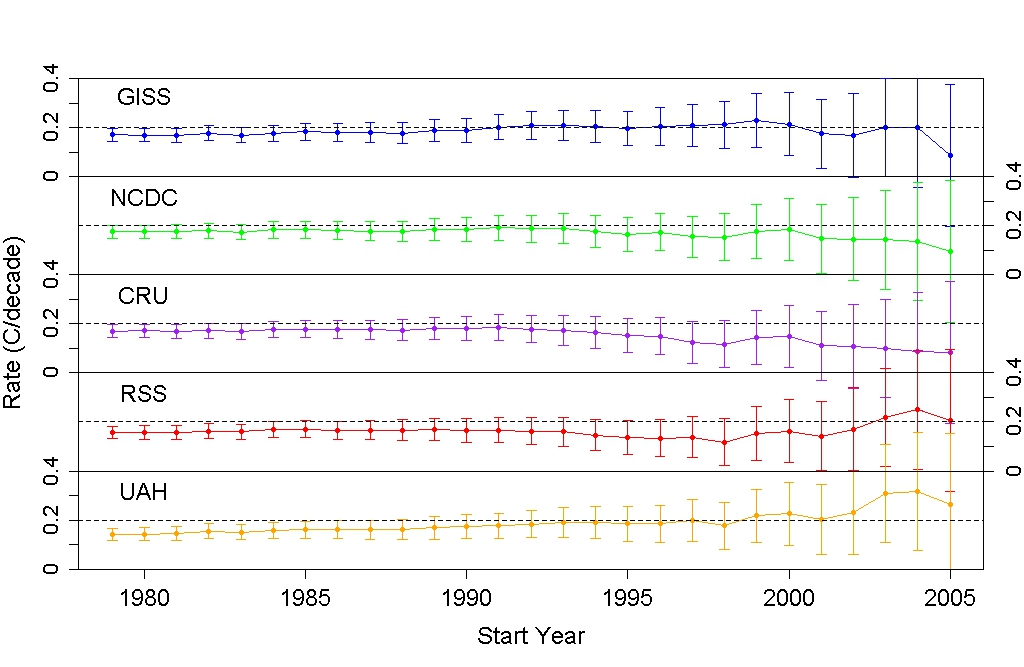
I calculated error bars on UAH trends. The black line on the second page shows the UAH trend ending in 2012, for different starting years. The error bars are shown in red; they're 95% confidence uncertainty bounds. Note that error bars on longer trends are smaller than the large error bars on shorter trends.
Anyone can reproduce my results by downloading the free "R" programming language used by professional statisticians. Then save this code as "significance.r":
# run using R CMD BATCH significance.r
# outputs to Rplots.pdf and significance.r.Rout
# load custom functions
# for generalised least squares
library(nlme)
# options
xunits="year"
textsize=1.4
titlesize=1.8
colfit="red"
pch1=20#points
# read basin data
indata = read.table("greenland2013/GIS_climate.nasa.txt",header=T)
title="Greenland mass"
yunits="gigatons"
tlims=c(-350,-190)
alims=c(-60,0)
#indata = indata[which(indata$x>2002.0),]
# remove mean
indata$y = indata$y - mean(indata$y)
n = length(indata$x)
n
midpoint=(indata$x[n]-indata$x[1])/2.0+indata$x[1]
# fit model
fit=gls(y~x,data=indata,corr=corARMA(p=1,q=1))
#fit=gls(y~x+sin(2*pi*x)+cos(2*pi*x),data=indata,corr=corARMA(p=1,q=1))
#fit=gls -
Re:Anti-science? See, now you have proof!
... if you really want to talk to a young earth creationist (I don't know why you would), you need to show them the evidence. Really dig deep. If they want to discuss carbon dating, then dig in and show the evidence we have of why carbon dating works. Eventually, if they are willing to go along with you (and it will take a lot of work so they might not), they will turn into an old-earth creationist.
Carbon-14 has a half-life of ~5730 years, and isotope detection has a finite noise floor. Also, radiocarbon dating has to compensate for the varying rate of cosmic-ray induced carbon-14 production, and even then only works for objects less than ~45,000 years old.
One way to establish the ~4.5 billion year old earth is isochron dating like uranium-lead dating, which doesn't require knowledge of initial isotope ratios, so it doesn't require the above compensation. Isochron dating only depends on how close to constant nuclear decay rates are over geological time, which can be estimated using supernovae, the Oklo natural nuclear reactor, etc.
-
Re:Yawn
... Things have changed. "Anthropogenic Global Warming" (AGW) advocates repeatedly and consistently stated that a trend of 10 years or more proved their point... [Jane Q. Public, 2013-05-05]
Presumably you're referring to "scientists." Also, I've repeatedly said:
Since climate is an average over ~20 years
In fact, I've repeatedly told you that ~20 years are needed:
As I've explained, climate is the global average over ~20 years. [Dumb Scientist to Jane Q. Public, 2010-02-16]
This graph shows why scientists prefer trends calculated over at least ~20 years. [Dumb Scientist to Jane Q. Public, 2013-01-21]
I've even gone into more detail, showing you a paper that says at least 17 years are required:
Of course, you ignored me just like you previously ignored riverat1:
And 10 years has what to do with climate trends? Not much. A recent paper by Santer et. al. calculated the signal (climate) to noise (weather/natural variation) ratio for climate trends. For 10 years the S/N ratio is less than 1. They found it takes 17 years to be sure the signal is greater than the noise. [riverat1 to Jane Q. Public, 2011-11-19]
For global temperatures, Santer et al. 2011 shows that one needs to average over ~17 years of data to obtain statistically significant climate trends. Here's another explanation by Tamino. Also, the Skeptical Science trend calculator helps visualize statistical significance. [Dumb Scientist, 2012-08-15]
Perhaps your ode to conspiracy theories distracted you, but I also linked to another method of calculating significance which is even more conservative:
Also, Bart
-
Re:Yawn
... Things have changed. "Anthropogenic Global Warming" (AGW) advocates repeatedly and consistently stated that a trend of 10 years or more proved their point... [Jane Q. Public, 2013-05-05]
Presumably you're referring to "scientists." Also, I've repeatedly said:
Since climate is an average over ~20 years
In fact, I've repeatedly told you that ~20 years are needed:
As I've explained, climate is the global average over ~20 years. [Dumb Scientist to Jane Q. Public, 2010-02-16]
This graph shows why scientists prefer trends calculated over at least ~20 years. [Dumb Scientist to Jane Q. Public, 2013-01-21]
I've even gone into more detail, showing you a paper that says at least 17 years are required:
Of course, you ignored me just like you previously ignored riverat1:
And 10 years has what to do with climate trends? Not much. A recent paper by Santer et. al. calculated the signal (climate) to noise (weather/natural variation) ratio for climate trends. For 10 years the S/N ratio is less than 1. They found it takes 17 years to be sure the signal is greater than the noise. [riverat1 to Jane Q. Public, 2011-11-19]
For global temperatures, Santer et al. 2011 shows that one needs to average over ~17 years of data to obtain statistically significant climate trends. Here's another explanation by Tamino. Also, the Skeptical Science trend calculator helps visualize statistical significance. [Dumb Scientist, 2012-08-15]
Perhaps your ode to conspiracy theories distracted you, but I also linked to another method of calculating significance which is even more conservative:
Also, Bart
-
Re:Yawn
... Things have changed. "Anthropogenic Global Warming" (AGW) advocates repeatedly and consistently stated that a trend of 10 years or more proved their point... [Jane Q. Public, 2013-05-05]
Presumably you're referring to "scientists." Also, I've repeatedly said:
Since climate is an average over ~20 years
In fact, I've repeatedly told you that ~20 years are needed:
As I've explained, climate is the global average over ~20 years. [Dumb Scientist to Jane Q. Public, 2010-02-16]
This graph shows why scientists prefer trends calculated over at least ~20 years. [Dumb Scientist to Jane Q. Public, 2013-01-21]
I've even gone into more detail, showing you a paper that says at least 17 years are required:
Of course, you ignored me just like you previously ignored riverat1:
And 10 years has what to do with climate trends? Not much. A recent paper by Santer et. al. calculated the signal (climate) to noise (weather/natural variation) ratio for climate trends. For 10 years the S/N ratio is less than 1. They found it takes 17 years to be sure the signal is greater than the noise. [riverat1 to Jane Q. Public, 2011-11-19]
For global temperatures, Santer et al. 2011 shows that one needs to average over ~17 years of data to obtain statistically significant climate trends. Here's another explanation by Tamino. Also, the Skeptical Science trend calculator helps visualize statistical significance. [Dumb Scientist, 2012-08-15]
Perhaps your ode to conspiracy theories distracted you, but I also linked to another method of calculating significance which is even more conservative:
Also, Bart
-
Re:Yawn
... Things have changed. "Anthropogenic Global Warming" (AGW) advocates repeatedly and consistently stated that a trend of 10 years or more proved their point... [Jane Q. Public, 2013-05-05]
Presumably you're referring to "scientists." Also, I've repeatedly said:
Since climate is an average over ~20 years
In fact, I've repeatedly told you that ~20 years are needed:
As I've explained, climate is the global average over ~20 years. [Dumb Scientist to Jane Q. Public, 2010-02-16]
This graph shows why scientists prefer trends calculated over at least ~20 years. [Dumb Scientist to Jane Q. Public, 2013-01-21]
I've even gone into more detail, showing you a paper that says at least 17 years are required:
Of course, you ignored me just like you previously ignored riverat1:
And 10 years has what to do with climate trends? Not much. A recent paper by Santer et. al. calculated the signal (climate) to noise (weather/natural variation) ratio for climate trends. For 10 years the S/N ratio is less than 1. They found it takes 17 years to be sure the signal is greater than the noise. [riverat1 to Jane Q. Public, 2011-11-19]
For global temperatures, Santer et al. 2011 shows that one needs to average over ~17 years of data to obtain statistically significant climate trends. Here's another explanation by Tamino. Also, the Skeptical Science trend calculator helps visualize statistical significance. [Dumb Scientist, 2012-08-15]
Perhaps your ode to conspiracy theories distracted you, but I also linked to another method of calculating significance which is even more conservative:
Also, Bart
-
Re:Yawn
... Things have changed. "Anthropogenic Global Warming" (AGW) advocates repeatedly and consistently stated that a trend of 10 years or more proved their point... [Jane Q. Public, 2013-05-05]
Presumably you're referring to "scientists." Also, I've repeatedly said:
Since climate is an average over ~20 years
In fact, I've repeatedly told you that ~20 years are needed:
As I've explained, climate is the global average over ~20 years. [Dumb Scientist to Jane Q. Public, 2010-02-16]
This graph shows why scientists prefer trends calculated over at least ~20 years. [Dumb Scientist to Jane Q. Public, 2013-01-21]
I've even gone into more detail, showing you a paper that says at least 17 years are required:
Of course, you ignored me just like you previously ignored riverat1:
And 10 years has what to do with climate trends? Not much. A recent paper by Santer et. al. calculated the signal (climate) to noise (weather/natural variation) ratio for climate trends. For 10 years the S/N ratio is less than 1. They found it takes 17 years to be sure the signal is greater than the noise. [riverat1 to Jane Q. Public, 2011-11-19]
For global temperatures, Santer et al. 2011 shows that one needs to average over ~17 years of data to obtain statistically significant climate trends. Here's another explanation by Tamino. Also, the Skeptical Science trend calculator helps visualize statistical significance. [Dumb Scientist, 2012-08-15]
Perhaps your ode to conspiracy theories distracted you, but I also linked to another method of calculating significance which is even more conservative:
Also, Bart
-
Re:Yawn
... Things have changed. "Anthropogenic Global Warming" (AGW) advocates repeatedly and consistently stated that a trend of 10 years or more proved their point... [Jane Q. Public, 2013-05-05]
Presumably you're referring to "scientists." Also, I've repeatedly said:
Since climate is an average over ~20 years
In fact, I've repeatedly told you that ~20 years are needed:
As I've explained, climate is the global average over ~20 years. [Dumb Scientist to Jane Q. Public, 2010-02-16]
This graph shows why scientists prefer trends calculated over at least ~20 years. [Dumb Scientist to Jane Q. Public, 2013-01-21]
I've even gone into more detail, showing you a paper that says at least 17 years are required:
Of course, you ignored me just like you previously ignored riverat1:
And 10 years has what to do with climate trends? Not much. A recent paper by Santer et. al. calculated the signal (climate) to noise (weather/natural variation) ratio for climate trends. For 10 years the S/N ratio is less than 1. They found it takes 17 years to be sure the signal is greater than the noise. [riverat1 to Jane Q. Public, 2011-11-19]
For global temperatures, Santer et al. 2011 shows that one needs to average over ~17 years of data to obtain statistically significant climate trends. Here's another explanation by Tamino. Also, the Skeptical Science trend calculator helps visualize statistical significance. [Dumb Scientist, 2012-08-15]
Perhaps your ode to conspiracy theories distracted you, but I also linked to another method of calculating significance which is even more conservative:
Also, Bart
-
Re:Yawn
... Things have changed. "Anthropogenic Global Warming" (AGW) advocates repeatedly and consistently stated that a trend of 10 years or more proved their point... [Jane Q. Public, 2013-05-05]
Presumably you're referring to "scientists." Also, I've repeatedly said:
Since climate is an average over ~20 years
In fact, I've repeatedly told you that ~20 years are needed:
As I've explained, climate is the global average over ~20 years. [Dumb Scientist to Jane Q. Public, 2010-02-16]
This graph shows why scientists prefer trends calculated over at least ~20 years. [Dumb Scientist to Jane Q. Public, 2013-01-21]
I've even gone into more detail, showing you a paper that says at least 17 years are required:
Of course, you ignored me just like you previously ignored riverat1:
And 10 years has what to do with climate trends? Not much. A recent paper by Santer et. al. calculated the signal (climate) to noise (weather/natural variation) ratio for climate trends. For 10 years the S/N ratio is less than 1. They found it takes 17 years to be sure the signal is greater than the noise. [riverat1 to Jane Q. Public, 2011-11-19]
For global temperatures, Santer et al. 2011 shows that one needs to average over ~17 years of data to obtain statistically significant climate trends. Here's another explanation by Tamino. Also, the Skeptical Science trend calculator helps visualize statistical significance. [Dumb Scientist, 2012-08-15]
Perhaps your ode to conspiracy theories distracted you, but I also linked to another method of calculating significance which is even more conservative:
Also, Bart
-
Re:And now Google Drive is down...
You really are an intolerant bunch, when it comes to matters of faith - any deviation from extreme alarmism is unacceptable. Here I was thinking Lomborg was one of you.
Contrarians often use Lomborg to support their misinformation, possibly because he's getting better at pretending to accept the science. When brucmack described Lomborg as more pragmatic than skeptic, I replied that "I've never heard of Lomborg before today, but your summary makes him sound like someone I could agree with."
But when I actually read his claims, it became clear that Lomborg is repeatedly misrepresenting science. Like many contrarians, Lomborg also misrepresents his own position by claiming to accept the science while simultaneously misrepresenting that science. Lomborg's books are often used to support accusations like these:
... Last time the Eugenics catastrophists, confident in their scientific consensus that genetic pollution would return us to the stone age, killed 7 million Jews to improve the race. Now poor people are dying because only rich people can afford the self inflicted expense of trying to appease the Carbon God.
... Mandatory reductions in greenhouse gas emissions would be the kiss of death. The U.S. is about to undergo this madness in the form of a deluge of Environmental Protection Agency carbon dioxide regulations that will strangle the economy and kill jobs. Unless the Congress can eliminate them via legislation, it will constitute a form of national suicide.
Consider a group of academics who claim the world faces an imminent catastrophe unless drastic steps are taken. Am I talking about Eugenics NAZIs or Climate alarmists? [Eric Worrall, 2012-12-18]
Its not my fault if you guys are pushing for the implementation of harmful policies on the basis of pseudoscientific predictions of imminent catastrophe - just like the NAZIs did. [Eric Worrall, 2012-12-29]
Given your gross advantage in economic and political muscle, its a wonder we've managed so far to hold off your new dark age.
-
Re:And now Google Drive is down...
You really are an intolerant bunch, when it comes to matters of faith - any deviation from extreme alarmism is unacceptable. Here I was thinking Lomborg was one of you.
Contrarians often use Lomborg to support their misinformation, possibly because he's getting better at pretending to accept the science. When brucmack described Lomborg as more pragmatic than skeptic, I replied that "I've never heard of Lomborg before today, but your summary makes him sound like someone I could agree with."
But when I actually read his claims, it became clear that Lomborg is repeatedly misrepresenting science. Like many contrarians, Lomborg also misrepresents his own position by claiming to accept the science while simultaneously misrepresenting that science. Lomborg's books are often used to support accusations like these:
... Last time the Eugenics catastrophists, confident in their scientific consensus that genetic pollution would return us to the stone age, killed 7 million Jews to improve the race. Now poor people are dying because only rich people can afford the self inflicted expense of trying to appease the Carbon God.
... Mandatory reductions in greenhouse gas emissions would be the kiss of death. The U.S. is about to undergo this madness in the form of a deluge of Environmental Protection Agency carbon dioxide regulations that will strangle the economy and kill jobs. Unless the Congress can eliminate them via legislation, it will constitute a form of national suicide.
Consider a group of academics who claim the world faces an imminent catastrophe unless drastic steps are taken. Am I talking about Eugenics NAZIs or Climate alarmists? [Eric Worrall, 2012-12-18]
Its not my fault if you guys are pushing for the implementation of harmful policies on the basis of pseudoscientific predictions of imminent catastrophe - just like the NAZIs did. [Eric Worrall, 2012-12-29]
Given your gross advantage in economic and political muscle, its a wonder we've managed so far to hold off your new dark age.
-
Re:And now Google Drive is down...
You really are an intolerant bunch, when it comes to matters of faith - any deviation from extreme alarmism is unacceptable. Here I was thinking Lomborg was one of you.
Contrarians often use Lomborg to support their misinformation, possibly because he's getting better at pretending to accept the science. When brucmack described Lomborg as more pragmatic than skeptic, I replied that "I've never heard of Lomborg before today, but your summary makes him sound like someone I could agree with."
But when I actually read his claims, it became clear that Lomborg is repeatedly misrepresenting science. Like many contrarians, Lomborg also misrepresents his own position by claiming to accept the science while simultaneously misrepresenting that science. Lomborg's books are often used to support accusations like these:
... Last time the Eugenics catastrophists, confident in their scientific consensus that genetic pollution would return us to the stone age, killed 7 million Jews to improve the race. Now poor people are dying because only rich people can afford the self inflicted expense of trying to appease the Carbon God.
... Mandatory reductions in greenhouse gas emissions would be the kiss of death. The U.S. is about to undergo this madness in the form of a deluge of Environmental Protection Agency carbon dioxide regulations that will strangle the economy and kill jobs. Unless the Congress can eliminate them via legislation, it will constitute a form of national suicide.
Consider a group of academics who claim the world faces an imminent catastrophe unless drastic steps are taken. Am I talking about Eugenics NAZIs or Climate alarmists? [Eric Worrall, 2012-12-18]
Its not my fault if you guys are pushing for the implementation of harmful policies on the basis of pseudoscientific predictions of imminent catastrophe - just like the NAZIs did. [Eric Worrall, 2012-12-29]
Given your gross advantage in economic and political muscle, its a wonder we've managed so far to hold off your new dark age.
-
Re:Great idea: White rooftops
My point was that the previously mentioned similarity deepens.
-
Re:Great idea: White rooftops
I won't read a wall of text. But you don't need to look far for me catching you in a lie. You just did, above. [ShakaUVM, 2013-02-04]
There's no need for you to read it, because you obviously read it (without comprehension) the first time around:
Defenders of Jones like to pretend he was being spamflooded by FOIA requests, but this is quite simply a lie from people unwilling to admit that "their team" could ever be in the ethical wrong. [ShakaUVM, 2011-10-30]
When you find yourself in a hole, it's better to stop digging than to keep baselessly accusing scientists of lying.
-
Re:Great idea: White rooftops
Slashdot's appetite for similar comments is insatiable.
-
Re:Great idea: White rooftops
-
Re:Great idea: White rooftops
Though I do agree we need more scientists in cabinet positions, his banner solution to global warming was painting rooftops white. Good riddance to him.
I've already already addressed this:
To be precise, he suggested that any roof which needs to be replaced anyway be replaced with a white roof, and that roofs on new buildings be white. The costs of this strategy are negligible. The benefits include lower air conditioning bills for homeowners, lower CO2 emissions because of the reduced electricity demand, and reflecting sunlight back into space which helps cool the planet. Roofs in Siberia should remain black, but white roofs are optimal even away from the tropics because snow covers them during much bitterly cold weather anyway. Also, black roofs aren’t efficient heaters because heat rises, and there’s less sunlight in the winter. Plus, black roofs radiate heat away better than white roofs.
I've run the cost comparison on it. It's horrendously expensive for very little benefit.
Nonsense. Making a new roof white rather than black has negligible costs, and many benefits.
Your recent lull in attacks on scientists prompted me to ignore your accusation that I'm quite simply lying, and your attacks on other scientists. However, your renewed misinformation campaign makes it clear that this was a mistake. I'll add your other baseless accusations back to my list of contrarian arguments to debunk. Stay tuned.
-
Re:I Almost Hate To Say This
Who are you, and why are you arguing with me? [Lonny Eachus]
Are you cruising the web hunting around for someone to argue with over trivialities, or what? Not very friendly. [Lonny Eachus]
I'm the Dumb Scientist, and I'm pointing out that you're spreading misinformation. Again.
I didn't claim, I said "looks like", and was referring to the popular sense. This is Twitter, not some science journal. [Lonny Eachus]
No, it doesn't even "look like" dark energy's dead, in any sense. You were just wrong. Again. Spreading misinformation on Twitter is still spreading misinformation. Please stop.
@jimmygle Interesting article. The other day it was announced that there is almost certainly no "dark energy" making the Universe expand. [Lonny Eachus]
Again with this nonsense? Physicists have never claimed that dark energy makes the Universe expand. Dark energy makes the expansion of the Universe accelerate.
@jimmygle "Almost certainly" to like 5 nines +. That is... apparently it is expanding. But not due to invisible "dark energy". [Lonny Eachus]
Lonny's confusion between expansion and acceleration reminds me of Jane Q. Public's similar confusion.
@jimmygle I read about it on Ars Technica the other day. Or maybe it was... wait. Here it is. bit.ly/S7dwQv [Lonny Eachus]
@jimmygle Haha. Well, the basic idea was that there must be SOMETHING forcing everything apart. So some bigwig physicists came up with the [Lonny Eachus]
@jimmygle
@jimmygle bit.ly/V3qJHe [Lonny Eachus]
Posting that link must be your way of retracting your claim. In it, Dr. Perlmutter explains how the accelerating expansion of the universe reveals the existence of dark energy.
Your other responses were even more disappointing...
This guy calling himself @dumb_scientist jumped into my twitterstream to argue about an article I linked to from Ars Technica. [Lonny Eachus]
Holy crap. Seems this @dumb_scientist guy has been stalking me online. His blog links to here bit.ly/13IPIVO
.. a comment to a friend, @ChiefUnlearner, mo
-
Re:I Almost Hate To Say This
Who are you, and why are you arguing with me? [Lonny Eachus]
Are you cruising the web hunting around for someone to argue with over trivialities, or what? Not very friendly. [Lonny Eachus]
I'm the Dumb Scientist, and I'm pointing out that you're spreading misinformation. Again.
I didn't claim, I said "looks like", and was referring to the popular sense. This is Twitter, not some science journal. [Lonny Eachus]
No, it doesn't even "look like" dark energy's dead, in any sense. You were just wrong. Again. Spreading misinformation on Twitter is still spreading misinformation. Please stop.
@jimmygle Interesting article. The other day it was announced that there is almost certainly no "dark energy" making the Universe expand. [Lonny Eachus]
Again with this nonsense? Physicists have never claimed that dark energy makes the Universe expand. Dark energy makes the expansion of the Universe accelerate.
@jimmygle "Almost certainly" to like 5 nines +. That is... apparently it is expanding. But not due to invisible "dark energy". [Lonny Eachus]
Lonny's confusion between expansion and acceleration reminds me of Jane Q. Public's similar confusion.
@jimmygle I read about it on Ars Technica the other day. Or maybe it was... wait. Here it is. bit.ly/S7dwQv [Lonny Eachus]
@jimmygle Haha. Well, the basic idea was that there must be SOMETHING forcing everything apart. So some bigwig physicists came up with the [Lonny Eachus]
@jimmygle
@jimmygle bit.ly/V3qJHe [Lonny Eachus]
Posting that link must be your way of retracting your claim. In it, Dr. Perlmutter explains how the accelerating expansion of the universe reveals the existence of dark energy.
Your other responses were even more disappointing...
This guy calling himself @dumb_scientist jumped into my twitterstream to argue about an article I linked to from Ars Technica. [Lonny Eachus]
Holy crap. Seems this @dumb_scientist guy has been stalking me online. His blog links to here bit.ly/13IPIVO
.. a comment to a friend, @ChiefUnlearner, mo
-
Re:Why even bother involving this study ?
When I saw your post, I clicked the link to look at it again, in case I had been in error, but now the site is not coming up for me. So any comment on my part will have to wait until such time as that page appears again. [Jane Q. Public]
You're right, woodfortrees is down. Instead, you could try the Skeptical Science trend calculator which also provides uncertainty bounds on the trend. Notice that when you select UAH without restricting the time period, it only goes back to 1980 because that's when the satellite was launched.
All I saw was a graph with some years on the tick marks, and a line that looked like it was supposed to be a regression fit. Except that it went from the lowest point to near the highest point, which is not at all typical of a regression line. I saw nothing further to clarify it. The site seems to be having problems right now (10:16 pm CST). The page won't load. So there is no way to sort out the issue. [Jane Q. Public]
You could always download the UAH data yourself and run a least squares regression using your own software. I've done that using R; here's a PDF of my results. The regression line and its uncertainty come directly from R's generalized least squares algorithm. It looks similar to the regression lines from woodfortrees and SkS. (Both my trend and SkS's are closer to 0.14C/decade; perhaps this is because SkS and I haven't updated our local UAH datasets in over a year?)
The second page of my PDF calculates the trends and uncertainties of the UAH data up to 2012, for different starting years, using an ARMA(1,1) noise model. This graph shows why scientists prefer trends calculated over at least ~20 years. Shorter timespans, such as 1998-2012) have larger uncertainty bounds (the red lines in that graph are 95% confidence intervals).
-
Re:Why even bother involving this study ?
Here is a graph of global temperatures using skeptic Roy Spencer's satellite reconstruction: http://woodfortrees.org/plot/uah/plot/uah-land/trend Temperatures have gone from -0.25 to 0.25 since 1980. That is 0.5C in 30 years or 0.16C/decade. [Layzej]
Here is a classic case of cherry-picking your data in order to try to prove your point. You are comparing the low temperature from one year to the high temperature of another. [Jane Q. Public]
That's nonsense, Jane. Click on "raw data" then scroll down:
#Time series (uah-land) from 1978.92 to 2013
#Least squares trend line; slope = 0.0175687 per year
1978.92 -0.295807
2013 0.302992
So Layzej actually understated the warming trend, which his link calculates (not cherry-picks!) based on all the UAH satellite data to be 0.175C/decade.
Note that the supposed average starts at that low point on the left. In a curve that accounted for prior data, the line would start somewhat further up. [Jane Q. Public]
The supposed average? Do you mean the trend line fit to the UAH data with ordinary least squares? Also: what prior data? Again, there is no prior UAH data.
Also, look at the years chosen: if you choose instead 1998 to present, you end up with (roughly) 0.4 to 0.3, or a change of -0.4. [Jane Q. Public]
Again, this is nonsense. Layzej didn't choose any years, as anyone who glances at the URL can tell. He loaded the entire UAH dataset.
Ironically, right after baselessly accusing Layzej of cherry-picking data to show that the Earth is warming, you once again endorse cherry-picking a shorter timespan, despite the fact that shorter timespans have larger error bars.
These error bars can be shrunk by accounting for natural variability. I've recently discussed warming trends and uncertainties over the last 16 years. This graph removes natural variations like solar activity, ENSO, volcanos, etc. Notice that the warming trends since 1998 for all 5 adjusted datasets are statistically significant at the 95% confidence level, and they're all statistically indistinguishable from the IPCC's projection.
I'm not arguing with you about AGW. I'm just saying that the evidence you have used to support your point is almost laughably weak. [Jane Q. Public]
No, you're not arguing about anthropogenic global warming; you're baselessly (and ironically) accusing Layzej of cherry-picking data to "try" to prove the obvious point that the world is warming as scientists predicted.
Jane, please stop spamming humanity with all this misinformation. It's staining your legacy and threatening the future of our civilization.
-
Re:Why even bother involving this study ?
Here is a graph of global temperatures using skeptic Roy Spencer's satellite reconstruction: http://woodfortrees.org/plot/uah/plot/uah-land/trend Temperatures have gone from -0.25 to 0.25 since 1980. That is 0.5C in 30 years or 0.16C/decade. [Layzej]
Here is a classic case of cherry-picking your data in order to try to prove your point. You are comparing the low temperature from one year to the high temperature of another. [Jane Q. Public]
That's nonsense, Jane. Click on "raw data" then scroll down:
#Time series (uah-land) from 1978.92 to 2013
#Least squares trend line; slope = 0.0175687 per year
1978.92 -0.295807
2013 0.302992
So Layzej actually understated the warming trend, which his link calculates (not cherry-picks!) based on all the UAH satellite data to be 0.175C/decade.
Note that the supposed average starts at that low point on the left. In a curve that accounted for prior data, the line would start somewhat further up. [Jane Q. Public]
The supposed average? Do you mean the trend line fit to the UAH data with ordinary least squares? Also: what prior data? Again, there is no prior UAH data.
Also, look at the years chosen: if you choose instead 1998 to present, you end up with (roughly) 0.4 to 0.3, or a change of -0.4. [Jane Q. Public]
Again, this is nonsense. Layzej didn't choose any years, as anyone who glances at the URL can tell. He loaded the entire UAH dataset.
Ironically, right after baselessly accusing Layzej of cherry-picking data to show that the Earth is warming, you once again endorse cherry-picking a shorter timespan, despite the fact that shorter timespans have larger error bars.
These error bars can be shrunk by accounting for natural variability. I've recently discussed warming trends and uncertainties over the last 16 years. This graph removes natural variations like solar activity, ENSO, volcanos, etc. Notice that the warming trends since 1998 for all 5 adjusted datasets are statistically significant at the 95% confidence level, and they're all statistically indistinguishable from the IPCC's projection.
I'm not arguing with you about AGW. I'm just saying that the evidence you have used to support your point is almost laughably weak. [Jane Q. Public]
No, you're not arguing about anthropogenic global warming; you're baselessly (and ironically) accusing Layzej of cherry-picking data to "try" to prove the obvious point that the world is warming as scientists predicted.
Jane, please stop spamming humanity with all this misinformation. It's staining your legacy and threatening the future of our civilization.
-
Re:Read the Stern Report.
Looks like the concept of "Dark Energy" that many physicists have been so fond of, is dead. bit.ly/S7dwQv [Lonny Eachus]
No, Lonny. The gizmag article you linked just shows that one type of dark energy (the cosmological constant) is more consistent with long-term observations showing that the proton to electron mass ratio (PEMR) has remained roughly constant over billions of years. Even wikipedia makes it clear that the cosmological constant is a type of dark energy:
In the standard model of cosmology, dark energy currently accounts for 73% of the total mass–energy of the universe.[2] Two proposed forms for dark energy are the cosmological constant, a constant energy density filling space homogeneously,[3] and scalar fields such as quintessence or moduli, dynamic quantities whose energy density can vary in time and space.
Because dynamic types of dark energy like quintessence tend to imply changes in the PEMR over billions of years, these observations suggest that physicists now have enough evidence to prefer a static type of dark energy- the cosmological constant. So why is Lonny once again wrongly claiming that dark energy is dead?
One reason might be these curious sentences in that gizmag article:
The concept of "dark energy" with a negative pressure was introduced to describe this acceleration.
A casual reader might conclude that dark energy's negative pressure distinguishes it from a cosmological constant, but both types of dark energy have negative pressure. In fact, I've explained to Jane Q. Public that "vacuum energy has pressure equal and opposite to its energy density" which is why its equation of state is w = -1. I continued, explaining why the universe's expansion accelerates for any w < -1/3.
Because -1 < -1/3, the cosmological constant's negative pressure accelerates the expansion of the universe. It is a type of dark energy, which accounts for roughly 3/4 of all the mass-energy in the universe.
-
Re:Read the Stern Report.
Looks like the concept of "Dark Energy" that many physicists have been so fond of, is dead. bit.ly/S7dwQv [Lonny Eachus]
No, Lonny. The gizmag article you linked just shows that one type of dark energy (the cosmological constant) is more consistent with long-term observations showing that the proton to electron mass ratio (PEMR) has remained roughly constant over billions of years. Even wikipedia makes it clear that the cosmological constant is a type of dark energy:
In the standard model of cosmology, dark energy currently accounts for 73% of the total mass–energy of the universe.[2] Two proposed forms for dark energy are the cosmological constant, a constant energy density filling space homogeneously,[3] and scalar fields such as quintessence or moduli, dynamic quantities whose energy density can vary in time and space.
Because dynamic types of dark energy like quintessence tend to imply changes in the PEMR over billions of years, these observations suggest that physicists now have enough evidence to prefer a static type of dark energy- the cosmological constant. So why is Lonny once again wrongly claiming that dark energy is dead?
One reason might be these curious sentences in that gizmag article:
The concept of "dark energy" with a negative pressure was introduced to describe this acceleration.
A casual reader might conclude that dark energy's negative pressure distinguishes it from a cosmological constant, but both types of dark energy have negative pressure. In fact, I've explained to Jane Q. Public that "vacuum energy has pressure equal and opposite to its energy density" which is why its equation of state is w = -1. I continued, explaining why the universe's expansion accelerates for any w < -1/3.
Because -1 < -1/3, the cosmological constant's negative pressure accelerates the expansion of the universe. It is a type of dark energy, which accounts for roughly 3/4 of all the mass-energy in the universe.
-
Re:Richard Muller
... Just in case you would like something other than just my word that it hasn't warmed significantly in the last 2 or 3 years. Now, call that what you will, but it isn't the rantings of some crazy person. However -- again for the sake of truth and fairness -- the graphs in that article are misleading. They are the doings of the media, not the scientist being quoted. [Jane Q. Public, 2011-11-22]
When you claimed that climate scientists predict temperature trends on timescales of 8 or 9 years, I pointed out that 8 or 9 years is too short to obtain a statistically significant trend. Now you've tightened your self-imposed blinders even further by talking about 2 or 3 year temperature trends. Note that any 2 or 3 (or 8 or 9) year timespan would be too short to obtain a statistically significant trend. It's not something special about the last 2,3,8, or 9 years, so contrarians can recycle this talking point ad nauseum. That's the entire point of the Escalator, in fact. (Incidentally, at least 17 years are needed to establish a statistically significant trend of global surface temperatures.)
But let's read your article, Scientist who said climate change sceptics had been proved wrong accused of hiding truth by colleague, by David Rose:
[Prof. Judith Curry] said that Prof Muller's claim that he has proven global warming sceptics wrong was also a 'huge mistake', with no scientific basis.
Wow. These are very serious accusations. But are they valid?
The graph in Rose's article labelled "the inconvenient truth" is misleading, but mainly for the same reason that Jane's references to short term trends are misleading. Since that graph only shows 10 years of data, any conclusions drawn from it will be conclusions about the noise in the climate, not the long-term trend. But this isn't really the media's fault: Prof. Curry chose that absurdly short timespan herself by talking about the trend since 1998.
Also, the abrupt cooling shown in the BEST data in April and May of 2010 isn't real. Those months only include data from 47 stations in Antarctica, compared to March 2010 which has 14488 spread around the world. So April and
-
Re:It's only arrogance if you're wrong.
It was a JOKE. Regardless, you somehow you missed the thread in which neutrino oscillation was actually adequately explained to me and I admitted that I was wrong. Gee, how could you have missed that part? It exists. Go look.
The last quote in my comment was the closest example I could find to a genuine admission that you'd been wrong. Even then, you manufactured unwarranted doubt by inserting words like could and theoretically. At the same time, you made additional claims which were never challenged, like equating the MSW effect with lasers.
Considering these claims led to interesting ideas. The Hamiltonians for MSW and vacuum oscillations are functionally identical in our universe. Parametric down-conversion of neutrinos seems to violate conservation of energy or imply radiation given lepton/B-L number conservation. Stimulated emission of individual neutrinos is impossible. The double-slit experiment is a good analogy for understanding the cause of neutrino oscillations. Others who found these ideas interesting might also enjoy this more productive 2010 conversation about neutrino oscillation.
To explain in a bit more detail: How would you feel, if somebody followed you around all the time, reciting mistaken comments you had made months or even years ago, and had long since publicly admitted were in error?
I agree with the AC that genuinely changing one's mind is admirable, but your "admissions" often seem like evasion tactics which exploit this admiration. For instance, 5 minutes after you "admitted" this mistake, you continued to imply that astrophysicists are confused.
Again, you still haven't provided a link to this other public admission of error. After you told me to go look for it, here's what I found:
"... STFU. Even with all the snide and insulting comments you have made so far, you have managed to add exactly nothing to the conversation that would actually be of use to anybody. Get stuffed, troll." [Jane Q. Public to Chris Burke]
Your estimate of utility seems comically backward, but my opinion is clearly worthless. So:
"... in case you did not know, "STFU" is hardly helpful or humorous. It's generally considered to be a nasty, arrogant thing to say (or write)." [Jane Q. Public to geekoid, 2010-09-16]
Are there any other admissions of error to be found?
-
Re:It's only arrogance if you're wrong.
It was a JOKE. Regardless, you somehow you missed the thread in which neutrino oscillation was actually adequately explained to me and I admitted that I was wrong. Gee, how could you have missed that part? It exists. Go look.
The last quote in my comment was the closest example I could find to a genuine admission that you'd been wrong. Even then, you manufactured unwarranted doubt by inserting words like could and theoretically. At the same time, you made additional claims which were never challenged, like equating the MSW effect with lasers.
Considering these claims led to interesting ideas. The Hamiltonians for MSW and vacuum oscillations are functionally identical in our universe. Parametric down-conversion of neutrinos seems to violate conservation of energy or imply radiation given lepton/B-L number conservation. Stimulated emission of individual neutrinos is impossible. The double-slit experiment is a good analogy for understanding the cause of neutrino oscillations. Others who found these ideas interesting might also enjoy this more productive 2010 conversation about neutrino oscillation.
To explain in a bit more detail: How would you feel, if somebody followed you around all the time, reciting mistaken comments you had made months or even years ago, and had long since publicly admitted were in error?
I agree with the AC that genuinely changing one's mind is admirable, but your "admissions" often seem like evasion tactics which exploit this admiration. For instance, 5 minutes after you "admitted" this mistake, you continued to imply that astrophysicists are confused.
Again, you still haven't provided a link to this other public admission of error. After you told me to go look for it, here's what I found:
"... STFU. Even with all the snide and insulting comments you have made so far, you have managed to add exactly nothing to the conversation that would actually be of use to anybody. Get stuffed, troll." [Jane Q. Public to Chris Burke]
Your estimate of utility seems comically backward, but my opinion is clearly worthless. So:
"... in case you did not know, "STFU" is hardly helpful or humorous. It's generally considered to be a nasty, arrogant thing to say (or write)." [Jane Q. Public to geekoid, 2010-09-16]
Are there any other admissions of error to be found?
-
Re:It's only arrogance if you're wrong.
It was a JOKE. Regardless, you somehow you missed the thread in which neutrino oscillation was actually adequately explained to me and I admitted that I was wrong. Gee, how could you have missed that part? It exists. Go look.
The last quote in my comment was the closest example I could find to a genuine admission that you'd been wrong. Even then, you manufactured unwarranted doubt by inserting words like could and theoretically. At the same time, you made additional claims which were never challenged, like equating the MSW effect with lasers.
Considering these claims led to interesting ideas. The Hamiltonians for MSW and vacuum oscillations are functionally identical in our universe. Parametric down-conversion of neutrinos seems to violate conservation of energy or imply radiation given lepton/B-L number conservation. Stimulated emission of individual neutrinos is impossible. The double-slit experiment is a good analogy for understanding the cause of neutrino oscillations. Others who found these ideas interesting might also enjoy this more productive 2010 conversation about neutrino oscillation.
To explain in a bit more detail: How would you feel, if somebody followed you around all the time, reciting mistaken comments you had made months or even years ago, and had long since publicly admitted were in error?
I agree with the AC that genuinely changing one's mind is admirable, but your "admissions" often seem like evasion tactics which exploit this admiration. For instance, 5 minutes after you "admitted" this mistake, you continued to imply that astrophysicists are confused.
Again, you still haven't provided a link to this other public admission of error. After you told me to go look for it, here's what I found:
"... STFU. Even with all the snide and insulting comments you have made so far, you have managed to add exactly nothing to the conversation that would actually be of use to anybody. Get stuffed, troll." [Jane Q. Public to Chris Burke]
Your estimate of utility seems comically backward, but my opinion is clearly worthless. So:
"... in case you did not know, "STFU" is hardly helpful or humorous. It's generally considered to be a nasty, arrogant thing to say (or write)." [Jane Q. Public to geekoid, 2010-09-16]
Are there any other admissions of error to be found?
-
Re:It's only arrogance if you're wrong.
... I have to ask you one more time: what part of STOP STALKING MY CONVERSATIONS, GO THE FUCK AWAY, AND LEAVE ME ALONE do you not understand??? THIS is a prime example of arrogance, and it is demonstrably no joke. You need to go take a l-o-n-g look in the mirror. And then go the fuck away. I am serious. This is getting to the point of stalking and harassment. Do you really want to go there? [Jane Q. Public]
This bears repeating, Mr. "Khayman80": You appear to have some kind of unhealthy obsession with me and it has gone far beyond the point of simply rubbing me the wrong way. If you do not cease and desist voluntarily, I will be compelled to start looking into what other options may be available. [Jane Q. Public]
Don't flatter yourself. Debunking misinformation and defending scientists against baseless attacks are my unhealthy obsessions. It's hardly my fault that you're one of the most prolific misinformers I've ever seen. If you didn't want people responding to your claims, you probably should've written them in a notebook instead of on a public website. It's also strange that you call my responses to your public comments "stalking and harassment" while quoting hacked private emails from years ago to baselessly attack scientists.
YOU don't have somebody following you around and harassing you with months-old, off-topic comments all over Slashdot. If this had been the only example, I wouldn't mind. But he has done it many times. Frankly, he acts like a stalker and I don't know what his obsession with me is, but I don't appreciate it in the least, and if somebody had been doing it to you, you wouldn't either. [Jane Q. Public]
Let's consider some of the "many times" you mentioned. When I asked for references to support your claims about climate science, you called me a vindictive asshole. Then I responded to your claims about the Casimir effect hours before my presentation at the GRACE science team meeting. Afterward, I wrote another comment about negative energy, then went on vacation. After returning home, I found that you'd dramatically expanded the scope of your claims. When I responded, you complained that I'd taken weeks and accused me of being a stalker.
My response to your claims about neutrino oscillation was interrupted last summer by a cross-country move, after which research quickly diverted my attention. However, the charming comments you left at Dumb Scientist in June reminded me that you hadn't retired. When I responded, you complained that I'd taken MONTHS and accused me of pathetic personal attacks. When I responded just now to your claims about neutrino oscillation, you complained that I'd taken too long and accused me of being a stalker. But refuting your claims about neutrino oscillation is a prerequisite to refuting your other claims about Latour's article, which you've asked for:
Where is your refutation of any argument I made HERE, in this thread? Where is it?
-
Re:It's only arrogance if you're wrong.
... I have to ask you one more time: what part of STOP STALKING MY CONVERSATIONS, GO THE FUCK AWAY, AND LEAVE ME ALONE do you not understand??? THIS is a prime example of arrogance, and it is demonstrably no joke. You need to go take a l-o-n-g look in the mirror. And then go the fuck away. I am serious. This is getting to the point of stalking and harassment. Do you really want to go there? [Jane Q. Public]
This bears repeating, Mr. "Khayman80": You appear to have some kind of unhealthy obsession with me and it has gone far beyond the point of simply rubbing me the wrong way. If you do not cease and desist voluntarily, I will be compelled to start looking into what other options may be available. [Jane Q. Public]
Don't flatter yourself. Debunking misinformation and defending scientists against baseless attacks are my unhealthy obsessions. It's hardly my fault that you're one of the most prolific misinformers I've ever seen. If you didn't want people responding to your claims, you probably should've written them in a notebook instead of on a public website. It's also strange that you call my responses to your public comments "stalking and harassment" while quoting hacked private emails from years ago to baselessly attack scientists.
YOU don't have somebody following you around and harassing you with months-old, off-topic comments all over Slashdot. If this had been the only example, I wouldn't mind. But he has done it many times. Frankly, he acts like a stalker and I don't know what his obsession with me is, but I don't appreciate it in the least, and if somebody had been doing it to you, you wouldn't either. [Jane Q. Public]
Let's consider some of the "many times" you mentioned. When I asked for references to support your claims about climate science, you called me a vindictive asshole. Then I responded to your claims about the Casimir effect hours before my presentation at the GRACE science team meeting. Afterward, I wrote another comment about negative energy, then went on vacation. After returning home, I found that you'd dramatically expanded the scope of your claims. When I responded, you complained that I'd taken weeks and accused me of being a stalker.
My response to your claims about neutrino oscillation was interrupted last summer by a cross-country move, after which research quickly diverted my attention. However, the charming comments you left at Dumb Scientist in June reminded me that you hadn't retired. When I responded, you complained that I'd taken MONTHS and accused me of pathetic personal attacks. When I responded just now to your claims about neutrino oscillation, you complained that I'd taken too long and accused me of being a stalker. But refuting your claims about neutrino oscillation is a prerequisite to refuting your other claims about Latour's article, which you've asked for:
Where is your refutation of any argument I made HERE, in this thread? Where is it?
-
Re:It's only arrogance if you're wrong.
... I have to ask you one more time: what part of STOP STALKING MY CONVERSATIONS, GO THE FUCK AWAY, AND LEAVE ME ALONE do you not understand??? THIS is a prime example of arrogance, and it is demonstrably no joke. You need to go take a l-o-n-g look in the mirror. And then go the fuck away. I am serious. This is getting to the point of stalking and harassment. Do you really want to go there? [Jane Q. Public]
This bears repeating, Mr. "Khayman80": You appear to have some kind of unhealthy obsession with me and it has gone far beyond the point of simply rubbing me the wrong way. If you do not cease and desist voluntarily, I will be compelled to start looking into what other options may be available. [Jane Q. Public]
Don't flatter yourself. Debunking misinformation and defending scientists against baseless attacks are my unhealthy obsessions. It's hardly my fault that you're one of the most prolific misinformers I've ever seen. If you didn't want people responding to your claims, you probably should've written them in a notebook instead of on a public website. It's also strange that you call my responses to your public comments "stalking and harassment" while quoting hacked private emails from years ago to baselessly attack scientists.
YOU don't have somebody following you around and harassing you with months-old, off-topic comments all over Slashdot. If this had been the only example, I wouldn't mind. But he has done it many times. Frankly, he acts like a stalker and I don't know what his obsession with me is, but I don't appreciate it in the least, and if somebody had been doing it to you, you wouldn't either. [Jane Q. Public]
Let's consider some of the "many times" you mentioned. When I asked for references to support your claims about climate science, you called me a vindictive asshole. Then I responded to your claims about the Casimir effect hours before my presentation at the GRACE science team meeting. Afterward, I wrote another comment about negative energy, then went on vacation. After returning home, I found that you'd dramatically expanded the scope of your claims. When I responded, you complained that I'd taken weeks and accused me of being a stalker.
My response to your claims about neutrino oscillation was interrupted last summer by a cross-country move, after which research quickly diverted my attention. However, the charming comments you left at Dumb Scientist in June reminded me that you hadn't retired. When I responded, you complained that I'd taken MONTHS and accused me of pathetic personal attacks. When I responded just now to your claims about neutrino oscillation, you complained that I'd taken too long and accused me of being a stalker. But refuting your claims about neutrino oscillation is a prerequisite to refuting your other claims about Latour's article, which you've asked for:
Where is your refutation of any argument I made HERE, in this thread? Where is it?
-
Re:...Why?
... "zero point" energy is NOT in fact zero (it is actually pretty huge)... [Jane Q. Public]
While talking with my first research advisor around 2003, I mused that it's unfortunate how the Casimir effect only supresses vacuum fluctuations with wavelengths larger than twice the spacing between the plates. Since fluctuations with shorter wavelengths have more energy, the Casimir effect only depletes a vanishingly small fraction of the vacuum energy between the plates. So I agree that a naive quantum calculation leads to a huge vacuum energy. But as I've just explained, the same theory of general relativity [1] that implies stable wormholes and the Alcubierre drive also seems to renormalize the vacuum energy to zero. So this just means that depleting vacuum energy could potentially lead to very negative energy densities.
In fact I thought it was pretty obvious to most people that the fact that "zero point" energy is NOT in fact zero (it is actually pretty huge), has been the motivation for finding ways to "Maxwell's Demon" the quantum vacuum fluctuations. There is nothing theoretically preventing it; one team this year found a possible means of exploiting it. We shall see. [Jane Q. Public]
I asked which team and you replied:
I looked again, and didn't find anything from this year. So my memory could be incorrect. [Jane Q. Public]
Agreed:
What I am curious about is: assume you get the virtual particles which then tunnel: what is the probability that they will tunnel with the same probability, then recombine properly? It seems to me (without having done the math), that there is some possibility here of ending up with a quantum Goretex, or, in other words, a Maxwell's Demon of sorts, no matter how small its effect might be. [Jane Q. Public, 2009-04-21]
Not having done the math often does lead to quantum Goretex and ironic references to Maxwell's (broken) Demon.
But there's Maclay and Forward, from 2004. There are more recent examples but I will not have time to hunt them up today. [Jane Q. Public]
Maclay and Forward 2004 [2] imagined accelerating a mirror fast enough that the dynamic Casimir effect creates real photons. A more recent example was in 2009, which imagined spinning magneto-electric nanoparticles fast enough that the centripetal acceleration created real photons. At the time, I called this device a photon drive. On page 2 of their 2004 paper, Maclay and Forward point out that more conventional photon drives would arguably be better than their propulsion system.
Granted, it's only a thought experiment,
-
Re:...Why?
... "zero point" energy is NOT in fact zero (it is actually pretty huge)... [Jane Q. Public]
While talking with my first research advisor around 2003, I mused that it's unfortunate how the Casimir effect only supresses vacuum fluctuations with wavelengths larger than twice the spacing between the plates. Since fluctuations with shorter wavelengths have more energy, the Casimir effect only depletes a vanishingly small fraction of the vacuum energy between the plates. So I agree that a naive quantum calculation leads to a huge vacuum energy. But as I've just explained, the same theory of general relativity [1] that implies stable wormholes and the Alcubierre drive also seems to renormalize the vacuum energy to zero. So this just means that depleting vacuum energy could potentially lead to very negative energy densities.
In fact I thought it was pretty obvious to most people that the fact that "zero point" energy is NOT in fact zero (it is actually pretty huge), has been the motivation for finding ways to "Maxwell's Demon" the quantum vacuum fluctuations. There is nothing theoretically preventing it; one team this year found a possible means of exploiting it. We shall see. [Jane Q. Public]
I asked which team and you replied:
I looked again, and didn't find anything from this year. So my memory could be incorrect. [Jane Q. Public]
Agreed:
What I am curious about is: assume you get the virtual particles which then tunnel: what is the probability that they will tunnel with the same probability, then recombine properly? It seems to me (without having done the math), that there is some possibility here of ending up with a quantum Goretex, or, in other words, a Maxwell's Demon of sorts, no matter how small its effect might be. [Jane Q. Public, 2009-04-21]
Not having done the math often does lead to quantum Goretex and ironic references to Maxwell's (broken) Demon.
But there's Maclay and Forward, from 2004. There are more recent examples but I will not have time to hunt them up today. [Jane Q. Public]
Maclay and Forward 2004 [2] imagined accelerating a mirror fast enough that the dynamic Casimir effect creates real photons. A more recent example was in 2009, which imagined spinning magneto-electric nanoparticles fast enough that the centripetal acceleration created real photons. At the time, I called this device a photon drive. On page 2 of their 2004 paper, Maclay and Forward point out that more conventional photon drives would arguably be better than their propulsion system.
Granted, it's only a thought experiment,
-
Re:...Why?
I will add a tidbit that I picked up last night shortly after I wrote the above. You mentioned that since the ground state (not your exact words) of the vacuum is "defined" to be 0, then the energy must be negative. I understand that logic. The problem is that the premise is incorrect. Planck's equations, as refined by Einstein et al. in 1913, show that in fact the vacuum energy of a quantum system must always be above its "potential well", or the theoretical zero state. Thus, "zero-point" energy is NOT "defined" to be zero, but in fact is always positive, and the Casimir effect then, even using your own framework, is not "negative energy". [Jane Q. Public]
If you really did "understand that logic" then you wouldn't have written all that nonsense about vectors. Instead, you'd have skipped immediately to this point, which now implicitly acknowledges that the Casimir vacuum has lower energy than the standard vacuum.
Remember that spacetime is curved near large masses, but ~flat far away from masses where only vacuum energy is present. This implies that vacuum energy exerts ~zero gravitational force, so its stress-energy tensor must be ~zero, so the standard vacuum has ~zero energy.
If you're interested in the details, John Baez summarizes several vacuum energy density calculations. A naive quantum field theory calculation yields a vacuum energy with a mass density of +10^96 kg/m^3, which would've ripped the universe apart [1] before galaxies could form. On the other hand, general relativity and observations of our nearly-flat universe place a more rigorous upper bound at +10^(-26) kg/m^3. It seems like [2] gravity renormalizes vacuum energy to zero, within about one part in 10^122. Even though renormalization was harshly criticized at first, it's necessary to explain why galaxies (and thus humans!) exist.
Here's another, purely quantum-based, argument [3] for renormalization:
"As there is no lower energy state than the ground state, there is no energy level transition available to release the ZPE. Therefore, it can be argued that hf/2 should be dropped before integration of the quantum expression. This procedure is an example of renormalization, which basically redefines the zero of energy." [Abbott et al. 1996]
Footnotes
[1] One might assume that a large positive vacuum energy would collapse the universe just like a large amount of positive mass-energy would. This doesn't happen because in general relativity gravity depends on energy and pressure. In natural units, vacuum energy has pressure equal and opposite to its energy density. Because the stress-energy tensor has three pressure terms (for x,y,z) and only one energy density term, the negative pressure of positive vacuum energy dominates, causing the expansion of the universe to accelerate. back
[2] It's also vaguely possible that zero point energy doesn't gravitate at all
-
Re:...Why?
Because those fluctuations do exist in the vacuum outside the plates (which is defined to have zero energy), the energy inside the plates is actually negative. The attractive force implies negative energy between the plates because force is the negative gradient of potential energy.
A force being applied in the context of the Casimir effect is definitely a vector. It has direction. Neither a positive or negative vector implies "negative energy": it simply defines the physical direction in which the energy is directed. The coordinates are arbitrary according to vector calculus. There are circumstances in which energy can also be considered a vector, but this is not one of them. The Casimir effect is definitely a measurable vector in a particular direction, and he clear implication then is positive energy. [Jane Q. Public]
Good grief, you're arguing with the definition of potential energy. I was referring to the fact that all conservative forces can be described as the negative vector gradient of a potential energy function. Many of your statements on this topic are confusing:
A force being applied in the context of the Casimir effect is definitely a vector. It has direction. [Jane Q. Public]
Yeah, forces are vectors...
Neither a positive or negative vector implies "negative energy": it simply defines the physical direction in which the energy is directed. [Jane Q. Public]
The force vector points from a region with high potential energy to a region with lower potential energy. That's why an attractive force implies that the Casimir vacuum has less energy than the standard vacuum. No energy is "directed" anywhere because we're talking about potential energy, not calculating Poynting vectors.
"Because those fluctuations do exist in the vacuum outside the plates (which is defined to have zero energy), the energy inside the plates is actually negative."
You're trying to get my goat. Haha. That isn't what it says. According to the article, the force is negative, in relation to the chosen physical framework, which (as it clearly says in the article) merely implies that the energy is lowered when the physical substrates come together. [Jane Q. Public]
The Casimir force between two parallel conducting plates is negative/attractive. Period. More complicated geometries can have repulsive Casimir forces, but that doesn't affect the attractive force between parallel plates any more than your meaningless caveat does. Perhaps you meant to say "According to the article, the energy is negative..."
The same phenomenon can be demonstrated with magnets. No "negative energy" is implied. [Jane Q. Public]
In my
-
Re:...Why?
"The Casimir effect is the best known example of negative energy:" [Dumb Scientist]
This is going to be one of my rare responses to your posts. Prepare to be ignored for the most part, from here on in.
Comments like these suggest that you're not really interested in studying physics. On the other hand, John Cramer's Alternate View columns inspired me to study physics in high school. In 1998, FTL Photons introduced me to the Casimir effect. In 2001, I made an offhand remark about these faster-than-light (FTL) implications to my experimental physics professor, and he asked me to give a presentation to the class.
The next comment I wrote summarized the first part of my presentation. The second part showed that virtual particles actually slow down light in the standard vacuum, because photons spend some of their time as electron-positron pairs that travel slower than "true" lightspeed. Because the Casimir effect suppresses some of these virtual particles, light actually travels faster between the plates (perpendicular to the plates) than in the standard vacuum. This is called the Scharnhorst effect.
The Casimir effect can be modeled mathematically as a negative-mass region; Hawking showed that negative energy is necessary for certain effects on WORMHOLES to take place in conjunction with such a negative mass. But he did not claim that the negative energy was supplied by it. But that does not establish a direct relationship between the two. It is a very FAR cry from equating negative energy with the Casimir effect. [Jane Q. Public]
Why are you talking about Hawking? I already pointed you to "Wormholes, Time Machines, and the Weak Energy Condition":
"The following model explores the use of the 'Casimir vacuum'[12] (a quantum state of the electromagnetic field that violates the unaveraged weak energy condition[11]) to support a wormhole..." [Morris, Thorne, and Yurtsever, 1988]
Nevertheless, Hawking's findings did not point at Casimir effect as a source of negative energy; they merely indicated that negative energy was necessary for the negative mass to have the calculated effect. Not the same thing. [Jane Q. Public]
Again, why are you talking about Hawking? You might want [1] to read "FTL Photons":
"Since the energy density of normal vacuum is defined to be zero, the vacuum between the metal plates actually becomes a region of negativ
-
Re:...Why?
"The Casimir effect is the best known example of negative energy:" [Dumb Scientist]
This is going to be one of my rare responses to your posts. Prepare to be ignored for the most part, from here on in.
Comments like these suggest that you're not really interested in studying physics. On the other hand, John Cramer's Alternate View columns inspired me to study physics in high school. In 1998, FTL Photons introduced me to the Casimir effect. In 2001, I made an offhand remark about these faster-than-light (FTL) implications to my experimental physics professor, and he asked me to give a presentation to the class.
The next comment I wrote summarized the first part of my presentation. The second part showed that virtual particles actually slow down light in the standard vacuum, because photons spend some of their time as electron-positron pairs that travel slower than "true" lightspeed. Because the Casimir effect suppresses some of these virtual particles, light actually travels faster between the plates (perpendicular to the plates) than in the standard vacuum. This is called the Scharnhorst effect.
The Casimir effect can be modeled mathematically as a negative-mass region; Hawking showed that negative energy is necessary for certain effects on WORMHOLES to take place in conjunction with such a negative mass. But he did not claim that the negative energy was supplied by it. But that does not establish a direct relationship between the two. It is a very FAR cry from equating negative energy with the Casimir effect. [Jane Q. Public]
Why are you talking about Hawking? I already pointed you to "Wormholes, Time Machines, and the Weak Energy Condition":
"The following model explores the use of the 'Casimir vacuum'[12] (a quantum state of the electromagnetic field that violates the unaveraged weak energy condition[11]) to support a wormhole..." [Morris, Thorne, and Yurtsever, 1988]
Nevertheless, Hawking's findings did not point at Casimir effect as a source of negative energy; they merely indicated that negative energy was necessary for the negative mass to have the calculated effect. Not the same thing. [Jane Q. Public]
Again, why are you talking about Hawking? You might want [1] to read "FTL Photons":
"Since the energy density of normal vacuum is defined to be zero, the vacuum between the metal plates actually becomes a region of negativ
-
Re:I'll believe it when I see...
I've explained why FTL travel implies time travel.
-
Re:Perhaps it is due to a misunderstanding?
(Ed. note: I've been trying to post comments like this one since 2012-09-01, but they never appeared on my article at the San Gabriel Valley Tribune. So I finally posted this reply at my website, Slashdot, and Mike Haseler's website Scottish Skeptic.)
Let's get the facts straight. Even doubling CO2, means its greenhouse effect would only rise global temperatures by 1C. That is half the threshold for action set by the IPCC.
But, this scam has nothing to do with their real science. These charlatans would be predicting the same nonsense if CO2's effect were twice as high or half as much, because the real contribution of CO2 is much smaller than the natural variation.
And let's not forget:
1. This scam is based on a rise in temperature from 1970 to 2000 which happens to be coincident with rising CO2. The overwhelming bulk of this rise has nothing to do with CO2 greenhouse effect.
2. Largely the same academics who cry wolf over this short term trend were crying wolf over the short term cooling before the 1970s.
3. It all stopped in 2000 (1998 to be precise). That's 14 years without warming, compared to the 30 year trend they say proves warming will continue till the earth fries (much like we were heading for an iceage)
4. And just to cap it all, it warmed the same amount, for the same period, before CO2 was measured rising between 1910 and 1940 and guess what
0. Many diverse lines of evidence (paleoclimate, modern observations, fundamental physics) show that doubling CO2 warms the planet by roughly 3C.
1. Human CO2 forcing has increased dramatically since 1970, while solar irradiance, volcanic activity, cosmic rays, solar flares, etc. have remained about the same.
2. Even during the 1970s, most scientific papers were predicting warming.
3. Skeptical Science's "going down the up escalator" shows at a glance that this often-repeated myth about global warming ending in 1998 is wrong.
4. The rate of warming from 1910 to 1940 was about 0.13C/decade compared to about 0.18C/decade from 1975 to 2005. But scientists don't simply compare the rates; they examine natural and human radiative forcings which change the global climate's total energy, which is indeed an average over at least several decades. In the early 20th century there was a lull in volcanic eruptions which usually cool the climate by blocking out the sun over a few years. Early human CO2 emissions and a slight increase in the Sun's brightness also played small roles. Internal variability modes, which shift energy from one part of the globe to another (i.e. climate cycles) are also important. Temperatures measured in the 1940s were warmer than the models; this discrepency is thought to be due in part to Ar
-
Re:Perhaps it is due to a misunderstanding?
(Ed. note: I've been trying to post comments like this one since 2012-09-01, but they never appeared on my article at the San Gabriel Valley Tribune. So I finally posted this reply at my website, Slashdot, and Mike Haseler's website Scottish Skeptic.)
Let's get the facts straight. Even doubling CO2, means its greenhouse effect would only rise global temperatures by 1C. That is half the threshold for action set by the IPCC.
But, this scam has nothing to do with their real science. These charlatans would be predicting the same nonsense if CO2's effect were twice as high or half as much, because the real contribution of CO2 is much smaller than the natural variation.
And let's not forget:
1. This scam is based on a rise in temperature from 1970 to 2000 which happens to be coincident with rising CO2. The overwhelming bulk of this rise has nothing to do with CO2 greenhouse effect.
2. Largely the same academics who cry wolf over this short term trend were crying wolf over the short term cooling before the 1970s.
3. It all stopped in 2000 (1998 to be precise). That's 14 years without warming, compared to the 30 year trend they say proves warming will continue till the earth fries (much like we were heading for an iceage)
4. And just to cap it all, it warmed the same amount, for the same period, before CO2 was measured rising between 1910 and 1940 and guess what
0. Many diverse lines of evidence (paleoclimate, modern observations, fundamental physics) show that doubling CO2 warms the planet by roughly 3C.
1. Human CO2 forcing has increased dramatically since 1970, while solar irradiance, volcanic activity, cosmic rays, solar flares, etc. have remained about the same.
2. Even during the 1970s, most scientific papers were predicting warming.
3. Skeptical Science's "going down the up escalator" shows at a glance that this often-repeated myth about global warming ending in 1998 is wrong.
4. The rate of warming from 1910 to 1940 was about 0.13C/decade compared to about 0.18C/decade from 1975 to 2005. But scientists don't simply compare the rates; they examine natural and human radiative forcings which change the global climate's total energy, which is indeed an average over at least several decades. In the early 20th century there was a lull in volcanic eruptions which usually cool the climate by blocking out the sun over a few years. Early human CO2 emissions and a slight increase in the Sun's brightness also played small roles. Internal variability modes, which shift energy from one part of the globe to another (i.e. climate cycles) are also important. Temperatures measured in the 1940s were warmer than the models; this discrepency is thought to be due in part to Ar
-
Re:CO2
I hoped to end this interview with a concise, uplifting challenge to build a better future through human ingenuity. Oh, well. The modern anthropogenic skyrocketing CO2 concentration is a trend I desperately want to reverse, but here's a more relevant answer:
Here is a related question: If the former case, volcanoes produced CO2 and that raised temps, that same rise should also cook CO2 out of the oceans, which would produce an even greater rise in temps. What could reverse this trend?
The end-Permian event and the PETM (linked above) were eventually reversed because accessible carbon sources are finite. Plate tectonics continually exposes new rocks which absorb CO2 as it weathers, and other biochemical sinks absorb CO2 from the air. Positive feedbacks such as those you describe don't necessarily involve runaway warming, any more than geometric series necessarily blow up to infinity. But life during one of these temporary excursions is usually... interesting.
-
Re:Detecting anthropogenic movement on the surface
GRACE can resolve nearly uncorrelated mascons that are blocks 400km on each side with a noise floor of ~1cm equivalent water height. (This is latitude dependent because GRACE's denser ground tracks near the poles allow for better resolution.) Each mascon has a mass of ~1.6 gigatons, and a fully-loaded coal train is ~10 kilotons, so GRACE falls short by about five orders of magnitude.
The improved laser ranging on the GRACE follow-on will increase sensitivity, and David Wiese analyzes improvements due to lowering the satellites' altitude and/or adding more satellites to the GRACE system.
You're right to suspect that detecting a tiny change in local gravity is limited by uncertainties in models such as atmosphere dynamics. I've discussed how GPS occultation data (among many other data sources) can be used to reduce these uncertainties.
Other anthropogenic effects such as groundwater depletion can already be detected with GRACE. Rodell et al. 2009 (PDF) and Tiwari et al. 2009 (PDF) observed this in northern India, and Famiglietti et al. 2011 (PDF) recently observed similar groundwater depletion in California.
-
Re:CO2
CO2 levels parallel average global temperatures, in looking at the geological record, correct? That gives much credence to CO2 as a mechanism for current climate change.
Correct. Here’s a figure from Royer et al. 2007 which concludes that “a climate sensitivity greater than 1.5C has probably been a robust feature of the Earth’s climate system over the past 420 million years”.
What increased C02 in ancient times? It is also my understanding that volcanic action produced CO2 which raised temps, Correct? Also, at other epochs, certain orbital factors cooked CO2 out of oceans. In this latter case, I would expect CO2 levels to lag temps (and then force greater changes) and in the former (volcanic) case CO2 levels would precede temp rise. Correct?
Correct. I've discussed the difference between these situations.
Here is a related question: If the former case, volcanoes produced CO2 and that raised temps, that same rise should also cook CO2 out of the oceans, which would produce an even greater rise in temps. What could reverse this trend?
Human ingenuity.
-
Re:Definition of 'climate'
That's a good question; I described the difference between climate and weather at the beginning of my article. I later updated it with a better analogy from NOAA: One way to distinguish between weather and climate is that the climate of your hometown will determine how many sweaters you have in your closet. The weather will determine if you should be wearing a sweater right now.
Many times the climate being discussed is global, so an average is taken over the entire Earth. For global temperatures, Santer et al. 2011 shows that one needs to average over ~17 years of data to obtain statistically significant climate trends. Here's another explanation by Tamino. Also, the Skeptical Science trend calculator helps visualize statistical significance.
-
Re:Classic Projection
What in the world was up with this letter from ex-employees [plantsneedco2.org] (also discussed on Slashdot [slashdot.org])? Was that just totally out of left field? Was there an internal reaction to it? Did you respond?
Yes, it was totally out of left field. I responded in an internal JPL email, and copied the email to my (other) website.
-Bryan Killett, aka khayman80, aka Dumb Scientist
(This was copied from very far down so readers don't have to wade through all these charming comments just to read my answer to eldavojohn's question.)
-
Re:GRACE life span
I've previously discussed some of the advantages of GRACE 2, which is the real successor to GRACE and has a vague launch date in the (hopefully early) 2020s. It'd be great if we could find some way to service and refuel these satellites to extend their lifespans, especially if the low-altitude drag-free option is chosen. But for now we're trying to do what we can with less funding.